Hubbry Logo
Visual angleVisual angleMain
Open search
Visual angle
Community hub
Visual angle
logo
8 pages, 0 posts
0 subscribers
Be the first to start a discussion here.
Contribute something
Visual angle
Visual angle
from Wikipedia
Diagram showing visual angle
If an object is close to the eye, the visual angle is relatively large, therefore the object is projected large on the retina. If the same object is further away, the area on the retina onto which it is projected is reduced.

Visual angle is the angle a viewed object subtends at the eye, usually stated in degrees of arc. It also is called the object's angular size.

The diagram on the right shows an observer's eye looking at a frontal extent (the vertical arrow) that has a linear size , located in the distance from point .

For present purposes, point can represent the eye's nodal points at about the center of the lens, and also represent the center of the eye's entrance pupil that is only a few millimeters in front of the lens.

The three lines from object endpoint heading toward the eye indicate the bundle of light rays that pass through the cornea, pupil and lens to form an optical image of endpoint on the retina at point . The central line of the bundle represents the chief ray.

The same holds for object point and its retinal image at .

The visual angle is the angle between the chief rays of and .

Measuring and computing

[edit]

The visual angle can be measured directly using a theodolite placed at point .

Or, it can be calculated (in radians) using the formula, .[1]
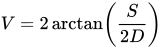
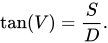
However, for visual angles smaller than about 10 degrees, this simpler formula provides very close approximations:
The retinal image and visual angle

[edit]

As the above sketch shows, a real image of the object is formed on the retina between points and . (See visual system). For small angles, the size of this retinal image is

where is the distance from the nodal points to the retina, about 17 mm.

Examples

[edit]

If one looks at a one-centimeter object at a distance of one meter and a two-centimeter object at a distance of two meters, both subtend the same visual angle of about 0.01 rad or 0.57°. Thus they have the same retinal image size .

That is just a bit larger than the retinal image size for the moon, which is about , because, with moon's mean diameter , and earth to moon mean distance averaging (), .


Also, for some easy observations, if one holds one's index finger at arm's length, the width of the index fingernail subtends approximately one degree, and the width of the thumb at the first joint subtends approximately two degrees.[2]

Therefore, if one is interested in the performance of the eye or the first processing steps in the visual cortex, it does not make sense to refer to the absolute size of a viewed object (its linear size ). What matters is the visual angle which determines the size of the retinal image.

Terminological confusions

[edit]

In astronomy the term apparent size refers to the physical angle or angular diameter.

But in psychophysics and experimental psychology the adjective "apparent" refers to a person's subjective experience. So, "apparent size" has referred to how large an object looks, also often called its "perceived size".

Additional confusion has occurred because there are two qualitatively different "size" experiences for a viewed object.[3] One is the perceived visual angle (or apparent visual angle) which is the subjective correlate of , also called the object's perceived or apparent angular size. The perceived visual angle is best defined as the difference between the perceived directions of the object's endpoints from oneself.[4]

The other "size" experience is the object's perceived linear size (or apparent linear size) which is the subjective correlate of , the object's physical width or height or diameter.

Widespread use of the ambiguous terms "apparent size" and "perceived size" without specifying the units of measure has caused confusion.

Representation of visual angle in visual cortex

[edit]

The brain's primary visual cortex (area V1 or Brodmann area 17) contains a spatially isomorphic representation of the retina (see retinotopy). Loosely speaking, it is a distorted "map" of the retina. Accordingly, the size of a given retinal image determines the extent of the neural activity pattern eventually generated in area V1 by the associated retinal activity pattern. Murray, Boyaci, & Kersten (2006) recently used Functional magnetic resonance imaging (fMRI) to show that an increase in a viewed target's visual angle, which increases , also increases the extent of the corresponding neural activity pattern in area V1.

The observers in experiment carried out by Murray and colleagues viewed a flat picture with two discs that subtended the same visual angle and formed retinal images of the same size , but the perceived angular size of one was about 17% larger than for the other, due to differences in the background patterns for the disks. It was shown that the areas of the activity in V1 related to the disks were of unequal size, despite the fact that the retinal images were the same size. This size difference in area V1 correlated with the 17% illusory difference between the perceived visual angles. This finding has implications for spatial illusions such as the visual angle illusion.[5]

See also

[edit]

Notes

[edit]

References

[edit]
[edit]
Revisions and contributorsEdit on WikipediaRead on Wikipedia
from Grokipedia
The visual angle is the angle subtended at the eye's nodal point by an object or a detail of it in the , determining the size of the image and thus the apparent angular size perceived by the observer. This measure is fundamental in vision science because it standardizes the description of stimuli independently of viewing distance, ensuring that the same visual angle corresponds to equivalent regardless of the object's physical size or proximity. For an object of height hh located at a distance dd from the eye, the vertical visual angle θ\theta (in radians or degrees) is calculated using the formula θ=2arctan(h2d)\theta = 2 \arctan\left(\frac{h}{2d}\right), assuming the object is centered and oriented perpendicular to the . This trigonometric relationship arises from the geometry of the eye-object configuration, where lines from the nodal point to the object's extremities form the angle; for small angles, it approximates to θhd\theta \approx \frac{h}{d} in radians. In practical applications, such as or , visual angle is expressed in degrees, minutes of arc, or logMAR units to quantify stimulus dimensions precisely. Visual angle plays a critical role in assessing human visual capabilities, notably in defining as the reciprocal of the minimum angle of resolution (MAR), where normal acuity corresponds to resolving details subtending 1 minute of arc (approximately 0.017 degrees). It is essential in fields like for calibrating gaze metrics, such as amplitudes in degrees, and in , like , where it determines the field-of-view coverage of the (up to about 180° to cover the full retina). Beyond perception, visual angle informs design in and displays to optimize immersion and readability by matching natural angular extents.

Core Concepts

Definition and Geometry

The visual angle refers to the angle subtended by an object or a specific detail within it at the observer's eye, specifically at the nodal point of the optical system, and is typically measured in degrees or radians. This angle quantifies the angular extent of the object as viewed from the eye's position, defined for a specific viewing position and object alignment, based on the object's size perpendicular to the and its distance from the eye. Geometrically, the visual angle arises from the spatial relationship between the object's physical and its from the eye. Consider an object of height SS located at a DD from the eye: lines drawn from the eye to the top and bottom extremities of the object form the two rays of , with the eye serving as the apex and the object's extent as the base. This configuration illustrates that the visual angle is a purely angular measure, determined by the of to rather than . As such, it fundamentally distinguishes angular —the perceived span in the —from linear , which remains constant regardless of viewing ; for instance, an object appears smaller in angular terms when farther away, even if its physical dimensions are unchanged, due to the inverse scaling with . Units for visual angle are derived from angular measurement conventions, with the degree (°) as the primary unit, where a full circle encompasses 360°. For finer precision, especially with small angles relevant to human vision, subdivisions include the arcminute ('), equivalent to 1/60 of a degree, and the arcsecond ("), which is 1/60 of an arcminute or 1/3600 of a degree. These smaller units are essential for describing subtle visual details, such as the resolution limits of the eye, which often operate in the range of arcminutes or arcseconds. This geometric foundation of visual angle directly governs the scale of the object's projection onto the as a downstream optical effect.

Measurement and Calculation

Direct measurement of visual angle can be achieved using surveying instruments such as , which combine a with graduated angular scales to precisely quantify the angle subtended by an object at the observer's eye. allow for empirical assessment by aligning the sighting mechanism with the extremities of the object and reading the directly from the instrument's horizontal or vertical circles, achieving accuracies on the order of arcminutes. For smaller-scale or settings, protractors or digital angle finders mounted on tripods provide simpler empirical tools, particularly when the observer's eye position is fixed relative to the object. Modern digital tools, including laser rangefinders integrated with inclinometers, further enhance precision by combining distance measurement with angular computation. The exact formula for visual angle VV derives from the geometry of the subtended arc, expressed as V=2arctan(S2D)V = 2 \arctan\left( \frac{S}{2D} \right) in radians, where SS is the physical size of the object perpendicular to the line of sight and DD is the distance from the eye to the object. To convert to degrees, multiply by 180π\frac{180}{\pi}: V=V×180π.V^\circ = V \times \frac{180}{\pi}. This formula assumes the object is oriented perpendicular to the viewing direction and the eye is positioned at a point source; deviations require adjustments for effective distance. For small visual angles under approximately 10° (0.174 radians), the simplifies calculations: VSDV \approx \frac{S}{D} in radians. This arises from the expansion of the arctangent function, where arctanααα33+\arctan \alpha \approx \alpha - \frac{\alpha^3}{3} + \cdots for small α=S2D\alpha = \frac{S}{2D}, leading to V2α=SDV \approx 2\alpha = \frac{S}{D} as higher-order terms become negligible. The approximation stems from the limit limθ0tanθθ=1\lim_{\theta \to 0} \frac{\tan \theta}{\theta} = 1, applied to the half-angle θ=V/2\theta = V/2, where tanθθ\tan \theta \approx \theta. For angles below 10°, the relative error is less than 0.25%, but it increases quadratically to about 2.3% at 30°, making the exact formula preferable for larger angles to avoid systematic underestimation of the subtended size. Computational considerations include ensuring consistent units for SS and DD (e.g., both in meters) to yield VV in radians, with subsequent conversion as needed. For non-perpendicular views or three-dimensional objects, vector-based calculations determine the angle between rays from the eye to the object's extremities: if u\mathbf{u} and v\mathbf{v} are position vectors to the endpoints, then V=arccos(uvuv).V = \arccos \left( \frac{\mathbf{u} \cdot \mathbf{v}}{|\mathbf{u}| |\mathbf{v}|} \right). This approach is common in computer graphics and vision software, such as implementations in MATLAB or OpenCV, where libraries handle the dot product and normalization for real-time computation. Online calculators and simulation tools further automate these, inputting dimensions and distances to output angles while accounting for observer height or tilt.

Physiological Aspects

Retinal Projection

The retinal projection refers to the optical formation of an image on the retina based on the visual angle subtended by an external object at the nodal point of the eye. In the human eye, modeled as a reduced optical system, the linear size of this image rr is given by r=ftanVr = f \tan V, where VV is the visual angle in radians and ff is the effective focal length from the posterior nodal point to the retina, approximately 17 mm. This relationship holds because incoming rays from the object converge through the eye's optics to form an inverted, real image on the curved retinal surface, with the scaling determined by the fixed posterior nodal distance in schematic eye models like Gullstrand's. For small visual angles, the formula approximates to rfVr \approx f V (with VV in radians), resulting in a retinal extent of roughly 0.3 mm per degree of visual angle across the central . This projection links the external geometry of visual angle directly to the physical dimensions of the image, independent of object distance once focused, and provides the foundational input for subsequent visual processing. Anatomically, the projection scales variably across the due to its curvature and receptor distribution, with the fovea—a pit-like region about 1.5 mm in diameter subtending roughly 5° of visual angle—serving as the site of highest acuity projection. Within the fovea, the central area of peak acuity spans approximately 2° of visual angle, where photoreceptors are densely packed (up to 200,000 per mm²) to capture fine details from projected images, while peripheral retinal regions receive coarser projections over larger angular extents. The fovea's specialized structure, including displacement of blood vessels and inner retinal layers, minimizes optical distortions in this high-resolution zone. The overall constrains retinal projection, with the human binocular extending approximately 200° horizontally and 130° vertically, allowing wide angular coverage but with effective detail limited by peripheral drop-off. In the periphery, projection scales to lower resolution due to sparser photoreceptor spacing (e.g., increasing from 3 µm center-to-center in the fovea to over 10 µm beyond 10° eccentricity) and reduced optical quality from corneal and lenticular aberrations. Thus, while the full field supports broad angular projection, usable visual angles for precise imaging are confined primarily to the central 10°–20°. Angular magnification in retinal projection relates to how accommodation modulates the visual angle for near objects by altering the eye's . Accommodation increases the lens power from about 20 D relaxed to 33 D fully accommodated, shortening the effective eye from 16.7 to approximately 14.3 and enabling focus at distances as close as 10–25 cm, which enlarges the subtended visual angle without degrading the projected image. This adjustment, achieved by contraction that rounds the lens, enhances the angular size of proximal objects relative to distant viewing, with the retinal image size still scaled by the near-constant 17 nodal-to-retina distance.

Cortical Representation

The primary (V1) exhibits a retinotopic organization that maps the onto the cortical surface in a topographic manner, preserving spatial relationships from the . This mapping includes distinct representations of polar angle, which corresponds to the angular position around the fovea, and eccentricity, the radial distance from the fovea measured in degrees of visual angle. Neural receptive fields in V1 systematically increase in size with greater eccentricity, scaling proportionally to the visual angle subtended by stimuli to accommodate the decreasing retinal sampling density in —a phenomenon driven by the cortical magnification factor, which allocates disproportionately more cortical area to central (foveal) representations. This organization ensures that visual angle is encoded at the earliest stages of cortical processing, with adjacent locations represented by nearby neurons. Key studies have elucidated how perceived visual angle modulates neural activity in V1 beyond mere retinal projection. In a foundational fMRI investigation, Murray et al. (2006) presented participants with two spheres of identical retinal size but differing perceived distances due to contextual depth cues, resulting in the distant sphere being perceived as at least 17% larger in . This perceptual led to a correspondingly larger activated region in V1 for the distant sphere, demonstrating that V1 representations integrate depth information to reflect perceived rather than retinal angular size, with BOLD signal extent scaling directly with the strength. Post-2011 research has extended these findings to higher early visual areas, revealing effects for angular size constancy. Neural correlates of visual angle encoding are evident in both population-level BOLD signals and single-neuron tuning properties. In fMRI, visual angle determines the spatial extent of activated cortex in retinotopic maps, with larger angles recruiting broader V1-V3 regions and eliciting stronger BOLD signals proportional to the cortical at that eccentricity; for example, a 5° stimulus at the fovea activates significantly more voxels than at 10° eccentricity due to higher central cortical . At the single-neuron level, V1 cells exhibit tuning to specific visual angles via centers and sizes, with spike rates peaking for stimuli matching the field's angular position and width, while paradigms show tuning curve sharpening after exposure to angular mismatches. Recent investigations have demonstrated the cortex's sensitivity to angular mappings. In higher visual areas, such as V4, encoding shifts toward size invariance while retaining angle-specific features critical for . V4 neurons compute object size independent of visual angle by integrating contour curvature and boundary information, achieving invariance across angular scales; for instance, single-unit recordings show V4 cells maintaining consistent firing rates for objects scaled by factors of 2-4° in angle, with tuning modulated by angular position via shape-selective filters rather than pure eccentricity. This angle-specific encoding in V4 supports perceptual constancy, where perceived angular size from lower areas is transformed into metric-independent representations, though it remains tethered to polar angle gradients inherited from V1-V2.

Practical Examples and Applications

Illustrative Examples

To illustrate the concept of visual angle, consider a small object such as a 1 cm wide viewed from a distance of 1 meter; this subtends an angular size of approximately 0.57 degrees at the eye. Similarly, the , with a of 3,474 km and an average distance from of 384,400 km, appears to subtend about 0.52 degrees. In human-scale observations, everyday body parts serve as intuitive references for estimating angles. For instance, holding at arm's length typically subtends around 2 degrees, while the width of the index fingernail at the same distance covers about 1 degree, and the span of a closed approximates 10 degrees. These hand-based measures provide a practical way to gauge angular extents in the environment without instruments. Astronomical examples further highlight the subtlety of visual angles. The sun subtends an average of about 0.53 degrees from , nearly matching the moon's size, which allows the moon to precisely eclipse the sun during a total . The effective visual angle can vary in daily activities due to changes in viewing , head position, or eye fixation. For example, during reading at a typical of 40-50 cm, individual letters in standard print often subtend around 0.3 degrees, but shifting the head or eyes alters this angle, influencing how text is perceived and processed.

Technological Applications

In and , the visual angle determines the field of view (FOV) captured by a lens, which is calculated as the angular extent of the scene projected onto the . For a 35 mm lens on a full-frame (35 mm format) , the horizontal FOV is approximately 53.1°, providing a moderately wide perspective suitable for environmental portraits and . Shorter focal lengths, which yield wider visual angles, also result in greater (DOF) for the same subject framing and , as the allowable subtends a smaller angular blur on the ; this relationship allows wider-angle lenses to maintain sharpness across larger distances without refocusing. Virtual reality (VR) and (AR) systems rely on visual angle to simulate immersive environments, with headset FOV directly influencing perceived spaciousness. The , for instance, offers a horizontal FOV of 110°, enabling broader compared to earlier models and enhancing user presence in virtual spaces. Accurate rendering requires interpupillary distance (IPD) adjustments to align the virtual cameras with the user's eye separation, correcting convergence angles and preventing depth distortions that overestimate or underestimate distances by up to 20% for mismatched IPDs around 63 mm. Mismatched visual angles between rendered scenes and user head movements contribute to through sensory conflicts with vestibular cues, as evidenced by studies showing increased vection and in stereoscopic head-mounted displays with high-fidelity visuals but limited real-world motion feedback. In display design and user interfaces, pixel angular density, measured in pixels per degree (PPD), ensures visual angle matches retinal resolution for sharp imagery. High-resolution screens target over 60 PPD to achieve retinal equivalence, where the with 20/20 vision cannot resolve further detail, as seen in automotive infotainment systems like the achieving this density at typical viewing distances. Astronomy tools leverage visual angle for precise , with magnifying the angular size of celestial objects to make faint details discernible. in a telescope is the ratio of the apparent angular size to the true angular size, approximated as the objective divided by the eyepiece , allowing users to enlarge a star cluster's from arcminutes to degrees without altering its intrinsic scale. Mobile applications like Stellarium facilitate estimation of celestial angles by incorporating an angular measurement tool that calculates separations between objects in degrees, minutes, and seconds based on user-selected positions. Autonomous vehicles integrate visual angle for and estimation, using camera feeds to compute an object's angular size and derive its range assuming known physical dimensions, such as estimating a pedestrian's from the at 2-5° for safety-critical maneuvers. As of September 2025, technologies like Morpho's Scanner enable such estimation with a single RGB camera for automotive applications.

Terminological Distinctions

The visual angle refers to the objective angular subtense formed by an object or detail at the observer's eye, typically measured in degrees, arcminutes, or arcseconds of arc, independent of perceptual interpretation. In contrast, apparent size denotes the subjective perception of an object's largeness, which may deviate from the actual visual angle due to contextual cues, distance estimation, or illusions, as explored in psychophysical studies on size constancy. Angular diameter specifically applies to the visual angle subtended by the diameter of a circular or spherical object, such as celestial bodies, distinguishing it from the broader application of visual angle to linear extents or non-circular shapes. In astronomy, visual angle is often quantified in arcseconds for resolving fine details like stellar diameters, where even the largest stars subtend angles below 0.1 arcseconds, emphasizing high-precision angular measurements for distant objects. Conversely, in , visual angle standardizes experimental stimuli to isolate perceived angles, with studies adjusting retinal projections to test thresholds in angle discrimination, typically ranging from 1 to 10 degrees. A related term, , extends the concept to three-dimensional extents, measured in steradians to quantify the portion of space occupied by an object from the viewpoint, such as the field of view for volumetric stimuli, unlike the planar visual angle. For moving objects, the instantaneous visual angle captures the subtense at a specific moment, while the average visual angle integrates changes over the , relevant in analyses of optic flow during locomotion. Historically, the foundations of visual angle trace to Ptolemaic in the 2nd century CE, where visual rays from the eye formed discrete angles to explain sight geometry, evolving through medieval translations and perspectives into the modern definition as a geometric property in 19th-century physiological , supplanting earlier terms like "visual cone angle." This progression avoided conflations such as "," now reserved for cosmological scales rather than basic visual geometry.

Common Misconceptions

A common misconception is that closer objects appear larger solely due to their linear size, whereas in reality, perceived size is determined by the visual angle they subtend at the eye, with the brain applying size constancy to maintain stable perceptions despite distance changes. This confusion is exemplified by the , where two lines of equal and visual angle appear unequal because converging lines create illusory depth cues, prompting the to rescale the "farther" line as larger to compensate for expected angular reduction with distance. Observers often overestimate the size difference, attributing it to linear properties rather than angular misestimation influenced by contextual depth. Another frequent error involves assuming that visual angle directly equates to perceived size without accounting for distance invariance mechanisms, as demonstrated by Emmert's law, which states that the apparent size of an scales linearly with the perceived of the projection surface despite a constant retinal visual angle. This leads to the mistaken belief that angular subtense alone dictates object magnitude, ignoring post- adjustments like size-contrast effects that can modulate perceived size by up to 6.3% even without direct retinal input. For instance, an viewed against a distant appears larger than on a nearby surface, revealing how cues override raw angular information in . Confusion between angular units and linear measures is widespread, particularly when estimating object size; individuals often equate visual angle in degrees with physical length in meters or inches, overlooking that angular size remains constant for the same object at varying distances while linear size does not. This mix-up is evident in illusions like the , where the moon's constant 0.52-degree angular diameter appears larger near the horizon due to perceived angular expansion (up to 1.5 times), not any change in linear dimensions, yet many attribute it to actual enlargement. Additionally, in non-scientific contexts, radians are sometimes erroneously applied to visual angle calculations, which are conventionally expressed in degrees for perceptual studies, leading to scaling errors since one approximates 57.3 degrees. Distinctions between psychophysical and astronomical uses of visual angle are often blurred, with the geometric in astronomy (e.g., the sun's 0.5-degree arc) assumed to match everyday perceived , whereas psychophysical can alter this through contextual factors like oculomotor adjustments or environmental cues. In astronomy, visual angle is a precise optical measure independent of observer , but in , it can be exaggerated or compressed, as in the where horizon cues inflate perceived angle without altering the geometric value. In , a prevalent pitfall is assuming that a display's specified (e.g., 170 degrees horizontal) replicates real-world visual angles accurately, whereas incorrect viewing distances distort perceived object sizes and shapes due to mismatched projections. For stereoscopic screens, viewing too far (e.g., 110 cm instead of intended 55 cm) stretches perceived depth by altering effective visual angles, compressing it when too close, leading users to misjudge scene layout as if it were linearly scaled rather than angularly dependent. This misconception ignores that flat-screen angles do not account for binocular disparities or head position, resulting in up to 50% errors in perceived size invariance.

References

Add your contribution
Related Hubs
Contribute something
User Avatar
No comments yet.


