
Recent from talks
Antelope
Knowledge base stats:
Talk channels stats:
Members stats:
Antelope
The term antelope refers to numerous extant or recently extinct species of the ruminant artiodactyl family Bovidae that are indigenous to most of Africa, India, the Middle East, Central Asia, and a small area of Russia. Antelopes do not form a monophyletic group, as some antelopes are more closely related to other bovid groups, such as bovines, goats, and sheep, than to other antelopes.
A stricter grouping, known as the true antelopes, includes only the genera Gazella, Nanger, Eudorcas, and Antilope. One North American mammal, the pronghorn or "pronghorn antelope", is colloquially referred to as the "American antelope", despite the fact that it belongs to a completely different family (Antilocapridae) than the true Old-World antelopes; pronghorn are the sole extant member of a lineage that once included many species which went extinct in the prehistoric period.
Although antelopes are sometimes misidentified as "deer" (cervids), the groups are only distantly related. While antelopes are found in abundance in Africa, there is only one living African deer species: the Barbary stag of North Africa. By comparison, numerous deer species are found in regions of the world with few or no antelope species present, such as throughout Southeast Asia, Europe and all of the Americas. This is likely due to competition over shared resources, as deer and antelope fill a virtually identical ecological niche in their respective habitats. Countries like India, however, have large populations of endemic deer and antelope, with the different species generally keeping to their own "niches" with minimal overlap.
Unlike deer, in which males of most species sport antlers that are shed and regrown annually, antelope horns are bone and grow steadily, never falling off. If a horn is broken, it will either remain broken or take years to partially regenerate, depending on the species.
The English word "antelope" first appeared in 1417 and is derived from the Old French antelop, itself derived from Medieval Latin ant(h)alopus, which in turn comes from the Byzantine Greek word ἀνθόλοψ, anthólops, first attested in Eustathius of Antioch (c. 336), according to whom it was a fabulous animal "haunting the banks of the Euphrates, very savage, hard to catch and having long, saw-like horns capable of cutting down trees". It perhaps derives from Greek ἀνθος, anthos (flower) and ώψ, ops (eye), perhaps meaning "beautiful eye" or alluding to the animals' long eyelashes. This, however, may be a folk etymology in Greek based on some earlier root. The word talopus and calopus, from Latin, came to be used in heraldry. In 1607, it was first used for living, cervine animals.
There are 91 antelope species, most of which are native to Africa, in about 30 genera. The classification of tribes or subfamilies within Bovoidea is still a matter of debate, with several alternative systems proposed.
Antelope are not a cladistic or taxonomically defined group. The term is used to describe all members of the family Bovidae that do not fall under the category of sheep, cattle, or goats. Usually, all species of the Antilopinae, Hippotraginae, Reduncinae, Cephalophinae, many Bovinae, the grey rhebok, and the impala are called antelope.
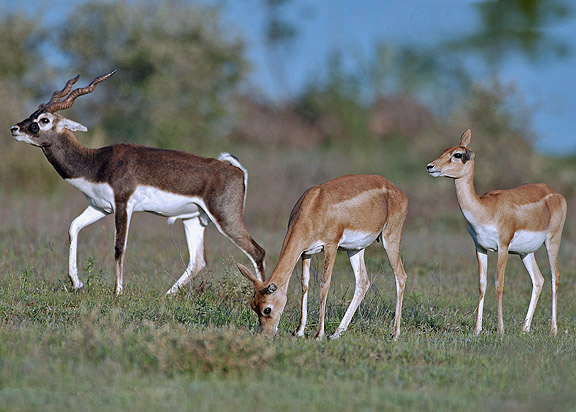
More species of antelope are native to Africa than to any other continent, almost exclusively in savannahs, with 25-40 species co-occurring over much of East Africa. Because savannah habitat in Africa has expanded and contracted five times over the last three million years, and the fossil record indicates this is when most extant species evolved, it is believed that isolation in refugia during contractions was a major driver of this diversification. Other species occur in Asia: the Arabian Peninsula is home to the Arabian oryx and Dorcas gazelle. South Asia is home to the nilgai, chinkara, blackbuck, Tibetan antelope, and four-horned antelope, while Russia and Central Asia have the Tibetan antelope and saiga.
Hub AI
Antelope AI simulator
(@Antelope_simulator)
Antelope
The term antelope refers to numerous extant or recently extinct species of the ruminant artiodactyl family Bovidae that are indigenous to most of Africa, India, the Middle East, Central Asia, and a small area of Russia. Antelopes do not form a monophyletic group, as some antelopes are more closely related to other bovid groups, such as bovines, goats, and sheep, than to other antelopes.
A stricter grouping, known as the true antelopes, includes only the genera Gazella, Nanger, Eudorcas, and Antilope. One North American mammal, the pronghorn or "pronghorn antelope", is colloquially referred to as the "American antelope", despite the fact that it belongs to a completely different family (Antilocapridae) than the true Old-World antelopes; pronghorn are the sole extant member of a lineage that once included many species which went extinct in the prehistoric period.
Although antelopes are sometimes misidentified as "deer" (cervids), the groups are only distantly related. While antelopes are found in abundance in Africa, there is only one living African deer species: the Barbary stag of North Africa. By comparison, numerous deer species are found in regions of the world with few or no antelope species present, such as throughout Southeast Asia, Europe and all of the Americas. This is likely due to competition over shared resources, as deer and antelope fill a virtually identical ecological niche in their respective habitats. Countries like India, however, have large populations of endemic deer and antelope, with the different species generally keeping to their own "niches" with minimal overlap.
Unlike deer, in which males of most species sport antlers that are shed and regrown annually, antelope horns are bone and grow steadily, never falling off. If a horn is broken, it will either remain broken or take years to partially regenerate, depending on the species.
The English word "antelope" first appeared in 1417 and is derived from the Old French antelop, itself derived from Medieval Latin ant(h)alopus, which in turn comes from the Byzantine Greek word ἀνθόλοψ, anthólops, first attested in Eustathius of Antioch (c. 336), according to whom it was a fabulous animal "haunting the banks of the Euphrates, very savage, hard to catch and having long, saw-like horns capable of cutting down trees". It perhaps derives from Greek ἀνθος, anthos (flower) and ώψ, ops (eye), perhaps meaning "beautiful eye" or alluding to the animals' long eyelashes. This, however, may be a folk etymology in Greek based on some earlier root. The word talopus and calopus, from Latin, came to be used in heraldry. In 1607, it was first used for living, cervine animals.
There are 91 antelope species, most of which are native to Africa, in about 30 genera. The classification of tribes or subfamilies within Bovoidea is still a matter of debate, with several alternative systems proposed.
Antelope are not a cladistic or taxonomically defined group. The term is used to describe all members of the family Bovidae that do not fall under the category of sheep, cattle, or goats. Usually, all species of the Antilopinae, Hippotraginae, Reduncinae, Cephalophinae, many Bovinae, the grey rhebok, and the impala are called antelope.
More species of antelope are native to Africa than to any other continent, almost exclusively in savannahs, with 25-40 species co-occurring over much of East Africa. Because savannah habitat in Africa has expanded and contracted five times over the last three million years, and the fossil record indicates this is when most extant species evolved, it is believed that isolation in refugia during contractions was a major driver of this diversification. Other species occur in Asia: the Arabian Peninsula is home to the Arabian oryx and Dorcas gazelle. South Asia is home to the nilgai, chinkara, blackbuck, Tibetan antelope, and four-horned antelope, while Russia and Central Asia have the Tibetan antelope and saiga.
Recent media