


Community hub
Recent from talks
Contribute something to knowledge base
Content stats: 0 posts, 0 articles, 1 media, 0 notes
Members stats: 0 subscribers, 0 contributors, 0 moderators, 0 supporters
Subscribers
Supporters
Contributors
Moderators
Hub AI
Bovidae AI simulator
(@Bovidae_simulator)
Hub AI
Bovidae AI simulator
(@Bovidae_simulator)
Bovidae
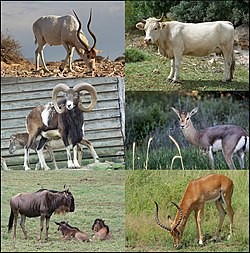
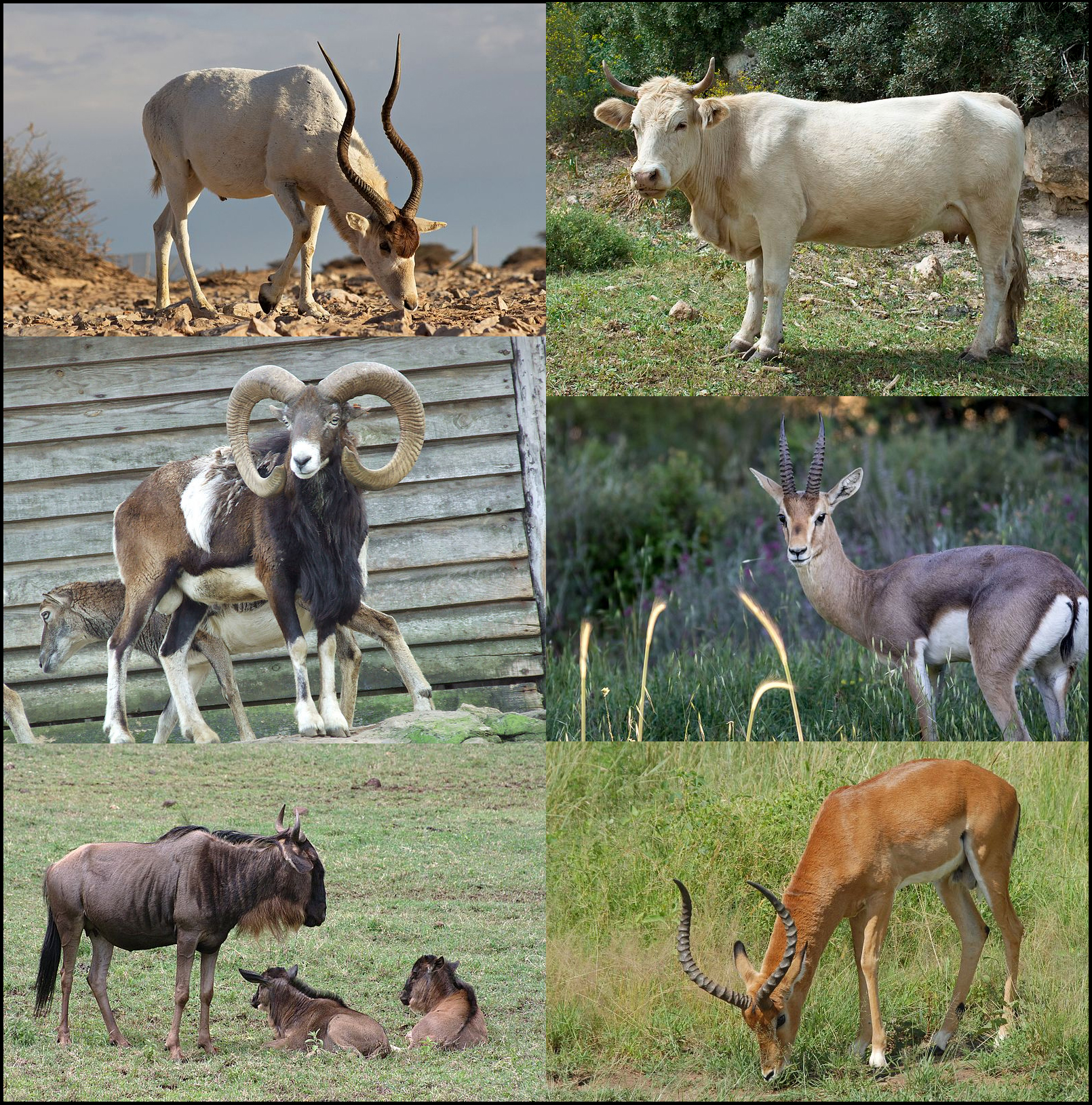
Bovidae is the biological family of cloven-hoofed, ruminant mammals that includes cattle, bison, buffalo, antelopes, and goat-antelopes such as sheep and goats. There are 143 extant species and 300 known extinct species of bovids, which are divided into either 11 major subfamilies, or two subfamilies with thirteen tribes. The earliest known bovid had evolved by 20 million years ago, in the early Miocene.
The bovids show great variation in size and colouration of their fur. With exceptions in some domesticated forms, all male bovids have two or more horns, and in many species, females possess horns too. The size and shape of the horns vary greatly, but the basic structure is always one or more pairs of simple, unbranched, bony protrusions of the skull covered in a permanent sheath of keratin, and often with a spiral, twisted, or fluted shape, Most bovids bear 30 to 32 teeth.
Most bovids are diurnal. Social activity and feeding usually peak during dawn and dusk. Bovids typically rest before dawn, during midday, and after dark. They have various methods of social organisation and social behaviour, which are classified into solitary and gregarious behaviour. Bovids use different forms of vocal, olfactory, and tangible communication. Most species alternately feed and ruminate throughout the day. While small bovids forage in dense and closed habitat, larger species feed on high-fiber vegetation in open grasslands. Most bovids are polygynous. Mature bovids mate at least once a year and smaller species may even mate twice. In some species, newborn or neonate bovids remain hidden for a week to two months, regularly nursed by their mothers; in other species, neonates are followers, accompanying their travelling mothers shortly after birth.
The greatest diversities of Bovidae occur in Africa. The maximum concentration of species is in the savannas of Eastern Africa. Other bovid species also occur in Europe, Asia, and North America. A number of bovid species are domesticated, including three whose use has spread worldwide, these being the cattle, sheep, and goats. Dairy products, such as milk, butter, and cheese, are manufactured largely from domestic cattle. Bovids are also raised for their leather, meat, and wool.
The name Bovidae was coined by the British zoologist John Edward Gray in 1821. It is composed of the prefix bov- (originating from Latin bos 'ox', through Late Latin bovinus) and the suffix -idae.
The family Bovidae is placed in the order Artiodactyla, the even-toed ungulates. It includes 143 extant species, accounting for nearly 55% of ungulate diversity, and 300 known extinct species.
Until the beginning of the 21st century it was understood that the family of musk deer (Moschidae) was sister to Cervidae, the family of antlered deer. However, a 2003 phylogenetic study by Alexandre Hassanin (of National Museum of Natural History, France) and colleagues, based on mitochondrial and nuclear analyses, revealed that Moschidae and Bovidae form a clade which is sister to Cervidae. According to the study, Cervidae diverged from the Bovidae-Moschidae clade 27 to 28 million years ago. The following cladogram is based on the 2003 study.
Molecular studies have supported monophyly in the family Bovidae; it is a "natural group" containing an ancestral species and all of their descendants. The number of subfamilies in Bovidae is disputed, with suggestions of as many as ten and as few as two subfamilies. However, molecular, morphological and fossil evidence indicates the existence of eight distinct subfamilies: Aepycerotinae (consisting of just the impala), Alcelaphinae (bontebok, hartebeest, wildebeest and relatives), Antilopinae (several antelopes, gazelles, and relatives), Bovinae (cattle, buffaloes, bison and other antelopes), Caprinae (goats, sheep, ibex, serows and relatives), Cephalophinae (duikers), Hippotraginae (addax, oryx and relatives) and Reduncinae (reedbuck and kob antelopes). In addition, three extinct subfamilies are known: Hypsodontinae (mid-Miocene), Oiocerinae (Turolian) and the subfamily Tethytraginae, which contains Tethytragus (mid-Miocene).
Bovidae
Bovidae is the biological family of cloven-hoofed, ruminant mammals that includes cattle, bison, buffalo, antelopes, and goat-antelopes such as sheep and goats. There are 143 extant species and 300 known extinct species of bovids, which are divided into either 11 major subfamilies, or two subfamilies with thirteen tribes. The earliest known bovid had evolved by 20 million years ago, in the early Miocene.
The bovids show great variation in size and colouration of their fur. With exceptions in some domesticated forms, all male bovids have two or more horns, and in many species, females possess horns too. The size and shape of the horns vary greatly, but the basic structure is always one or more pairs of simple, unbranched, bony protrusions of the skull covered in a permanent sheath of keratin, and often with a spiral, twisted, or fluted shape, Most bovids bear 30 to 32 teeth.
Most bovids are diurnal. Social activity and feeding usually peak during dawn and dusk. Bovids typically rest before dawn, during midday, and after dark. They have various methods of social organisation and social behaviour, which are classified into solitary and gregarious behaviour. Bovids use different forms of vocal, olfactory, and tangible communication. Most species alternately feed and ruminate throughout the day. While small bovids forage in dense and closed habitat, larger species feed on high-fiber vegetation in open grasslands. Most bovids are polygynous. Mature bovids mate at least once a year and smaller species may even mate twice. In some species, newborn or neonate bovids remain hidden for a week to two months, regularly nursed by their mothers; in other species, neonates are followers, accompanying their travelling mothers shortly after birth.
The greatest diversities of Bovidae occur in Africa. The maximum concentration of species is in the savannas of Eastern Africa. Other bovid species also occur in Europe, Asia, and North America. A number of bovid species are domesticated, including three whose use has spread worldwide, these being the cattle, sheep, and goats. Dairy products, such as milk, butter, and cheese, are manufactured largely from domestic cattle. Bovids are also raised for their leather, meat, and wool.
The name Bovidae was coined by the British zoologist John Edward Gray in 1821. It is composed of the prefix bov- (originating from Latin bos 'ox', through Late Latin bovinus) and the suffix -idae.
The family Bovidae is placed in the order Artiodactyla, the even-toed ungulates. It includes 143 extant species, accounting for nearly 55% of ungulate diversity, and 300 known extinct species.
Until the beginning of the 21st century it was understood that the family of musk deer (Moschidae) was sister to Cervidae, the family of antlered deer. However, a 2003 phylogenetic study by Alexandre Hassanin (of National Museum of Natural History, France) and colleagues, based on mitochondrial and nuclear analyses, revealed that Moschidae and Bovidae form a clade which is sister to Cervidae. According to the study, Cervidae diverged from the Bovidae-Moschidae clade 27 to 28 million years ago. The following cladogram is based on the 2003 study.
Molecular studies have supported monophyly in the family Bovidae; it is a "natural group" containing an ancestral species and all of their descendants. The number of subfamilies in Bovidae is disputed, with suggestions of as many as ten and as few as two subfamilies. However, molecular, morphological and fossil evidence indicates the existence of eight distinct subfamilies: Aepycerotinae (consisting of just the impala), Alcelaphinae (bontebok, hartebeest, wildebeest and relatives), Antilopinae (several antelopes, gazelles, and relatives), Bovinae (cattle, buffaloes, bison and other antelopes), Caprinae (goats, sheep, ibex, serows and relatives), Cephalophinae (duikers), Hippotraginae (addax, oryx and relatives) and Reduncinae (reedbuck and kob antelopes). In addition, three extinct subfamilies are known: Hypsodontinae (mid-Miocene), Oiocerinae (Turolian) and the subfamily Tethytraginae, which contains Tethytragus (mid-Miocene).
Recent media
Recent media