Hubbry Logo
Small unit tacticsSmall unit tacticsMain
Open search
Small unit tactics
Community hub
Small unit tactics
logo
8 pages, 0 posts
0 subscribers
Be the first to start a discussion here.
Small unit tactics
Small unit tactics
from Wikipedia
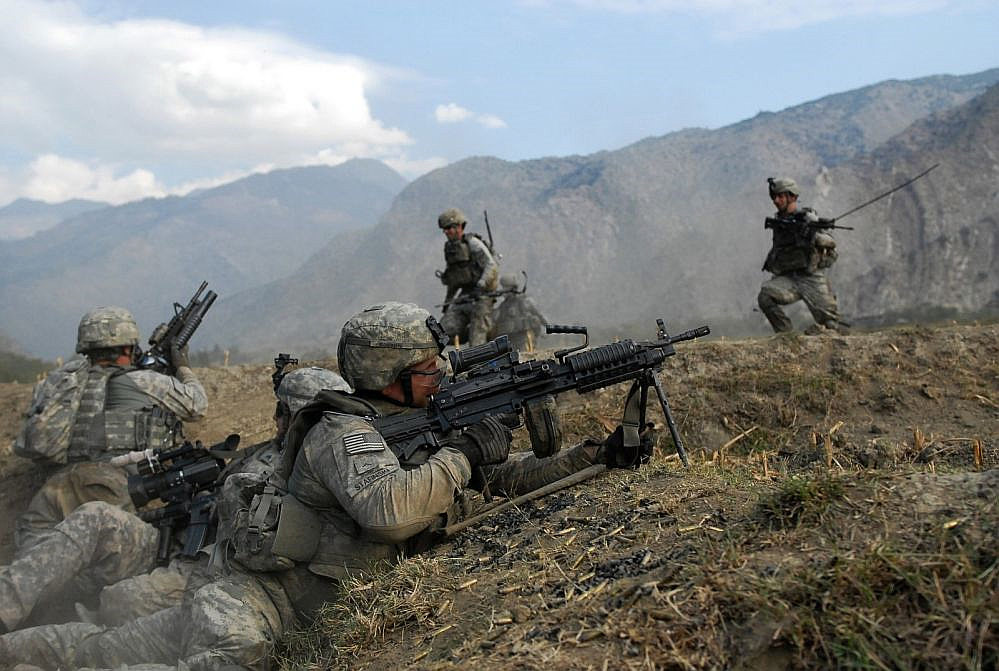
U.S Soldiers in action
4th Infantry Division in Afghanistan

Small unit tactics is the application of US Army military doctrine for the combat deployment of platoons and smaller units in a particular strategic and logistic environment.[1][2][3] The composition of a United States Army squad falls into three broad categories: classical, balanced and combined.

Classical

[edit]

United States Army 'classical' squads are composed of three elements; a command and support element, a base of fire element, and a maneuver element. The command and support element could include a squad leader, an assistant squad leader, a medic, a forward observer and a radio operator or it could be limited to a squad leader. The fire element consists of a machine gunner and one or two personnel who act as loaders and barrel changers for the gun and porters for its ammunition and ancillary components. The maneuver element is composed of troops armed with assault rifles, entrenching tools, grenades and additional ammunition for the machine gun and tasked with the role of enabling the safe movement of the fire element by scouting ahead and providing a security detail.

Balanced

[edit]

Balanced squads are composed of two or three fire teams coupled with a command and support element. The fire teams could either be standard base of fire elements organized around a machine gun and protected by assault rifle or submachine gun wielding ammunition porters or the fire teams could be organized as 'storm' units composed of a handful of personnel armed with assault rifles reinforced with a squad automatic weapon and grenade launchers.

Combined

[edit]

The combined squad is composed of dissimilar fire teams; an RPG team, a fire team and a sniper team. The RPG team consists of two personnel; one armed with an RPG launcher and the other porting extra RPGs and providing protection with an assault rifle. The fire team is composed of two personnel; one carrying a machine gun and the other porting its ammunition. The sniper team consists of one or two persons, one deploying the weapon, often a semi-automatic designated marksman rifle as opposed to a true sniper rifle, and the other acting as spotter and providing close protection.

Combat Strategy and Phases

[edit]

Assault

[edit]

The two major techniques of squad assault are bounded fire and advancing under the cover of suppressive fire of supporting units. Bounded fire entails having one element of the squad provide covering fire and field obscuration while the second element maneuvers forward to provide covering fire that allows the first element to leapfrog forward. This process is repeated until the maneuver element is in grenade range of the enemy positions. Advancing under the cover of supporting units requires the squad to stealthily advance towards the enemy position from a weakly held sector after the enemy has been suppressed by overwhelming fire. Once the squad has closed with the enemy it uses grenades and squad automatic fire to engage the enemy. This allows sufficient disruption of the enemy's control of their defensive front to allow other squads to advance unopposed. United States Marines squads are arranged into "Buddy Pairs" and will assault in "Buddy Rushes", ensuring that one Marine is firing at the enemy while the other is maneuvering.

Interim

[edit]

In this phase the squad consolidates its position by entrenchment, construction of fortifications, creation of passageways between structures and forward reconnaissance of surrounding areas. Minor chemical decontamination will commence as seals, respirators and masks are checked for damage. Body armor will be examined to replace damaged ceramic plates. Casualties will be treated, evacuated and/or replaced. The squad will use this period to familiarise itself with its surroundings, dig in to defensible positions, recharge itself, repair any damage to itself and prepare either for the next offensive movement, or go on the defensive against a counterattack.

Defensive

[edit]

On the defensive, an isolated squad will allow a small element to hold a weak and easily evacuated position behind a remote detonated mine, flanked by a machine gun. As the enemy advances, the small forward element will pull back. When its former position is overrun the mine will be detonated to distract the attackers, and then the machine gun will open fire on the attacker's flank. The machine gun will then switch to engage and suppress the tail of the enemy assault as the rest of the squad maneuvers against its dislocated and exposed flanks, which have been pulled forward from their defensive line to support the head of the assault. On the defensive, a squad with a secure means of communication will fix the enemy into interlocked fields of fire and call in fire support from supporting units.

References

[edit]
Revisions and contributorsEdit on WikipediaRead on Wikipedia
from Grokipedia
Small unit tactics, particularly in the context of modern Western militaries such as the , encompass the coordinated employment, ordered arrangement, and directed actions of military forces at the , , and levels to achieve tactical objectives in , emphasizing the integration of , maneuver, and under conditions of contact. These tactics focus on the art and science of winning engagements through rapid , exploitation of and vulnerabilities, and maintenance of to avoid surprise while transitioning to decisive action. In contemporary applications as of 2025, they increasingly incorporate unmanned systems, electronic warfare, and AI-assisted tools to enhance lethality and situational awareness. Primarily applied in , armored, or contexts, small unit tactics enable subordinate leaders to execute missions independently within a larger operational framework, adapting to dynamic conditions. Key principles of small unit tactics include achieving a decision by identifying and attacking critical vulnerabilities with a main effort, gaining advantages through integration—such as pairing assaults with supporting fires from guns or launchers—and employing surprise via stealth, , or speed to disrupt reactions. Leaders apply factors like mission, , , troops available, time, and civil considerations (METT-TC) to select formations (e.g., for balanced or line for maximum firepower) and movement techniques, such as bounding overwatch when contact is expected, ensuring 360-degree and minimizing risks like through positive target identification and fire control measures. is integral, involving a five-step process to identify hazards, assess risks, develop controls, implement them, and supervise outcomes, while passive measures like concealment enhance protection against aerial or chemical threats. In offensive operations, small units conduct movements to contact using elements to fix and finish the , followed by attacks that mass combat power at decisive points through forms of maneuver like penetration or , exploiting success with rapid pursuits to prevent enemy reorganization. Defensive tactics involve organizing positions for area or mobile defense, using obstacles and fires to canalize enemies into engagement areas for counterattacks, or employing delays to trade space for time via successive bounds. Enabling tasks, such as patrols by platoons to gather or screens to provide early warning, support these efforts, with rehearsals and troop-leading procedures ensuring and adaptability. Overall, small unit tactics prioritize speed, initiative, and cooperation to outpace the , fostering decentralized execution where junior leaders improvise within ’s to sustain in fluid environments.

Fundamentals

Definition and Scope

Small unit tactics refer to the methods and principles employed by military units typically ranging from 4 to 40 personnel, such as fire teams, squads, and platoons, to achieve immediate objectives through coordinated actions involving movement, , and maneuver. These tactics emphasize the practical of forces in , focusing on the ordered and deliberate control of formations, movements, and fires to maximize potential at the tactical level. In essence, they enable small units to execute offensive, defensive, and enabling tasks by integrating direct and indirect fires with dismounted movements. The scope of small unit tactics is primarily confined to dismounted operations, where foot-mobile soldiers use , machine guns, and man-portable anti-armor systems to engage enemies in close-range, fluid environments, excluding standalone vehicular or air operations unless they support infantry actions at this scale. This contrasts with grand tactics, which involve larger formations like battalions or brigades coordinating across broader fronts, and , which addresses national-level objectives and over extended campaigns. Small unit tactics thus prioritize immediate battlefield effects, such as finding, fixing, and finishing enemy elements, without encompassing operational or strategic planning. Central to small unit tactics are characteristics like initiative, adaptability, and decentralized , which allow leaders and soldiers to act decisively within the commander's intent amid uncertain, close-quarters combat. Initiative manifests as disciplined, independent actions by subordinates to seize opportunities or counter threats without awaiting higher approval, fostering bold yet controlled responses. Adaptability involves flexible adjustments to formations, movement techniques, and fire plans based on , disposition, and mission variables, ensuring units remain effective in dynamic conditions. Decentralized decision-making empowers small teams to operate autonomously, relying on principles to maintain unity of effort while exploiting localized advantages.

Unit Organization

Small unit tactics rely on structured organizations that enable coordinated action at the lowest levels, with the fire team serving as the fundamental building block in most modern militaries. In the United States Army, a standard infantry fire team consists of four soldiers: a (typically a who directs the team and maintains communication), a (who provides covering fire and may carry additional munitions), an automatic rifleman (equipped with the M250 for , as of 2025 under the program), and a ( with an M7 rifle fitted with an M320 for support). This composition balances mobility, , and area suppression, with the M250's sustained influencing the team's ability to establish a base of fire during maneuvers. The , or section in some armies, expands this structure to 8-12 soldiers, functioning as the primary maneuver element. In the U.S. Army, an comprises nine soldiers: a (a who coordinates the unit and ensures security), and two fire teams of four each, allowing for flexible task division such as one team providing covering fire while the other advances. Key roles within the include the point man (leading movement to detect threats), flank security (protecting the sides from ), and rear guard (covering the withdrawal or preventing trailing attacks), all assigned dynamically by the to maintain 360-degree awareness. The integration of squad automatic weapons like the M250 further shapes this organization, enabling one fire team to deliver volume of fire equivalent to larger units in earlier doctrines. At the platoon level, organizations scale to 20-40 soldiers to conduct independent operations, incorporating specialized elements for enhanced capability. A U.S. Army platoon typically includes 30-40 personnel: a (a responsible for overall command and mission execution), a (who handles and discipline), a radio telephone operator for communications, three squads of nine each, and a weapons squad of nine equipped with M240L medium machine guns and anti-tank missiles for sustained and anti-armor support. Command operates through a decentralized , where squad leaders exercise initiative in real-time decisions under the platoon leader's guidance, fostering rapid adaptation to battlefield conditions.
ComponentPersonnelKey Roles and Equipment
Fire Team4 (M7 rifle), (M7, shoulder-launched munitions), automatic (M250), (M7 with M320).
9 (M7), two fire teams; roles include point man, flank security, rear guard.
30-40 and (M7), RTO (M7), three rifle , one weapons squad (M240L, ).
Variations exist across militaries, reflecting doctrinal differences and equipment availability. In the , the equivalent of a U.S. squad is a section of 8-10 soldiers, divided into two fire teams of four (each with a leader, , , and either a or machine gunner using the L7A2 ), commanded by a who reports to a of 25-30 soldiers led by a . This structure emphasizes versatility in roles, with the L7A2 providing similar suppressive capabilities as the U.S. M250. Such attachments as forward observers for coordination or combat engineers for obstacle breaching are temporarily added to squads or platoons based on mission requirements, enhancing specialized functions without altering core hierarchies.

Historical Evolution

Classical Period

Small unit tactics from the classical period through the early were characterized by close-order formations that emphasized collective discipline and physical proximity to compensate for limited individual and communication. In , the organized into files typically 8 to 16 men deep, where soldiers interlocked their large hoplon shields to form a protective wall while thrusting with 7- to 8-foot spears (doru) from the front ranks. This subunit structure allowed for a dense, momentum-driven advance, with rear ranks providing support through pressure and replacement of fallen comrades, enabling sustained pushes against enemy lines. The Roman manipular system introduced greater flexibility to small unit operations during the , dividing legions into maniples of approximately 120 men, further subdivided into two centuries of 60 each, which could operate as independent skirmishing elements. These subunits, arranged in a formation across three lines (, , ), permitted rotating fresh troops into combat while allowing gaps for missile fire or maneuver, adapting to terrain and enemy movements more dynamically than the rigid Greek phalanx. Medieval adaptations shifted toward mounted and mixed small units, with knightly retinues often comprising 10 to 20 men-at-arms, including knights and sergeants, who employed using lances for shock charges and bows for from horseback. Feudal levies, by contrast, consisted of loosely organized groups summoned from vassals, relying on melee engagements with spears, axes, and swords in fluid, less disciplined formations that prioritized numbers over cohesion. By the , early modern evolved into pike-and-shot blocks, where squad-sized groups of 10 to 20 soldiers integrated for with pikemen to defend against , culminating in charges once firearms were reloaded. These mixed subunits formed the core of larger tercios or battalions, delivering coordinated musket salvos—often in ranks firing by cascade—to disrupt foes before closing with pikes or early bayonets. The refined these approaches through linear tactics in European armies, where battalions were divided into companies of 80 to 100 men that formed thin lines, typically two or three ranks deep, to maximize from muskets. Light companies detached as skirmishers operated in loose, dispersed formations to screen the main line, harass enemies with individual aimed shots, and probe for weaknesses, while the advanced in disciplined order for decisive assaults. These tactics suited open and emphasized musketry over maneuver, with small units maintaining alignment to deliver massed fire. A key limitation of these classical tactics was the heavy reliance on massed, close-order formations, necessitated by the slow reload times of early firearms (up to 30-60 seconds per shot) and the absence of reliable long-range communication, which restricted independent small unit initiative and exposed troops to devastating enemy volleys or charges if cohesion broke. This formation-centric approach laid the groundwork for later evolutions toward more dispersed maneuvers in industrialized warfare.

Modern Developments

The 19th century marked a pivotal shift in small unit tactics, influenced by industrialization and advancements in weaponry. Napoleonic-era skirmishers, who operated in loose, dispersed formations to screen main lines and harass enemies, evolved into more independent units as rifled muskets extended effective firing ranges to 300-500 yards, necessitating thinner lines to reduce casualties from accurate fire. In the (1861-1865), this led to innovative squad-level ambushes that exploited natural cover such as fences, walls, and terrain contours, allowing small groups of 8-12 soldiers to deliver devastating volleys before withdrawing, a departure from rigid linear formations. World War I further transformed tactics amid static trench warfare, where machine guns dominated open ground and compelled the adoption of smaller, specialized units. parties, typically comprising 10-20 soldiers, conducted nighttime incursions to capture prisoners, destroy machine gun nests, and demoralize foes, relying on clubs, grenades, and bayonets for silent close combat to avoid alerting defenders. The suppressive power of machine guns prompted a doctrinal shift toward smaller, specialized units that provided mutual covering fire and infiltration capabilities, laying the groundwork for decentralized operations in contested environments. World War II accelerated these trends with integrated firepower and mobility. German assault squads, building on World War I Sturmtruppen infiltration methods, employed submachine guns like the MP40 for rapid close-range fire and flamethrowers to clear bunkers during breakthroughs, emphasizing small-group advances through weak points rather than frontal assaults. In the Pacific theater, U.S. Marine and Army squads executed fire-and-maneuver tactics during island-hopping campaigns, such as at and , where one fire team suppressed Japanese positions with automatic weapons while another maneuvered to flank, adapting to dense jungles and fortified caves. Post-1945 developments emphasized agility in asymmetric conflicts. During the (1955-1975), U.S. small-unit patrolling—often involving squads of 9-13 soldiers—focused on ambushes and search-and-destroy missions in rugged terrain, bolstered by the lightweight , which enabled sustained automatic fire for suppressive roles without excessive weight. The 1991 integrated night-vision goggles into platoon raids, allowing small units to navigate and strike Iraqi positions under darkness, achieving surprise and minimizing exposure to defensive fire. By the , drone-assisted squad operations have become standard, with unmanned aerial systems like the RQ-11 providing real-time overhead surveillance and targeting data to U.S. Army teams, enhancing situational awareness during urban and patrols. Throughout these eras, key technological drivers—improved firearms for enhanced lethality at the level, radios for real-time coordination among dispersed elements, and for greater individual survivability—have enabled smaller units to operate with increased independence and effectiveness, reducing reliance on massed formations.

Core Principles

Fire and Maneuver

Fire and maneuver is a foundational tactic in small unit operations, where one element provides suppressive, direct, or to neutralize or fix the , enabling another element to advance or reposition to gain a decisive advantage. This principle ensures that movement is never conducted without supporting , as "fire without movement is indecisive" and "exposed movement without is disastrous." The cycle repeats, with roles alternating between base-of- and bounding elements, to progressively close with and destroy the while minimizing exposure. At the or level, this tactic integrates superiority with tactical positioning, influenced by factors such as , disposition, and available weapons. Key techniques include bounding overwatch, where elements alternate advances of 50-100 meters while maintaining visual contact and mutual support, typically within two-thirds of the supporting weapon's effective range. Fire teams often employ a formation with 10-meter intervals to facilitate this maneuver, allowing the team leader to direct fire and movement while providing 360-degree security. In squad-level execution, one fire team establishes a base of fire, suppressing enemy positions with aimed or area fire, as the other team bounds forward in short leaps, then assumes the role. This method balances speed and security when enemy contact is expected, with distances adjusted based on visibility and . Weapons integration emphasizes the complementary use of automatic weapons for suppression and rifles for precision engagement. Automatic rifles like the M249 provide at sustained rates of 100 rounds per minute or rapid rates of 200 rounds per minute, while machine guns such as the M240 deliver sustained fire at 100 rounds per minute (6-9 round bursts every 4-5 seconds) or rapid fire at 200 rounds per minute to fix the enemy. launchers and anti-armor systems like the Javelin are synchronized to create dilemmas for the enemy, with indirect fires from mortars adding area suppression. Leaders plan fire rates and ammunition based on the duration needed to support the bounding element's movement. Risks include overexposure to counterfire, enemy armor threats, and during transitions, which can be countered through analysis for covered routes, fire control measures like restrictions, and isolation of enemy reinforcements via superior fire volume. Coordination relies on hand and signals—such as horizontal arm sweeps for "commence firing" or sharp downward gestures for "cease fire"—to direct shifts without radios, supplemented by or voice commands for clarity in noisy environments. These signals prevent and ensure precise execution under stress. Training emphasizes repetitive drills to instill speed, volume of , and leader initiative, including battle drills for actions on contact and assaults, as well as rehearsals for integration and target engagement. Crew drills focus on range card preparation, adjustment, and displacement under live , while troop-leading procedures ensure squads practice shoot-move-communicate fundamentals. This builds disciplined initiative, allowing junior leaders to adapt and maneuver in dynamic situations. and maneuver applies directly in phases to seize objectives.

Cover and Concealment

In small unit tactics, cover refers to any terrain or man-made structure that provides physical protection from enemy fire, including and fragments, by blocking or deflecting projectiles. Concealment, by contrast, involves elements that hide personnel or positions from enemy observation and surveillance without offering ballistic protection, such as vegetation, smoke, or materials that prevent detection at distances greater than 35 meters. These principles enable squads and platoons to survive initial contact, maintain initiative, and support maneuvers by minimizing exposure to direct observation and fire. Cover is categorized as hard or soft based on its durability and effectiveness. Hard cover, such as walls or earth-reinforced bunkers, offers robust against most fire and fragments, while soft cover like dense brush or shallow ditches provides limited shielding that may fail against sustained or heavy-caliber impacts. Fighting positions integrate both cover and concealment, divided into hasty and prepared types; hasty positions, such as prone fighting holes or skirmisher's trenches dug to 18 inches deep with a low , can be established in minutes using available for immediate during movement halts. Prepared positions, including full foxholes with overhead cover and grenade sumps, require more time and materials like sandbags filled three-quarters full to create thicker barriers. In applications, small units exploit natural features for defilade positions, where squads position behind hills or ridges to expose only weapon systems in a hull-down configuration, limiting enemy targeting while allowing aimed . Urban settings might involve using building walls for corner-fed , where Soldiers peek briefly from cover to engage, reducing exposure. These measures support and maneuver by allowing one element to suppress from concealed cover while another advances. Camouflage techniques enhance concealment through discipline and materials tailored to the environment. Snipers employ ghillie suits, loose garments covered in local and netting to break up outlines and blend with terrain, enabling prolonged observation without detection. Squads maintain movement discipline to avoid creating silhouettes against skylines, shining equipment, or disturbing , while using or natural obscurants for temporary visual barriers. Limitations of cover and concealment include vulnerability to indirect fire or ricochets causing bullet splash, which can penetrate soft cover or deflect into positions. Units must plan multiple routes and dispersed positions to prevent enfilade fire—long-range shots raking along lines of troops—and account for dead space where cover fails to protect against grazing fire. Advanced enemy sensors, like thermal imaging, can compromise camouflage, necessitating constant position shifts and terrain analysis via OAKOC (observation, avenues of approach, key terrain, obstacles, cover and concealment).

Offensive Tactics

Assault Phase

The assault phase of small unit tactics represents the decisive moment in offensive operations where platoons and squads transition from suppression to close combat, aiming to overrun and seize enemy positions through rapid, coordinated aggression. Building on core principles such as fire and maneuver, this phase emphasizes overwhelming the defender with synchronized fires and movement to disrupt their ability to respond effectively. The phase typically breaks down into distinct sub-phases: the approach under fire, the final rush within approximately 50 meters, and, if applicable in urban or fortified environments, room or building clearing. During the approach under fire, squads advance toward using tactical movement techniques such as traveling or bounding , while a base of fire element delivers to fix the enemy and enable the maneuver element to close the distance without prohibitive casualties. This maneuver occurs under covering fire from machine guns, grenade launchers, or vehicle-mounted weapons, with dismounted units clearing danger areas to maintain momentum. The final rush begins once the assault element is within 50 meters, exploiting the effects of prior suppression to rapidly close with the enemy position through aggressive rushes, either by the full squad, alternating fire teams, or individual bounds depending on the volume of return fire. Fire teams lead this phase with fragmentation grenades thrown into enemy positions or embrasures to neutralize defenders, followed by bursts of automatic fire from automatic riflemen to maintain suppression during the advance. In cases involving structures, room or building clearing follows a systematic approach: fire teams leapfrog through entry points, employing top-down or bottom-up methods to methodically search and secure spaces, marking cleared areas to avoid re-clearing and collecting any intelligence or evidence encountered. Key techniques include the use of bang-out charges—small explosive breaching devices—for gaining entry through doors or obstacles, combined with diversionary blasts to disorient defenders prior to the rush. Fire teams integrate M203 for high-explosive rounds (arming at about 30 meters) or multi-projectile rounds at closer ranges to enhance suppression, while riflemen deliver aimed or to cover the movement. Coordination is directed by the platoon leader, who synchronizes lifts and shifts of supporting fires—shifting from overhead suppression to flanking or oblique angles—and issues cease-fire signals via radio, hand signals, pyrotechnics, or visual cues to prevent friendly casualties during the final closure. Squad and fire team leaders maintain unit integrity through decentralized execution, ensuring deconfliction with company fire support teams and adapting to terrain or enemy reactions in real time. Weapons suited to close-range engagements include and submachine guns for their maneuverability and in confined spaces, alongside breaching tools such as shotgun rounds for locks, bolt cutters, or Halligan bars for mechanical entry, and shoulder-launched multipurpose assault weapons (SMAW) for heavier obstacles. Success in the assault phase is measured by the ability to execute with speed—minimizing exposure time to enemy fire—and by achieving fire superiority before physical contact, allowing the unit to seize the objective with preserved combat power and low casualties from the approach.

Exploitation and Pursuit

Exploitation follows immediately after a successful , transitioning small units from the intensity of close combat to rapid forward movement that capitalizes on enemy disorganization and prevents recovery. In small unit tactics, this phase emphasizes maintaining offensive momentum at the or level to disrupt deeper enemy elements, such as command posts or reserves, while securing captured ground for follow-on forces. The primary objectives of exploitation are to prevent enemy fallback by pushing deeper into their positions and cutting off retreat routes using flanking squads or fire teams. This involves aggressive penetration to target vulnerable rear areas, disorganizing the enemy's cohesion and will to fight, ultimately aiming for decisive results like surrender or complete destruction. For platoons, these goals are achieved by exploiting breakthroughs created during the assault, using speed and surprise to seize key and block enemy withdrawal paths. Key techniques include rapid platoon advances across captured ground, where squads bound forward in overwatch formations to maintain suppressive fire while maneuvering. Fire teams mop up bypassed enemy pockets through systematic clearing, employing grenades and close-quarters weapons to neutralize isolated threats without halting the main effort. Combined arms integration, such as coordinating with attached mortars or aviation for indirect fires, supports these actions by suppressing potential counterattacks and obscuring enemy movements. Platoon leaders designate limits of advance and rally points to control the tempo, ensuring units do not fragment during the push. Pursuit methods focus on tracking and engaging the withdrawing enemy to prevent reorganization, often using visual signs like footprints or vehicle tracks to follow the route. In small units, squads track wounded personnel or vehicles by maintaining visual contact or employing military working dogs for scent detection, which can extend pursuit through dense terrain where human observers might lose the trail. Modern adaptations incorporate small unmanned aerial systems (drones) for overhead , allowing platoons to trail retreating forces in real-time and identify sites or rally points without exposing ground elements, as described in updated doctrine as of 2023. These methods emphasize relentless pressure, with direct fires shifted to pin the enemy while maneuver elements encircle or cut off escape avenues. Significant risks in exploitation and pursuit include overextension, which can expose flanks to ambushes or counterattacks from bypassed forces, potentially leading to unit isolation and . Platoons must balance speed with , as and logistical strain from sustained movement can cause , allowing the enemy to regroup. To mitigate these, reserve elements or squads secure flanks and rear areas, while leaders monitor for signs of enemy reinforcement through continuous .

Defensive Tactics

Defensive Positioning

Defensive positioning in small unit tactics refers to the strategic occupation and preparation of by platoons and squads to repel enemy attacks, focusing on maximizing , protection, and flexibility while minimizing vulnerabilities. This involves selecting positions that leverage natural and artificial features for mutual support among elements, ensuring the unit can hold ground under pressure. Preparation emphasizes rapid setup in dynamic environments, with squads integrating to cover all probable enemy approaches. Positions are categorized as hasty or deliberate based on time and resources available. Hasty positions are established quickly during movement or unexpected contact, using existing features like ditches or walls for immediate cover with minimal digging, typically 2-3 feet wide to allow firing to the front and obliques. In contrast, deliberate positions require and engineering, incorporating trenches, overhead cover, and obstacles for sustained defense against determined assaults. Within these, units designate primary positions as the main fighting locations covering likely enemy avenues of approach; alternate positions serve as backups in the same sector if the primary becomes untenable; and supplementary positions address secondary threats, such as flanks or gaps. Squad integration ensures cohesive defense through fields of , where weapons systems like guns and overlap to eliminate dead space and provide mutual support, often achieved by echeloning positions in a V-formation or layered setup. Each or is assigned sectors of —defined arcs, typically 180 degrees for squads, with right and left limits marked by stakes or —to cover primary and secondary areas, using range cards to specify engagement distances and heights that minimize exposure. These sectors integrate with cover and concealment principles to protect positions while enabling enfilade along probable enemy paths. Fortifications enhance position survivability, starting with sandbags for parapets (12 for frontal , 18 for flanks and rear, built 39 inches thick and 10-12 inches high) and overhead cover (76 sandbags, 18 inches deep, filled to 75% capacity). Wire obstacles include protective wire 40-500 meters forward to delay and tactical wire along final protective lines to channel attackers into kill zones, often using concertina coils for efficiency. In deliberate defenses, anti-personnel mines such as Claymores or scatterable types are emplaced as protective or tactical obstacles, always covered by observation and fire to disrupt and canalize enemy movements. Early warning systems detect threats before they reach main positions, employing sentries in observation posts (minimum two Soldiers, rotated every 12 hours) to monitor sectors and report via radio or signals. Trip flares, including variants, are positioned along likely approaches to illuminate intruders at night, integrated with security patrols for 360-degree vigilance. blends positions with the environment using natural materials like foliage or synthetic netting, ensuring undetectability from 35 meters, while maintaining noise and light discipline to avoid revealing locations. Key principles guide positioning: depth over width creates layered defenses with echeloned positions and obstacles to absorb and channel attacks, reducing the risk of penetration compared to linear setups. Mobility preserves flexibility, with rehearsed routes to alternate or supplementary positions allowing squads to shift under pressure without losing cohesion, supported by priority-of-work sequences starting with security and weapon emplacement.

Counterattack and Withdrawal

In small unit defensive operations, a represents a reactive offensive maneuver executed by a or to disrupt enemy momentum, regain lost ground, or seize the initiative. Typically localized to the or level, it involves rapid, coordinated pushes using techniques, such as bounding , to surprise and overwhelm the attacker from an unexpected direction. Reserves, often consisting of a or team held back from the main line, are committed immediately to exploit enemy vulnerabilities, such as overextension or disorientation following an initial assault. For instance, teams or antiarmor systems like the may provide to fix the enemy while the maneuvering element closes for close combat. These counterattacks are planned as either hasty actions, leveraging available forces for immediate response, or deliberate operations with preassigned objectives and . The or directs the effort, synchronizing direct fires from crew-served weapons with to isolate the enemy penetration and prevent reinforcement. Success hinges on surprise and speed, often achieved by maneuvering against exposed flanks while security elements maintain contact to prevent enemy withdrawal. Withdrawal techniques in small unit tactics enable disengagement from unfavorable engagements while preserving , typically under the direction of the to reposition or avoid decisive defeat. Key methods include thinning the lines, where forward elements gradually pull back while maintaining fire superiority to mask the movement, and bounding retreat, in which one or fire team provides fire as others displace 100-200 meters rearward in leaps. This bounding process uses from machine guns or designated marksmen to cover the moving element, ensuring no gaps expose the unit to enfilade fire. Under pressure, an assisted withdrawal may employ a rear guard or detachment left in contact to delay the enemy, allowing the main body to break clean. Coordination during both counterattacks and withdrawals is critical to avoid and maintain cohesion, often relying on for obscuration to conceal movements and feints to draw enemy fire away from the main effort. Rally points, pre-designated along withdrawal routes, serve as consolidation areas where squads reorganize, account for personnel, and redistribute before continuing. Control measures such as phase lines, trigger lines, and sectors of fire ensure synchronized actions, with the forward observer shifting indirect fires to support the maneuver. In a bounding withdrawal, for example, the element signals the move via or short-range radios, firing until the bounding team reaches cover before displacing itself. These elements build directly on established defensive positions to provide a base for reactive measures. Criteria for initiating a withdrawal focus on preserving the unit's fighting capability, such as when levels are low, impair maneuver, or the achieves overwhelming numerical superiority in the engagement area. The decision avoids by enforcing disciplined fire from the rear guard, ensuring the unit disengages methodically rather than fragmenting under pursuit. Commanders assess via mission variables like and , opting for withdrawal only if it improves the tactical situation without exposing adjacent units. Modern aids enhance the execution of these tactics through real-time communication and mobility options. Radios enable platoon leaders to adjust movements dynamically, coordinating with higher echelons for or shifts during withdrawal. Where available, vehicles such as HMMWVs or platforms facilitate extraction of wounded or heavy weapons, allowing squads to bound farther and faster while maintaining fire. Digital tools, including GPS for navigation to rally points and thermal sights for low-visibility targeting, further support coordination and surprise in counterattacks.

Specialized Applications

Urban and Close-Quarters Combat

Urban and close-quarters combat represents a distinct adaptation of small unit tactics, where dense built environments impose three-dimensional constraints on movement and engagement, emphasizing deliberate, methodical actions to mitigate risks from restricted visibility and potential intermingling. In such settings, small units like squads or fire teams operate in narrow streets, multi-story buildings, and rubble-strewn areas, facing vertical threats from windows, rooftops, and upper floors that create a complex with dead spaces and concealed enemy positions. These environments demand heightened , as subterranean systems like sewers can enable flanking maneuvers, while debris from prior fighting obstructs paths and complicates navigation. Key techniques prioritize controlled entry and clearance to minimize exposure. Units employ stack formations, where team members position themselves in a linear or staggered line outside doors or breaches, followed by rapid room entry using "" to systematically clear angles and within structures. Mouse-holing—creating breaches in interior walls with explosives like C4 or shoulder-launched multipurpose assault weapons (SMAW)—allows teams to move between rooms or floors without exposing themselves to open doors or streets, often preferred as the safest method in contested buildings. Breaching options include mechanical tools, ballistic methods with shotguns, or explosive charges, with a focus on entering structures from the top and fighting downward to leverage gravity and reduce unknown threats below. Weapons and engagement protocols are tailored for maneuverability and precision in confined spaces. Short-barreled carbines like the M4 rifle facilitate handling in tight quarters, supplemented by flashbangs such as the to disorient occupants during entries, and shotguns for . stress target discrimination to distinguish combatants from civilians, often guided by mission-specific factors and restrictive directives that minimize , such as ceasing fire once threats end and respecting non-combatants in mixed populations. Squad roles emphasize coordinated coverage and security. Typically organized into four-man teams, one element may secure a or while another covers adjacent streets or stairwells, using mirrors or periscopes to check corners without exposure. Sentinels or positions monitor potential routes, ensuring the assault team receives early warning. Challenges in urban combat include navigating rubble that slows advances and hides threats, as well as booby traps like improvised explosive devices (IEDs) or mined entry points, which demand constant vigilance and engineer support for neutralization. Post-9/11 operations in , such as the Second Battle of Fallujah in 2004, underscored these issues, where dense insurgent defenses in house-to-house fighting led to adaptations like integrated coalition squads for room-by-room clearances amid widespread booby traps and rubble. In Baghdad's , lessons from 2003-2008 highlighted the need for dispersed small units in joint security stations to counter IEDs and , with concrete barriers and presence patrols enhancing control while rubble and debris complicated and maneuver. These experiences reinforced the value of intelligence-driven raids and support to overcome environmental hazards without escalating civilian risks.

Night and Low-Visibility Operations

Night and low-visibility operations present significant challenges for small units due to reduced visibility from darkness, , , , or thermal crossover, which impairs , navigation, communication, and coordination while elevating risks of and disorientation. Unaided human detection ranges typically drop to approximately 50 meters for movement or man-sized targets under optimal moonlight conditions, further limited by and . Friendly identification becomes particularly problematic, as soldiers may hesitate to engage due to , increasing to enemy exploitation. To counter these issues, small units employ techniques emphasizing stealth and control, such as silent movement patrols that maintain and through frequent halts, terrain association, , and GPS for navigation. Infrared markers, including IR chemlights and luminous tape on helmets or , enhance by allowing passive identification without alerting enemies. Night ambushes leverage command-detonated devices like mines to initiate surprise in the kill zone, often combined with from security and elements in linear, L-shaped, or V-shaped formations for rapid execution and withdrawal. Equipment plays a pivotal role in restoring effectiveness; night-vision devices (NVDs), such as the or the newer ENVG-B binocular system (as of 2023), enable squad-level visibility comparable to daylight for movement and engagement up to several hundred meters or more, fusing and image intensification with overlays. weapon sights, including those integrated with systems like the missile (effective up to 4 km), facilitate target acquisition by detecting heat signatures through obscurants like smoke. Additional aids include IR aiming lights, laser pointers like the PEQ-15 (successor to PEQ-2), and IR illuminators for precise fire control without visible light. Formations adapt to low visibility by tightening intervals to 5-10 meters, favoring file or adjusted setups for better control and reduced separation risks during movement. Communication relies on , whispers, or IR pointers to minimize detection, with leaders assigning weapons control status (e.g., "weapons tight" near friendlies) to prevent . Training emphasizes proficiency in equipment limitations, such as NVD battery life requiring regular checks and spares, alongside rehearsals for night navigation, , and target identification to build confidence and reduce hesitancy. Historically, these operations evolved from reliance on flares and infrared searchlights for limited illumination to modern optics like starlight and thermal systems introduced in the and proliferated by the 1990s, and advanced further in the 2010s-2020s with digital fusion technologies like the ENVG-B and (IVAS), enabling small units to conduct near-daylight maneuvers with and AI-assisted targeting (as of 2025). As of 2025, advancements like the Squad Binocular Night Vision Goggle (SBNVG) for and Family of Weapon Sights - Individual (FWS-I) further integrate heads-up displays to improve small unit coordination and in low-visibility environments.

References

Add your contribution
Related Hubs
User Avatar
No comments yet.