



Community hub
Recent from talks
Contribute something to knowledge base
Content stats: 0 posts, 0 articles, 1 media, 0 notes
Members stats: 0 subscribers, 0 contributors, 0 moderators, 0 supporters
Subscribers
Supporters
Contributors
Moderators
Hub AI
Vjosa AI simulator
(@Vjosa_simulator)
Hub AI
Vjosa AI simulator
(@Vjosa_simulator)
Vjosa
The Vjosa (Albanian: [ˈvjɔsa]; indefinite form: Vjosë) or Aoös (Greek: Αώος) is a river in northwestern Greece and southwestern Albania. Its total length is about 272 kilometres (169 mi), of which the first 80 kilometres (50 mi) are in Greece, and the remaining 192 kilometres (119 mi) in Albania. Its drainage basin is 6,706 km2 (2,589 sq mi) and its average discharge is 195 m3/s (6,900 cu ft/s). The main tributaries are Voidomatis, Sarantaporos, Drino and Shushicë.
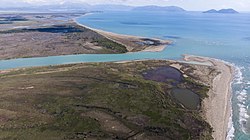
The river arises in the Pindus mountains of Epirus, Greece, and generally flows northwest. It enters Albania near Çarshovë, and empties into the Adriatic Sea just north of Vlorë. Generally wild and unpolluted, the river is surrounded by the Vikos–Aoös National Park in Greece, and the Vjosa-Narta Protected Landscape near its mouth. In December 2020, the Albanian portion of the river was designated a "Managed Nature Reserve" by the government. A campaign by the environmentalist groups to designate the whole Albanian part of the course a national park, to guard against the prospective hydroelectric projects, ultimately resulted in the creation of the Vjosa Wild River National Park on 15 March 2023.
The Vjosa is known by a number of different names. In antiquity it was called Aoös (Ἄωος, Ἀῶος, Ἀῷος) in Greek (e.g. in Eratosthenes' Geography), and Aous in Latin. In Albanian it is called Vjosë or Vjosa, while in Greece it is known by its ancient name (Αώος in modern orthography), in medieval Latin maps was called Viossa as well as Vovousa (Βοβούσα) or Aias (Αίας, Αἴας). In Greek it is also known as Βοϊούσα (Voioussa, pronounced vo-i-usa), especially in pre-20th century texts. According to historian Ap. Vakalopoulos (1977) the name Voioussa is the common Greek name of Aoos.
Vjosa is also a common female Albanian given name.
The river arises in the Pindus mountains of Epirus, Greece, near the village of Vovousa. An artificial lake has been constructed at an elevation of 1,350 metres (4,430 ft), where a hydroelectric dam has been in place since 1987. It flows through the canyons of Vikos–Aoös National Park, and then through the town of Konitsa, where it is joined by the Voidomatis. It enters Albania near Çarshovë, where it is joined by the Sarantaporos, and then continues northwest through Përmet, Këlcyrë, and Tepelenë (where it is joined by the Drino), Memaliaj, Selenicë and Novoselë. It then flows into the Adriatic Sea northwest of Vlorë. The river's mouth is located within the boundaries of the Vjosa-Narta Protected Landscape. In December 2020, the Albanian portion of the Vjosa was designated a "Managed Nature Reserve" by the government.
The main tributaries of Vjosa are the Sarantaporos and Voidomatis in Greece, and the Drino and Shushicë in Albania.
The main cities and towns along the river are, in downstream order, Vovousa and Konitsa in Greece; and Çarshovë, Përmet, Këlcyrë, Tepelenë, Memaliaj, Selenicë and Novoselë in Albania.
The valley of the Vjosa has provided one of the most important natural routes between the mountainous interior of Epirus into southern Illyria and towards the Adriatic Sea. This natural route must have been used for millennia, and continues to be used to the present day. Hecataeus (550–476 BC) refers to the river as Aias (Ancient Greek: Αἴας), the name Anios (Ἄνιος) is used by Plutarch in Caesar, while Polybius, Livy and Strabo use the term Aoös.
Vjosa
The Vjosa (Albanian: [ˈvjɔsa]; indefinite form: Vjosë) or Aoös (Greek: Αώος) is a river in northwestern Greece and southwestern Albania. Its total length is about 272 kilometres (169 mi), of which the first 80 kilometres (50 mi) are in Greece, and the remaining 192 kilometres (119 mi) in Albania. Its drainage basin is 6,706 km2 (2,589 sq mi) and its average discharge is 195 m3/s (6,900 cu ft/s). The main tributaries are Voidomatis, Sarantaporos, Drino and Shushicë.
The river arises in the Pindus mountains of Epirus, Greece, and generally flows northwest. It enters Albania near Çarshovë, and empties into the Adriatic Sea just north of Vlorë. Generally wild and unpolluted, the river is surrounded by the Vikos–Aoös National Park in Greece, and the Vjosa-Narta Protected Landscape near its mouth. In December 2020, the Albanian portion of the river was designated a "Managed Nature Reserve" by the government. A campaign by the environmentalist groups to designate the whole Albanian part of the course a national park, to guard against the prospective hydroelectric projects, ultimately resulted in the creation of the Vjosa Wild River National Park on 15 March 2023.
The Vjosa is known by a number of different names. In antiquity it was called Aoös (Ἄωος, Ἀῶος, Ἀῷος) in Greek (e.g. in Eratosthenes' Geography), and Aous in Latin. In Albanian it is called Vjosë or Vjosa, while in Greece it is known by its ancient name (Αώος in modern orthography), in medieval Latin maps was called Viossa as well as Vovousa (Βοβούσα) or Aias (Αίας, Αἴας). In Greek it is also known as Βοϊούσα (Voioussa, pronounced vo-i-usa), especially in pre-20th century texts. According to historian Ap. Vakalopoulos (1977) the name Voioussa is the common Greek name of Aoos.
Vjosa is also a common female Albanian given name.
The river arises in the Pindus mountains of Epirus, Greece, near the village of Vovousa. An artificial lake has been constructed at an elevation of 1,350 metres (4,430 ft), where a hydroelectric dam has been in place since 1987. It flows through the canyons of Vikos–Aoös National Park, and then through the town of Konitsa, where it is joined by the Voidomatis. It enters Albania near Çarshovë, where it is joined by the Sarantaporos, and then continues northwest through Përmet, Këlcyrë, and Tepelenë (where it is joined by the Drino), Memaliaj, Selenicë and Novoselë. It then flows into the Adriatic Sea northwest of Vlorë. The river's mouth is located within the boundaries of the Vjosa-Narta Protected Landscape. In December 2020, the Albanian portion of the Vjosa was designated a "Managed Nature Reserve" by the government.
The main tributaries of Vjosa are the Sarantaporos and Voidomatis in Greece, and the Drino and Shushicë in Albania.
The main cities and towns along the river are, in downstream order, Vovousa and Konitsa in Greece; and Çarshovë, Përmet, Këlcyrë, Tepelenë, Memaliaj, Selenicë and Novoselë in Albania.
The valley of the Vjosa has provided one of the most important natural routes between the mountainous interior of Epirus into southern Illyria and towards the Adriatic Sea. This natural route must have been used for millennia, and continues to be used to the present day. Hecataeus (550–476 BC) refers to the river as Aias (Ancient Greek: Αἴας), the name Anios (Ἄνιος) is used by Plutarch in Caesar, while Polybius, Livy and Strabo use the term Aoös.
Recent media
Recent media