Hubbry Logo
ApochromatApochromatMain
Open search
Apochromat
Community hub
Apochromat
logo
8 pages, 0 posts
0 subscribers
Be the first to start a discussion here.
Apochromat
Apochromat
from Wikipedia
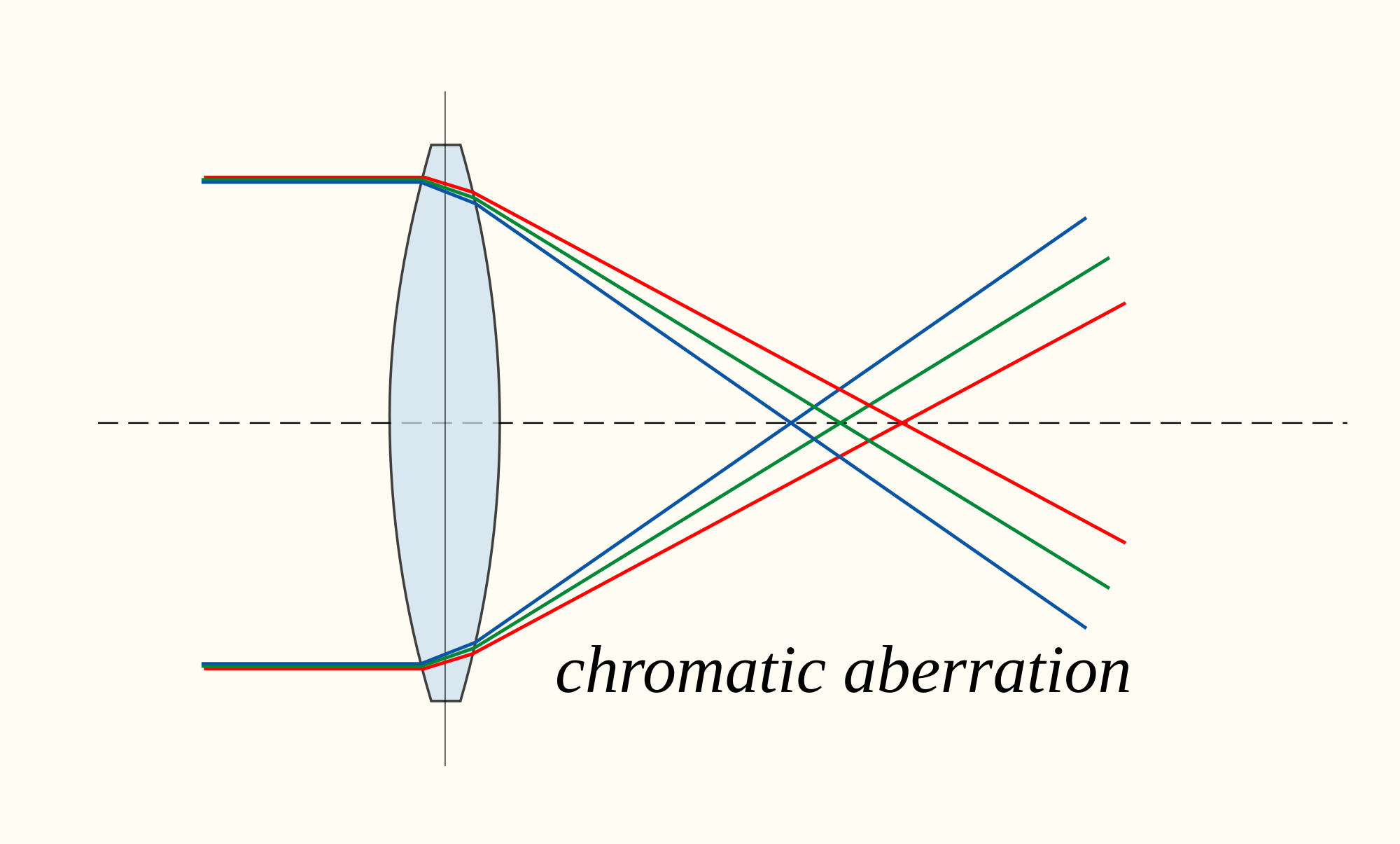
Chromatic aberration of a single lens causes different wavelengths of light to have differing focal lengths.

An apochromat, or apochromatic lens (apo), is a photographic or other lens that has better correction of chromatic and spherical aberration than the much more common achromat lenses.

The prefix apo- comes from the Greek preposition ἀπό-, meaning free from or away from.

Explanation

[edit]

Chromatic aberration is the phenomenon of different colors focusing at different distances from a lens. In photography, chromatic aberration produces soft overall images, and color fringing at high-contrast edges, like an edge between black and white. Astronomers face similar problems, particularly with telescopes that use lenses rather than mirrors. Achromatic lenses are corrected to bring two wavelengths into focus in the same plane – typically red (~0.590 μm) and blue (~0.495 μm). Apochromatic lenses are designed to bring three colors into focus in the same plane – typically red (~0.620 μm), green (~0.530 μm), and blue (~0.465 μm).[1] The residual color error (secondary spectrum) can be up to an order of magnitude less than for an achromatic lens of equivalent aperture and focal length. Apochromats are also corrected for spherical aberration at two wavelengths, rather than one as in an achromat.

Apochromatic lens brings three colors to a common focal plane. Notice that this lens is designed for astronomy, not viewing, since one of the wavelengths (~0.780 μm) is in the near infrared, outside the visible spectrum.

Telescope objective lenses for wide-band digital imaging in astronomy must have apochromatic correction, as the optical sensitivity of typical CCD imaging arrays can extend from the ultraviolet through the visible spectrum and into the near infrared wavelength range. Apochromatic lenses for astrophotography in the 60–150 mm aperture range have been developed and marketed by several firms, with focal ratios ranging from f/5 to f/7. Focused and guided properly during the exposure, these apochromatic objectives are capable of producing the sharpest wide-field astrophotographs optically possible for the given aperture sizes.

Graphic arts process (copy) cameras generally use apochromatic lenses for sharpest possible imagery as well. Classically designed apochromatic process camera lenses generally have a maximum aperture limited to about f/9. More recently, higher-speed apochromatic lenses have been produced for medium format, digital and 35 mm cameras.

Apochromat lens.svg
The Apochromatic lens usually comprises three elements that bring light of three distinct colors to a common focus

Apochromatic designs require optical glasses with special dispersive properties to achieve three color crossings. This is usually achieved using costly fluoro-crown glasses, abnormal flint glasses, and even optically transparent liquids with highly unusual dispersive properties in the thin spaces between glass elements. The temperature dependence of glass and liquid index of refraction and dispersion must be accounted for during apochromat design to assure good optical performance over reasonable temperature ranges with only slight re-focusing. In some cases, apochromatic designs without anomalous dispersion glasses are possible.

Use in photography

[edit]

Independent tests can be used to demonstrate that the "APO" designation is used rather loosely by some photographic lens manufacturers to describe the color accuracy of their lenses, as comparable lenses have shown superior color accuracy even though they did not carry the "APO" designation.[2][3]

Also, when considering lens design, the "APO" designation is used more conservatively in astronomy-related optics (e.g. telescopes) and microscopy than in photography. For example, telescopes that are marked "APO" are specialized, fixed focal length lenses that are optimised for infinity-like distances whereas in photography, even certain relatively low-priced general-purpose zoom lenses are given the APO designation.[4]

Often, however, apochromatic lenses used in fine cameras are not termed apochromats, Instead, they may be simply called "fluorite lenses", based on the material with anomalous partial dispersion which allowed them to be apochromatic. Such lenses began to be available to photographers in 1969, with the Canon FL-F 300mm f/5.6 telephoto lens. Fluorite has some drawbacks, for example vulnerability to sudden changes in temperature, and thus attempts were made to use substitutes, such as fluorophosphate glasses, which ameliorate, but do not completely eliminate (as compared with ordinary glass) these drawbacks.

See also

[edit]
Focus error for four types of lens, over the visible and near infrared spectrum.

References

[edit]
Revisions and contributorsEdit on WikipediaRead on Wikipedia
from Grokipedia
An apochromat, also known as an apochromatic lens or objective, is an advanced optical system designed to correct for three wavelengths of light—typically red, green, and blue—focusing them at the same focal plane while also addressing for enhanced image flatness and resolution. This superior correction minimizes color fringing and secondary spectra across the visible range (approximately 400–700 nm), outperforming achromatic lenses, which align only two wavelengths and leave residual chromatic errors.

Design and Function

Apochromats achieve their performance through multi-element constructions, often or more complex assemblies, incorporating specialized glasses with varying dispersion properties, such as crown glass, , and low-dispersion materials like or fluor-crown. Numerical optimization determines the precise lens curvatures, thicknesses, and spacings to nullify axial and transverse chromatic aberrations at the target wavelengths, enabling wider apertures and higher numerical apertures (NA) without compromising sharpness. Variants like plan-apochromats further correct field curvature for flat-field imaging, while super-apochromats extend correction to four wavelengths for even broader performance.

Historical Development

The apochromat originated in the late 19th century through collaborations at , where physicist and chemist developed novel optical glasses, including and fluoro-crown types, to enable three-color correction. Abbe presented the first apochromatic microscope objectives in 1886, marking a breakthrough that surpassed earlier achromats invented in the and revolutionized high-magnification imaging by reducing aberrations that limited resolution. Subsequent advancements in the early , such as Albert König's triplet designs around 1900, extended apochromats to astronomical telescopes, with further innovations like triplets in the 1980s enhancing applications in and .

Applications and Significance

In , apochromats are essential for oil-immersion objectives with high NA (up to 1.4), providing critical detail in biological and materials samples, as seen in systems like confocal Raman setups. Astronomical refractors employ apochromatic triplets for color-true views of celestial objects, suppressing false hues and enabling larger apertures for faint-object detection. In , especially digital formats, apochromats in premium lenses (e.g., telephoto designs) deliver exceptional sharpness and minimal fringing on sensors, with their value amplified by the Bayer filter's sensitivity to color errors. Overall, apochromats remain a cornerstone of precision , balancing complexity and cost for applications demanding ultimate fidelity in color and contrast.

Definition and Optical Principles

Definition

An apochromat, or apochromatic lens, is an optical lens or lens engineered to bring three distinct wavelengths of —typically in the , , and regions of the , such as approximately 0.620 μm, 0.530 μm, and 0.465 μm—to the same focal plane, thereby minimizing far more effectively than conventional achromatic lenses. This design addresses the failure of simpler lenses to focus all colors precisely, where shorter wavelengths (like ) tend to converge closer to the lens than longer ones (like ). The basic functionality of an apochromat lies in its compensation for the dispersion of refractive indices across the , ensuring that light rays of these selected wavelengths converge at a single point to produce sharper images with significantly reduced color fringing and improved contrast. By achieving this level of correction, apochromats deliver superior optical performance for applications requiring high-fidelity color reproduction, outperforming achromats that only align two wavelengths. , the primary optical flaw targeted, causes blurred edges and false color artifacts in uncorrected systems. The term "apochromat" originates from the Greek roots "apo," meaning away from or free from, and "chroma," meaning color, signifying a lens that eliminates color-related optical errors.

Chromatic and Spherical Aberration Correction

Chromatic aberration arises from the dispersion of light in optical materials, where different wavelengths refract at varying angles due to their differing speeds in the medium, resulting in focal shifts for colors across the spectrum. In apochromats, this is addressed by correcting for three specific wavelengths—typically the blue F-line (486 nm), yellow d-line (589 nm), and red C-line (656 nm)—eliminating both primary and secondary spectrum errors that plague simpler achromatic designs. This multi-wavelength correction ensures that red, green, and blue light converge to a common focal point, substantially reducing color fringing and blur in images. Spherical aberration in lenses stems from a mismatch in curvature between the lens surfaces and the ideal spherical of incoming , causing peripheral rays to focus at different points than paraxial (central) rays, which degrades sharpness and contrast, particularly off-axis. Apochromats minimize this simultaneously with chromatic corrections through careful balancing of lens elements, achieving a flatter field of focus and enabling high-resolution without the spherical blur common in uncorrected or achromatic systems. The correction mechanism relies on the differential dispersion properties of types, quantified by the νd=nd1nFnC\nu_d = \frac{n_d - 1}{n_F - n_C}, where ndn_d, nFn_F, and nCn_C are the refractive indices at the d-line (), F-line (), and C-line (), respectively. By combining elements with high Abbe numbers (low-dispersion crown glasses) and low Abbe numbers (high-dispersion flint glasses), designers balance the powers to achieve zero longitudinal for the three target wavelengths, while also optimizing shapes to counter spherical effects. Quantitatively, apochromats reduce the residual secondary spectrum to approximately 1/10th that of comparable achromats, allowing sharp focus within about 0.1% of the across the , which is critical for applications demanding precise color fidelity and resolution.

Historical Development

Origins and Invention

The concept of the apochromat emerged in the late as an advancement over achromatic lenses, which had been developed in the to address but still suffered from residual color fringing due to correction for only two wavelengths. Chester More Hall conceived the achromatic doublet around 1729 by combining and elements, though he did not publicize it, while John Dollond independently patented the design in 1758 after verifying its principles experimentally. These early achromats improved and performance by minimizing dispersion, yet limitations in dispersion properties highlighted the need for correction across three or more wavelengths, particularly in high-magnification where chromatic errors distorted fine details. The term "apochromat" emerged in the late to describe lenses achieving superior chromatic correction beyond achromats. Building on theoretical and new glass formulations, , a physicist at , collaborated with chemist , who founded a glassworks in to produce specialized optical glasses with tailored refractive indices and dispersion characteristics. This partnership addressed the achromat's shortcomings by enabling designs that corrected for primary and secondary color spectra simultaneously. The key invention occurred in 1886 when Zeiss introduced the first practical apochromatic microscope objectives, calculated by Abbe to correct chromatic and spherical aberrations for three wavelengths—typically in the red, green, and blue regions—using combinations of , flint, and elements. These objectives incorporated natural (), which Abbe had begun experimenting with around 1881 for its unique low-dispersion properties that complemented Schott's new glass types, allowing unprecedented image clarity at high magnifications. Early adoption extended to photographic lenses in the early , with firms like C.P. Goerz adapting apochromatic principles for camera objectives to achieve sharper, color-fringe-free images on panchromatic plates around 1904. However, widespread use was initially constrained by the scarcity and fragility of high-quality crystals and the limited variety of optical glasses available, restricting production to specialized applications until further refinements in material sourcing.

Advancements in Materials and Design

In the late , a major material breakthrough occurred with the introduction of artificially grown () elements in apochromat lenses, enabling superior low-dispersion correction and reduced chromatic aberrations compared to traditional glasses. Canon pioneered this in 1969 with the FL-F 300mm f/5.6 , the first production interchangeable-lens camera optic to incorporate artificially grown fluorite crystals for enhanced contrast and color fidelity. Building on this, Nikon introduced extra-low dispersion (ED) glass in 1971 with the Nikkor-H 300mm f/2.8 ED lens, marking the world's first photographic application of this material to effectively correct secondary spectrum chromatic aberrations. During the 1970s and 1980s, both Nikon and Canon expanded the use of ED glasses—often based on fluorophosphate compositions—alongside in their apochromat designs, allowing for broader spectral correction and improved performance in telephoto and macro lenses. Apochromat designs evolved significantly throughout the , transitioning from simple three-element symmetric configurations, akin to early Cooke triplets adapted for , to complex multi-element asymmetric arrangements that better managed off-axis aberrations and wider fields of view. This shift enabled higher numerical apertures and reduced overall lens size while maintaining apochromatic correction across the . In the 21st century, the integration of aspheric surfaces into apochromat lenses has further refined performance by minimizing spherical aberrations and allowing fewer elements for compact designs, as seen in modern high-resolution optics. Diffractive optics have also been incorporated into hybrid refractive-diffractive apochromats, providing extended chromatic correction over broad wavelengths; for instance, 3D-printed prototypes since 2021 demonstrate aberration-free imaging from blue to red light using combined refractive and diffractive elements. More recently, in 2023, advancements extended apochromatic principles to X-ray focusing optics, enabling applications in broader spectral ranges beyond the visible. These advancements address limitations in traditional glass-based systems, particularly for demanding applications requiring thermal stability. To mitigate focal length shifts due to in environments, contemporary apochromat designs employ athermalization techniques, such as matched coefficients of across multiple glass types, ensuring consistent performance across temperature variations. Key milestones include the refinement of oil-immersion apochromats for in the 1970s, exemplified by a 1975 patent for a high-numerical-aperture objective correcting three wavelengths in oil media. In astronomy, the 1990s saw the proliferation of apochromatic refractors paired with dedicated APO teleconverters, enhancing magnification while preserving in amateur and professional setups.

Design and Construction

Lens Configurations

Apochromat lenses typically employ triplet configurations consisting of three air-spaced or cemented elements arranged as two outer convex positive lenses made from crown glass flanking a central concave negative lens of , with the elements often bent to achieve symmetrical power distribution that minimizes off-axis aberrations. This design corrects for three wavelengths while addressing through balanced curvatures, as seen in early photographic objectives like the Taylor-type triplet modification. For applications requiring a flat image field, such as in , Petzval-type configurations use a quadruplet arrangement with two separated positive doublets, where the rear group acts as a field flattener to reduce Petzval and ensure even focus across the frame. In advanced telephoto apochromats, configurations often integrate a -based doublet—comprising a convex fluorite element paired with a concave crown glass element—for primary chromatic correction, combined with extra-low dispersion (ED) glass singlets to further suppress secondary in longer focal lengths. Geometric features enhance performance by incorporating aspheric surfaces on one or more elements to reduce without increasing element count, allowing compact designs with high numerical apertures. For wide-angle apochromats, retrofocus architectures invert the telephoto principle, positioning a diverging front group ahead of the converging rear to extend the back focal distance sufficiently for clearance while preserving aberration control. These configurations typically operate at f-numbers between f/4 and f/8 for optimal aberration balance, where correction is most effective without excessive light loss. Field curvature is controlled through symmetric bending and field-flattening elements, ensuring sharp focus across the image plane in corrected systems.

Materials and Manufacturing

Apochromatic lenses primarily utilize materials with exceptionally low chromatic dispersion to achieve correction for three wavelengths, typically incorporating fluorite (calcium fluoride, CaF₂) as a key element due to its high Abbe number exceeding 95, which minimizes color fringing. Fluorite's partial dispersion properties enable superior aberration control compared to standard crown glasses, making it ideal for the positive elements in multi-lens designs. Complementing fluorite are fluorophosphate glasses, such as those in Ohara's S-FPL series (e.g., S-FPL53 with Vd ≈ 94.9), which offer similar low-dispersion characteristics while providing greater mechanical durability for integration into complex assemblies. To balance the dispersion and correct secondary spectrum, anomalous partial dispersion glasses like dense flints (SF series) are employed, featuring low Abbe numbers (e.g., N-SF66 with Vd = 20.88) that counteract residual color errors when paired with low-dispersion crowns. Manufacturing apochromats involves precision grinding and , particularly challenging for due to its softness (Mohs hardness ≈ 4) and proneness to subsurface defects like scratches or inclusions during processing. Specialized techniques, such as followed by controlled with non-aqueous slurries, are required to achieve surface figure errors below λ/10 while avoiding deliquescence or thermal cracking. Anti-reflective coatings are applied via (e.g., ion-assisted e-beam ) to reduce flare and enhance transmission across the , with multilayer dielectric stacks tailored for the lens materials' refractive indices. Multi-element assemblies demand tight alignment tolerances, often below 1 arcminute for decentration and tilt, to preserve the corrected optical performance and prevent induced aberrations. Key challenges include fluorite's high material cost—approximately 7-10 times that of standard optical glass like N-BK7 due to the complex process required for optical-grade purity—and its sensitivity to mismatches (CTE ≈ 18.5 × 10⁻⁶/K versus ≈8.3 × 10⁻⁶/K for ), which can induce stress in cemented elements. These are mitigated through hybrid designs combining glass-fluorite bonds with low-stress adhesives or air-spaced configurations to accommodate differential expansion. Since the 2000s, computer numerical control (CNC) machining has enabled efficient production of aspheric surfaces in these materials, reducing reliance on labor-intensive hand figuring and improving reproducibility for high-volume applications. Since the , precision molding and advanced coatings have further enhanced manufacturability, allowing for more cost-effective production of complex apochromatic elements. Overall, apochromats cost 2-5 times more than equivalent achromats, driven by the need for 99.9% material homogeneity ( variation ≤5 ppm over the ) to avoid distortions in low-dispersion elements, alongside stringent fabrication yields. Configurations incorporating these materials, such as triplet designs with central elements, further amplify production complexity but yield unmatched color fidelity.

Applications

In Photography

Apochromatic lenses play a crucial role in by providing superior edge-to-edge sharpness and color fidelity, particularly in telephoto and macro applications where chromatic aberrations can otherwise degrade image quality. These lenses correct for color fringing across three wavelengths, ensuring that high-megapixel sensors capture precise details without unwanted or halos, making them essential for professional portraiture and . In backlit scenes, apochromats reduce and maintain contrast, allowing photographers to achieve natural color reproduction with minimal reliance on post-processing corrections. A notable historical example is Canon's FL-F 300mm f/5.6 lens, introduced in 1969 as the world's first consumer incorporating artificial crystals for apochromatic correction. This design used two elements to minimize chromatic aberrations, delivering high contrast and resolution for super-telephoto imaging. A modern counterpart is Leica's APO-Summicron-M 50mm f/2 ASPH, released in 2012, which employs specially formulated anomalous partial dispersion glass to achieve apochromatic correction, reducing aberrations to negligible levels suitable for digital sensors and ensuring over 50% contrast across the frame even at wide apertures. The advantages of apochromats in include enhanced compatibility with high-resolution cameras, where their inherent precision minimizes the need for software-based aberration fixes, preserving subtle tonal gradations in portraits and expansive landscapes. They excel in scenarios demanding color accuracy, such as macro work, by focusing , , and blue light at the same plane, resulting in sharper images with faithful hues. However, these lenses are often bulkier and more expensive due to the complex use of low-dispersion materials like or ED glass, which increases costs and size, particularly challenging for wide-angle designs. Additionally, the "APO" designation is sometimes applied loosely in marketing for zoom lenses, where full apochromatic performance may not be achieved across the entire range, leading to potential overstatement of benefits.

In Microscopy and Astronomy

In microscopy, apochromat objectives are essential for high-resolution imaging of biological samples, particularly in oil-immersion configurations such as 100x with a (NA) of 1.4, which correct chromatic aberrations across the UV-visible spectrum to enable precise observations. These objectives minimize color fringing and spherical aberrations, allowing sub-micron resolution—down to approximately 0.2 μm—for detailed visualization of cellular structures in techniques like . The Zeiss Plan-Apochromat series, featuring models like the 63x/1.4 oil-immersion objective, supports 3D confocal imaging with high contrast and flat fields, making it ideal for applications where image brightness scales with the fourth power of NA. Nikon CFI Apochromat objectives, introduced in the , further advance this field with models like the 100x/1.45 oil-immersion variant, achieving high transmission from UV to near-IR wavelengths for multi-color live-cell . These designs provide unmatched chromatic correction and resolution, facilitating the study of dynamic biological processes without significant from longer-wavelength dyes. In astronomy, apochromat refractor telescopes with apertures of 60-150 mm and focal ratios of f/5 to f/7 are prized for wide-field , where they minimize chromatic errors in broadband CCD imaging of galaxies and nebulae. The FSQ series, such as the FSQ-106N model with a 106 mm at f/5, employs a quadruplet design incorporating elements to deliver a flat focus across 400-700 nm, ensuring sharp, color-accurate images over large fields. This configuration corrects for and , producing coma-free fields that integrate seamlessly with modern digital sensors for high-contrast captures of extended celestial objects.

Comparisons

With Achromatic Lenses

Achromatic lenses correct for two wavelengths, typically in the and regions of the , using a simple crown-flint glass doublet that brings those colors to a common focus while leaving a residual secondary . This secondary spectrum results in a focal shift of approximately 1/20th of the primary chromatic difference across the spectrum, leading to noticeable color fringing and reduced sharpness in images, particularly at higher magnifications or wider apertures. In contrast, apochromatic lenses achieve correction for three wavelengths—, , and —substantially minimizing the secondary spectrum to about 1/200th of the focal shift seen in achromats, thereby providing crisper focus and superior color across the visible range. Performance-wise, achromatic lenses perform adequately at apertures of f/8 or slower, where the reduced rays limit the of residual aberrations, making them suitable for many standard tasks. Apochromats, however, excel in demanding scenarios at faster apertures like f/2.8 to f/5.6, where they maintain minimal color shift on modern digital sensors, ensuring high-resolution with negligible fringing even under bright, high-contrast conditions. The increased complexity of apochromats stems from their use of at least three lens elements, incorporating exotic low-dispersion glasses such as extra-low dispersion (ED) or materials, compared to the two-element design of achromats. This design elevates costs by a factor of 2 to 3 times, reflecting the precision required for multi-element alignment and specialized glass production. Consequently, achromats find broad application in general where cost-effectiveness is prioritized, while apochromats are reserved for color-critical fields like high-end , , and professional demanding utmost clarity.

With Other Advanced Lenses

Apochromatic lenses differ from super-apochromats, which achieve chromatic correction across four or more wavelengths, often extending from ultraviolet to infrared regions, enabling broader spectral performance in applications like advanced microscopy. Super-apochromats typically employ more complex designs, such as triplets or combinations of multiple elements with specialized glasses and liquids, or diffractive surfaces to minimize secondary spectrum beyond the three primary visible wavelengths corrected by apochromats. While apochromats suffice for visible-light imaging at lower cost, super-apochromats demand higher material and fabrication expenses due to their extended correction. In comparison to fluorite singlets or extra-low dispersion (ED) elements, apochromats integrate these materials strategically to balance chromatic correction. , or , offers superior dispersion control over ED glass, reducing more effectively in singlets. Apochromats often pair with ED elements or crown/flint glasses to achieve apochromatic performance, providing robust correction for visible spectra in triplet configurations. Emerging variants include planar apochromats, which enhance over standard curved-field apochromats, ensuring uniform sharpness across the image plane for and . These designs, such as Nikon's CFI Plan Apochromat objectives, maintain apochromatic color fidelity while minimizing field curvature for larger sensor formats. Diffractive apochromat hybrids, like Canon's multi-layer diffractive optics (DO) introduced in the early , combine refractive elements with diffractive surfaces to shrink lens size and weight while approximating apochromatic correction, though they risk increased without advanced coatings. Overall, apochromats an optimal balance for visible-spectrum correction at moderate complexity and , whereas super-apochromats and specialized hybrids extend capabilities at the expense of greater design intricacy and potential artifacts like .

References

Add your contribution
Related Hubs
User Avatar
No comments yet.