
Recent from talks
Apocynaceae
Knowledge base stats:
Talk channels stats:
Members stats:
Apocynaceae
Apocynaceae (/əˌpɑːsəˈneɪsiˌaɪ, -siːˌiː/, from Apocynum, Greek for "dog-away") is a family of flowering plants that includes trees, shrubs, herbs, stem succulents, and vines, commonly known as the dogbane family, because some taxa were used as dog poison.[when?] Notable members of the family include oleander, dogbanes, milkweeds, and periwinkles. The family is native to the European, Asian, African, Australian, and American tropics or subtropics, with some temperate members as well. The former family Asclepiadaceae (now known as Asclepiadoideae) is considered a subfamily of Apocynaceae and contains 348 genera. A list of Apocynaceae genera may be found here.
Many species are tall trees found in tropical forests, but some grow in tropical dry (xeric) environments. Also perennial herbs from temperate zones occur. Many of these plants have milky latex, and many species are poisonous if ingested, the family being rich in genera containing alkaloids and cardiac glycosides, those containing the latter often finding use as arrow poisons. Some genera of Apocynaceae, such as Adenium, bleed clear sap without latex when damaged, and others, such as Pachypodium, have milky latex apart from their sap.
The dogbane/milkweed family includes annual plants, perennial herbs, stem succulents, woody shrubs, trees, or vines. Most exude a milky latex when cut.
Leaves are simple. They may appear one at a time (singly) with each occurrence on alternating sides of the stem, but usually occur in pairs (and rarely in whorls). When paired, they occur on opposite sides of the stem (opposite), with each pair occurring at an angle rotated 90° to the pair below it (decussate).
There is no stipule (a small leaf-like structure at the base of the leaf stem), or stipules are small and sometimes finger-like.
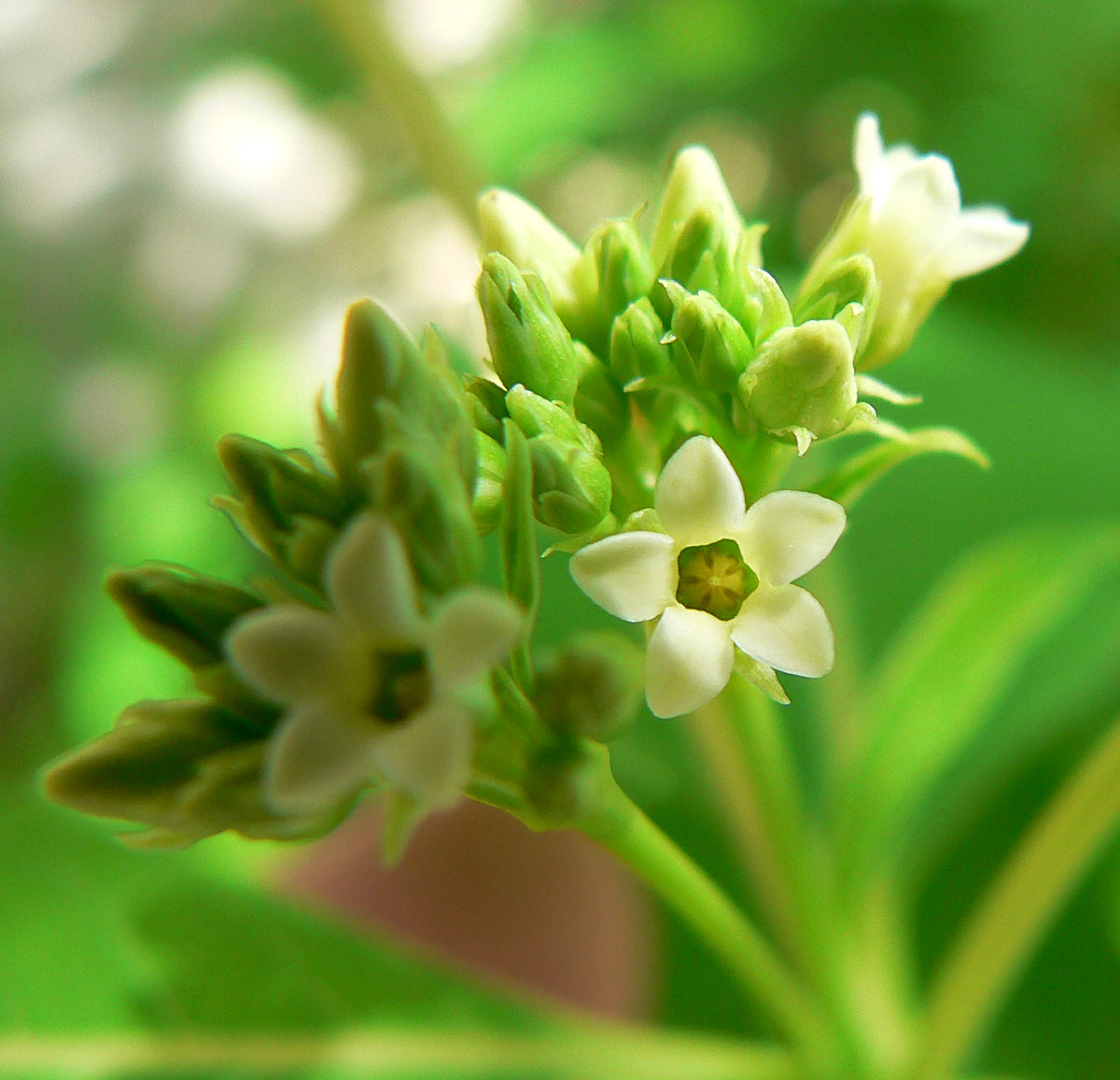
Flowers have radial symmetry (actinomorphic), and are borne in heads that are cymes or racemes, or are solitary in axils. They are perfect (bisexual), with a synsepalous, five-lobed calyx united into a tube at the base. Inflorescences are terminal or axillary. Five petals are united into a tube with four or five epipetalous stamens. The style head is swollen. The pollen is transported in foam. The ovary is usually superior, bicarpellary, and apocarpous, with a common fused style and stigma. (Fig. 5. and Fig.6. in the illustration of Rhigospira quadrangularis show a typical tripartite style which divides into three zones (specialised for pollen deposition, viscin secretion, and the reception of pollen).
The fruit is a drupe, a berry, a capsule, or a (frequently paired) follicle. The seeds are often winged or have appendages of long silky hairs.
As of 2012, the family was described as comprising some 5,100 species, in five subfamilies:
Hub AI
Apocynaceae AI simulator
(@Apocynaceae_simulator)
Apocynaceae
Apocynaceae (/əˌpɑːsəˈneɪsiˌaɪ, -siːˌiː/, from Apocynum, Greek for "dog-away") is a family of flowering plants that includes trees, shrubs, herbs, stem succulents, and vines, commonly known as the dogbane family, because some taxa were used as dog poison.[when?] Notable members of the family include oleander, dogbanes, milkweeds, and periwinkles. The family is native to the European, Asian, African, Australian, and American tropics or subtropics, with some temperate members as well. The former family Asclepiadaceae (now known as Asclepiadoideae) is considered a subfamily of Apocynaceae and contains 348 genera. A list of Apocynaceae genera may be found here.
Many species are tall trees found in tropical forests, but some grow in tropical dry (xeric) environments. Also perennial herbs from temperate zones occur. Many of these plants have milky latex, and many species are poisonous if ingested, the family being rich in genera containing alkaloids and cardiac glycosides, those containing the latter often finding use as arrow poisons. Some genera of Apocynaceae, such as Adenium, bleed clear sap without latex when damaged, and others, such as Pachypodium, have milky latex apart from their sap.
The dogbane/milkweed family includes annual plants, perennial herbs, stem succulents, woody shrubs, trees, or vines. Most exude a milky latex when cut.
Leaves are simple. They may appear one at a time (singly) with each occurrence on alternating sides of the stem, but usually occur in pairs (and rarely in whorls). When paired, they occur on opposite sides of the stem (opposite), with each pair occurring at an angle rotated 90° to the pair below it (decussate).
There is no stipule (a small leaf-like structure at the base of the leaf stem), or stipules are small and sometimes finger-like.
Flowers have radial symmetry (actinomorphic), and are borne in heads that are cymes or racemes, or are solitary in axils. They are perfect (bisexual), with a synsepalous, five-lobed calyx united into a tube at the base. Inflorescences are terminal or axillary. Five petals are united into a tube with four or five epipetalous stamens. The style head is swollen. The pollen is transported in foam. The ovary is usually superior, bicarpellary, and apocarpous, with a common fused style and stigma. (Fig. 5. and Fig.6. in the illustration of Rhigospira quadrangularis show a typical tripartite style which divides into three zones (specialised for pollen deposition, viscin secretion, and the reception of pollen).
The fruit is a drupe, a berry, a capsule, or a (frequently paired) follicle. The seeds are often winged or have appendages of long silky hairs.
As of 2012, the family was described as comprising some 5,100 species, in five subfamilies:
Recent media