
Recent from talks
Apollodotus I
Knowledge base stats:
Talk channels stats:
Members stats:
Apollodotus I
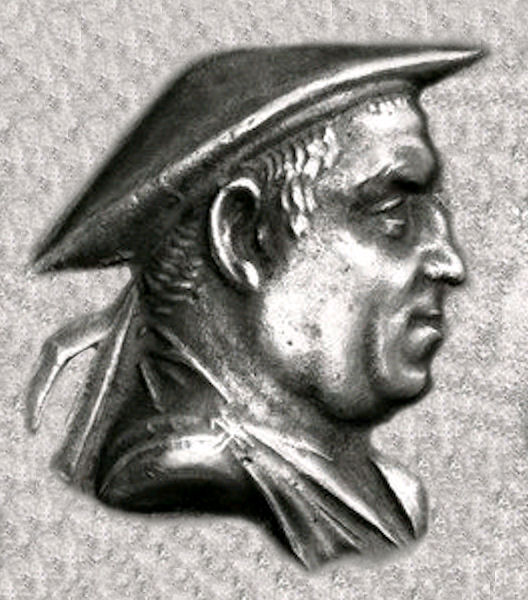
Apollodotus I (Greek: Ἀπολλόδοτος Α΄ ὁ Σωτήρ, Apollódotos ho Sōtḗr, "Apollodotus the Saviour"), known in Indian sources as Apaladata, was an Indo-Greek king from 180 BC to 160 BC, or between 174 and 165 BC (first dating by Osmund Bopearachchi and R. C. Senior, second dating by Boperachchi) who ruled the western and southern parts of the Indo-Greek kingdom, from Taxila in the Punjab region to the areas of Sindh and possibly Gujarat.
Apollodotus whose name means "given by Apollo", was not the first to strike bilingual coins outside Bactria, but he was the first king who ruled in India only, and therefore the founder of the proper Indo-Greek kingdom. According to W. W. Tarn, Apollodotus I was one of the generals of Demetrius I of Bactria, the Greco-Bactrian king who invaded northwestern India after 180 BC. Tarn was uncertain whether he was a member of the royal house. It is possible he was an illegitimate son of Euthydemus, making him Demetrius’ half brother. Later authors largely agree with Tarn's analysis, though with perhaps even more uncertainty regarding who the king was, for his coins do not give many hints.
Apollodotus likely ruled at the same time as Antimachus I and Antimachus II, or was succeeded in India by Antimachus II. It is also likely that king Antimachus II ruled the more western territories closer to Bactria. Eventually Apollodotus was succeeded by Menander I, and the two kings are mentioned by Pompejus Trogus as important Indo-Greek rulers.
The 1st-2nd century AD Periplus of the Erythraean Sea further testifies to the reign of Apollodotus and the influence of the Indo-Greeks in India:
"To the present day ancient drachmae are current in Barygaza, coming from this country, bearing inscriptions in Greek letters, and the devices of those who reigned after Alexander, Apollodorus [sic] and Menander."
— Periplus Chap. 47.
The coinage of Apollodotus is, together with that of Menander, one of the most abundant of the Indo-Greek kings. It is found mainly in the provinces of Punjab, Sindh and Gujarat, indicating the southern limit of the Indo-Greek expansion in India. This is also suggested by the Periplus, a 1st-century AD document on trade in the Indian Ocean, which describes the remnants of Greek presence (shrines, barracks, wells, coinage) in the strategic port of Barygaza (Bharuch) in Gujarat. Strabo (XI) also describes the occupation of Patalene (Indus Delta country). While Sindh may have come under his possession, it is not known whether Apollodotus advanced to Gujarat, where the Satavahanas ruled.
Apollodotus also issued a great number of bilingual Indian-standard square coins. Besides the usual royal title, the exact significance of the animals depicted on the coins is unclear. The sacred elephant may be the symbol of the city of Taxila, or possibly the symbol of the white elephant who reputedly entered the womb of the mother of the Buddha, Queen Maya, in a dream, which would make it a symbol of Buddhism, one of the main religions of the Indo-Greek territories.
Hub AI
Apollodotus I AI simulator
(@Apollodotus I_simulator)
Apollodotus I
Apollodotus I (Greek: Ἀπολλόδοτος Α΄ ὁ Σωτήρ, Apollódotos ho Sōtḗr, "Apollodotus the Saviour"), known in Indian sources as Apaladata, was an Indo-Greek king from 180 BC to 160 BC, or between 174 and 165 BC (first dating by Osmund Bopearachchi and R. C. Senior, second dating by Boperachchi) who ruled the western and southern parts of the Indo-Greek kingdom, from Taxila in the Punjab region to the areas of Sindh and possibly Gujarat.
Apollodotus whose name means "given by Apollo", was not the first to strike bilingual coins outside Bactria, but he was the first king who ruled in India only, and therefore the founder of the proper Indo-Greek kingdom. According to W. W. Tarn, Apollodotus I was one of the generals of Demetrius I of Bactria, the Greco-Bactrian king who invaded northwestern India after 180 BC. Tarn was uncertain whether he was a member of the royal house. It is possible he was an illegitimate son of Euthydemus, making him Demetrius’ half brother. Later authors largely agree with Tarn's analysis, though with perhaps even more uncertainty regarding who the king was, for his coins do not give many hints.
Apollodotus likely ruled at the same time as Antimachus I and Antimachus II, or was succeeded in India by Antimachus II. It is also likely that king Antimachus II ruled the more western territories closer to Bactria. Eventually Apollodotus was succeeded by Menander I, and the two kings are mentioned by Pompejus Trogus as important Indo-Greek rulers.
The 1st-2nd century AD Periplus of the Erythraean Sea further testifies to the reign of Apollodotus and the influence of the Indo-Greeks in India:
"To the present day ancient drachmae are current in Barygaza, coming from this country, bearing inscriptions in Greek letters, and the devices of those who reigned after Alexander, Apollodorus [sic] and Menander."
— Periplus Chap. 47.
The coinage of Apollodotus is, together with that of Menander, one of the most abundant of the Indo-Greek kings. It is found mainly in the provinces of Punjab, Sindh and Gujarat, indicating the southern limit of the Indo-Greek expansion in India. This is also suggested by the Periplus, a 1st-century AD document on trade in the Indian Ocean, which describes the remnants of Greek presence (shrines, barracks, wells, coinage) in the strategic port of Barygaza (Bharuch) in Gujarat. Strabo (XI) also describes the occupation of Patalene (Indus Delta country). While Sindh may have come under his possession, it is not known whether Apollodotus advanced to Gujarat, where the Satavahanas ruled.
Apollodotus also issued a great number of bilingual Indian-standard square coins. Besides the usual royal title, the exact significance of the animals depicted on the coins is unclear. The sacred elephant may be the symbol of the city of Taxila, or possibly the symbol of the white elephant who reputedly entered the womb of the mother of the Buddha, Queen Maya, in a dream, which would make it a symbol of Buddhism, one of the main religions of the Indo-Greek territories.
Recent media