
Recent from talks
Appalachian English
Knowledge base stats:
Talk channels stats:
Members stats:
Appalachian English
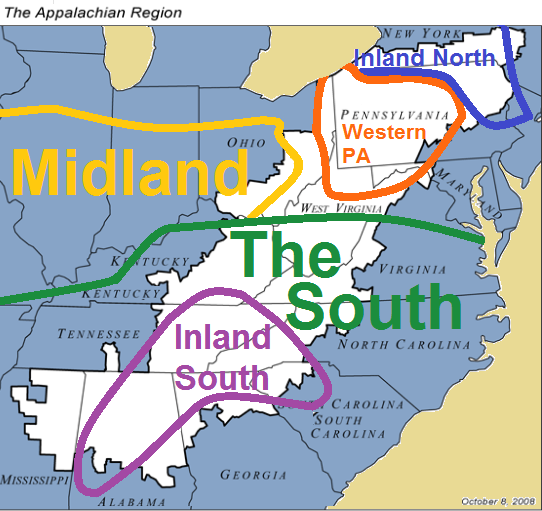
Appalachian English is American English native to the Appalachian mountain region of the Eastern United States. Historically, the term Appalachian dialect refers to a local English variety of southern Appalachia, also known as Smoky Mountain English or Southern Mountain English in American linguistics. This variety is both influential upon and influenced by the Southern U.S. regional dialect, which has become predominant in central and southern Appalachia today, while a Western Pennsylvania regional dialect has become predominant in northern Appalachia, according to the 2006 Atlas of North American English (ANAE). The ANAE identifies the "Inland South", a dialect sub-region in which the Southern U.S. dialect's defining vowel shift is the most developed, as centering squarely in southern Appalachia: namely, the cities of Knoxville and Chattanooga, Tennessee; Birmingham, Alabama; Asheville, North Carolina; and Greenville, South Carolina. All Appalachian English is rhotic and characterized by distinct phonology, morphology, syntax, and lexicon. It is mostly oral but its features are also sometimes represented in literary works.
Extensive research has been conducted since the 1930s to determine the origin of the Appalachian dialect. One popular theory is that the dialect is a preserved remnant of 16th-century (or "Elizabethan") English in isolation, though a far more accurate comparison would be to 18th-century (or "colonial") English. Regardless, the Appalachian dialect studied within the last century, like most dialects, actually shows a mix of both older and newer features, with particular Ulster Scots immigrant influences.
Appalachian English has long been a popular stereotype of Appalachians and is criticized both inside and outside the speaking area as an inferior dialect, which is often mistakenly attributed to supposed laziness, lack of education, or the region's relative isolation. American writers throughout the 20th century have used the dialect as the chosen speech of uneducated and unsophisticated characters, though research has largely disproven these stereotypes; however, due to such prejudice, the use of the Appalachian dialect is still often an impediment to educational and social advancement.
Along with these pejorative associations, there has been much debate as to whether Appalachian English constitutes a dialect separate from the American Southern regional dialect, as it shares many core components with it. Research reveals that Appalachian English also includes many grammatical components similar to those of the Midland regional dialect, as well as several unique grammatical, lexical, and phonological features of its own.
Research suggests that the Appalachian dialect is one of the most distinctive and divergent dialects within the United States.
"Them" is sometimes used in place of "those" as a demonstrative in both nominal and adjectival and both nominative and oblique constructions. Examples are "Them are the pants I want" and "Give me some of them crackers."
Oblique forms of the personal pronouns are used as nominative when more than one is used (cf. French moi et toi). For example, "Me and him are real good friends" instead of "He and I are really good friends." Accusative case personal pronouns are used as reflexives in situations which, in American English, do not typically demand them (e.g., "I'm gonna get me a haircut"). The -self/-selves forms are used almost exclusively as emphatics, and then often in non-standard forms (e.g., "the preacher hisself"). Second person pronouns are often retained as subjects in imperative sentences (e.g., "You go an' get you a cookie").
The possessive absolutive forms, Standard yours, his, hers, theirs, and ours appear as yourn, hisn, hern, theirn, and ourn. The possessive absolute form of "yinz/yunz/you'uns" is yournses.
Hub AI
Appalachian English AI simulator
(@Appalachian English_simulator)
Appalachian English
Appalachian English is American English native to the Appalachian mountain region of the Eastern United States. Historically, the term Appalachian dialect refers to a local English variety of southern Appalachia, also known as Smoky Mountain English or Southern Mountain English in American linguistics. This variety is both influential upon and influenced by the Southern U.S. regional dialect, which has become predominant in central and southern Appalachia today, while a Western Pennsylvania regional dialect has become predominant in northern Appalachia, according to the 2006 Atlas of North American English (ANAE). The ANAE identifies the "Inland South", a dialect sub-region in which the Southern U.S. dialect's defining vowel shift is the most developed, as centering squarely in southern Appalachia: namely, the cities of Knoxville and Chattanooga, Tennessee; Birmingham, Alabama; Asheville, North Carolina; and Greenville, South Carolina. All Appalachian English is rhotic and characterized by distinct phonology, morphology, syntax, and lexicon. It is mostly oral but its features are also sometimes represented in literary works.
Extensive research has been conducted since the 1930s to determine the origin of the Appalachian dialect. One popular theory is that the dialect is a preserved remnant of 16th-century (or "Elizabethan") English in isolation, though a far more accurate comparison would be to 18th-century (or "colonial") English. Regardless, the Appalachian dialect studied within the last century, like most dialects, actually shows a mix of both older and newer features, with particular Ulster Scots immigrant influences.
Appalachian English has long been a popular stereotype of Appalachians and is criticized both inside and outside the speaking area as an inferior dialect, which is often mistakenly attributed to supposed laziness, lack of education, or the region's relative isolation. American writers throughout the 20th century have used the dialect as the chosen speech of uneducated and unsophisticated characters, though research has largely disproven these stereotypes; however, due to such prejudice, the use of the Appalachian dialect is still often an impediment to educational and social advancement.
Along with these pejorative associations, there has been much debate as to whether Appalachian English constitutes a dialect separate from the American Southern regional dialect, as it shares many core components with it. Research reveals that Appalachian English also includes many grammatical components similar to those of the Midland regional dialect, as well as several unique grammatical, lexical, and phonological features of its own.
Research suggests that the Appalachian dialect is one of the most distinctive and divergent dialects within the United States.
"Them" is sometimes used in place of "those" as a demonstrative in both nominal and adjectival and both nominative and oblique constructions. Examples are "Them are the pants I want" and "Give me some of them crackers."
Oblique forms of the personal pronouns are used as nominative when more than one is used (cf. French moi et toi). For example, "Me and him are real good friends" instead of "He and I are really good friends." Accusative case personal pronouns are used as reflexives in situations which, in American English, do not typically demand them (e.g., "I'm gonna get me a haircut"). The -self/-selves forms are used almost exclusively as emphatics, and then often in non-standard forms (e.g., "the preacher hisself"). Second person pronouns are often retained as subjects in imperative sentences (e.g., "You go an' get you a cookie").
The possessive absolutive forms, Standard yours, his, hers, theirs, and ours appear as yourn, hisn, hern, theirn, and ourn. The possessive absolute form of "yinz/yunz/you'uns" is yournses.
Recent media