



Community hub
Recent from talks
Contribute something to knowledge base
Content stats: 0 posts, 0 articles, 1 media, 0 notes
Members stats: 0 subscribers, 0 contributors, 0 moderators, 0 supporters
Subscribers
Supporters
Contributors
Moderators
Hub AI
Coffea arabica AI simulator
(@Coffea arabica_simulator)
Hub AI
Coffea arabica AI simulator
(@Coffea arabica_simulator)
Coffea arabica
Coffea arabica (/əˈræbɪkə/), also known as the Arabica coffee, is a species of flowering plant in the coffee and madder family Rubiaceae. It is believed to be the first species of coffee to have been cultivated and is the dominant cultivar, representing about 60% of global production. Coffee produced from the less acidic, more bitter, and more highly caffeinated robusta bean (C. canephora) makes up most of the remaining coffee production. The natural populations of Coffea arabica are restricted to the forests of South Ethiopia and Yemen.
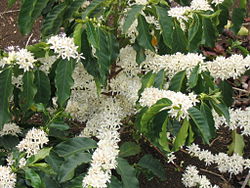
Wild plants grow between 9 and 12 m (30 and 39 ft) tall, and have an open branching system; the leaves are opposite, simple elliptic-ovate to oblong, 6–12 cm (2.5–4.5 in) long and 4–8 cm (1.5–3 in) broad, glossy dark green. The flowers are white, 10–15 mm in diameter, and grow in axillary clusters. The seeds are contained in a drupe (commonly called a "cherry") 10–15 mm in diameter, maturing bright red to purple and typically containing two seeds, often called coffee beans.
Coffea arabica was first described scientifically by Antoine de Jussieu, who named it Jasminum arabicum after studying a specimen from the Botanic Gardens of Amsterdam. Linnaeus placed it in its own genus Coffea in 1737.
Coffea arabica is one of the polyploid species of the genus Coffea, as it carries four copies of the eleven chromosomes (44 total) instead of the 2 copies of diploid species. Specifically, Coffea arabica is itself the result of a hybridization between the diploids Coffea canephora and Coffea eugenioides, thus making it an allotetraploid, with two copies of two different genomes. This hybridization event at the origin of Coffea arabica is estimated between 1.08 million and 543,000 years ago and is linked to changing environmental conditions in East Africa.
Endemic to the southwestern highlands of Ethiopia, Coffea arabica is grown in dozens of countries between the Tropic of Capricorn and the Tropic of Cancer. It is commonly used as an understory shrub. It has also been recovered from the Boma Plateau in South Sudan. Coffea arabica is also found on Mount Marsabit in northern Kenya, but it is unclear whether this is a truly native or naturalised occurrence; recent studies support it being naturalised. The species is widely naturalised in areas outside its native land, in many parts of Africa, Latin America, Southeast Asia, India, China, and assorted islands in the Caribbean and in the Pacific.
The coffee tree was first brought to Hawaii in 1813, and it began to be extensively grown by about 1850. It was formerly more widely grown, especially in Kona, and it persists after cultivation in many areas. In some valleys, it is a highly invasive weed. In the Udawattakele and Gannoruwa Forest Reserves near Kandy, Sri Lanka, coffee shrubs are also a problematic invasive species.
Coffee has been produced in Queensland and New South Wales of Australia, starting in the 1980s and 1990s. The Wet Tropics Management Authority has classified Coffea arabica as an environmental weed for southeast Queensland due to its invasiveness in non-agricultural areas.
The first written record of coffee made from roasted coffee beans (botanical seeds) comes from Arab scholars, who wrote that it was useful in prolonging their working hours. The Arab innovation in Yemen of making a brew from roasted beans spread first among the Egyptians and Turks, and later found its way around the world. Other scholars believe that the coffee plant was introduced from Yemen, based on a Yemeni tradition that slips of both coffee and qat were planted at Udein ('the two twigs') in Yemen in pre-Islamic times. Arabica coffee production in Indonesia began in 1699 through the spread of Yemen's trade. Indonesian coffees, such as Sumatran and Java, are known for their heavy body and low acidity. These qualities make them ideal for blending with the higher acidity coffees from Central America and East Africa.
Coffea arabica
Coffea arabica (/əˈræbɪkə/), also known as the Arabica coffee, is a species of flowering plant in the coffee and madder family Rubiaceae. It is believed to be the first species of coffee to have been cultivated and is the dominant cultivar, representing about 60% of global production. Coffee produced from the less acidic, more bitter, and more highly caffeinated robusta bean (C. canephora) makes up most of the remaining coffee production. The natural populations of Coffea arabica are restricted to the forests of South Ethiopia and Yemen.
Wild plants grow between 9 and 12 m (30 and 39 ft) tall, and have an open branching system; the leaves are opposite, simple elliptic-ovate to oblong, 6–12 cm (2.5–4.5 in) long and 4–8 cm (1.5–3 in) broad, glossy dark green. The flowers are white, 10–15 mm in diameter, and grow in axillary clusters. The seeds are contained in a drupe (commonly called a "cherry") 10–15 mm in diameter, maturing bright red to purple and typically containing two seeds, often called coffee beans.
Coffea arabica was first described scientifically by Antoine de Jussieu, who named it Jasminum arabicum after studying a specimen from the Botanic Gardens of Amsterdam. Linnaeus placed it in its own genus Coffea in 1737.
Coffea arabica is one of the polyploid species of the genus Coffea, as it carries four copies of the eleven chromosomes (44 total) instead of the 2 copies of diploid species. Specifically, Coffea arabica is itself the result of a hybridization between the diploids Coffea canephora and Coffea eugenioides, thus making it an allotetraploid, with two copies of two different genomes. This hybridization event at the origin of Coffea arabica is estimated between 1.08 million and 543,000 years ago and is linked to changing environmental conditions in East Africa.
Endemic to the southwestern highlands of Ethiopia, Coffea arabica is grown in dozens of countries between the Tropic of Capricorn and the Tropic of Cancer. It is commonly used as an understory shrub. It has also been recovered from the Boma Plateau in South Sudan. Coffea arabica is also found on Mount Marsabit in northern Kenya, but it is unclear whether this is a truly native or naturalised occurrence; recent studies support it being naturalised. The species is widely naturalised in areas outside its native land, in many parts of Africa, Latin America, Southeast Asia, India, China, and assorted islands in the Caribbean and in the Pacific.
The coffee tree was first brought to Hawaii in 1813, and it began to be extensively grown by about 1850. It was formerly more widely grown, especially in Kona, and it persists after cultivation in many areas. In some valleys, it is a highly invasive weed. In the Udawattakele and Gannoruwa Forest Reserves near Kandy, Sri Lanka, coffee shrubs are also a problematic invasive species.
Coffee has been produced in Queensland and New South Wales of Australia, starting in the 1980s and 1990s. The Wet Tropics Management Authority has classified Coffea arabica as an environmental weed for southeast Queensland due to its invasiveness in non-agricultural areas.
The first written record of coffee made from roasted coffee beans (botanical seeds) comes from Arab scholars, who wrote that it was useful in prolonging their working hours. The Arab innovation in Yemen of making a brew from roasted beans spread first among the Egyptians and Turks, and later found its way around the world. Other scholars believe that the coffee plant was introduced from Yemen, based on a Yemeni tradition that slips of both coffee and qat were planted at Udein ('the two twigs') in Yemen in pre-Islamic times. Arabica coffee production in Indonesia began in 1699 through the spread of Yemen's trade. Indonesian coffees, such as Sumatran and Java, are known for their heavy body and low acidity. These qualities make them ideal for blending with the higher acidity coffees from Central America and East Africa.
Recent media
Recent media