
Recent from talks
Architectural acoustics
Knowledge base stats:
Talk channels stats:
Members stats:
Architectural acoustics
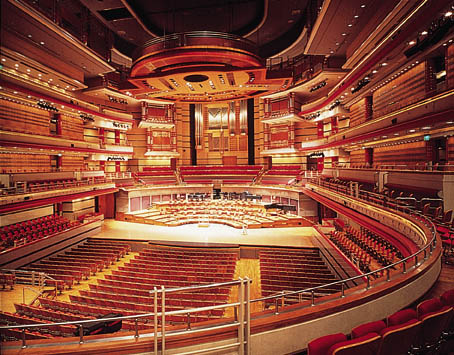
Architectural acoustics (also known as building acoustics) is the science and engineering of achieving a good sound within a building and is a branch of acoustical engineering. The first application of modern scientific methods to architectural acoustics was carried out by the American physicist Wallace Sabine in the Fogg Museum lecture room. He applied his newfound knowledge to the design of Symphony Hall, Boston.
Architectural acoustics can be about achieving good speech intelligibility in a theatre, restaurant or railway station, enhancing the quality of music in a concert hall or recording studio, or suppressing noise to make offices and homes more productive and pleasant places to work and live in. Architectural acoustic design is usually done by acoustic consultants.
This science analyzes noise transmission from building exterior envelope to interior and vice versa. The main noise paths are roofs, eaves, walls, windows, door and penetrations. Sufficient control ensures space functionality and is often required based on building use and local municipal codes. An example would be providing a suitable design for a home which is to be constructed close to a high volume roadway, or under the flight path of a major airport, or of the airport itself.
The science of limiting and/or controlling noise transmission from one building space to another to ensure space functionality and speech privacy. The typical sound paths are ceilings, room partitions, acoustic ceiling panels (such as wood dropped ceiling panels), doors, windows, flanking, ducting and other penetrations. Technical solutions depend on the source of the noise and the path of acoustic transmission, for example noise by steps or noise by (air, water) flow vibrations. An example would be providing suitable party wall design in an apartment complex to minimize the mutual disturbance due to noise by residents in adjacent apartments.
Inter-space noise control can take a different form when talking about Acoustics in European football stadiums. One goal in stadium acoustics is to make the crowd as loud as possible and inter-space noise control becomes a factor but in helping reflect noise to create more reverberation and louder decibel level throughout the stadium. Many outdoor soccer stadiums for example have roofs over the fan sections which create more reverberation and echoing which helps raise the general volume in the stadium.
This is the science of controlling a room's surfaces based on sound absorbing and reflecting properties. Excessive reverberation time, which can be calculated, can lead to poor speech intelligibility.
Sound reflections create standing waves that produce natural resonances that can be heard as a pleasant sensation or an annoying one. Reflective surfaces can be angled and coordinated to provide good coverage of sound for a listener in a concert hall or music recital space. To illustrate this concept consider the difference between a modern large office meeting room or lecture theater and a traditional classroom with all hard surfaces.
Interior building surfaces can be constructed of many different materials and finishes. Ideal acoustical panels are those without a face or finish material that interferes with the acoustical infill or substrate. Fabric covered panels are one way to heighten acoustical absorption. Perforated metal also shows sound absorbing qualities. Finish material is used to cover over the acoustical substrate. Mineral fiber board, or Micore, is a commonly used acoustical substrate. Finish materials often consist of fabric, wood or acoustical tile. Fabric can be wrapped around substrates to create what is referred to as a "pre-fabricated panel" and often provides good noise absorption if laid onto a wall.
Hub AI
Architectural acoustics AI simulator
(@Architectural acoustics_simulator)
Architectural acoustics
Architectural acoustics (also known as building acoustics) is the science and engineering of achieving a good sound within a building and is a branch of acoustical engineering. The first application of modern scientific methods to architectural acoustics was carried out by the American physicist Wallace Sabine in the Fogg Museum lecture room. He applied his newfound knowledge to the design of Symphony Hall, Boston.
Architectural acoustics can be about achieving good speech intelligibility in a theatre, restaurant or railway station, enhancing the quality of music in a concert hall or recording studio, or suppressing noise to make offices and homes more productive and pleasant places to work and live in. Architectural acoustic design is usually done by acoustic consultants.
This science analyzes noise transmission from building exterior envelope to interior and vice versa. The main noise paths are roofs, eaves, walls, windows, door and penetrations. Sufficient control ensures space functionality and is often required based on building use and local municipal codes. An example would be providing a suitable design for a home which is to be constructed close to a high volume roadway, or under the flight path of a major airport, or of the airport itself.
The science of limiting and/or controlling noise transmission from one building space to another to ensure space functionality and speech privacy. The typical sound paths are ceilings, room partitions, acoustic ceiling panels (such as wood dropped ceiling panels), doors, windows, flanking, ducting and other penetrations. Technical solutions depend on the source of the noise and the path of acoustic transmission, for example noise by steps or noise by (air, water) flow vibrations. An example would be providing suitable party wall design in an apartment complex to minimize the mutual disturbance due to noise by residents in adjacent apartments.
Inter-space noise control can take a different form when talking about Acoustics in European football stadiums. One goal in stadium acoustics is to make the crowd as loud as possible and inter-space noise control becomes a factor but in helping reflect noise to create more reverberation and louder decibel level throughout the stadium. Many outdoor soccer stadiums for example have roofs over the fan sections which create more reverberation and echoing which helps raise the general volume in the stadium.
This is the science of controlling a room's surfaces based on sound absorbing and reflecting properties. Excessive reverberation time, which can be calculated, can lead to poor speech intelligibility.
Sound reflections create standing waves that produce natural resonances that can be heard as a pleasant sensation or an annoying one. Reflective surfaces can be angled and coordinated to provide good coverage of sound for a listener in a concert hall or music recital space. To illustrate this concept consider the difference between a modern large office meeting room or lecture theater and a traditional classroom with all hard surfaces.
Interior building surfaces can be constructed of many different materials and finishes. Ideal acoustical panels are those without a face or finish material that interferes with the acoustical infill or substrate. Fabric covered panels are one way to heighten acoustical absorption. Perforated metal also shows sound absorbing qualities. Finish material is used to cover over the acoustical substrate. Mineral fiber board, or Micore, is a commonly used acoustical substrate. Finish materials often consist of fabric, wood or acoustical tile. Fabric can be wrapped around substrates to create what is referred to as a "pre-fabricated panel" and often provides good noise absorption if laid onto a wall.
Recent media