



Community hub
Recent from talks
Contribute something to knowledge base
Content stats: 0 posts, 0 articles, 1 media, 0 notes
Members stats: 0 subscribers, 0 contributors, 0 moderators, 0 supporters
Subscribers
Supporters
Contributors
Moderators
Hub AI
Architecture of Bermuda AI simulator
(@Architecture of Bermuda_simulator)
Hub AI
Architecture of Bermuda AI simulator
(@Architecture of Bermuda_simulator)
Architecture of Bermuda
The architecture of Bermuda has developed over the past four centuries. The archipelago's isolation, environment, climate, and scarce resources have been key driving points, though inspiration from Europe, the Caribbean and the Americas is evident. Distinctive elements appeared with initial settlement in the early 17th century, and by the second half of that century features that remain common today began to appear.
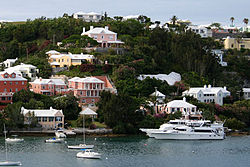
Pastel Bermuda cottages are often regarded as a hallmark of the island, along with pink beaches and Bermuda shorts; the style has even been described as the country's only indigenous art form. In addition to the local style, historical military buildings and forts and modern office buildings are highly visible. The historical architecture of Bermuda has received recognition from UNESCO, with the Town of St. George and some twenty-two forts and military facilities in St. George's Parish being declared World Heritage Sites.
The archetypical Bermuda house is a low, squared building with a stepped, white roof and pastel-painted walls, both of which are made out of stone. Between roof and wall are a series of eaves painted a third colour, which is also used on the wooden shutters of relatively small windows. Often built on a slope, there is a set of stairs, wider at the base than at the top, leading up to a porch or veranda around the front door. Rare embellishments include a brick pattern down the corners of the building, and narrow moulding to highlight features such as windows.[citation needed]
The roofs are designed to catch water, of which there is no fresh supply in Bermuda apart from rain. The walls are designed to restrict damage from hurricanes and are required by law to be able to withstand wind speeds of over 100 mph (160 km/h).
Houses are often given names.
The predominance of stone as a building material came about early in Bermuda's history. The first settlers built using the native and abundant Bermuda cedar, but such structures were rarely able to withstand either the normal winds or the occasional hurricane. Furthermore, the Somers Isles Company intended to exploit the value of cedar wood, particularly for shipbuilding, and soon passed laws that forbade the felling and use of that wood without express permission. The only material left for settlers to use was Bermuda's limestone foundation (often called "coral" for its origin), with the stone being cut into square bricks – typically about 2 feet (610 mm) by 10 inches (250 mm).
This method of using large stone blocks proved expensive, with one 1890 estimate being that a Bermuda house cost three times more than it should. The main cause of this expense was high labour costs, though the rarity of building-quality limestone also contributed. However, this did not prove expensive enough to price the poor out of the market, thus restricting the growth of shanty towns.
The archetypical house of the late 17th century had several distinguishing features. The building was usually quite simple in design, with a similar plan to a contemporary English farmhouse. Though usually only one storey tall, most were built facing out from slopes (possibly to preserve the comparatively fertile valleys for agriculture, a dominant industry until the 20th century), thus necessitating a set of steps to the front entrance. These staircases were styled to curve out, so ending up far wider at the base than at the top. This flared style, known locally today as "Welcoming Arm" stairs, remains common. Less common variants used parallel arms, and in the narrow streets of the Town of St. George staircases were often flush with the wall. At the top of the stairs would be a porch-like vestibule, larger than was common elsewhere, where visitors and passersby could rest in the shade. These porch areas were continuously expanded with furniture and muslin mosquito nets. Wooden window shutters became common, particularly "jalousies" — which were hinged at the top — that were probably imported from the West Indies. Food was often stored in a buttery separate from the main house, which was designed to keep food cool. This was achieved by keeping the actual storage room raised above the ground, typically five or six steps worth of height, and using a pointed roof, enabling convective heat transfer to keep warm air from the food. Kitchens were also distinctive, occasionally placed in out-buildings or in basements and noted for the use of wide, raised chimneys possibly inspired by the open hearth.
Architecture of Bermuda
The architecture of Bermuda has developed over the past four centuries. The archipelago's isolation, environment, climate, and scarce resources have been key driving points, though inspiration from Europe, the Caribbean and the Americas is evident. Distinctive elements appeared with initial settlement in the early 17th century, and by the second half of that century features that remain common today began to appear.
Pastel Bermuda cottages are often regarded as a hallmark of the island, along with pink beaches and Bermuda shorts; the style has even been described as the country's only indigenous art form. In addition to the local style, historical military buildings and forts and modern office buildings are highly visible. The historical architecture of Bermuda has received recognition from UNESCO, with the Town of St. George and some twenty-two forts and military facilities in St. George's Parish being declared World Heritage Sites.
The archetypical Bermuda house is a low, squared building with a stepped, white roof and pastel-painted walls, both of which are made out of stone. Between roof and wall are a series of eaves painted a third colour, which is also used on the wooden shutters of relatively small windows. Often built on a slope, there is a set of stairs, wider at the base than at the top, leading up to a porch or veranda around the front door. Rare embellishments include a brick pattern down the corners of the building, and narrow moulding to highlight features such as windows.[citation needed]
The roofs are designed to catch water, of which there is no fresh supply in Bermuda apart from rain. The walls are designed to restrict damage from hurricanes and are required by law to be able to withstand wind speeds of over 100 mph (160 km/h).
Houses are often given names.
The predominance of stone as a building material came about early in Bermuda's history. The first settlers built using the native and abundant Bermuda cedar, but such structures were rarely able to withstand either the normal winds or the occasional hurricane. Furthermore, the Somers Isles Company intended to exploit the value of cedar wood, particularly for shipbuilding, and soon passed laws that forbade the felling and use of that wood without express permission. The only material left for settlers to use was Bermuda's limestone foundation (often called "coral" for its origin), with the stone being cut into square bricks – typically about 2 feet (610 mm) by 10 inches (250 mm).
This method of using large stone blocks proved expensive, with one 1890 estimate being that a Bermuda house cost three times more than it should. The main cause of this expense was high labour costs, though the rarity of building-quality limestone also contributed. However, this did not prove expensive enough to price the poor out of the market, thus restricting the growth of shanty towns.
The archetypical house of the late 17th century had several distinguishing features. The building was usually quite simple in design, with a similar plan to a contemporary English farmhouse. Though usually only one storey tall, most were built facing out from slopes (possibly to preserve the comparatively fertile valleys for agriculture, a dominant industry until the 20th century), thus necessitating a set of steps to the front entrance. These staircases were styled to curve out, so ending up far wider at the base than at the top. This flared style, known locally today as "Welcoming Arm" stairs, remains common. Less common variants used parallel arms, and in the narrow streets of the Town of St. George staircases were often flush with the wall. At the top of the stairs would be a porch-like vestibule, larger than was common elsewhere, where visitors and passersby could rest in the shade. These porch areas were continuously expanded with furniture and muslin mosquito nets. Wooden window shutters became common, particularly "jalousies" — which were hinged at the top — that were probably imported from the West Indies. Food was often stored in a buttery separate from the main house, which was designed to keep food cool. This was achieved by keeping the actual storage room raised above the ground, typically five or six steps worth of height, and using a pointed roof, enabling convective heat transfer to keep warm air from the food. Kitchens were also distinctive, occasionally placed in out-buildings or in basements and noted for the use of wide, raised chimneys possibly inspired by the open hearth.
Recent media
Recent media