Hubbry Logo
Area code 260Area code 260Main
Open search
Area code 260
Community hub
Area code 260
logo
8 pages, 0 posts
0 subscribers
Be the first to start a discussion here.
Contribute something
Area code 260
Area code 260
from Wikipedia
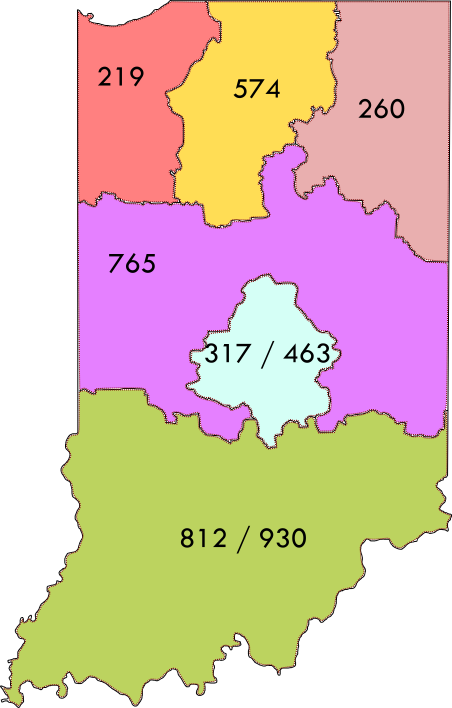
Area Code map for all of Indiana

Area code 260 is a telephone area code in the North American Numbering Plan (NANP) for the northeastern part of the U.S. state of Indiana. Cities served include Angola, Auburn, Bluffton, Butler, Columbia City, Decatur, Fort Wayne, Huntington, New Haven, and Wabash.

History

[edit]

In 1947, American Telephone and Telegraph (AT&T) published the first configuration of proposed numbering plan areas (NPAs) for a new nationwide numbering and toll call routing system. Indiana was divided to receive two area codes. Area code 317 served the northern two-thirds of Indiana, while area code 812 served the southern third. In the first change of the original plan in 1948, 317 was cut back to central Indiana, while the northern third of Indiana, including Gary, Hammond, East Chicago, South Bend, Elkhart and Fort Wayne, received area code 219.[1]

Eventual depletion of numbers in area code 219 in the late 1990s prompted a three-way split of 219. As the result of a random drawing, northwest Indiana retained 219, 574 was assigned to north-central Indiana, (including South Bend), and northeast Indiana received 260. The split took place on January 15, 2002, with mandatory dialing effective five months later.[2]

References

[edit]
[edit]
Revisions and contributorsEdit on WikipediaRead on Wikipedia
from Grokipedia
Area code 260 is a area code in the (NANP) serving the northeastern portion of in the United States. It primarily covers the Fort Wayne metropolitan area and surrounding communities, including major cities such as Fort Wayne, Huntington, Auburn, New Haven, and Wabash. The area code operates in the and requires 10-digit dialing for local calls. Area code 260 was created in a geographic split of area code 219. It serves northeastern as the sole area code for its territory, covering 12 counties. Unlike some regions, it does not overlay with another code. The region is a mix of urban, suburban, and rural areas, with Fort Wayne as Indiana's second-largest city and a key economic hub for , healthcare, and . The area code supports a of over 800,000 residents and facilitates communication across diverse communities near the Indiana-Michigan and Indiana-Ohio borders. As of the April 2025 NANPA projections, numbering resources in area code 260 are projected to remain sufficient until the third quarter of 2060.

Geography and Coverage

Service Area

Area code 260 serves the northeastern portion of , encompassing all or parts of 13 counties: Adams, Allen, DeKalb, Huntington, Jay (partial), Kosciusko (partial), LaGrange (partial), Noble, Steuben, Wells, Whitley, and portions of Wabash and Blackford counties. This region includes diverse landscapes of rural farmlands, forested areas, and urban developments along the borders with to the east and to the north. The service area covers approximately 4,000 square miles, blending agricultural expanses with industrial and commercial zones in the border . At its core lies the Fort Wayne metropolitan area, which functions as the primary economic hub, driving manufacturing, healthcare, and logistics activities across the region. Geographically, the boundaries extend to the northern limit near the state line, the eastern edge along the border, the southern perimeter approximating the division with area codes 765 and 574, and the western flank adjacent to area code 574. These limits were established through the 2002 split from to address growing demand in the region.

Major Cities and Counties

Area code 260 serves several key population centers in northeastern , with Fort Wayne as the dominant urban hub. The largest city is Fort Wayne, with a 2020 U.S. Census population of 263,886, serving as the county seat of and a major regional economic driver. Other significant cities include Huntington (17,022 residents), the of ; New Haven (15,339), a of Fort Wayne in ; Auburn (13,464), the of ; Columbia City (9,975), the of ; Decatur (9,913), the of ; Wabash (10,440), the of ; Bluffton (10,539), the of ; (9,383), the of ; and (2,632), in .
CityCounty2020 Population
Fort WayneAllen263,886
HuntingtonHuntington17,022
New HavenAllen15,339
AuburnDeKalb13,464
WabashWabash10,440
BlufftonWells10,539
Columbia CityWhitley9,975
DecaturAdams9,913
Steuben9,383
DeKalb2,632
The area code provides full telephone service across eight counties—Allen, Adams, DeKalb, Huntington, Noble, Steuben, Wells, and Whitley—and partial coverage in five others: Blackford, , Kosciusko, LaGrange, and Wabash. These counties encompass a mix of urban, suburban, and rural landscapes, with Allen County alone accounting for over 40% of the total regional . Economically, the cities within area code 260 reflect diverse strengths tied to their locations. Fort Wayne stands out as a center for and healthcare, with major employers in automotive parts, , and regional hospitals forming the backbone of its economy. benefits from proximity to Pokagon State Park, a 1,260-acre site on that draws tourists for , , and winter activities, supporting local and sectors. In Auburn, the automotive heritage is prominent, highlighted by the Auburn Cord Duesenberg Automobile Museum, which preserves over 120 vintage vehicles from the early 20th-century Company and attracts enthusiasts year-round. Demographically, the region served by area code 260 is predominantly rural outside of Fort Wayne's urban core, with an overall of approximately 200 people per across its roughly 4,000 s of coverage. The total exceeds 840,000, featuring a mix of Midwestern demographics including a majority , growing communities in areas, and a median age around 38 years. This structure underscores the area's role as a blend of agricultural roots and industrial vitality in the U.S. Midwest.

Borders and Adjacent Codes

Area code 260 encompasses northeastern Indiana and shares its external boundaries with several neighboring area codes in the North American Numbering Plan (NANP). To the north, it adjoins Michigan's area codes 269 and 517, with cross-border service occurring near Angola in Steuben County, where Indiana's northern edge meets Michigan's Branch and Hillsdale counties. On the eastern border, area code 260 interfaces with Ohio's area codes 419 and 567 near Auburn in DeKalb County, as well as 937 and its overlay 326 further southeast near Fort Wayne, aligning with Williams and Darke counties in Ohio. The southern boundary of area code 260 connects with Indiana's , particularly along the edges of Blackford and Jay counties, where 260 serves the northern portions while 765 covers the adjacent southern areas. To the west, area code 260 shares its perimeter with Indiana's , notably in the vicinity of Whitley and Wabash counties, facilitating regional connectivity in north-central Indiana. Area code 260 does not directly border any international boundaries, though its historical relation to the former area code 219 places it in proximity to Lake Michigan's influence without direct adjacency. These borders, established by the 2002 split from area code 219, follow standard NANP protocols for roaming and international calls, with the entire region observing Eastern Time for synchronization across most adjacencies.

History

Early Indiana Numbering Plan

In 1947, as part of the initial implementation of the by the , Indiana was divided into two area codes to accommodate the state's telephone traffic. Area code 317 was assigned to the northern two-thirds of the state, encompassing major population centers such as , Fort Wayne, Gary, and South Bend, while area code 812 covered the southern third, including Bloomington and areas bordering . This division reflected the 's strategy to allocate codes based on projected post-World War II population distribution and toll traffic volumes, ensuring efficient routing for the era's predominantly manual long-distance switching systems. By 1948, rapid growth in 's industrial and urban areas, particularly near , necessitated the first area code split in the nation. The northern portion of 317 was separated to create , which served all of northern Indiana from Gary westward to the Illinois border, eastward to Fort Wayne, and northward to the border, while 317 was retained for central Indiana around . The rationale for this adjustment stemmed from the Bell System's need to balance switching loads on rotary-dial equipment, where codes with lower middle digits like 219 (a 2) were reserved for high-population regions to minimize dialing time and operator intervention, aligning with the manual and early automated infrastructure of the late 1940s. Area code 219 operated as the sole code for northwestern and northeastern for decades, handling the region's expanding telephone demand without overlays or further subdivisions until the late . A key development in its early operations was the introduction of in the , which allowed customers in the 219 area to place long-distance calls without operator assistance, beginning with nationwide rollout in 1951 and extending to exchanges progressively through the decade. This innovation supported growing and industrial activity, though sustained population increases in cities like Fort Wayne eventually pressured the code's capacity.

Creation via Split from 219

By the late 1990s, , which covered much of , was experiencing rapid number depletion due to the growth of services, including the proliferation of cell phones, fax machines, and additional lines for homes and businesses; projections indicated exhaustion as early as summer 2002 without intervention. To avert this crisis, number rationing measures were implemented in June 1999, the Indiana Utility Regulatory Commission (IURC) opened an investigation in September 1999, and number recovery efforts were ordered in early 2001. On June 14, 2001, the IURC approved a three-way geographic split of 219 by a 3-1 vote, dividing the region into northwest (Area A: Gary, East Chicago, Michigan City, Valparaiso, Rensselaer), north-central (Area B: South Bend, Elkhart, Winamac, Logansport, ), and northeast (Area C: LaGrange, Fort Wayne, North Manchester, Silver Lake, Wabash, Warren, Portland) sections, with the split expected to provide relief for at least 20 years. This decision followed extensive public input and aimed to preserve community interests while addressing the shortage. To assign the codes fairly, the IURC conducted a random drawing on July 11, 2001, using index cards and sealed envelopes; northwest Indiana retained 219, north-central received 574, and northeast was assigned 260, with the new codes selected from available North American Numbering Plan (NANP) options and carrying no geographic significance. Implementation proceeded with area code 260's activation on January 15, 2002, marking the start of a permissive period for 10-digit dialing that lasted until June 14, 2002, after which mandatory 10-digit dialing was enforced across the affected regions. The geographic nature of the split minimized disruptions, as customers in the northeast region kept their existing seven-digit numbers but added the new area code prefix, though some rate center realignments were required to align exchanges properly, with Fort Wayne serving as a key protected central office to maintain service continuity. To facilitate the change, the IURC and telephone carriers launched public awareness campaigns, including educational materials, announcements, and a 45-day recorded message system post-mandatory date to assist callers using outdated formats, ensuring broad understanding and smooth adoption.

Current Status and Operations

Dialing Procedures

In area code 260, local calls to numbers within the same area code can be placed using 7-digit dialing, a practice still supported in this non-overlaid region of northeastern . This distinguishes it from overlaid area codes elsewhere in the (NANP), where mandatory 10-digit dialing applies to all local calls. However, calls from area code 260 to adjacent area codes, such as 574 () or 765 (central ), require 10-digit dialing consisting of the destination area code followed by the 7-digit number. For long-distance calls to area code 260 from outside but within the NANP, the standard procedure is to dial 1 followed by the 3-digit area code 260 and the 7-digit telephone number (1 + 260 + NXX-XXXX). Within the NANP, the 0 + prefix is not used for direct-dialed long-distance calls; instead, it connects to the operator for assistance with , third-party, or person-to-person calls. These procedures have remained consistent since the area's inclusion in the NANP, ensuring across the U.S., , and other member countries. Emergency services are accessed by dialing 911 directly, without any area code or prefix, providing immediate connection to local public safety answering points. Operator assistance is available by dialing , which routes to an automated or live operator for directory inquiries, repairs, or billing questions. Special services include at 411 for local and national listings, and a local time and temperature service in Fort Wayne at 260-422-0123, operated by since 2021. The 2002 split from , effective January 15 with mandatory procedures by June 14, eliminated permissive 7-digit dialing across the divided region to prevent errors during the transition, requiring 10-digit specification for the appropriate code. Today, with no overlay in 260, 7-digit local dialing persists without remnants of that period, but 10-digit enforcement for cross-boundary calls helps avoid confusion in areas with multiple codes. This setup aligns with the Federal Communications Commission's (FCC) 2021 mandate for 10-digit dialing in regions using as a central office code to support the Lifeline, as 260 lacks such assignments and thus faces no dialing conflicts.

Number Resource Management

The administration of telephone numbering resources in area code 260 is handled by the Administrator (), currently operated by , which oversees central office (CO) code assignments and overall plan compliance across the NANP region. In Indiana, the Office of Utility Consumer Counselor (OUCC) serves as the state consumer advocate, participating in numbering plan decisions and relief planning to protect consumer interests. As of 2025, area code 260 operates without an overlay, functioning as the sole code for its northeastern service area, with 437 active CO code prefixes supporting local telephone service. NANPA projections indicate that available numbers in 260 are expected to deplete around 2053, driven by steady but moderate expansion in wireless subscriptions and (VoIP) services, which together account for the majority of new number demands. To extend the lifespan of the code, conservation efforts include thousands-block number pooling, implemented nationwide since 2000, which allows carriers to share 1,000-number blocks more efficiently rather than entire 10,000-number prefixes, and rate center optimization following the split from 219 to minimize unused assignments in smaller locales. Additionally, certain thousands blocks are held in reserve by for future needs or emergencies, helping to curb rapid exhaustion. The most recent CO code prefix assignment in 260 occurred on February 13, 2025, reflecting controlled growth without urgency for relief measures. Usage patterns in 260 show high penetration, exceeding 60% of active lines as of 2025, consistent with national trends where mobile connections outnumber traditional landlines, while business lines remain concentrated in major hubs like Fort Wayne to support commercial density.

References

Add your contribution
Related Hubs
Contribute something
User Avatar
No comments yet.