


Community hub
0 subscribers8 pages, 0 posts
Recent from talks
All channels
Be the first to start a discussion here.
Be the first to start a discussion here.
Be the first to start a discussion here.
Be the first to start a discussion here.
Contribute something
Welcome to the community hub built to collect knowledge and have discussions related to Arilus.
Nothing was collected or created yet.
Arilus
View on Wikipediafrom Wikipedia
| Arilus | |
|---|---|

| |
| Arilus cristatus | |
Scientific classification 
| |
| Kingdom: | Animalia |
| Phylum: | Arthropoda |
| Class: | Insecta |
| Order: | Hemiptera |
| Suborder: | Heteroptera |
| Family: | Reduviidae |
| Subfamily: | Harpactorinae |
| Tribe: | Harpactorini |
| Genus: | Arilus Hahn, 1831 |
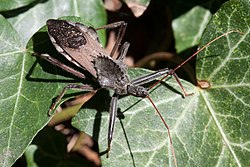
Arilus, or wheel bugs due to the semicircular crest on the pronotum,[1][2][3] is a genus of true bugs in the family Reduviidae, subfamily Harpactorinae and tribe Harpactorini. Most species are found in the Americas.[4] Arilus is a generalist predator of insects.[2]
See North American wheel bug for details about a representative species.
Species
[edit]Five extant species plus one fossil species are included within this genus:[5]
- Arilus carinatus (Forster, 1771)
- Arilus cristatus (Linnaeus, 1763) the North American wheel bug
- Arilus depressicollis (Stål, 1859)
- †Arilus faujasi Riou, 1999
- Arilus gallus (Stål, 1872)
- Arilus nigriceps Herrich-Schaeffer, 1848
Three additional species originally described in the genus are currently incertae sedis.[5]
- Arilus auctus Germar, 1837
- Arilus collaris Herrich-Schaeffer, 1848
- Arilus spiniceps Blanchard, 1843
References
[edit]- ^ Aldrich, Jeffrey R.; Chauhan, Kamlesh R.; Zhang, Aijun; Zarbin, Paulo H.G. (2013). "Exocrine Secretions of Wheel Bugs (Heteroptera: Reduviidae: Arilus spp.): Clarification and Chemistry". Zeitschrift für Naturforschung C. 68 (11–12): 522–526. doi:10.1515/znc-2013-11-1211. Retrieved 2022-02-01.
- ^ a b Laiton J., Laura A.; Giraldo-Jaramillo, Marisol; Forero, Dimitri; Benavides M., Pablo (2021). "The wheel bug Arilus gallus (Hemiptera: Reduviidae): life history and description of immature stages". Proceedings of the Entomological Society of Washington. 123 (3): 551–563. doi:10.4289/0013-8797.123.3.551.
- ^ Fitzsimmons, Jay M.; Fitzsimmons, Lauren P. (2010). "Pre-copulatory behavior of the wheel bug Arilus gallus (Hemiptera: Reduviidae)". Entomological News. 121 (3): 304–307. Retrieved 2022-02-01.
- ^ GBIF: Arilus Hahn, 1831
- ^ a b "Arilus Hahn, 1831: Genus information BioLib". biolib.cz. Retrieved 11 May 2020.
External links
[edit] Data related to Harpactorini at Wikispecies
 Media related to Arilus at Wikimedia Commons


| Authority control databases: National |
|---|

Arilus
View on Grokipediafrom Grokipedia
Taxonomy
Classification
Arilus is a genus of true bugs classified within the kingdom Animalia, phylum Arthropoda, class Insecta, order Hemiptera, suborder Heteroptera, family Reduviidae, subfamily Harpactorinae, and tribe Harpactorini.[5] The genus was established by Carl Wilhelm Hahn in 1831 in his work Die wanzenartigen Insecten (Hemiptera).[5] Phylogenetically, Arilus belongs to the diverse family Reduviidae, commonly known as assassin bugs, which are characterized as generalist predators that employ a proboscis to capture and feed on a wide range of invertebrate prey.[6] Within the subfamily Harpactorinae, the largest in Reduviidae with over 2,000 species, Arilus is positioned in the tribe Harpactorini alongside genera such as Apiomerus; it is distinguished from close relatives by a unique pronotal crest.[1] Historically, the taxonomy of Arilus underwent revisions in the mid-20th century, with Wygodzinsky recognizing four species in the genus in his 1949 catalog of Neotropical Reduviidae.[7] Subsequent updates, incorporating morphological and distributional data, have refined this to five extant species, all restricted to the New World.[2][4]Etymology and history
The genus Arilus was established by German entomologist Carl Wilhelm Hahn in 1831 as part of his work on hemipteran insects, Die wanzenartigen Insecten (Hemiptera Heteroptera).[5] The common name "wheel bugs" for species in this genus derives from the distinctive gear-like, semicircular crest on the pronotum of adults, which resembles a cogwheel.[1] The type species, Arilus cristatus, was first described by Carl Linnaeus in 1763 under the name Cimex cristatus, reflecting its initial classification among the broader group of bed bugs and related hemipterans before recognition as an assassin bug.[1] Early taxonomic efforts often confused Arilus with other genera in the family Reduviidae, leading to several junior synonyms such as Prionotus Laporte and Prionides Uhler, the latter two invalidated as preoccupied names.[8] A significant advancement in the understanding of Arilus came with Pedro Wygodzinsky's 1949 systematic checklist of American Reduviidae, which recognized four species within the genus—expanding beyond earlier views that treated it primarily as a monospecific group—and provided a foundational catalog for Neotropical diversity.[1] This revision highlighted the New World distribution of Arilus, with only A. cristatus occurring in the United States.[1]Physical description
Adult morphology
Adult Arilus specimens exhibit a robust body structure typical of predatory assassin bugs in the family Reduviidae, measuring 25–38 mm in length.[9][4] The coloration is predominantly grayish-brown, often with variable mottling or scattered tiny white patches and granules, providing camouflage among bark and foliage.[1][10] A diagnostic feature unique to the genus is the prominent, semicircular crest on the pronotum, resembling a cogwheel or toothed wheel with 8–12 tubercles, which aids in species identification within the Reduviidae.[1][11] The body is covered in fine yellowish pubescence except on the wings, and the head is narrow with large eyes. Antennae are four-segmented and typically brown, while the piercing-sucking mouthparts consist of a stout rostrum.[12][10] The forelegs are raptorial, enlarged and adapted for grasping prey, and the hemelytra feature a coriaceous basal portion with membranous, iridescent bronze tips.[1][10] Sexual dimorphism is evident in size and abdominal shape, with females generally larger and possessing a broader abdomen that more widely exposes the lateral margins compared to males.[1][9]Nymphal stages
The nymphs of Arilus species, such as A. cristatus, undergo incomplete metamorphosis through five distinct instars, remaining wingless until the final molt to adulthood. Nymphal development typically spans about 99 days under favorable conditions, with average durations of 21 days for the first instar, 14 days for the second, 15 days for the third, 17 days for the fourth, and 32 days for the fifth; the overall life span of the insect, including egg and adult stages, ranges from 1 to 2 years, with one generation per year and overwintering as eggs.[1][10] Early instars exhibit bright red or orange coloration with prominent black markings, serving as aposematic warning coloration to potential predators, while later instars gradually darken to gray or brown tones resembling adults. Wing pads begin developing in the third and fourth instars, becoming more pronounced by the fifth, and nymphs lack the pronotal crest, which develops fully during the final molt to adulthood. First-instar nymphs measure approximately 3 mm in length, progressively increasing in size to about 25 mm by the fifth instar, reflecting steady growth in body proportions and leg length.[1][13][14] In early instars, nymphs are often gregarious, clustering in groups on host plants shortly after hatching from eggs, which facilitates initial foraging and protection; however, they become more solitary and dispersive in later stages as they seek larger prey. Defensive scent glands, located dorsally on the abdomen, are present from the first instar and release pungent chemicals when threatened, serving as a primary chemical defense mechanism similar to that in adults. These morphological and behavioral shifts prepare the nymphs for the transition to the adult predatory form, with full development of the pronotal crest and wings occurring upon the final molt.[15][10]Distribution and habitat
Geographic range
The genus Arilus is endemic to the Western Hemisphere, with its distribution encompassing the Nearctic and Neotropical realms, extending from southern Canada in the north to northern South America in the south.[2] All known extant species are confined to the Americas, with no records of invasive expansion beyond this region.[5] Among the extant species, A. cristatus occupies eastern North America, ranging from southern Canada through the eastern United States to Mexico.[1] A. carinatus is distributed across South America, recorded from Brazil, Ecuador, Peru, and Argentina.[16][17] A. depressicollis occurs in southern Mexico, while A. gallus is found in Central and South America.[2] Additional species include A. nigriceps and A. auctus (Puerto Rico).[2]Habitat preferences
Arilus species are primarily arboreal predators found in a variety of vegetated environments across their range, including woodlands, forests, orchards, gardens, and field edges. They commonly inhabit areas with abundant prey, such as among flowers, shrubs, and trees, where adults and nymphs perch on trunks, branches, and foliage to ambush insects.[1][18][19] Within these habitats, Arilus shows a preference for deciduous trees like locust and pecan, as well as shrubs and flowering plants such as goldenrod, sunflower, and cotton, often occupying the canopy layers or mid-level branches. The genus tolerates urban and suburban edges, appearing on porches, screens, and garden structures, but avoids arid or desert-like zones, favoring humid temperate and subtropical conditions. Egg clusters are typically laid on tree trunks or limbs at heights below 4 feet (1.2 meters), providing sheltered microhabitats for development.[1][18][19] Activity patterns exhibit strong seasonal variations, with adults most active during warm months from late spring through early fall, peaking in summer when temperatures support foraging in the canopy. In temperate regions, the insects overwinter in the egg stage, with clusters enduring cold weather on protected bark or twigs until hatching in spring. This univoltine life history aligns with genus-wide patterns, where all known species, including A. cristatus in North American temperate forests, rely on arboreal microhabitats for survival and predation.[1][18]Species
Extant species
The genus Arilus comprises five extant species, all endemic to the Americas and members of the assassin bug family Reduviidae. These species are differentiated primarily by variations in body size, coloration, and the shape and prominence of the pronotal crest, a semicircular structure unique to the genus. Arilus cristatus is the sole representative in the United States, where it is widely distributed and recognized as a beneficial predator. All species are currently regarded as least concern with respect to conservation, as none are listed as threatened or endangered on the IUCN Red List.[2][1][20]- Arilus carinatus (Forster, 1771): Distributed throughout South America, this species is notably smaller than its North American congener and features a less pronounced pronotal crest.[2][21]
- Arilus cristatus (Linnaeus, 1763): Native to North America from southern Canada to Mexico, it is the largest species in the genus, measuring up to 38 mm in length, with a gray-brown body and a prominent, cogwheel-like pronotal crest.[1][22]
- Arilus depressicollis (Stål, 1859): Occurring in southern Mexico and Central America, this species is distinguished by its depressed pronotum, which contributes to a flatter overall profile compared to other Arilus taxa.[2][23]
- Arilus gallus (Stål, 1872): Found in the Caribbean and northern South America, including tropical regions like Costa Rica, this species exhibits adaptations suited to humid, lowland environments.[2][24]
- Arilus nigriceps Herrich-Schaeffer, 1848: Restricted to South America, it is characterized by a black head (nigriceps meaning "black-headed") and the typical genus crest, though specific size and coloration details remain less documented than for A. cristatus.[2][25]