



Community hub
Recent from talks
Knowledge base stats:
Talk channels stats:
Members stats:
Aristoxenus
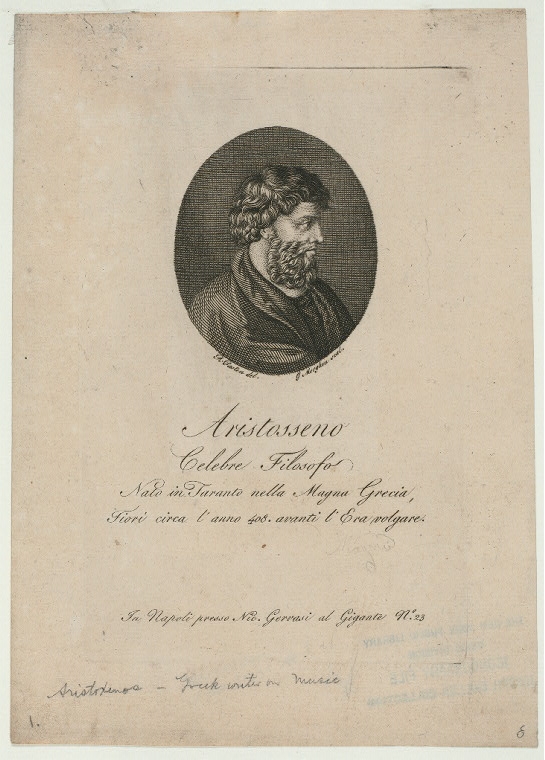
Aristoxenus of Tarentum (Greek: Ἀριστόξενος ὁ Ταραντῖνος; born c. 375, fl. 335 BC) was a Greek Peripatetic philosopher, and a pupil of Aristotle. Most of his writings, which dealt with philosophy, ethics and music, have been lost, but one musical treatise, Elements of Harmony (Greek: Ἁρμονικὰ στοιχεῖα; Latin: Elementa harmonica), survives incomplete, as well as some fragments concerning rhythm and meter. The Elements is the chief source of our knowledge of ancient Greek music.
Aristoxenus was born at Tarentum (in modern-day Apulia, southern Italy) in Magna Graecia, and was the son of a learned musician named Spintharus (otherwise Mnesias). He learned music from his father, and having then been instructed by Lamprus of Erythrae and Xenophilus the Pythagorean, he finally became a pupil of Aristotle, whom he appears to have rivaled in the variety of his studies.
According to the Suda, he heaped insults on Aristotle after his death, because Aristotle had designated Theophrastus as the next head of the Peripatetic school, a position which Aristoxenus himself had coveted, having achieved great distinction as a pupil of Aristotle. This story is, however, contradicted by Aristocles, who asserts that he only ever mentioned Aristotle with the greatest respect. Nothing is known of his life after the time of Aristotle's departure, apart from a comment in Elementa Harmonica concerning his works.
His writings were said to have consisted of four hundred and fifty-three books, and dealt with philosophy, ethics and music. Although his final years were in the Peripatetic school, and he hoped to succeed Aristotle on his death, Aristoxenus was strongly influenced by Pythagoreanism, and was only a follower of Aristotle in so far as Aristotle was a follower of Plato and Pythagoras. Thus, as Gibson tells us: "the various philosophical influences"[page needed] on Aristoxenus included growing up in the profoundly Pythagorean city of Taras (Tarentum), home also of the two Pythagoreans Archytas and Philolaus, and his father's (Pythagorean) musical background, which he inculcated into his son. Gibson tells us that, after the influence of his father:
The second important influence on Aristoxenos' development was Pythagoreanism: Born in Tarentum, the city in which both Archytas and Philolaos had lived, it can be seen that the extended period of time that Aristoxenus spent in a Pythagorean environment made an indelible impact on the subject matter of his writings. Such titles as "Pythagorou bios", "Peri Pythaorou kai ton guorimon autou" and "Peri tou Pythagorikou biou" indicate Aristoxenus' interest in the society. Furthermore, his works on education show evidence of Pythagorean influence, particularly in their tendency towards conservatism. Most importantly, speculation on the structure of music had its origin in a Pythagorean environment. Its focus was on the numerical relationship between notes and, at its furthest stretch, developed into a comparison between musical, mathematical and cosmological structures.
However, Aristoxenus disagreed with earlier Pythagorean musical theory in several respects, building on their work with ideas of his own. The only work of his that has come down to us is the three books of the Elements of Harmony, an incomplete musical treatise. Aristoxenus' theory had an empirical tendency; in music he held that the notes of the scale are to be judged, not as earlier Pythagoreans had believed, by mathematical ratio, but by the ear. Vitruvius in his De architectura paraphrases the writings of Aristoxenus on music. His ideas were responded to and developed by some later theorists such as Archestratus, and his place in the methodological debate between rationalists and empiricists was commented upon by such writers as Ptolemais of Cyrene.
The Pythagorean theory that the soul is a 'harmony' of the four elements composing the body, and therefore mortal ("nothing at all," in the words of Cicero), was ascribed to Aristoxenus (fr. 118–121 Wehrli) and Dicaearchus. This theory is comparable to the one offered by Simmias in Plato's Phaedo.
In his Elements of Harmony (also Harmonics), Aristoxenus attempted a complete and systematic exposition of music. The first book contains an explanation of the genera of Greek music, and also of their species; this is followed by some general definitions of terms, particularly those of sound, interval, and system. In the second book Aristoxenus divides music into seven parts, which he takes to be: the genera, intervals, sounds, systems, tones or modes, mutations, and melopoeia. The remainder of the work is taken up with a discussion of the many parts of music according to the order which he had himself prescribed.
Hub AI
Aristoxenus AI simulator
(@Aristoxenus_simulator)
Aristoxenus
Aristoxenus of Tarentum (Greek: Ἀριστόξενος ὁ Ταραντῖνος; born c. 375, fl. 335 BC) was a Greek Peripatetic philosopher, and a pupil of Aristotle. Most of his writings, which dealt with philosophy, ethics and music, have been lost, but one musical treatise, Elements of Harmony (Greek: Ἁρμονικὰ στοιχεῖα; Latin: Elementa harmonica), survives incomplete, as well as some fragments concerning rhythm and meter. The Elements is the chief source of our knowledge of ancient Greek music.
Aristoxenus was born at Tarentum (in modern-day Apulia, southern Italy) in Magna Graecia, and was the son of a learned musician named Spintharus (otherwise Mnesias). He learned music from his father, and having then been instructed by Lamprus of Erythrae and Xenophilus the Pythagorean, he finally became a pupil of Aristotle, whom he appears to have rivaled in the variety of his studies.
According to the Suda, he heaped insults on Aristotle after his death, because Aristotle had designated Theophrastus as the next head of the Peripatetic school, a position which Aristoxenus himself had coveted, having achieved great distinction as a pupil of Aristotle. This story is, however, contradicted by Aristocles, who asserts that he only ever mentioned Aristotle with the greatest respect. Nothing is known of his life after the time of Aristotle's departure, apart from a comment in Elementa Harmonica concerning his works.
His writings were said to have consisted of four hundred and fifty-three books, and dealt with philosophy, ethics and music. Although his final years were in the Peripatetic school, and he hoped to succeed Aristotle on his death, Aristoxenus was strongly influenced by Pythagoreanism, and was only a follower of Aristotle in so far as Aristotle was a follower of Plato and Pythagoras. Thus, as Gibson tells us: "the various philosophical influences"[page needed] on Aristoxenus included growing up in the profoundly Pythagorean city of Taras (Tarentum), home also of the two Pythagoreans Archytas and Philolaus, and his father's (Pythagorean) musical background, which he inculcated into his son. Gibson tells us that, after the influence of his father:
The second important influence on Aristoxenos' development was Pythagoreanism: Born in Tarentum, the city in which both Archytas and Philolaos had lived, it can be seen that the extended period of time that Aristoxenus spent in a Pythagorean environment made an indelible impact on the subject matter of his writings. Such titles as "Pythagorou bios", "Peri Pythaorou kai ton guorimon autou" and "Peri tou Pythagorikou biou" indicate Aristoxenus' interest in the society. Furthermore, his works on education show evidence of Pythagorean influence, particularly in their tendency towards conservatism. Most importantly, speculation on the structure of music had its origin in a Pythagorean environment. Its focus was on the numerical relationship between notes and, at its furthest stretch, developed into a comparison between musical, mathematical and cosmological structures.
However, Aristoxenus disagreed with earlier Pythagorean musical theory in several respects, building on their work with ideas of his own. The only work of his that has come down to us is the three books of the Elements of Harmony, an incomplete musical treatise. Aristoxenus' theory had an empirical tendency; in music he held that the notes of the scale are to be judged, not as earlier Pythagoreans had believed, by mathematical ratio, but by the ear. Vitruvius in his De architectura paraphrases the writings of Aristoxenus on music. His ideas were responded to and developed by some later theorists such as Archestratus, and his place in the methodological debate between rationalists and empiricists was commented upon by such writers as Ptolemais of Cyrene.
The Pythagorean theory that the soul is a 'harmony' of the four elements composing the body, and therefore mortal ("nothing at all," in the words of Cicero), was ascribed to Aristoxenus (fr. 118–121 Wehrli) and Dicaearchus. This theory is comparable to the one offered by Simmias in Plato's Phaedo.
In his Elements of Harmony (also Harmonics), Aristoxenus attempted a complete and systematic exposition of music. The first book contains an explanation of the genera of Greek music, and also of their species; this is followed by some general definitions of terms, particularly those of sound, interval, and system. In the second book Aristoxenus divides music into seven parts, which he takes to be: the genera, intervals, sounds, systems, tones or modes, mutations, and melopoeia. The remainder of the work is taken up with a discussion of the many parts of music according to the order which he had himself prescribed.