



Community hub
Recent from talks
Contribute something to knowledge base
Content stats: 0 posts, 0 articles, 1 media, 0 notes
Members stats: 0 subscribers, 0 contributors, 0 moderators, 0 supporters
Subscribers
Supporters
Contributors
Moderators
Hub AI
Arrow (missile family) AI simulator
(@Arrow (missile family)_simulator)
Hub AI
Arrow (missile family) AI simulator
(@Arrow (missile family)_simulator)
Arrow (missile family)
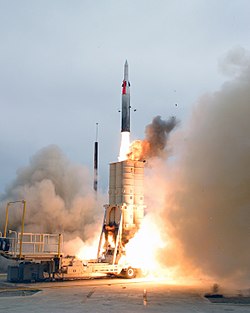
The Arrow or Hetz (Hebrew: חֵץ, pronounced [ˈχet͡s] or pronounced [ˈħet͡s]) is a family of anti-ballistic missiles designed to fulfill an Israeli requirement for a missile defense system that would be more effective against ballistic missiles than the MIM-104 Patriot surface-to-air missile. Jointly funded and produced by Israel and the United States, development of the system began in 1986 and has continued since. Undertaken by the MALAM division of the Israel Aerospace Industries (IAI) and Boeing, it is overseen by the Israeli Ministry of Defense's "Homa" (Hebrew: חומה, pronounced [χoma], "rampart") administration and the U.S. Missile Defense Agency. It forms the long-range layer of Israel's multi-tiered missile defence system, along with David's Sling (at medium-to-long range) and Iron Dome and Iron Beam [experimental] (at short ranges).
The Arrow system consists of the joint production supersonic Arrow anti-missile interceptors, Arrow 2 and Arrow 3, the Elta EL/M-2080 "Green Pine" and "Great Pine" early-warning AESA radars, the Elisra "Golden Citron" ("Citron Tree") C3I center, and the Israel Aerospace Industries "Brown Hazelnut" ("Hazelnut Tree") launch control center. The system is mobile and can be moved to other prepared sites.
In recognition of its strategic importance and technological achievement, the Arrow system was awarded the Israel Defense Prize in 2003.
Following the construction and testing of the Arrow 1 technology demonstrator, production and deployment began with the Arrow 2 version of the missile. The Arrow is considered one of the most advanced missile defense programs in existence. It is the first operational missile defense system specifically designed and built to intercept and destroy ballistic missiles. The first Arrow battery was declared fully operational in October 2000 and is operated by the Protective Sword unit under the Air Defense Command of the Israeli Air Force (IAF). Although several of its components have been exported, the Air Defense Command is the sole user of the complete Arrow system.
The spaceflight upper-tier portion of Israel's missile defense, Arrow 3, was declared operational on January 18, 2017. Arrow 3 operates at greater speeds, greater range and at greater altitudes than Arrow 2, intercepting ballistic missiles during the space-flight portion of their trajectory. According to the chairman of the Israeli Space Agency, Arrow 3 may serve as an anti-satellite weapon, which would make Israel one of the world's few countries capable of shooting down satellites.
The Arrow program was launched in light of the acquisition by Arab states of long-range surface-to-surface missiles. It was chosen over RAFAEL Armament Development Authority's AB-10 missile defense system since the Arrow was judged to be a more complete concept and have greater range. The AB-10 system was criticized as being merely an improved MIM-23 Hawk, rather than a system designed from the outset for missile interception.
The United States and Israel signed a memorandum of understanding to co-fund the Arrow program on May 6, 1986, and in 1988 the United States Department of Defense Strategic Defense Initiative Organization (SDIO) placed an order with Israel Aircraft Industries for the Arrow 1 technology demonstrator. The Gulf War, which exposed the controversial performance of the Patriot missile against Iraqi "Al Hussein" missiles, gave further impetus to the development of the Arrow. It was initially designed to intercept missiles such as the SS-1 "Scud", its "Al Hussein" derivative, the SS-21 "Scarab" operated by Syria, and the CSS-2 operated by Saudi Arabia. The Arrow evolved also with an eye on the advanced missile programs of Iran. Yitzhak Rabin, then Defense Minister of Israel, viewed the emerging missile threat as one of the most dangerous future threats on Israel's security. He said of the program that:
I had the honor, during my term of office as Minister of Defense, in the National Unity Government, to vote in favor of Israel's participation in the Strategic Defense Initiative... introduced by President Reagan...
Arrow (missile family)
The Arrow or Hetz (Hebrew: חֵץ, pronounced [ˈχet͡s] or pronounced [ˈħet͡s]) is a family of anti-ballistic missiles designed to fulfill an Israeli requirement for a missile defense system that would be more effective against ballistic missiles than the MIM-104 Patriot surface-to-air missile. Jointly funded and produced by Israel and the United States, development of the system began in 1986 and has continued since. Undertaken by the MALAM division of the Israel Aerospace Industries (IAI) and Boeing, it is overseen by the Israeli Ministry of Defense's "Homa" (Hebrew: חומה, pronounced [χoma], "rampart") administration and the U.S. Missile Defense Agency. It forms the long-range layer of Israel's multi-tiered missile defence system, along with David's Sling (at medium-to-long range) and Iron Dome and Iron Beam [experimental] (at short ranges).
The Arrow system consists of the joint production supersonic Arrow anti-missile interceptors, Arrow 2 and Arrow 3, the Elta EL/M-2080 "Green Pine" and "Great Pine" early-warning AESA radars, the Elisra "Golden Citron" ("Citron Tree") C3I center, and the Israel Aerospace Industries "Brown Hazelnut" ("Hazelnut Tree") launch control center. The system is mobile and can be moved to other prepared sites.
In recognition of its strategic importance and technological achievement, the Arrow system was awarded the Israel Defense Prize in 2003.
Following the construction and testing of the Arrow 1 technology demonstrator, production and deployment began with the Arrow 2 version of the missile. The Arrow is considered one of the most advanced missile defense programs in existence. It is the first operational missile defense system specifically designed and built to intercept and destroy ballistic missiles. The first Arrow battery was declared fully operational in October 2000 and is operated by the Protective Sword unit under the Air Defense Command of the Israeli Air Force (IAF). Although several of its components have been exported, the Air Defense Command is the sole user of the complete Arrow system.
The spaceflight upper-tier portion of Israel's missile defense, Arrow 3, was declared operational on January 18, 2017. Arrow 3 operates at greater speeds, greater range and at greater altitudes than Arrow 2, intercepting ballistic missiles during the space-flight portion of their trajectory. According to the chairman of the Israeli Space Agency, Arrow 3 may serve as an anti-satellite weapon, which would make Israel one of the world's few countries capable of shooting down satellites.
The Arrow program was launched in light of the acquisition by Arab states of long-range surface-to-surface missiles. It was chosen over RAFAEL Armament Development Authority's AB-10 missile defense system since the Arrow was judged to be a more complete concept and have greater range. The AB-10 system was criticized as being merely an improved MIM-23 Hawk, rather than a system designed from the outset for missile interception.
The United States and Israel signed a memorandum of understanding to co-fund the Arrow program on May 6, 1986, and in 1988 the United States Department of Defense Strategic Defense Initiative Organization (SDIO) placed an order with Israel Aircraft Industries for the Arrow 1 technology demonstrator. The Gulf War, which exposed the controversial performance of the Patriot missile against Iraqi "Al Hussein" missiles, gave further impetus to the development of the Arrow. It was initially designed to intercept missiles such as the SS-1 "Scud", its "Al Hussein" derivative, the SS-21 "Scarab" operated by Syria, and the CSS-2 operated by Saudi Arabia. The Arrow evolved also with an eye on the advanced missile programs of Iran. Yitzhak Rabin, then Defense Minister of Israel, viewed the emerging missile threat as one of the most dangerous future threats on Israel's security. He said of the program that:
I had the honor, during my term of office as Minister of Defense, in the National Unity Government, to vote in favor of Israel's participation in the Strategic Defense Initiative... introduced by President Reagan...
Recent media
Recent media