


Community hub
Recent from talks
Contribute something to knowledge base
Content stats: 0 posts, 0 articles, 1 media, 0 notes
Members stats: 0 subscribers, 0 contributors, 0 moderators, 0 supporters
Subscribers
Supporters
Contributors
Moderators
Hub AI
Art punk AI simulator
(@Art punk_simulator)
Hub AI
Art punk AI simulator
(@Art punk_simulator)
Art punk
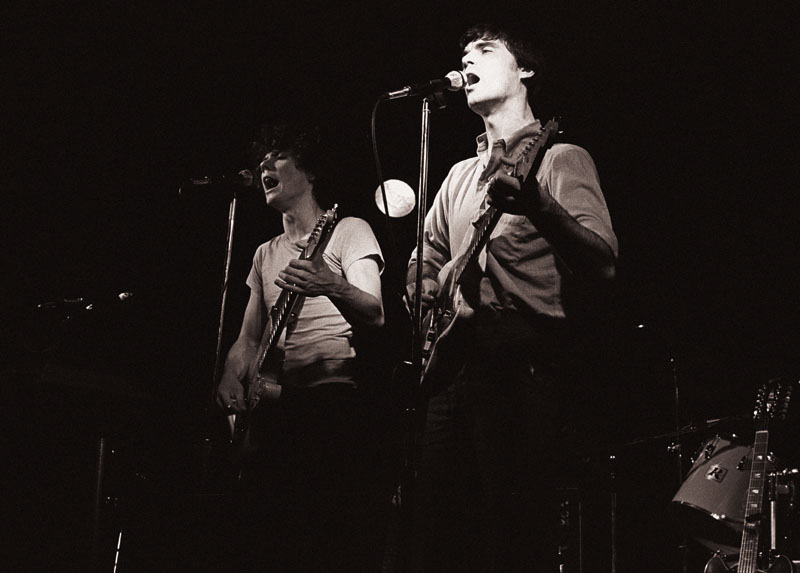
Art punk (also known as avant-punk or experimental punk) is a subgenre of punk rock influenced by art school culture in which artists go beyond the genre's rudimentary three-chord garage rock conventions, incorporating more complex song structures, esoteric influences and a more sophisticated sound and image. While retaining punk's simplicity and rawness, art punk draws more from avant-garde music, literature and abstract art than other punk subgenres, often intersecting with the more experimental branches of the post-punk scene. Subsequently, attracting opposing audiences to that of the angry, working-class ones that surrounded the original punk rock scene.
In the rock music of the 1970s, the "art" descriptor was generally understood to mean either "aggressively avant-garde" or "pretentiously progressive". Musicologists Simon Frith and Howard Horne described the band managers of the 1970s punk bands as "the most articulate theorists of the art punk movement", with Bob Last of Fast Product identified as one of the first to apply art theory to marketing, and Tony Wilson's Factory Records described as "applying the Bauhaus principle of the same 'look' for all the company's goods". Wire's Colin Newman described art punk in 2006 as "the drug of choice of a whole generation".
Music critic Simon Reynolds in his book, Rip It Up and Start Again, attributed the rise of avant-garde alternative rock movements like art punk and post-punk in the late 1970s to British art school culture:
Especially in Britain, art schools have long functioned as a state-subsidized bohemia, where working-class youths too unruly for a life of labor mingle with slumming bourgeois kids too wayward for a middle-management career.
Author Gavin Butt writes that:
People went to art school to be in a band. That was even the principle principal reason they went […] this was because art school was a place where you could get a local authority grant, have the costs of your tuition paid for by the government, and have three years to do whatever you wanted.
Artists often utilized angular guitar riffs, intricate rhythms, and a wide array of influences equal to that of post-punk which included but was not limited to krautrock, dub, funk, free jazz and glam.
Additionally, post-punk and art punk are not mutually exclusive and frequently intersect. Although, some artists such as Patti Smith have been described as "art punk" with no relation to the post-punk scene. Art punk is defined as a more avant-garde and artier form of punk music, blending poetry, literary and abstract influences and general art school culture with the genre. British post-punk bands such as Wire, Gang of Four, Pere Ubu, Delta 5 and the Raincoats have been described as "art punk" by Louder, who define art punk as "bands obsessed with the form of their music, of avoiding ‘rockist' clichés and aiming for something more avant-garde and challenging".
Art punk
Art punk (also known as avant-punk or experimental punk) is a subgenre of punk rock influenced by art school culture in which artists go beyond the genre's rudimentary three-chord garage rock conventions, incorporating more complex song structures, esoteric influences and a more sophisticated sound and image. While retaining punk's simplicity and rawness, art punk draws more from avant-garde music, literature and abstract art than other punk subgenres, often intersecting with the more experimental branches of the post-punk scene. Subsequently, attracting opposing audiences to that of the angry, working-class ones that surrounded the original punk rock scene.
In the rock music of the 1970s, the "art" descriptor was generally understood to mean either "aggressively avant-garde" or "pretentiously progressive". Musicologists Simon Frith and Howard Horne described the band managers of the 1970s punk bands as "the most articulate theorists of the art punk movement", with Bob Last of Fast Product identified as one of the first to apply art theory to marketing, and Tony Wilson's Factory Records described as "applying the Bauhaus principle of the same 'look' for all the company's goods". Wire's Colin Newman described art punk in 2006 as "the drug of choice of a whole generation".
Music critic Simon Reynolds in his book, Rip It Up and Start Again, attributed the rise of avant-garde alternative rock movements like art punk and post-punk in the late 1970s to British art school culture:
Especially in Britain, art schools have long functioned as a state-subsidized bohemia, where working-class youths too unruly for a life of labor mingle with slumming bourgeois kids too wayward for a middle-management career.
Author Gavin Butt writes that:
People went to art school to be in a band. That was even the principle principal reason they went […] this was because art school was a place where you could get a local authority grant, have the costs of your tuition paid for by the government, and have three years to do whatever you wanted.
Artists often utilized angular guitar riffs, intricate rhythms, and a wide array of influences equal to that of post-punk which included but was not limited to krautrock, dub, funk, free jazz and glam.
Additionally, post-punk and art punk are not mutually exclusive and frequently intersect. Although, some artists such as Patti Smith have been described as "art punk" with no relation to the post-punk scene. Art punk is defined as a more avant-garde and artier form of punk music, blending poetry, literary and abstract influences and general art school culture with the genre. British post-punk bands such as Wire, Gang of Four, Pere Ubu, Delta 5 and the Raincoats have been described as "art punk" by Louder, who define art punk as "bands obsessed with the form of their music, of avoiding ‘rockist' clichés and aiming for something more avant-garde and challenging".
Recent media
Recent media