
Recent from talks
Arthur Conan Doyle
Knowledge base stats:
Talk channels stats:
Members stats:
Arthur Conan Doyle
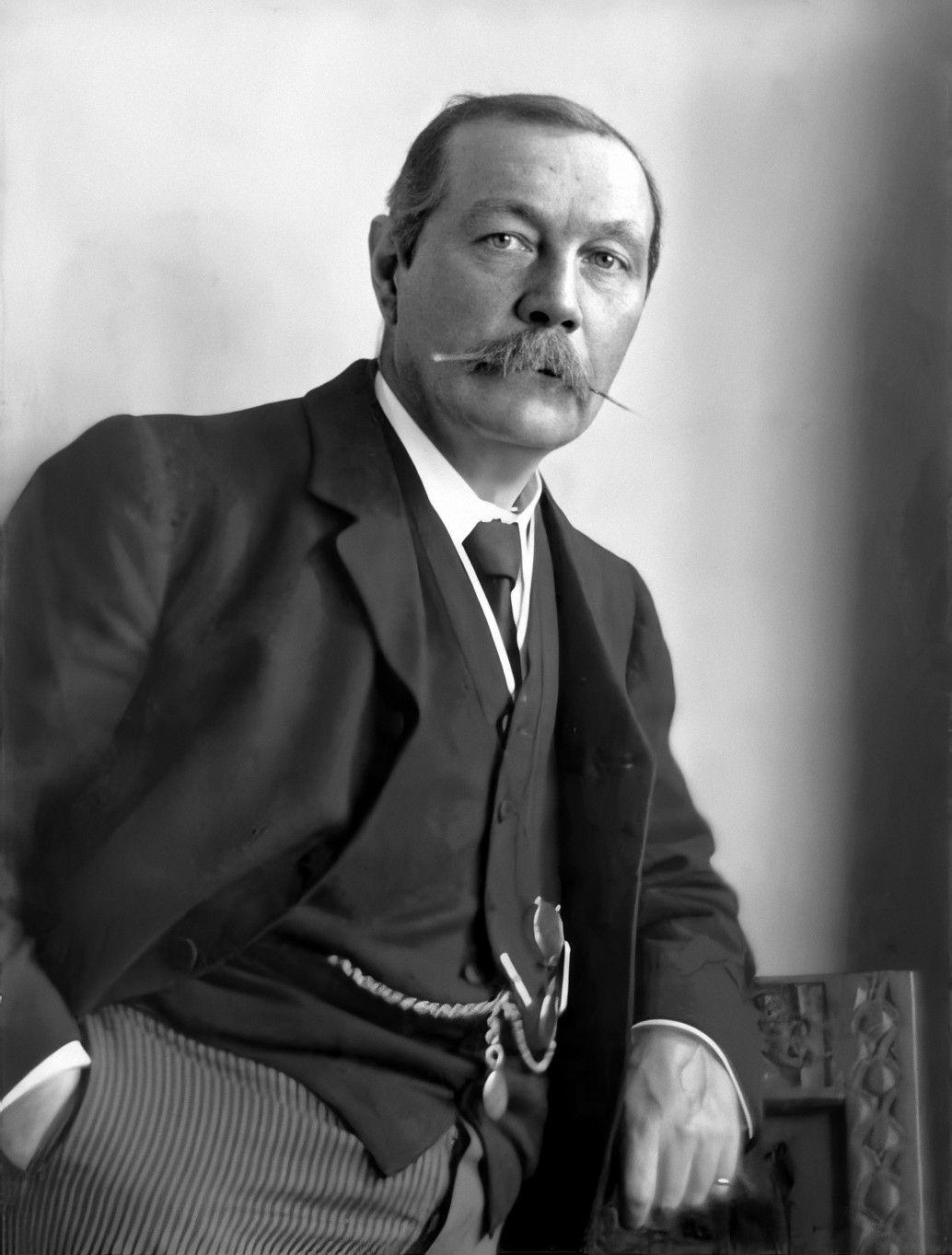
Sir Arthur Ignatius Conan Doyle (22 May 1859 – 7 July 1930) was a British writer and physician. He created the character Sherlock Holmes in 1887 for A Study in Scarlet, the first of four novels and fifty-six short stories about Holmes and Dr. Watson. The Sherlock Holmes stories are milestones in the field of crime fiction.
Doyle was a prolific writer. In addition to the Holmes stories, his works include fantasy and science fiction stories about Professor Challenger, and humorous stories about the Napoleonic soldier Brigadier Gerard, as well as plays, romances, poetry, non-fiction, and historical novels. One of Doyle's early short stories, "J. Habakuk Jephson's Statement" (1884), helped to popularise the mystery of the brigantine Mary Celeste, found drifting at sea with no crew member aboard.
Doyle is often referred to as "Sir Arthur Conan Doyle" or "Conan Doyle", implying that "Conan" is part of a compound surname rather than a middle name. However, his baptism entry in the register of St Mary's Cathedral, Edinburgh, gives "Arthur Ignatius Conan" as his given names and "Doyle" as his surname. It also names Michael Conan as his godfather. The catalogues of the British Library and the Library of Congress treat "Doyle" alone as his surname.
Steven Doyle, publisher of The Baker Street Journal, wrote: "Conan was Arthur's middle name. Shortly after he graduated from high school he began using Conan as a sort of surname. But technically his last name is simply 'Doyle'." When knighted, he was gazetted as Doyle, not under the compound Conan Doyle.
Doyle was born on 22 May 1859 at 11 Picardy Place, Edinburgh, Scotland. His father, Charles Altamont Doyle, was born in England, of Irish Catholic descent, and his mother, Mary (née Foley), was Irish Catholic. His parents married in 1855. In 1864, the family scattered because of Charles's growing alcoholism. The children were temporarily housed across Edinburgh. Arthur lodged with Mary Burton, the aunt of a friend, at Liberton Bank House on Gilmerton Road, while studying at Newington Academy.
In 1867, the family came together again and lived in squalid tenement flats at 3 Sciennes Place. Doyle's father died in 1893, in the Crichton Royal, Dumfries, after many years of psychiatric illness. Beginning at an early age, throughout his life Doyle wrote letters to his mother. Many of them were preserved.
Supported by wealthy uncles, Doyle was sent to England, to the Jesuit preparatory school Hodder Place, Stonyhurst in Lancashire, at the age of nine (1868–70). He went on to Stonyhurst College, which he attended until 1875. While Doyle was not unhappy at Stonyhurst, he said he did not have any fond memories of it because the school was run on medieval principles: the only subjects covered were rudiments, rhetoric, Euclidean geometry, algebra, and the classics. Doyle commented later in his life that this academic system could be excused only "on the plea that any exercise, however stupid in itself, forms a sort of mental dumbbell by which one can improve one's mind". He found the school harsh, noting that, instead of compassion and warmth, it favoured the threat of corporal punishment and ritual humiliation.
From 1875 to 1876, he was educated at the Jesuit school Stella Matutina in Feldkirch, Austria. His family decided that he would spend a year there in order to perfect his German and broaden his academic horizons. He was raised Catholic but later rejected the faith and became an agnostic. One source attributed his drift away from religion to the time he spent in the less strict Austrian school. He also later became a spiritualist mystic.
Hub AI
Arthur Conan Doyle AI simulator
(@Arthur Conan Doyle_simulator)
Arthur Conan Doyle
Sir Arthur Ignatius Conan Doyle (22 May 1859 – 7 July 1930) was a British writer and physician. He created the character Sherlock Holmes in 1887 for A Study in Scarlet, the first of four novels and fifty-six short stories about Holmes and Dr. Watson. The Sherlock Holmes stories are milestones in the field of crime fiction.
Doyle was a prolific writer. In addition to the Holmes stories, his works include fantasy and science fiction stories about Professor Challenger, and humorous stories about the Napoleonic soldier Brigadier Gerard, as well as plays, romances, poetry, non-fiction, and historical novels. One of Doyle's early short stories, "J. Habakuk Jephson's Statement" (1884), helped to popularise the mystery of the brigantine Mary Celeste, found drifting at sea with no crew member aboard.
Doyle is often referred to as "Sir Arthur Conan Doyle" or "Conan Doyle", implying that "Conan" is part of a compound surname rather than a middle name. However, his baptism entry in the register of St Mary's Cathedral, Edinburgh, gives "Arthur Ignatius Conan" as his given names and "Doyle" as his surname. It also names Michael Conan as his godfather. The catalogues of the British Library and the Library of Congress treat "Doyle" alone as his surname.
Steven Doyle, publisher of The Baker Street Journal, wrote: "Conan was Arthur's middle name. Shortly after he graduated from high school he began using Conan as a sort of surname. But technically his last name is simply 'Doyle'." When knighted, he was gazetted as Doyle, not under the compound Conan Doyle.
Doyle was born on 22 May 1859 at 11 Picardy Place, Edinburgh, Scotland. His father, Charles Altamont Doyle, was born in England, of Irish Catholic descent, and his mother, Mary (née Foley), was Irish Catholic. His parents married in 1855. In 1864, the family scattered because of Charles's growing alcoholism. The children were temporarily housed across Edinburgh. Arthur lodged with Mary Burton, the aunt of a friend, at Liberton Bank House on Gilmerton Road, while studying at Newington Academy.
In 1867, the family came together again and lived in squalid tenement flats at 3 Sciennes Place. Doyle's father died in 1893, in the Crichton Royal, Dumfries, after many years of psychiatric illness. Beginning at an early age, throughout his life Doyle wrote letters to his mother. Many of them were preserved.
Supported by wealthy uncles, Doyle was sent to England, to the Jesuit preparatory school Hodder Place, Stonyhurst in Lancashire, at the age of nine (1868–70). He went on to Stonyhurst College, which he attended until 1875. While Doyle was not unhappy at Stonyhurst, he said he did not have any fond memories of it because the school was run on medieval principles: the only subjects covered were rudiments, rhetoric, Euclidean geometry, algebra, and the classics. Doyle commented later in his life that this academic system could be excused only "on the plea that any exercise, however stupid in itself, forms a sort of mental dumbbell by which one can improve one's mind". He found the school harsh, noting that, instead of compassion and warmth, it favoured the threat of corporal punishment and ritual humiliation.
From 1875 to 1876, he was educated at the Jesuit school Stella Matutina in Feldkirch, Austria. His family decided that he would spend a year there in order to perfect his German and broaden his academic horizons. He was raised Catholic but later rejected the faith and became an agnostic. One source attributed his drift away from religion to the time he spent in the less strict Austrian school. He also later became a spiritualist mystic.
Recent media