
Recent from talks
Rocket artillery
Knowledge base stats:
Talk channels stats:
Members stats:
Rocket artillery
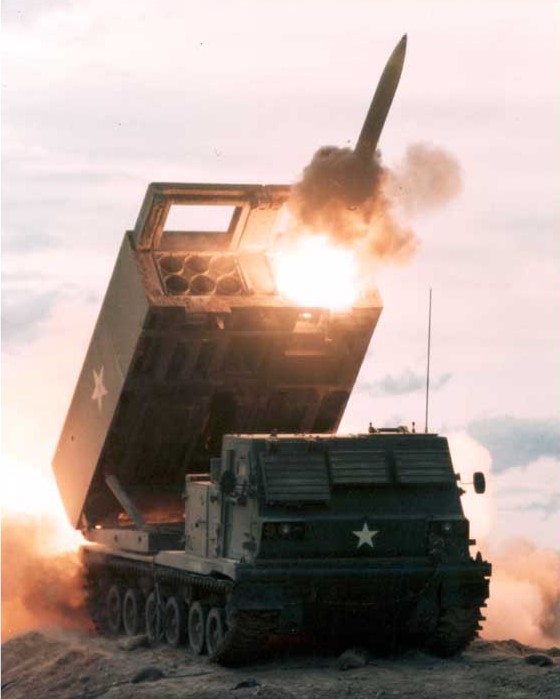
Rocket artillery is artillery that uses rockets as the projectile. The use of rocket artillery dates back to medieval China where devices such as fire arrows were used (albeit mostly as a psychological weapon). Fire arrows were also used in multiple launch systems and transported via carts. In the late nineteenth century, due to improvements in the power and range of conventional artillery, the use of early military rockets declined; they were finally used on a small scale by both sides during the American Civil War. Modern rocket artillery was first employed during World War II, in the form of the German Nebelwerfer family of rocket ordnance designs, Soviet Katyusha-series and numerous other systems employed on a smaller scale by the Western allies and Japan. In modern use, the rockets are often guided by an internal guiding system or GPS in order to maintain accuracy.
The use of rockets as some form of artillery dates back to medieval China where devices such as fire arrows were used (albeit mostly as a psychological weapon). Fire arrows were also used in multiple launch systems and transported via carts. Devices such as the Korean hwacha were able to fire hundreds of fire arrows simultaneously. The use of medieval rocket artillery was picked up by the invading Mongols and spread to the Ottoman Turks who in turn used them on the European battlefield.
The use of war-rockets is well documented in medieval Europe. In 1408 Duke John the Fearless of Burgundy used 300 incendiary rockets in the Battle of Othée. The city dwellers coped with this tactic by covering their roofs with dirt.
In the Mughal Empire under Akbar's reign during the 16th century, Mughal artillery rockets began to use metal casing, which made them more weatherproof and allowed a larger amount of gunpowder, increasing their destructive power. Mughal ban iron rockets were described by European visitors, including François Bernier who witnessed the 1658 Battle of Samugarh fought between brothers Aurangzeb and Dara Shikoh.
The earliest successful utilization of metal-cylinder rocket artillery is associated with the Kingdom of Mysore, South India. Tipu Sultan successfully established the powerful Sultanate of Mysore and introduced the first iron-cased metal-cylinder rocket. The Mysorean rockets of this period were innovative, chiefly because of the use of iron tubes that tightly packed the gunpowder propellant; this enabled higher thrust and longer range for the missile (up to 2 km range).
Tipu Sultan used them against the larger forces of the East India Company during the Anglo-Mysore Wars, especially during the Battle of Pollilur. Another battle where these missiles were deployed was the Battle of Sultanpet Tope, where Colonel Arthur Wellesley, later famous as the First Duke of Wellington, was almost defeated by Tipu's Diwan Purnaiah.
The rockets had a demoralizing effect on the enemy due to the noise and bursting light. The rockets could be of various sizes but usually consisted of a tube of soft hammered iron about 8 inches (20 cm) long and 1.5 to 3 inches (3.8 to 7.6 cm) in diameter, closed at one end and strapped to a shaft of bamboo about 4 ft (1 m) long. The iron tube acted as a combustion chamber and contained well-packed black powder propellant. A rocket carrying about one pound (~500 gm) of powder could travel almost 1,000 yards (~900 m).
According to Stephen Oliver Fought and John F. Guilmartin, Jr. in Encyclopædia Britannica (2008):
Hub AI
Rocket artillery AI simulator
(@Rocket artillery_simulator)
Rocket artillery
Rocket artillery is artillery that uses rockets as the projectile. The use of rocket artillery dates back to medieval China where devices such as fire arrows were used (albeit mostly as a psychological weapon). Fire arrows were also used in multiple launch systems and transported via carts. In the late nineteenth century, due to improvements in the power and range of conventional artillery, the use of early military rockets declined; they were finally used on a small scale by both sides during the American Civil War. Modern rocket artillery was first employed during World War II, in the form of the German Nebelwerfer family of rocket ordnance designs, Soviet Katyusha-series and numerous other systems employed on a smaller scale by the Western allies and Japan. In modern use, the rockets are often guided by an internal guiding system or GPS in order to maintain accuracy.
The use of rockets as some form of artillery dates back to medieval China where devices such as fire arrows were used (albeit mostly as a psychological weapon). Fire arrows were also used in multiple launch systems and transported via carts. Devices such as the Korean hwacha were able to fire hundreds of fire arrows simultaneously. The use of medieval rocket artillery was picked up by the invading Mongols and spread to the Ottoman Turks who in turn used them on the European battlefield.
The use of war-rockets is well documented in medieval Europe. In 1408 Duke John the Fearless of Burgundy used 300 incendiary rockets in the Battle of Othée. The city dwellers coped with this tactic by covering their roofs with dirt.
In the Mughal Empire under Akbar's reign during the 16th century, Mughal artillery rockets began to use metal casing, which made them more weatherproof and allowed a larger amount of gunpowder, increasing their destructive power. Mughal ban iron rockets were described by European visitors, including François Bernier who witnessed the 1658 Battle of Samugarh fought between brothers Aurangzeb and Dara Shikoh.
The earliest successful utilization of metal-cylinder rocket artillery is associated with the Kingdom of Mysore, South India. Tipu Sultan successfully established the powerful Sultanate of Mysore and introduced the first iron-cased metal-cylinder rocket. The Mysorean rockets of this period were innovative, chiefly because of the use of iron tubes that tightly packed the gunpowder propellant; this enabled higher thrust and longer range for the missile (up to 2 km range).
Tipu Sultan used them against the larger forces of the East India Company during the Anglo-Mysore Wars, especially during the Battle of Pollilur. Another battle where these missiles were deployed was the Battle of Sultanpet Tope, where Colonel Arthur Wellesley, later famous as the First Duke of Wellington, was almost defeated by Tipu's Diwan Purnaiah.
The rockets had a demoralizing effect on the enemy due to the noise and bursting light. The rockets could be of various sizes but usually consisted of a tube of soft hammered iron about 8 inches (20 cm) long and 1.5 to 3 inches (3.8 to 7.6 cm) in diameter, closed at one end and strapped to a shaft of bamboo about 4 ft (1 m) long. The iron tube acted as a combustion chamber and contained well-packed black powder propellant. A rocket carrying about one pound (~500 gm) of powder could travel almost 1,000 yards (~900 m).
According to Stephen Oliver Fought and John F. Guilmartin, Jr. in Encyclopædia Britannica (2008):
Recent media