Hubbry Logo
Fire arrowFire arrowMain
Open search
Fire arrow
Community hub
Fire arrow
logo
8 pages, 0 posts
0 subscribers
Be the first to start a discussion here.
Fire arrow
Fire arrow
from Wikipedia
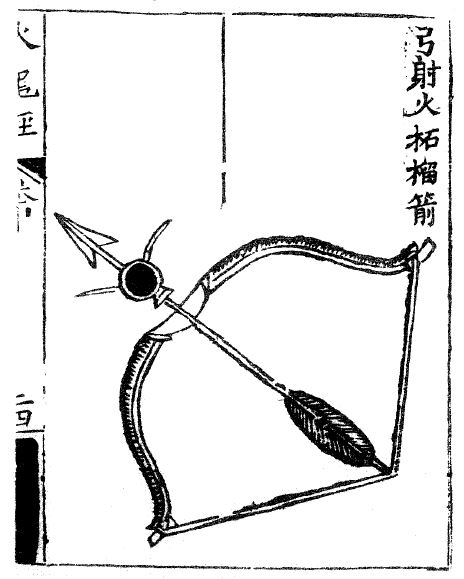
An arrow strapped with gunpowder ready to be shot from a bow. From the Huolongjing
Depiction of rocket arrows, from the Huolongjing. The right arrow reads 'fire arrow', the middle is an 'arrow frame in the shape of a dragon' and the left is a 'complete fire arrow'.

Fire arrows were one of the earliest forms of weaponized gunpowder, being used from the 9th century onward. Not to be confused with earlier incendiary arrow projectiles, the fire arrow was a gunpowder weapon which receives its name from the translated Chinese term huǒjiàn (火箭), which literally means fire arrow. In China, a 'fire arrow' referred to a gunpowder projectile consisting of a bag of incendiary gunpowder attached to the shaft of an arrow. Fire arrows are the predecessors of fire lances, the first firearm.[1]

Later rockets utilizing gunpowder were used to provide arrows with propulsive force and the term fire arrow became synonymous with rockets in the Chinese language. In other languages such as Sanskrit, 'fire arrow' (agni astra) underwent a different semantic shift and became synonymous with 'cannon'.[2]

Design

[edit]

Although the fire arrow is most commonly associated with its rocket mechanism,[3] it originally consisted of a pouch of gunpowder attached to an arrow. This type of fire arrow served the function of an incendiary and was launched using a bow or crossbow.

According to the Wujing Zongyao the fire arrow was constructed and used in the following manner:

Behind the arrow head wrap up some gunpowder with two or three layers of soft paper, and bind it to the arrow shaft in a lump shaped like a pomegranate. Cover it with a piece of hemp cloth tightly tied, and sealed fast with molten pine resin. Light the fuse and then shoot it off from a bow.[4]

Incendiary gunpowder weapons had an advantage over previous incendiaries by using their own built-in oxygen supply to create flames, and were therefore harder to put out, similar to Greek fire. However, unlike Greek fire, gunpowder's physical properties are solid rather than liquid, which makes it easier to store and load.[4]

The rocket propelled fire arrow appeared later. By the mid-14th century, rocket arrow launchers had appeared in the Ming dynasty and later on mobile rocket arrow launchers that were utilized in China and later spread to Korea. The fire arrows propelled by gunpowder may have had a range of up to 1,000 ft (300 m).[5]

History

[edit]
Arabic illustration showing a gunpowder arrow on the left, fireworks in the middle, and a midfa (fire lance or hand cannon) on the right, from Rzevuski MS, c. 1320-1350[6]
Two fire arrows (crossbow bolts). Southern Germany, ca. 15th century, with preserved incendiary mixture of charcoal, sulphur, saltpeter and textile on the shaft.

The fire arrows were first reported to have been used by the Southern Wu in 904 during the siege of Yuzhang.[1]

In 969, gunpowder propelled rocket arrows were invented by Yue Yifang and Feng Jisheng.[7]

In 975, the state of Wuyue sent a unit of soldiers skilled in the handling of fire arrows to the Song dynasty. In the same year, the Song used fire arrows to destroy the fleet of Southern Tang.[8]

Published in 1044, the Wujing Zongyao, or Complete Compendium of Military Classics, states that in 994, the city of Zitong was attacked by a Liao army of 100,000 men who were driven back by regular war machines and fire arrows.[8][9]

In 1083, Song records state that the court produced 350,000 fire arrows and sent them to two garrisons.[10]

On March 1, 1126, the Song general Li Gang used a fire arrow machine known as the Thunderbolt thrower during the Jingkang Incident.[11]

By 1127, the Jin were also using fire arrows produced by captured Song artisans.[12]

In 1159, fire arrows were used by the Song navy in sinking a Jin fleet.[13]

In 1161, the general Yu Yunwen used fire arrows at the Battle of Caishi, near present-day Ma'anshan, during a Jin maritime incursion.[14]

By 1206, "gunpowder arrows" (huoyaojian) rather than just "fire arrows" (huojian) were mentioned.[15]

In 1245, a military exercise was conducted on the Qiantang River using what were probably rockets.[16][15]

The Mongols also made use of the fire arrow during their campaigns in Japan. Probably as a result of the Mongolian military campaigns the fire arrows later spread into the Middle East, where they were mentioned by Al Hasan Al Ramma in the late 13th century.[17]

In 1374, the kingdom of Joseon also started producing gunpowder and by 1377, was producing cannons and fire arrows, which they used against wokou pirates.[18][19] Korean fire arrows were used against the Japanese during the invasion of Korea in 1592.[20]

In 1380, an order of "wasp nest" rocket arrow launchers were ordered by the Ming army and in 1400, rocket arrow launchers were recorded to have been used by Li Jinglong.[21]

In 1451, a type of mobile rocket arrow launcher known as the "Munjong Hwacha" was invented in Joseon.[22]

The Japanese version of the fire arrow was known as the bo hiya. The Japanese pirates (wokou, also known as wako or kaizoku) in the 16th century were reported to have used the bo hiya which had the appearance of a large arrow. A burning element made from incendiary waterproof rope was wrapped around the shaft and when lit the bo hiya was launched from a mortar like weapon hiya taihou or a wide bore Tanegashima matchlock arquebus. During one sea battle it was said the bo hiya were "falling like rain".[23]

Rocket invention

[edit]

The dating of the appearance of the gunpowder propelled fire arrow, otherwise known as a rocket, more specifically a solid-propellant rocket, is disputed. The History of Song attributes the invention to different people at different times, Yue Yifang and Feng Jisheng in 969 and Tang Fu in 1000. However, Joseph Needham argues that rockets could not have existed prior to the 12th century since the gunpowder formulas listed in the Wujing Zongyao are not suitable as rocket propellant.[24] According to Stephen G. Haw, there is only slight evidence that rockets existed prior to 1200 and it is more likely they were not produced or used for warfare until the latter half of the 13th century.[25]

[edit]

See also

[edit]

References

[edit]

Bibliography

[edit]
[edit]
Revisions and contributorsEdit on WikipediaRead on Wikipedia
from Grokipedia
A fire arrow is an incendiary weapon consisting of a standard fitted with a combustible material, such as pitch, , or cloth soaked in oil, attached to its head or shaft to ignite targets like wooden fortifications, ships, or enemy positions upon impact. These projectiles were launched using conventional bows or crossbows and relied on the 's to deliver and sustain flames, often enhanced with chemicals to produce hotter, more adhesive fires that were difficult to extinguish. The earliest archaeological evidence of fire arrows comes from the Assyrian in 701 BC, where reliefs depict their use by both Assyrians and Judeans. One of the early documented uses in Greek contexts dates to 480 BC, when Persian forces employed them during their invasion of to burn structures and ships. By 429 BC, during the , Spartan besiegers at used fire arrows wrapped in flammable fibers and treated with , creating toxic and intense blazes, as described by the historian ; defenders countered with wet animal hides to smother the flames. In the of Tyre in 332 BC, Alexander the Great's forces faced similar incendiary arrows from Phoenician defenders, highlighting their role in naval and siege tactics across civilizations. Fire arrows saw widespread adoption in , with evidence of their use in during the period (220–265 AD), where they were deployed against fortifications, though systematic accounts appear in the 10th century under the . By 1045 AD, Chinese military texts by Tseng Kung-Liang detailed the construction of fire arrows using gunpowder-infused paper tubes for propulsion, evolving them from simple incendiaries into early rocket-like weapons that could deliver flames over greater distances. In 1232 AD, during the defense of against Mongol invaders, forces barraged enemies with volleys of these enhanced fire arrows, demonstrating their tactical value in repelling cavalry charges and sieges. In medieval Europe and the , fire arrows remained a staple of warfare, often integrated with incendiary mixtures like —a petroleum-based substance—to target wooden engines and fleets, as seen in the defense of in 673 AD and 718 AD. Incendiary bolts coated in and were described in Roman military texts by the 4th century AD, such as by , while earlier variants like the Iberian had been used in antiquity. Despite their effectiveness against combustible targets, fire arrows had limitations, such as vulnerability to wind and rain, and were typically used sparingly alongside standard due to the preparation time required. Their legacy influenced the development of rockets and modern pyrotechnic weapons, underscoring the enduring role of incendiaries in .

Types and Design

Incendiary Arrows

Incendiary arrows represented one of the earliest forms of fire-based projectiles in ancient warfare, predating explosive enhancements and relying on simple flammable attachments to standard arrows for ignition purposes. These weapons typically featured combustible materials such as pitch, resin, oil-soaked rags, or animal fat secured to the arrowhead or along the shaft, which were ignited immediately before launch using a bow or crossbow. The design aimed to deliver a sustained flame upon impact, exploiting the arrow's velocity to spread fire to combustible targets. Construction techniques varied by culture but emphasized secure containment to prevent premature ignition while allowing airflow for combustion. Flammable substances were often bundled in cloth pouches or twisted wire baskets affixed near the arrowhead, enabling the fire to burn steadily during flight without significantly altering the arrow's aerodynamics. A notable example from Roman military texts describes fire darts made from hollow cane shafts filled with petroleum-based mixtures like bitumen or tar, reinforced with iron bands and punctured with small holes along the underside to supply oxygen; a small sack of the same material at the rear was lit before discharge, igniting the contents through friction and air rush. This method, documented in the 4th century CE, allowed for more intense and persistent burning compared to basic rag attachments. The primary purpose of incendiary arrows was to ignite structures, ships, or dry during sieges, creating chaos and forcing defenders to divert resources to . Their effectiveness stemmed from the psychological terror of fire and the potential for chain reactions in wooden fortifications or thatched roofs, though practical limitations included reduced range due to the added of incendiary loads—often halving effective —and the of flames spreading to the archer's bowstring or clothing if not carefully managed. In dry conditions, they proved particularly devastating against exposed targets, but wet weather or stone defenses diminished their impact. Specific historical examples illustrate their tactical role across ancient civilizations. During the Assyrian of the Judean city of Lachish in 701 BCE, both Assyrian attackers and Judean defenders deployed fire arrows, as evidenced by relief carvings from Sennacherib's palace depicting flaming projectiles launched toward the city gates and walls amid the broader assault involving rams and ramps. Greek forces, drawing from earlier Near Eastern traditions, adapted variants using tar-soaked fibers for hotter flames, while Romans incorporated compounds into resin mixtures to produce acrid smoke alongside fire, enhancing disruption in close-quarters engagements like urban s. These non-propulsive designs focused solely on ignition, contrasting with later explosive variants.

Gunpowder Fire Arrows

Gunpowder fire arrows marked a significant evolution in incendiary weaponry during the in , integrating as both an incendiary agent and a minor aid for ignition upon impact, distinguishing them from earlier non-explosive flaming arrows. Documented in the military compendium (1044 CE), these arrows transitioned simple projectile designs toward proto-explosive devices by attaching a contained charge to the shaft, which burst to spread flames and debris on striking a target. Launched from conventional bows or crossbows, the gunpowder provided a sudden ignition rather than sustained burning, enhancing destructive potential against fortifications, ships, or troop formations. The construction of gunpowder fire arrows emphasized secure containment and aerodynamic balance to ensure reliable flight and detonation. As detailed in the , the process began by wrapping a quantity of in 2–3 layers of soft paper to form a compact, pomegranate-shaped pouch positioned directly behind the , then binding it firmly to the shaft with thread. This pouch was further encased in cloth for reinforcement and sealed with molten to waterproof the assembly and prevent spillage or accidental sparking during handling or launch. A short fuse, often made from treated cord, was inserted to light the charge just before firing, allowing the powder to ignite mid-flight and detonate fully upon impact; careful attention to the pouch's weight—typically adding significant mass to the —required adjustments to and shaft length to preserve balance and accuracy. The composition for these arrows was an early incendiary variant optimized for rapid rather than high , typically comprising roughly 50% (saltpeter) as the oxidizer, 25% to lower the ignition temperature, and the balance or similar carbonaceous material to sustain the burn. Additional incendiary additives, such as extra , pine resin, and pitch, were incorporated in some formulations—often in approximate ratios like 4:2:1 for the coating—to amplify flammability and to targets, creating a more viscous, spreading fire on explosion. These mixtures were prepared in small batches to fit the pouch, with the providing multiple recipes tailored for "fire medicine" applications, emphasizing low-nitrate blends to prioritize incendiary effects over violent . Early fire arrows faced notable limitations that constrained their tactical utility, including reduced range—generally under 100 meters—stemming from the destabilizing weight of the pouch, which disrupted arrow and limited bow draw effectiveness. Instability in flight was common, exacerbated by uneven powder distribution or fuse variability, while the primary risk of premature ignition during loading or the brief aerial time posed dangers to the archer and reduced reliability in windy or damp conditions. These factors kept such arrows as specialized tools rather than versatile weapons until later refinements.

Rocket Fire Arrows

Rocket fire arrows were self-propelled incendiary projectiles that integrated systems with traditional arrow designs, enabling greater range and autonomy compared to bow-launched variants. The core design featured a hollow tube—initially constructed from or paper, and later reinforced with metal—filled with gunpowder propellant and securely attached to the arrow's shaft. This tube served as the rocket motor, ignited via a fuse at the base during launch to generate , while the incorporated an incendiary , often containing flammable materials like pitch or additional gunpowder charges, to set targets ablaze on impact. The composition mirrored basic —a mixture of saltpeter, , and —but was optimized for sustained propulsion through adjustments such as a slower achieved by varying particle sizes or additives, distinguishing it from explosive-focused formulations. Technical specifications varied, but 14th-century innovations documented in the military treatise included stabilizing fins or wing-like structures attached to the rocket body to enhance flight stability and accuracy during ascent. These designs allowed ranges extending several hundred meters, far surpassing unpropelled arrows, though exact distances depended on and wind conditions. Variants encompassed single-stage rockets, where a solitary tube propelled a single arrow, and multi-arrow launchers for . A prominent example was the Korean hwacha, developed in 1451 CE, which mounted up to 200 rocket arrows on a two-wheeled frame with drilled launch holes, enabling simultaneous ignition via a master fuse for rapid, area-saturating barrages. This launcher design emphasized mobility and coordinated deployment, with each singijeon arrow featuring an attached rocket tube similar to Chinese models but scaled for massed effect. Manufacturing processes prioritized safety through sealing techniques, such as tightly binding the propellant tube with cords or to prevent premature leaks or explosions during handling. Production occurred on a massive scale in state-controlled arsenals; for instance, Song dynasty records indicate that in 1083 CE, the imperial court manufactured and distributed 350,000 fire arrows to frontier garrisons, reflecting centralized efforts to standardize and mass-produce these weapons.

Historical Use

Origins in Ancient China

Incendiary fire arrows, without gunpowder propulsion, were used in as early as the period (220–265 CE). For instance, the Wei general Chi Shao employed fire arrows against and in attacks on Chen Cang. The earliest recorded use of -based fire arrows occurred in 904 CE during the siege of Yuzhang, where forces of the Southern Wu kingdom, under the command of warlord Yang Xingmi, employed incendiary arrows propelled by early mixtures to ignite enemy fortifications. These weapons marked one of the initial applications of in warfare, transitioning from purely incendiary devices to more effective projectiles by attaching small packets of the substance to arrow shafts for sustained burning upon impact. By the mid-10th century, fire arrows saw widespread adoption within the , particularly in 975 CE when Song naval forces utilized them alongside incendiary bombs to devastating effect against the fleet on the River, contributing to the rapid conquest and destruction of the rival state's armada. The invention of gunpowder-propelled variants is attributed to Song generals Yue Yifang and Feng Jisheng in 969 CE, though some historical accounts credit Tang Fu around 1000 CE; these developments enhanced range and incendiary power, allowing arrows to ignite targets from afar. These innovations were comprehensively documented in the , a pivotal 1044 CE military compendium compiled under Emperor Renzong, which outlined formulations for charges, arrow construction methods—including or wrappers filled with saltpeter, , and —and techniques such as standardized molding for warheads to equip large armies efficiently. In early tactics, fire arrows proved instrumental in naval engagements and sieges, as exemplified by their deployment during the in 1161 CE, where forces under Yu Yunwen launched volleys of these weapons from crossbows and trebuchets to set ablaze the invading Jin dynasty's fleet, securing a decisive victory through coordinated incendiary barrages that complemented traditional . scaled up during the era enabled thousands of arrows to be prepared in state arsenals, often bundled in quivers for rapid firing by specialized units. Within the broader cultural and military context of the dynasty's protracted conflicts, fire arrows integrated seamlessly with emerging armaments like fire lances—short-range flamethrowers—during the Song-Mongol wars of the 13th century, where they helped defend key cities such as in 1232 CE against Mongol assaults by creating walls of flame to disrupt cavalry charges and siege engines.

Adoption in Asia and Middle East

The technology of fire arrows, originating from ancient Chinese innovations, spread westward through the Mongol invasions of the 13th century, reaching the where it was adopted by the during sieges such as the 1258 sack of Baghdad, in which Mongol forces employed incendiary arrows alongside pots to ignite city defenses and structures. This transmission facilitated the integration of gunpowder-based incendiaries into regional warfare, as evidenced by the 1270s writings of Syrian engineer Hasan al-Rammah, who detailed various rocket-propelled fire arrows in his treatise The Book of Military Horsemanship and Ingenious War Devices, attributing their advanced forms to recent Eastern influences. Under the , these weapons enhanced siege capabilities against fortified positions in Persia and , combining Mongol mobility with local pyrotechnic expertise to target wooden fortifications and supply lines. In Korea, fire arrows were introduced in 1377 by inventor Choe Mu-seon, who developed formulations and early rocket variants known as singijeon to counter Japanese pirate raids, marking the first domestic production of such weapons in the dynasty. By 1451, King Munjong oversaw significant advancements, upgrading the —a cart-mounted — to fire up to 100 gunpowder-propelled arrows simultaneously, primarily for anti-cavalry roles in defensive battles against nomadic threats. This evolution transformed fire arrows from individual projectiles into volley systems, with the deployed in key engagements to disrupt enemy charges over ranges exceeding 100 meters, emphasizing area denial through incendiary barrages. Japanese adaptations emerged in the 16th century during the Sengoku period, where bo hiya rockets—thick, finned arrows with gunpowder charges and incendiary tips—were integrated into samurai archery traditions and naval tactics. These weapons, launched from hand-held tubes or larger cannons, were favored by warriors and pirates (wokou) for igniting wooden castles and ships, as seen in coastal defenses and battles like those during the Imjin War preparations. The bo hiya extended traditional yabusame archery by adding propulsion, allowing volleys to achieve greater destructive impact against clustered foes or fortifications without close engagement. In the , Ottoman and Persian forces adapted fire arrows from to 15th centuries, blending Mongol-derived rockets with indigenous incendiaries like for campaigns in and the . These regional tweaks prioritized incendiary effects over propulsion, reflecting local resource availability and tactical needs in prolonged sieges.

Applications in Europe and Other Regions

In , fire arrows were primarily employed as incendiary weapons rather than propelled explosives, consisting of arrows tipped with pitch, rags, or other flammable materials soaked in or resin to ignite structures during sieges. This non-gunpowder variant contrasted with the more advanced Asian designs, focusing on starting fires to weaken fortifications and force surrender. In the (1096–1291 CE), both Christian and Muslim armies frequently deployed flaming arrows; for instance, at the Siege of Acre (1189–1191 CE), Muslim defenders launched incendiary projectiles, including variants on arrows, against crusader camps and ships to counter assaults. Roman and Byzantine military traditions featured early forms of fire darts and arrows, often incorporating petroleum-based incendiaries for defensive purposes. In the CE, Roman historian described fire-darts—hollow cane shafts reinforced with iron and filled with or similar substances—used by Persian troops to set ablaze during of Amida in 359 CE. Byzantine forces continued this practice, employing incendiary arrows alongside in sieges to protect ; during the Fourth Crusade's assault in 1204 CE, defenders hurled flaming arrows and pots from the walls to repel crusader ladders and battering rams, though the city's fall ultimately overwhelmed these efforts. In other regions outside Asia, pre-gunpowder incendiary arrows appeared sporadically, adapted from local materials for tactical ignition. Scythian nomads of the Eurasian steppes (circa 7th–3rd centuries BCE) reportedly used arrows tipped with flammable substances, such as or pitch, in raids to burn enemy camps, though primary evidence is limited to Greek accounts of their archery prowess. In ancient , the (circa 4th century BCE) detailed recipes for incendiary arrows coated in materials like oil-soaked cloth or compounds, primarily to target war elephants and wooden fortifications by igniting panic and structural damage. Variants in the and , involving natural resins or animal fats bound to arrowheads, emerged but remained largely undocumented until European colonial encounters in the 16th–18th centuries, when observers noted their use by indigenous groups in defensive skirmishes against settlements. Tactically, these fire arrows in and other regions emphasized anti-fortification roles, launched in volleys to spread flames across palisades, thatched roofs, or supply stores, compelling defenders to divert resources to . Unlike Asian gunpowder variants imported later via Ottoman contacts, European adoption of explosive fire arrows remained rare in the 15th–16th centuries, limited to experimental uses in conflicts like the , where Ottoman-influenced rockets were tested but overshadowed by emerging cannons. Their prominence declined with the widespread deployment of gunpowder from the late 15th century onward, as cannons provided superior range and destructive power for breaching walls, rendering incendiary arrows obsolete in large-scale sieges.

Technological Evolution

Development of Propulsion Systems

The development of fire arrow propulsion began in the with simple attachments of gunpowder-filled pouches to traditional arrows, as described in the 1044 military text . These early designs involved wrapping in paper or silk behind the arrowhead, creating a burst pouch that ignited upon launch from a bow to provide supplementary and incendiary effect; this marked the transition from purely ballistic arrows to rocket-assisted variants used effectively in battles like the 1232 defense of against Mongol forces. By the 14th century, during the , propulsion systems evolved into more sophisticated enclosed structures, with the treatise detailing bamboo tubes filled with strapped to s, allowing for sustained and true rocketry principles through rearward expulsion of gases. Experiments with compositions, including variations in saltpeter, , and ratios, aimed at controlling burn rates to ensure stable flight trajectories rather than erratic bursts, reflecting iterative testing to balance duration and arrow integrity. Key innovations included stabilizing features such as extended feathers or rudimentary fins on the arrow shaft to counter rotational instability, alongside multi-stage concepts in the , like the huolongchushui ("fire dragon issuing from the water"), where initial booster stages ignited secondary s for extended range and payload delivery. Materials for containment advanced from fragile paper pouches, prone to premature rupture, to durable tubes sealed with or for better pressure management, enabling propellant refinements that extended effective ranges beyond 300 meters in tested configurations. Later variants incorporated metal reinforcements or casings around the to withstand higher pressures, improving reliability in field conditions. These evolutions prioritized conceptual efficiency over raw power, drawing on foundational applications while addressing the limitations of open-pouch designs. Significant challenges in these systems included sensitivity to , which could deflect arrows during prolonged phases, and ignition reliability, often compromised by inconsistent fuses or environmental moisture leading to misfires. Solutions involved refined tube geometries for more directed exhaust—such as slightly constricted openings to enhance —and protective coatings on fuses, though accuracy remained variable, with historical accounts noting frequent deviations in unguided flights. Testing in the era emphasized these issues through practical iterations, establishing fire arrows as precursors to dedicated rocketry while highlighting the trade-offs in early solid-propellant designs.

Influence on Early Rocketry

During the 13th to 15th centuries, fire arrows transitioned from bow-launched projectiles to independent systems, detaching from traditional mechanisms. This evolution began prominently in 1232 CE during the Battle of Kai-feng-fu, where Chinese forces employed "arrows of flying fire"—gunpowder-filled tubes attached to stabilizing sticks that propelled themselves without bows—successfully repelling Mongol invaders. These early fire dragon s, as they were later termed, represented a pivotal shift toward self-propelled weaponry, influencing subsequent designs that separated from arrow entirely by the . This technological detachment laid foundational precedents for later rocketry, directly inspiring 19th-century European developments such as the . British artillery officer adapted iron-cased rocket designs after encountering in during the late ; these Indian weapons, developed under and , traced their lineage to Chinese through Mongol transmission and regional innovations, featuring enhanced range and stability for battlefield barrages. also contributed to the global evolution of , transitioning from military incendiaries to celebratory displays as formulations improved for controlled bursts and aerial effects by the . In modern contexts, fire arrows inform historical reenactments and educational efforts, with replicas of Korean launchers—multiple-rocket systems firing fire arrows—demonstrated at sites like the to illustrate pre-modern artillery. Their incendiary nature has prompted safety analyses under , as Protocol III to the (1980) restricts the use of such weapons in civilian areas to prevent indiscriminate harm, a principle echoed in post-WWII bans on flame-based munitions. educational resources frequently reference fire arrows as the genesis of rocketry, highlighting their role in early propulsion experiments and contrasting them with liquid-fuel advancements.

References

Add your contribution
Related Hubs
User Avatar
No comments yet.