Hubbry Logo
Division algebraDivision algebraMain
Open search
Division algebra
Community hub
Division algebra
logo
7 pages, 0 posts
0 subscribers
Be the first to start a discussion here.
Division algebra
Division algebra
from Wikipedia

In the field of mathematics called abstract algebra, a division algebra is, roughly speaking, an algebra over a field in which division, except by zero, is always possible.

Definitions

[edit]

Formally, we start with a non-zero algebra D over a field. We call D a division algebra if for any element a in D and any non-zero element b in D there exists precisely one element x in D with a = bx and precisely one element y in D such that a = yb.

For associative algebras, the definition can be simplified as follows: a non-zero associative algebra over a field is a division algebra if and only if it has a multiplicative identity element 1 and every non-zero element a has a multiplicative inverse (i.e. an element x with ax = xa = 1).

Associative division algebras

[edit]

The best-known examples of associative division algebras are the finite-dimensional real ones (that is, algebras over the field R of real numbers, which are finite-dimensional as a vector space over the reals). The Frobenius theorem states that up to isomorphism there are three such algebras: the reals themselves (dimension 1), the field of complex numbers (dimension 2), and the quaternions (dimension 4).

Wedderburn's little theorem states that if D is a finite division algebra, then D is a finite field.[1]

Over an algebraically closed field K (for example the complex numbers C), there are no finite-dimensional associative division algebras, except K itself.[2]

Associative division algebras have no nonzero zero divisors. A finite-dimensional unital associative algebra (over any field) is a division algebra if and only if it has no nonzero zero divisors.

Whenever A is an associative unital algebra over the field F and S is a simple module over A, then the endomorphism ring of S is a division algebra over F; every associative division algebra over F arises in this fashion.

The center of an associative division algebra D over the field K is a field containing K. The dimension of such an algebra over its center, if finite, is a perfect square: it is equal to the square of the dimension of a maximal subfield of D over the center. Given a field F, the Brauer equivalence classes of simple (contains only trivial two-sided ideals) associative division algebras whose center is F and which are finite-dimensional over F can be turned into a group, the Brauer group of the field F.

One way to construct finite-dimensional associative division algebras over arbitrary fields is given by the quaternion algebras (see also quaternions).

For infinite-dimensional associative division algebras, the most important cases are those where the space has some reasonable topology. See for example normed division algebras and Banach algebras.

Not necessarily associative division algebras

[edit]

If the division algebra is not assumed to be associative, usually some weaker condition (such as alternativity or power associativity) is imposed instead. See algebra over a field for a list of such conditions.

Over the reals there are (up to isomorphism) only two unitary commutative finite-dimensional division algebras: the reals themselves, and the complex numbers. These are of course both associative. For a non-associative example, consider the complex numbers with multiplication defined by taking the complex conjugate of the usual multiplication:

This is a commutative, non-associative division algebra of dimension 2 over the reals, and has no unit element. There are infinitely many other non-isomorphic commutative, non-associative, finite-dimensional real divisional algebras, but they all have dimension 2.

In fact, every finite-dimensional real commutative division algebra is either 1- or 2-dimensional. This is known as Hopf's theorem, and was proved in 1940. The proof uses methods from topology. Although a later proof was found using algebraic geometry, no direct algebraic proof is known. The fundamental theorem of algebra is a corollary of Hopf's theorem.

Dropping the requirement of commutativity, Hopf generalized his result: Any finite-dimensional real division algebra must have dimension a power of 2.

Later work showed that in fact, any finite-dimensional real division algebra must be of dimension 1, 2, 4, or 8. This was independently proved by Michel Kervaire and John Milnor in 1958, again using techniques of algebraic topology, in particular K-theory. Adolf Hurwitz had shown in 1898 that the identity held only for dimensions 1, 2, 4 and 8.[3] (See Hurwitz's theorem.) The challenge of constructing a division algebra of three dimensions was tackled by several early mathematicians. Kenneth O. May surveyed these attempts in 1966.[4]

Any real finite-dimensional division algebra over the reals must be

  • isomorphic to R or C if unitary and commutative (equivalently: associative and commutative)
  • isomorphic to the quaternions if noncommutative but associative
  • isomorphic to the octonions if non-associative but alternative.

The following is known about the dimension of a finite-dimensional division algebra A over a field K:

  • dim A = 1 if K is algebraically closed,
  • dim A = 1, 2, 4 or 8 if K is real closed, and
  • If K is neither algebraically nor real closed, then there are infinitely many dimensions in which there exist division algebras over K.

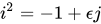
We may say an algebra A has multiplicative inverses if for any nonzero there is an element with . An associative algebra has multiplicative inverses if and only if it is a division algebra. However, this fails for nonassociative algebras. The sedenions are a nonassociative algebra over the real numbers that has multiplicative inverses, but is not a division algebra. On the other hand, we can construct a division algebra without multiplicative inverses by taking the quaternions and modifying the product, setting for some small nonzero real number while leaving the rest of the multiplication table unchanged. The element then has both right and left inverses, but they are not equal.

See also

[edit]

Notes

[edit]

References

[edit]
[edit]
Revisions and contributorsEdit on WikipediaRead on Wikipedia
from Grokipedia
A division algebra is a finite-dimensional algebra over a field in which every non-zero element admits a two-sided multiplicative inverse. These structures generalize fields by allowing non-commutative multiplication, though they retain the property that division by non-zero elements is always possible. Division algebras may or may not be associative, with the associative case corresponding to division rings or skew fields. Over the real numbers, the classification of finite-dimensional division algebras is governed by two fundamental theorems. The Frobenius theorem states that the only associative ones are the real numbers R\mathbb{R} (dimension 1), the complex numbers C\mathbb{C} (dimension 2), and the quaternions H\mathbb{H} (dimension 4). For the non-associative case, the Bott-Milnor-Kervaire theorem establishes that all finite-dimensional real division algebras have dimension 1, 2, 4, or 8, with the O\mathbb{O} providing the unique example in dimension 8. These algebras play a central role in various areas of mathematics and physics, including the study of normed division algebras, Clifford algebras, and spinor representations, as well as applications in , such as the parallelizability of spheres. Their multiplicative norms satisfy key inequalities like the Hurwitz theorem, which bounds the possible dimensions for real division algebras with compatible norms.

Basic Concepts

Definition

A division algebra over a field KK is a finite-dimensional AA over KK equipped with a bilinear operation, making AA into an over KK. The multiplication is KK-bilinear, meaning it is linear in each separately and compatible with from KK. The defining property is that division by nonzero elements is always possible: for every nonzero aAa \in A and every bAb \in A, the equations ax=ba x = b and ya=by a = b have unique solutions x,yAx, y \in A. Equivalently, the left multiplication map La:AAL_a: A \to A given by La(x)=axL_a(x) = a x and the right multiplication map Ra:AAR_a: A \to A given by Ra(x)=xaR_a(x) = x a are bijective linear endomorphisms of AA for all nonzero aAa \in A. This condition implies that every nonzero element has a unique two-sided . Division algebras are unital, possessing a multiplicative identity 1A1 \in A such that 1a=a1=a1 \cdot a = a \cdot 1 = a for all aAa \in A. In finite dimensions, this division property is equivalent to the absence of zero divisors: if x0x \neq 0 and y0y \neq 0 in AA, then xy0x y \neq 0. Division algebras generalize fields, which are commutative and associative division algebras of dimension 1 over themselves, by allowing non-commutativity and non-associativity in the multiplication. Formally, the division condition can be expressed as: for all a,bAa, b \in A with b0b \neq 0, there exists a unique cAc \in A such that a=bca = b c, and a unique dAd \in A such that a=dba = d b.

Properties

A division algebra over a field kk is characterized by the absence of zero divisors, meaning that for any elements a,ba, b in the algebra, if ab=0ab = 0, then either a=0a = 0 or b=0b = 0. This property ensures that the left and right multiplication maps La:xaxL_a: x \mapsto ax and Ra:xxaR_a: x \mapsto xa are bijective for every non-zero aa, distinguishing division algebras from more general algebras that may contain zero divisors. Every non-zero element aa in a division algebra is invertible, possessing both a left inverse bb such that ba=1ba = 1 and a right inverse cc such that ac=1ac = 1. In such structures, the left and right inverses coincide, yielding a unique two-sided inverse a1a^{-1} satisfying aa1=a1a=1.a a^{-1} = a^{-1} a = 1. This invertibility follows directly from the bijectivity of the maps and the ring-theoretic principle that elements with matching left and right inverses form units. Division algebras are finite-dimensional over their base field kk, such as R\mathbb{R} or C\mathbb{C}, as this finiteness enables key structural analyses in classical contexts.

Real Division Algebras

Frobenius Theorem

The Frobenius theorem states that, up to , the only finite-dimensional associative division algebras over the real numbers R\mathbb{R} are R\mathbb{R} itself ( 1), the complex numbers C\mathbb{C} ( 2), and the quaternions H\mathbb{H} ( 4). This classification highlights the rarity of such structures, as no associative division algebras over R\mathbb{R} exist in other finite s. The theorem was proved by in his 1877 paper "Über lineare Substitutionen und bilineare Formen." In this work, Frobenius analyzed bilinear forms and substitutions to derive the constraints on associative algebras without zero divisors. To illustrate the non-real cases, consider C\mathbb{C} as R\mathbb{R} where i2=1i^2 = -1. The quaternions H\mathbb{H} extend this to dimension 4 with basis {1,i,j,k}\{1, i, j, k\} over R\mathbb{R}, satisfying the relations i2=j2=k2=1,ij=k,jk=i,ki=j,ji=k,kj=i,ik=j.\begin{align*} i^2 &= j^2 = k^2 = -1, \\ ij &= k, \quad jk = i, \quad ki = j, \\ ji &= -k, \quad kj = -i, \quad ik = -j. \end{align*} These multiplication rules ensure H\mathbb{H} is associative and division, serving as the highest-dimensional example (detailed further in the section on examples and constructions). A sketch of the proof begins by noting that the center Z(A)Z(A) of such an AA (with RZ(A)\mathbb{R} \subseteq Z(A)) must be exactly R\mathbb{R}, as any larger commutative subfield would contradict the real-closed property of R\mathbb{R}. If AA is commutative, it is a field extension of R\mathbb{R}, hence isomorphic to R\mathbb{R} or C\mathbb{C} (the only finite extensions). For non-commutative AA, select iAZ(A)i \in A \setminus Z(A) with i2=1i^2 = -1; the centralizer CA(i)={aA[a,i]=aiia=0}C_A(i) = \{a \in A \mid [a, i] = ai - ia = 0\} is then isomorphic to C\mathbb{C}. If dimA>2\dim A > 2, find jACA(i)j \in A \setminus C_A(i) with j2=1j^2 = -1 and ji=ijji = -ij; setting k=ijk = ij yields the quaternion relations, forcing dimA=4\dim A = 4. Higher dimensions lead to contradictions via the anticommutativity and in the pure imaginary subspace {vAv2<0}\{v \in A \mid v^2 < 0\}. Thus, no associative real division algebras exist beyond dimension 4.

Composition Algebras

A composition algebra over the real numbers R\mathbb{R} is defined as a finite-dimensional unital algebra AA equipped with a non-degenerate quadratic form N:ARN: A \to \mathbb{R} such that N(ab)=N(a)N(b)N(ab) = N(a) N(b) for all a,bAa, b \in A. This multiplicative property of the norm extends the framework of to non-associative settings, where the quadratic form often arises from an inner product via N(a)=a,aN(a) = \langle a, a \rangle. Hurwitz's theorem classifies the normed division composition algebras over R\mathbb{R}, asserting that the only such algebras are the reals R\mathbb{R}, complexes C\mathbb{C}, quaternions H\mathbb{H}, and octonions O\mathbb{O}, occurring in dimensions 1, 2, 4, and 8, respectively. These algebras satisfy the division property, meaning every nonzero element has a multiplicative inverse, due to the positive-definiteness of the norm ensuring N(a)>0N(a) > 0 for a0a \neq 0. The theorem highlights the exceptional of these dimensions, as higher-dimensional attempts fail to preserve both the composition property and the division ring structure. The real, complex, quaternion, and octonion algebras exhibit key structural properties: they are alternative, meaning the subalgebra generated by any two elements is associative, and power-associative, where powers of a single element associate in any order. For the octonions O\mathbb{O}, the quadratic form is explicitly N(x)=xxˉN(x) = x \bar{x}, with xˉ\bar{x} denoting the standard conjugation that fixes the real part and negates the imaginary components. An illustrative counterexample beyond dimension 8 is the sedenion algebra S\mathbb{S}, the 16-dimensional extension of the octonions via the Cayley-Dickson construction, which admits zero divisors—nonzero elements a,ba, b with ab=0ab = 0—and thus fails to be a division algebra despite inheriting a similar norm structure. The octonions themselves are detailed further in the section on non-associative division algebras.

Associative Division Algebras

Division Rings

A , also known as a skew field, is an associative ring with unity in which every nonzero element has a . In the context of algebras over a field KK, an associative division algebra over KK is a division ring DD that is finite-dimensional as a over KK and has KK as its (i.e., the center of DD is KK). Such structures generalize fields while preserving the ability to perform division, but they may fail to be commutative. Wedderburn's little theorem establishes a fundamental restriction on the existence of non-commutative examples: every finite is commutative and hence a field. This result, proved in 1905, implies that non-commutative division rings must be infinite, highlighting the scarcity of such objects in finite settings. Over the real numbers, the only associative division algebras are the reals, complexes, and quaternions, as classified by the Frobenius theorem. Division rings with center KK play a central role in the theory of central simple algebras over KK, which are finite-dimensional associative KK-algebras that are simple as rings (having no nontrivial two-sided ideals) and have KK as their center. By the Artin-Wedderburn theorem, every central simple algebra is isomorphic to a matrix algebra over a unique (up to isomorphism) division ring with center KK, making such division rings the "maximal" or division form of central simple algebras. The Brauer group Br(K)\mathrm{Br}(K) classifies central simple algebras up to (i.e., tensor equivalence over KK), where the class of a division ring corresponds to the maximal order in the group, and the group operation is induced by the . A key invariant for elements in a central division algebra DD over KK is the reduced norm, defined as a Nrd:D×K×\mathrm{Nrd}: D^\times \to K^\times. For an element xD×x \in D^\times, the reduced norm is the of the KK- given by left by xx on the DD, viewed as a dimKD×dimKD\dim_K D \times \dim_K D matrix over a ; it generalizes the usual norm in field extensions and the in matrix algebras. The kernel of Nrd\mathrm{Nrd} consists precisely of elements whose left is singular over KK, providing a tool to study invertibility and ramification in number-theoretic contexts. For simple semisimple rings, the Artin-Wedderburn decomposition further specializes: a simple is isomorphic to the full Mn(D)M_n(D) over a DD, where DD is unique up to isomorphism.

Examples and Constructions

The real numbers R\mathbb{R} form the prototypical 1-dimensional associative division algebra over themselves, where multiplication is the standard field operation. The complex numbers C\mathbb{C} provide the next example, a 2-dimensional associative division algebra over R\mathbb{R} with basis {1,i}\{1, i\}, where i2=1i^2 = -1 and every nonzero element has a multiplicative inverse given by the usual complex conjugate formula. The quaternions H\mathbb{H} constitute a 4-dimensional associative division algebra over R\mathbb{R}, non-commutative but with every nonzero element invertible. They have basis {1,i,j,k}\{1, i, j, k\} satisfying the relations i2=j2=k2=1i^2 = j^2 = k^2 = -1, ij=kij = k, jk=ijk = i, ki=jki = j, and ji=kji = -k, kj=ikj = -i, ik=jik = -j. One explicit construction identifies H\mathbb{H} with pairs of complex numbers (z,w)(z, w) where z,wCz, w \in \mathbb{C}, equipped with componentwise addition and multiplication (z1,w1)(z2,w2)=(z1z2w2w1,z1w2+w1z2)(z_1, w_1)(z_2, w_2) = (z_1 z_2 - \overline{w_2} w_1, z_1 w_2 + w_1 \overline{z_2}). Over finite fields, Wedderburn's little theorem establishes that every finite associative division ring is commutative and thus a field; hence, the only examples are the finite fields Fq\mathbb{F}_q for prime powers qq. For general fields KK of characteristic not 2, quaternion algebras generalize H\mathbb{H}: the algebra (a,b)K(a, b)_K is the 4-dimensional central simple algebra over KK with basis {1,i,j,ij}\{1, i, j, ij\} satisfying i2=ai^2 = a, j2=bK×j^2 = b \in K^\times, and ji=ijji = -ij. This is a division algebra precisely when it does not split, i.e., is not isomorphic to the matrix algebra M2(K)M_2(K). Cyclic algebras provide higher-dimensional constructions of associative division algebras. For a field KK, a cyclic Galois extension L/KL/K of degree nn with Galois group generated by σ\sigma, and aK×a \in K^\times, the cyclic algebra (L/K,σ,a)(L/K, \sigma, a) (or (χ,a)n(\chi, a)_n where χ\chi generates the cyclic group) is the n2n^2-dimensional algebra over KK consisting of elements j=0n1xjuj\sum_{j=0}^{n-1} x_j u^j with xjLx_j \in L, subject to un=au^n = a and ux=σ(x)uu x = \sigma(x) u for xLx \in L. This is a division algebra if and only if aNL/K(L×)a \notin N_{L/K}(L^\times), where NL/KN_{L/K} is the relative norm map from L×L^\times to K×K^\times, with symbol algebras arising as special cases over fields supporting symbols in the Brauer group. Crossed product algebras offer a broader construction for associative division rings, potentially non-central. Given a L/KL/K with finite G=Gal(L/K)G = \mathrm{Gal}(L/K) and a 2-cocycle χ:G×GL×\chi: G \times G \to L^\times, the crossed product LχGL \rtimes_\chi G is the G2|G|^2-dimensional over KK with basis {eggG}\{e_g \mid g \in G\}, where addition is componentwise, egx=σg(x)ege_g x = \sigma_g(x) e_g for xLx \in L, and multiplication egeh=χ(g,h)eghe_g e_h = \chi(g, h) e_{gh}. This yields a division ring when the cocycle is non-trivial in a suitable sense, capturing many non-commutative examples over number fields.

Non-Associative Division Algebras

Alternative Algebras

Alternative algebras represent a class of non-associative algebras that impose a weaker condition than full associativity, yet retain many useful structural properties. Formally, an over a field FF is an AA equipped with a bilinear such that the left alternative (xx)y=x(xy)(xx)y = x(xy) and the right alternative y(xx)=(yx)xy(xx) = (yx)x hold for all x,yAx, y \in A. Equivalently, alternativity can be expressed via the associator [a,b,c]=(ab)ca(bc)[a, b, c] = (ab)c - a(bc), which vanishes whenever any two of the arguments a,b,ca, b, c are equal; that is, [x,x,y]=0[x, x, y] = 0 and [y,x,x]=0[y, x, x] = 0 for all x,yAx, y \in A. A key property of alternative algebras is that the subalgebra generated by any two elements is associative, ensuring that local behavior mimics associative structures. They are also power-associative, meaning the subalgebra generated by any single element is associative, which follows from the alternative laws. Alternative algebras satisfy the Moufang identities, such as (xy)a=x(yax)(xy)a = x(ya x) and a(xy)=(ax)ya(xy) = (a x)y for the left Moufang identity (with analogous right and flexible forms), providing additional symmetries that facilitate structural analysis. Moreover, alternative algebras are flexible, satisfying (xy)x=x(yx)(xy)x = x(yx) for all x,yAx, y \in A, a consequence of the alternative laws. In the context of division algebras, an alternative algebra over a field of characteristic not 2 or 3 with no zero divisors is a division algebra, where every nonzero element admits a two-sided inverse. Such structures inherit the flexibility and power-associativity properties, and their non-associativity is controlled by the alternator vanishing on repeated arguments. Notably, all finite-dimensional normed division algebras over the real numbers are alternative, encompassing the reals, complexes, quaternions, and octonions as the only examples. The octonions serve as a prime example of a non-associative alternative division algebra.

Octonions

The , denoted O\mathbb{O}, form the unique 8-dimensional real division algebra that is non-associative. They extend the quaternions H\mathbb{H} through the Cayley-Dickson construction, which doubles the dimension by introducing a new e7e_7 with the rule (a+be7)(c+de7)=(acdˉb)+(da+bcˉ)e7(a + b e_7)(c + d e_7) = (ac - \bar{d} b) + (d a + b \bar{c}) e_7, where ˉ\bar{\cdot} denotes conjugation in H\mathbb{H}. This process yields a basis {1,e1,,e7}\{1, e_1, \dots, e_7\} over R\mathbb{R}, where the first four elements span a copy of H\mathbb{H} and the remaining units satisfy specific anticommutation relations derived from the construction. The multiplication of basis elements eieje_i e_j (for i,j=1,,7i, j = 1, \dots, 7) is defined using the , a of order 2 that encodes the cyclic ordering and signs of products along its lines. Specifically, eiej=δij+k=17Cijkek,e_i e_j = -\delta_{ij} + \sum_{k=1}^7 C_{ijk} e_k, where δij\delta_{ij} is the and CijkC_{ijk} are totally antisymmetric determined by the geometry (e.g., e1e2=e4e_1 e_2 = e_4, e1e4=e2e_1 e_4 = -e_2). This multiplication is non-commutative and non-associative; for instance, (e1e2)e3=e6(e_1 e_2) e_3 = -e_6, while e1(e2e3)=e6e_1 (e_2 e_3) = e_6, illustrating the failure of associativity. The admit a multiplicative Euclidean norm N(x)=i=07xi2=xxˉN(x) = \sum_{i=0}^7 x_i^2 = x \bar{x}, where xˉ\bar{x} is the conjugate (real part plus negatives of imaginary parts), satisfying N(xy)=N(x)N(y)N(xy) = N(x) N(y) for all x,yOx, y \in \mathbb{O}. This norm ensures O\mathbb{O} is a division algebra, as nonzero elements have inverses x1=xˉ/N(x)x^{-1} = \bar{x} / N(x). The algebra is alternative, meaning it satisfies (xx)y=x(xy)(xx)y = x(xy) and (yxx)=(yx)x(yxx) = (yx)x for all elements, and power-associative, so subalgebras generated by single elements are associative. The of O\mathbb{O} is the exceptional G2G_2, which preserves the multiplication and norm. Octonions underpin the structure of exceptional groups like G2G_2, F4F_4, and E6E_6, where derivations and automorphisms arise from octonionic operations, providing a geometric foundation for these algebras in higher-dimensional .

Generalizations

Over Arbitrary Fields

Over the complex numbers C\mathbb{C}, which is an algebraically closed field, the only finite-dimensional associative division algebra is C\mathbb{C} itself. This result follows from the fact that any finite extension of an algebraically closed field is trivial, and thus any finite-dimensional division algebra over C\mathbb{C} must coincide with the base field, as it admits no nontrivial irreducible representations. A simpler analogue of the Frobenius theorem holds here, relying on the algebraic closure rather than detailed analysis of idempotents or involutions. Over finite fields Fq\mathbb{F}_q, every finite-dimensional associative division algebra is commutative and hence a of Fq\mathbb{F}_q. This is a consequence of Wedderburn's little theorem, which asserts that every finite is commutative. Consequently, non-commutative examples do not exist in this setting, and all such algebras are precisely the finite s. For pp-adic fields Qp\mathbb{Q}_p, the situation is richer: for each positive integer nn, there exists a unique central division algebra of degree nn up to . These are classified by the Brauer group Br(Qp)Q/Z\mathrm{Br}(\mathbb{Q}_p) \cong \mathbb{Q}/\mathbb{Z}, where the algebra of index nn corresponds to the class with invariant 1/nmod11/n \mod 1. This uniqueness stems from local and the cyclic nature of the Brauer group for non-archimedean local fields. In general, finite-dimensional central division algebras over an arbitrary field KK are classified up to by the Brauer group Br(K)\mathrm{Br}(K), where each nontrivial class contains a unique division representative. Over number fields, the group is often generated by algebras (χ,a)n( \chi, a )_n, which are cyclic algebras associated to a cyclic character χ\chi of Gal(L/K)\mathrm{Gal}(L/K) and an element aK×a \in K^\times, providing explicit constructions for many classes. Pfister forms play a role in this classification through their connection to the norm residue in , linking quadratic forms to 2-torsion elements in Br(K)\mathrm{Br}(K) via Merkurjev-Suslin theory. The degree of a central division DD over its KK is defined as deg(D)=dimKD\deg(D) = \sqrt{\dim_K D}
Add your contribution
Related Hubs
User Avatar
No comments yet.