


Community hub
Recent from talks
Contribute something
Nothing was collected or created yet.
Structure constants
View on Wikipedia


In mathematics, the structure constants or structure coefficients of an algebra over a field are the coefficients of the basis expansion (into linear combination of basis vectors) of the products of basis vectors. Because the product operation in the algebra is bilinear, by linearity knowing the product of basis vectors allows to compute the product of any elements (just like a matrix allows to compute the action of the linear operator on any vector by providing the action of the operator on basis vectors). Therefore, the structure constants can be used to specify the product operation of the algebra (just like a matrix defines a linear operator). Given the structure constants, the resulting product is obtained by bilinearity and can be uniquely extended to all vectors in the vector space, thus uniquely determining the product for the algebra.
Structure constants are used whenever an explicit form for the algebra must be given. Thus, they are frequently used when discussing Lie algebras in physics, as the basis vectors indicate specific directions in physical space, or correspond to specific particles (recall that Lie algebras are algebras over a field, with the bilinear product being given by the Lie bracket, usually defined via the commutator).
Definition
[edit]Given a set of basis vectors for the underlying vector space of the algebra, the product operation is uniquely defined by the products of basis vectors:

- .

The structure constants or structure coefficients are just the coefficients of in the same basis:


- .
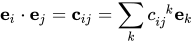
Otherwise said they are the coefficients that express as linear combination of the basis vectors .

The upper and lower indices are frequently not distinguished, unless the algebra is endowed with some other structure that would require this (for example, a pseudo-Riemannian metric, on the algebra of the indefinite orthogonal group so(p,q)). That is, structure constants are often written with all-upper, or all-lower indexes. The distinction between upper and lower is then a convention, reminding the reader that lower indices behave like the components of a dual vector, i.e. are covariant under a change of basis, while upper indices are contravariant.
The structure constants obviously depend on the chosen basis. For Lie algebras, one frequently used convention for the basis is in terms of the ladder operators defined by the Cartan subalgebra; this is presented further down in the article, after some preliminary examples.
Example: Lie algebras
[edit]For a Lie algebra, the basis vectors are termed the generators of the algebra, and the product rather called the Lie bracket (often the Lie bracket is an additional product operation beyond the already existing product, thus necessitating a separate name). For two vectors and in the algebra, the Lie bracket is denoted .


![{\displaystyle [A,B]}](https://wikimedia.org/api/rest_v1/media/math/render/svg/1993067bb075f2ebfa02e78959b7c5bed68e06f4)
Again, there is no particular need to distinguish the upper and lower indices; they can be written all up or all down. In physics, it is common to use the notation for the generators, and or (ignoring the upper-lower distinction) for the structure constants. The linear expansion of the Lie bracket of pairs of generators then looks like


- .
![{\displaystyle [T_{a},T_{b}]=\sum _{c}f_{ab}^{\;\;c}T_{c}}](https://wikimedia.org/api/rest_v1/media/math/render/svg/8e50d04a4503f35c95e183b3d82b990fb829a2b1)
Again, by linear extension, the structure constants completely determine the Lie brackets of all elements of the Lie algebra.
All Lie algebras satisfy the Jacobi identity. For the basis vectors, it can be written as
![{\displaystyle [T_{a},[T_{b},T_{c}]]+[T_{b},[T_{c},T_{a}]]+[T_{c},[T_{a},T_{b}]]=0}](https://wikimedia.org/api/rest_v1/media/math/render/svg/7cd3c047943acfec66f668eb6b405ee4d7027f02)
and this leads directly to a corresponding identity in terms of the structure constants:

The above, and the remainder of this article, make use of the Einstein summation convention for repeated indexes.
The structure constants play a role in Lie algebra representations, and in fact, give exactly the matrix elements of the adjoint representation. The Killing form and the Casimir invariant also have a particularly simple form, when written in terms of the structure constants.
The structure constants often make an appearance in the approximation to the Baker–Campbell–Hausdorff formula for the product of two elements of a Lie group. For small elements of the Lie algebra, the structure of the Lie group near the identity element is given by

![{\displaystyle \exp(X)\exp(Y)\approx \exp(X+Y+{\tfrac {1}{2}}[X,Y]).}](https://wikimedia.org/api/rest_v1/media/math/render/svg/0f8aebe7057d3a62a7bd7473592a9cb831980969)
Note the factor of 1/2. They also appear in explicit expressions for differentials, such as ; see Baker–Campbell–Hausdorff formula#Infinitesimal case for details.

Lie algebra examples
[edit]𝔰𝔲(2) and 𝔰𝔬(3)
[edit]The algebra of the special unitary group SU(2) is three-dimensional, with generators given by the Pauli matrices . The generators of the group SU(2) satisfy the commutation relations (where is the Levi-Civita symbol): where


![{\displaystyle [\sigma _{a},\sigma _{b}]=2i\varepsilon ^{abc}\sigma _{c}}](https://wikimedia.org/api/rest_v1/media/math/render/svg/e7db3c957e6dd15be0bbed9871641f5b0bf47715)

In this case, the structure constants are . Note that the constant 2i can be absorbed into the definition of the basis vectors; thus, defining , one can equally well write
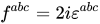

![{\displaystyle [t_{a},t_{b}]=\varepsilon ^{abc}t_{c}}](https://wikimedia.org/api/rest_v1/media/math/render/svg/c0b5ca81154daac2a8e82a052876b14c7763bf75)
Doing so emphasizes that the Lie algebra of the Lie group SU(2) is isomorphic to the Lie algebra of SO(3). This brings the structure constants into line with those of the rotation group SO(3). That is, the commutator for the angular momentum operators are then commonly written as where are written so as to obey the right hand rule for rotations in 3-dimensional space.

![{\displaystyle [L_{i},L_{j}]=\varepsilon ^{ijk}L_{k}}](https://wikimedia.org/api/rest_v1/media/math/render/svg/0fc651b044961890d0d46ffed06e9c3f892e6570)

The difference of the factor of 2i between these two sets of structure constants can be infuriating, as it involves some subtlety. Thus, for example, the two-dimensional complex vector space can be given a real structure. This leads to two inequivalent two-dimensional fundamental representations of , which are isomorphic, but are complex conjugate representations; both, however, are considered to be real representations, precisely because they act on a space with a real structure.[1] In the case of three dimensions, there is only one three-dimensional representation, the adjoint representation, which is a real representation; more precisely, it is the same as its dual representation, shown above. That is, one has that the transpose is minus itself:

In any case, the Lie groups are considered to be real, precisely because it is possible to write the structure constants so that they are purely real.
𝔰𝔲(3)
[edit]A less trivial example is given by SU(3):[2]
Its generators, T, in the defining representation, are:

where , the Gell-Mann matrices, are the SU(3) analog of the Pauli matrices for SU(2):

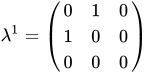
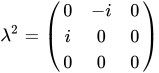
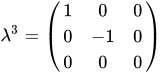
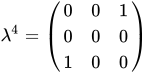
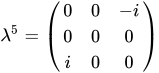
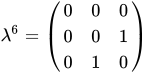
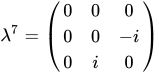
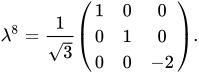
These obey the relations
![{\displaystyle \left[T^{a},T^{b}\right]=if^{abc}T^{c}\,}](https://wikimedia.org/api/rest_v1/media/math/render/svg/c1ae57c8b4abd049b22dc80cf66e6238f61c71ff)

The structure constants are totally antisymmetric. They are given by:


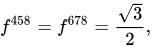
and all other not related to these by permuting indices are zero.
The d take the values:



𝔰𝔲(N)
[edit]For the general case of 𝔰𝔲(N), there exists closed formula to obtain the structure constant, without having to compute commutation and anti-commutation relations between the generators. We first define the generators of 𝔰𝔲(N), based on a generalisation of the Pauli matrices and of the Gell-Mann matrices (using the bra-ket notation where is the matrix unit). There are symmetric matrices,


- ,

anti-symmetric matrices,
- ,

and diagonal matrices,

- .

To differenciate those matrices we define the following indices:
- ,
- ,
- ,



with the condition .

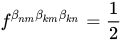
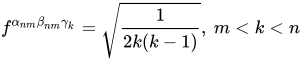
All the non-zero totally anti-symmetric structure constants are
- ,
- ,
- ,
- .


All the non-zero totally symmetric structure constants are
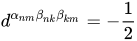
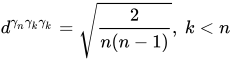
- ,
- ,
- ,
- ,
- ,
- ,
- ,
- .





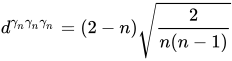
Examples from other algebras
[edit]Hall polynomials
[edit]The Hall polynomials are the structure constants of the Hall algebra.
Hopf algebras
[edit]In addition to the product, the coproduct and the antipode of a Hopf algebra can be expressed in terms of structure constants. The connecting axiom, which defines a consistency condition on the Hopf algebra, can be expressed as a relation between these various structure constants.
Applications
[edit]- A Lie group is abelian exactly when all structure constants are 0.
- A Lie group is real exactly when its structure constants are real.
- The structure constants are completely anti-symmetric in all indices if and only if the Lie algebra is a direct sum of simple compact Lie algebras.
- A nilpotent Lie group admits a lattice if and only if its Lie algebra admits a basis with rational structure constants: this is Malcev's criterion. Not all nilpotent Lie groups admit lattices; for more details, see also Raghunathan.[5]
- In quantum chromodynamics, the symbol represents the gauge covariant gluon field strength tensor, analogous to the electromagnetic field strength tensor, Fμν, in quantum electrodynamics. It is given by:[6] where fabc are the structure constants of SU(3). Note that the rules to push-up or pull-down the a, b, or c indexes are trivial, (+,... +), so that fabc = fabc = fa
bc whereas for the μ or ν indexes one has the non-trivial relativistic rules, corresponding e.g. to the metric signature (+ − − −).


Choosing a basis for a Lie algebra
[edit]One conventional approach to providing a basis for a Lie algebra is by means of the so-called "ladder operators" appearing as eigenvectors of the Cartan subalgebra. The construction of this basis, using conventional notation, is quickly sketched here. An alternative construction (the Serre construction) can be found in the article semisimple Lie algebra.
Given a Lie algebra , the Cartan subalgebra is the maximal Abelian subalgebra. By definition, it consists of those elements that commute with one-another. An orthonormal basis can be freely chosen on ; write this basis as with


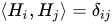
where is the inner product on the vector space. The dimension of this subalgebra is called the rank of the algebra. In the adjoint representation, the matrices are mutually commuting, and can be simultaneously diagonalized. The matrices have (simultaneous) eigenvectors; those with a non-zero eigenvalue are conventionally denoted by . Together with the these span the entire vector space . The commutation relations are then


![{\displaystyle [H_{i},H_{j}]=0\quad {\mbox{and}}\quad [H_{i},E_{\alpha }]=\alpha _{i}E_{\alpha }}](https://wikimedia.org/api/rest_v1/media/math/render/svg/027f36f1610dbc36d7ce8757ca0a497dbb130f91)
The eigenvectors are determined only up to overall scale; one conventional normalization is to set
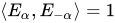
This allows the remaining commutation relations to be written as
![{\displaystyle [E_{\alpha },E_{-\alpha }]=\alpha _{i}H_{i}}](https://wikimedia.org/api/rest_v1/media/math/render/svg/2ffaf5f7103cee22ab11e6643e8dafbbb4a8e565)
and
![{\displaystyle [E_{\alpha },E_{\beta }]=N_{\alpha ,\beta }E_{\alpha +\beta }}](https://wikimedia.org/api/rest_v1/media/math/render/svg/e9c47510c0154478eb8413a39a1d7f62275d4313)
with this last subject to the condition that the roots (defined below) sum to a non-zero value: . The are sometimes called ladder operators, as they have this property of raising/lowering the value of .


For a given , there are as many as there are and so one may define the vector , this vector is termed a root of the algebra. The roots of Lie algebras appear in regular structures (for example, in simple Lie algebras, the roots can have only two different lengths); see root system for details.


The structure constants have the property that they are non-zero only when are a root. In addition, they are antisymmetric:


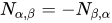
and can always be chosen such that

They also obey cocycle conditions:[7]

whenever , and also that


whenever .

References
[edit]- ^ Fulton, William; Harris, Joe (1991). Representation theory. A first course. Graduate Texts in Mathematics, Readings in Mathematics. Vol. 129. New York: Springer-Verlag. doi:10.1007/978-1-4612-0979-9. ISBN 978-0-387-97495-8. MR 1153249. OCLC 246650103.
- ^ Weinberg, Steven (1995). The Quantum Theory of Fields. Vol. 1 Foundations. Cambridge University Press. ISBN 0-521-55001-7.
- ^ Bossion, D.; Huo, P. (2021). "General Formulas of the Structure Constants in the 𝔰𝔲(N) Lie Algebra". arXiv:2108.07219 [math-ph].
- ^ Bossion, D.; Ying, W.; Chowdhury, S. N.; Huo, P. (2022). "Non-adiabatic mapping dynamics in the phase space of the SU(N) Lie group". J. Chem. Phys. 157 (8): 084105. Bibcode:2022JChPh.157h4105B. doi:10.1063/5.0094893. PMID 36049982. S2CID 251187368.
- ^ Raghunathan, Madabusi S. (2012) [1972]. "2. Lattices in Nilpotent Lie Groups". Discrete Subgroups of Lie Groups. Springer. ISBN 978-3-642-86428-5.
- ^ Eidemüller, M.; Dosch, H.G.; Jamin, M. (2000) [1999]. "The field strength correlator from QCD sum rules". Nucl. Phys. B Proc. Suppl. 86 (1–3): 421–5. arXiv:hep-ph/9908318. Bibcode:2000NuPhS..86..421E. doi:10.1016/S0920-5632(00)00598-3. S2CID 18237543.
- ^ Cornwell, J.F. (1984). Group Theory In Physics. Vol. 2 Lie Groups and their applications. Academic Press. ISBN 0121898040. OCLC 969857292.
Structure constants
View on GrokipediaFundamentals
General Definition
In mathematics, an algebra over a field is a vector space over equipped with a bilinear multiplication operation , often denoted by , where bilinearity means that is linear in each argument separately.[4] This structure generalizes rings by incorporating the vector space properties over , allowing scalar multiplication from to interact compatibly with the algebra's internal multiplication.[5] To express this multiplication explicitly, choose a basis for , where is a finite or infinite index set. The product of basis elements is then given by where the scalars are called the structure constants of the algebra with respect to this basis.[6] Due to bilinearity, the multiplication of any two elements and (with coefficients ) extends linearly as Thus, the structure constants fully determine the entire multiplication table of the algebra relative to the fixed basis.[6] The multiplication operation itself is an intrinsic, coordinate-free property of the algebra, independent of any basis choice.[7] However, the structure constants depend on the basis: under a change of basis, they transform according to the representation matrices of the new basis elements, abstracting the bilinear map into numerical coefficients that encode the algebra's structure in a specific coordinate system.[6] This basis-dependent formulation facilitates computations while preserving the underlying abstract nature of the multiplication. In specialized cases, such as Lie algebras, the bilinear operation takes the form of a skew-symmetric bracket.Historical Context
The concept of structure constants originated in the late 19th century with the work of Norwegian mathematician Sophus Lie (1842–1899), who pioneered the theory of continuous transformation groups as a tool for analyzing symmetries in differential equations. Lie's investigations into infinitesimal transformations led to the formulation of the Lie bracket operation on the tangent space at the identity, where the coefficients defining this bracket in a basis are precisely the structure constants, encapsulating the algebraic structure of these groups.[8] His seminal contributions, detailed in works such as Theorie der Transformationsgruppen (1888–1893), laid the foundational framework for what would become Lie algebras, though the explicit terminology and systematic use of structure constants developed later. A pivotal advancement occurred through the efforts of French mathematician Élie Cartan (1869–1951) between 1894 and 1900, who formalized the study of Lie algebras independently of the groups themselves and employed structure constants explicitly in the classification of simple Lie algebras. In his doctoral thesis, Sur la structure des groupes de transformations finis et continus (1894), Cartan utilized these constants to decompose algebras into root systems and Cartan subalgebras, confirming and extending Wilhelm Killing's earlier classifications by resolving inconsistencies and introducing invariant bilinear forms.[9] Over the following years, including in his 1900 memoir on infinite continuous groups, Cartan refined these tools to handle both finite-dimensional and more general cases, establishing structure constants as central to algebraic classification and symmetry analysis. In the early 20th century, particularly during the 1920s and 1930s, German mathematician Hermann Weyl (1885–1955) significantly expanded the role of structure constants in representation theory, integrating them into the study of compact semisimple Lie groups. Weyl's four landmark papers from 1925–1926 demonstrated how real-valued structure constants in suitable bases facilitate the complete reducibility of representations and the computation of characters via the Weyl character formula, bridging algebraic invariants with geometric and analytic properties.[10] His work, including the 1927 Peter–Weyl theorem, emphasized the Killing form—derived from structure constants—to identify Cartan subalgebras and root systems, influencing applications in quantum mechanics and crystallography.[11] Following World War II, structure constants gained prominence in quantum mechanics and particle physics, where they underpinned symmetry groups describing fundamental interactions. A key milestone was the independent introduction of SU(3) flavor symmetry by Murray Gell-Mann (1929–2019) and Yuval Ne'eman in 1961 to organize the growing zoo of hadrons, using the group's structure constants—embodied in the Gell-Mann matrices—to predict particle multiplets and decay patterns under the "eightfold way."[12][13] This framework, detailed in their 1961 papers, not only explained experimental data from accelerators but also paved the way for the quark model, earning Gell-Mann the 1969 Nobel Prize in Physics. Since the 1980s, advances in symbolic computation have transformed the handling of structure constants, enabling automated derivation and manipulation for high-dimensional Lie algebras beyond manual feasibility. Early algorithmic developments, such as those presented at the 1986 Symposium on Symbolic and Algebraic Computation, introduced methods for computing brackets and constants in systems like REDUCE and MACSYMA.[14] By the 1990s, packages in GAP and later MAGMA incorporated these techniques for semisimple cases, supporting classifications and representation computations with polynomial-time efficiency over symbolic fields.[15]Lie Algebras
Definition in Lie Algebras
A Lie algebra over a field (typically or ) is a vector space equipped with a bilinear map called the Lie bracket that satisfies two axioms: skew-symmetry, for all , and the Jacobi identity, for all .[16] These properties ensure that the bracket captures an infinitesimal version of the non-commutative multiplication in associated Lie groups.[16] Given a basis for the finite-dimensional Lie algebra , the structure constants (for ) are defined by expressing the Lie bracket of basis elements as a linear combination of the basis: The skew-symmetry of the bracket immediately implies that the structure constants are antisymmetric in the lower indices: for all .[16] These constants completely determine the Lie algebra structure, as the bracket of any two elements can be computed via linearity.[16] The Jacobi identity, when applied to basis elements, imposes a quadratic constraint on the structure constants. Specifically, for all indices , This relation ensures the associativity-like property of the bracket holds across the entire algebra. In certain contexts, particularly for semisimple or simple Lie algebras over , alternative notations for the structure constants are used to exploit additional symmetries. For instance, in the Lie algebra , the generators (with ) satisfy , where the are real structure constants that are totally antisymmetric in all three indices.[17] This normalization is common in physics applications, such as quantum chromodynamics, and highlights the complete antisymmetry arising from the properties of compact real forms.[17]Key Properties
The structure constants of a Lie algebra, defined by the Lie bracket in a basis , satisfy the antisymmetry relation for all indices , which follows directly from the antisymmetry of the Lie bracket .[18] In addition, these constants obey the Jacobi identity, which imposes a further constraint in cyclic permutations of the indices.[19] For simple Lie algebras over the complex numbers , the structure constants can be chosen to be totally antisymmetric, meaning (with lowered indices via the Killing form, as detailed below), when the basis is orthonormal with respect to an invariant bilinear form.[19] This total antisymmetry simplifies computations and reflects the underlying symmetry of the algebra. For compact real Lie algebras, such as those underlying compact Lie groups like SU(n) or SO(n), the structure constants are real and totally antisymmetric in an appropriate orthonormal basis.[20] The structure constants also encode the adjoint representation of the Lie algebra, where the action of basis elements on the algebra itself is given by , representing the linear maps .[19] In matrix form, the generators of the adjoint representation have elements (up to index conventions and signs depending on the basis).[17] A key invariant bilinear form associated with the Lie algebra is the Killing form (or Cartan-Killing form), defined as for in the algebra, which is symmetric and ad-invariant.[21] In terms of the structure constants and basis, the components are , providing a metric on the algebra that can be used to raise and lower indices.[22] For semisimple Lie algebras, the Killing form is non-degenerate, which implies that the algebra decomposes into a direct sum of simple ideals and allows the definition of root systems relative to a Cartan subalgebra, where roots are linear functionals determined by the adjoint action and the form's inner product structure.[22] This non-degeneracy is a hallmark property that distinguishes semisimple algebras from solvable or nilpotent ones and underpins the Cartan-Weyl classification of such algebras.[21]Examples
su(2) and so(3)
The Lie algebra consists of anti-Hermitian traceless matrices and admits a standard basis given by the generators for , where are the Pauli matrices: , , and .[23] The commutation relations in this basis are , where is the totally antisymmetric Levi-Civita symbol with , so the structure constants are .[23] The Lie algebra consists of real antisymmetric matrices and has a standard basis of rotation generators for , explicitly given by The commutation relations are , yielding structure constants .[23] The Lie algebras and are isomorphic, with the isomorphism mapping preserving the structure constants .[23] In physics applications, such as angular momentum in quantum mechanics and rigid body rotations in classical mechanics, normalization conventions often employ Hermitian generators for , leading to and structure constants incorporating a factor of , or rescale by factors of 2 to match trace normalizations like .[24] Since both algebras are three-dimensional, their adjoint representation is the three-dimensional defining representation of , where the generators act as the explicit matrices above; the matrix elements of the adjoint representation satisfy , directly encoding the structure constants.[23]su(3)
The su(3) Lie algebra, underlying the special unitary group SU(3), is an 8-dimensional real Lie algebra realized in the physics convention by Hermitian traceless generators (for ), where the Lie algebra elements are (anti-Hermitian), and the are the Gell-Mann matrices. These satisfy the commutation relations , with summation over repeated indices implied, and the structure constants are real and totally antisymmetric in all indices. The Gell-Mann matrices are explicitly: This basis is normalized such that .[25] The structure constants fully determine the algebra, with all non-zero values (up to antisymmetric permutations) listed in the following table for the ordered indices in the standard physics convention:| 123 | 1 | 367 | |
| 147 | -1/2 | 458 | |
| 156 | 678 | ||
| 246 | -1/2 | ||
| 257 | -1/2 | ||
| 345 | -1/2 |