
Recent from talks
Moine Thrust Belt
Knowledge base stats:
Talk channels stats:
Members stats:
Moine Thrust Belt
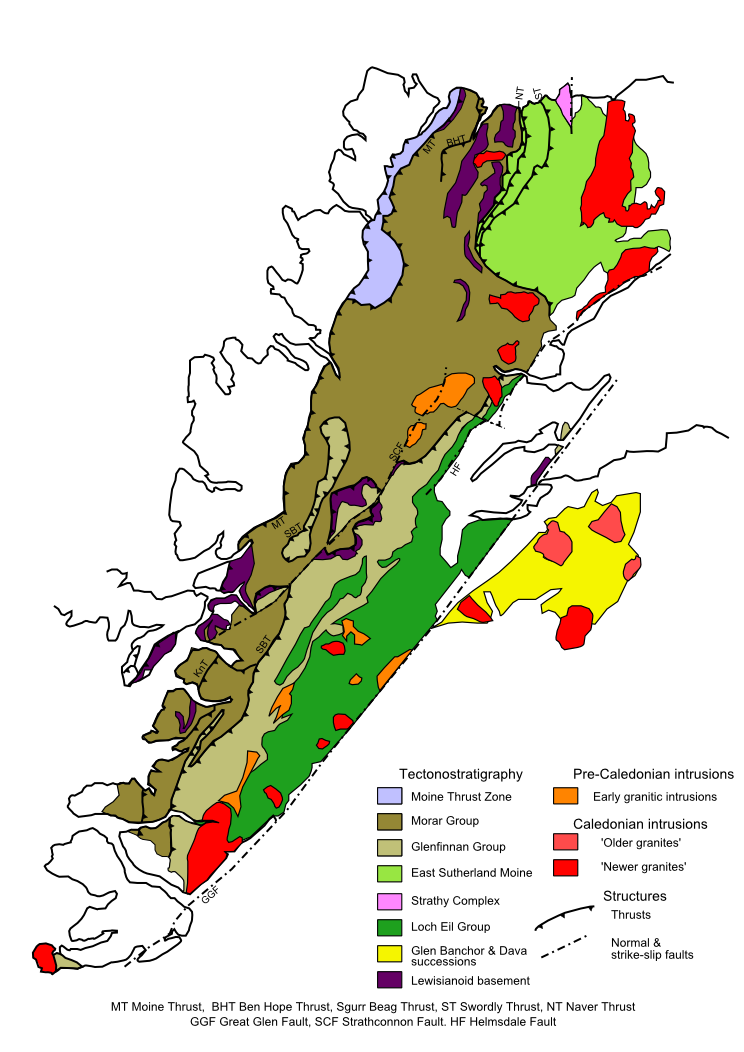
The Moine Thrust Belt or Moine Thrust Zone is a linear tectonic feature in the Scottish Highlands which runs from Loch Eriboll on the north coast 190 kilometres (120 mi) southwest to the Sleat peninsula on the Isle of Skye. The thrust belt consists of a series of thrust faults that branch off the Moine Thrust itself. Topographically, the belt marks a change from rugged, terraced mountains with steep sides sculptured from weathered igneous, sedimentary and metamorphic rocks in the west to an extensive landscape of rolling hills over a metamorphic rock base to the east. Mountains within the belt display complexly folded and faulted layers and the width of the main part of the zone varies up to ten kilometres (six miles), although it is significantly wider on Skye.
The presence of metamorphic gneisses and schists lying apparently stratigraphically above sedimentary rocks of lower Paleozoic age in the Northwest Highlands had been known since the early 19th century, convincing Roderick Murchison that the change was a purely metamorphic effect and that the upper gneiss was younger than the sediments beneath. Initially he was supported in this interpretation by Archibald Geikie and James Nicol. After further fieldwork, Nicol changed his mind and advocated instead that the contact at the base of the upper gneisses was tectonic, starting what was known as the Highlands Controversy. A tectonic interpretation was supported by, amongst others, Charles Lapworth who had corresponded with Albert Heim on similar structures in the Alps.
In 1883 and 1884 the survey geologists Ben Peach and John Horne were sent into the area by the survey's director Archibald Geikie to carry out detailed mapping. The results of the mapping proved conclusively to Peach and Horne that the contact was tectonic and they were eventually able to persuade Geikie when he visited them briefly in the field in October 1884. In November that year Peach and Horne's preliminary results were published and Geikie published a paper in the same issue of Nature in which he coined the term "thrust-plane" for these low-angle faults, although the term was probably already in use before then. By 1888 the term "Moine Thrust" was being used for the tectonic break at the base of Moine schists (what is now called the Morar Group of the Wester Ross Supergroup). The recognition of the Moine Thrust Belt in the early 1880s was a milestone in the history of geology as it was one of the first thrust belts discovered and where the importance of large scale horizontal rather than vertical movements became apparent. Detailed mapping of the Moine Thrust Belt by the survey continued for another two decades, culminating in the classic survey memoir The Geological Structure of the North-West Highlands of Scotland, published in 1907.
The Moine Thrust Belt was formed during the Scandian orogenic phase Caledonian Orogeny cycle as part of the collision between Laurentia and Baltica. It is the most westerly Scandian structure in Scotland apart from the Outer Isles Fault in the Outer Hebrides, which is developed within the Hebridean terrane. The Moine Thrust Belt defines the boundary between the Hebridean terrane to its northwest and the Northern Highlands terrane to its southeast. The thrust carried metamorphic material over 200 km across Scotland entirely masking the geology of the previous terrane. However, small windows, such as the Assynt window and the Glen Achall imbricated thrust system, allow geologists to estimate what the geology of Scotland was like before the Caledonian Orogeny.
The relationship between the Moine Thrust Belt and other Scandian age structures in Scandinavia and East Greenland remains unclear, due to uncertainties associated with the Great Glen Fault zone. This major sinistral (left-lateral) strike-slip fault was also active during the late stages of the orogeny, but continued to move during the early Devonian and appears to truncate the southern end of the thrust belt. The total late Caledonian displacement on the Great Glen Fault is poorly constrained, making reconstruction of the southern part of the orogenic belt difficult.
The stratigraphic sequence of the footwall of the Moine Thrust is the full sequence characteristic of the Hebridean terrane.
The Lewisian complex consists of mainly granitic gneisses that are of Archaean and Paleoproterozoic age. They form the basement to both the Stoer Group, the Wester Ross Supergroup and the Loch Ness Supergroup of the Northern Highlands terrane, in both the footwall and hanging wall of the Moine Thrust.
The Torridon and Sleat groups are of Neoproterozoic age and consists mainly of sandstone with a maximum preserved thickness of over 8 km. The unconformity at the base of these groups is highly irregular, showing that it was deposited on an eroded land surface.
Hub AI
Moine Thrust Belt AI simulator
(@Moine Thrust Belt_simulator)
Moine Thrust Belt
The Moine Thrust Belt or Moine Thrust Zone is a linear tectonic feature in the Scottish Highlands which runs from Loch Eriboll on the north coast 190 kilometres (120 mi) southwest to the Sleat peninsula on the Isle of Skye. The thrust belt consists of a series of thrust faults that branch off the Moine Thrust itself. Topographically, the belt marks a change from rugged, terraced mountains with steep sides sculptured from weathered igneous, sedimentary and metamorphic rocks in the west to an extensive landscape of rolling hills over a metamorphic rock base to the east. Mountains within the belt display complexly folded and faulted layers and the width of the main part of the zone varies up to ten kilometres (six miles), although it is significantly wider on Skye.
The presence of metamorphic gneisses and schists lying apparently stratigraphically above sedimentary rocks of lower Paleozoic age in the Northwest Highlands had been known since the early 19th century, convincing Roderick Murchison that the change was a purely metamorphic effect and that the upper gneiss was younger than the sediments beneath. Initially he was supported in this interpretation by Archibald Geikie and James Nicol. After further fieldwork, Nicol changed his mind and advocated instead that the contact at the base of the upper gneisses was tectonic, starting what was known as the Highlands Controversy. A tectonic interpretation was supported by, amongst others, Charles Lapworth who had corresponded with Albert Heim on similar structures in the Alps.
In 1883 and 1884 the survey geologists Ben Peach and John Horne were sent into the area by the survey's director Archibald Geikie to carry out detailed mapping. The results of the mapping proved conclusively to Peach and Horne that the contact was tectonic and they were eventually able to persuade Geikie when he visited them briefly in the field in October 1884. In November that year Peach and Horne's preliminary results were published and Geikie published a paper in the same issue of Nature in which he coined the term "thrust-plane" for these low-angle faults, although the term was probably already in use before then. By 1888 the term "Moine Thrust" was being used for the tectonic break at the base of Moine schists (what is now called the Morar Group of the Wester Ross Supergroup). The recognition of the Moine Thrust Belt in the early 1880s was a milestone in the history of geology as it was one of the first thrust belts discovered and where the importance of large scale horizontal rather than vertical movements became apparent. Detailed mapping of the Moine Thrust Belt by the survey continued for another two decades, culminating in the classic survey memoir The Geological Structure of the North-West Highlands of Scotland, published in 1907.
The Moine Thrust Belt was formed during the Scandian orogenic phase Caledonian Orogeny cycle as part of the collision between Laurentia and Baltica. It is the most westerly Scandian structure in Scotland apart from the Outer Isles Fault in the Outer Hebrides, which is developed within the Hebridean terrane. The Moine Thrust Belt defines the boundary between the Hebridean terrane to its northwest and the Northern Highlands terrane to its southeast. The thrust carried metamorphic material over 200 km across Scotland entirely masking the geology of the previous terrane. However, small windows, such as the Assynt window and the Glen Achall imbricated thrust system, allow geologists to estimate what the geology of Scotland was like before the Caledonian Orogeny.
The relationship between the Moine Thrust Belt and other Scandian age structures in Scandinavia and East Greenland remains unclear, due to uncertainties associated with the Great Glen Fault zone. This major sinistral (left-lateral) strike-slip fault was also active during the late stages of the orogeny, but continued to move during the early Devonian and appears to truncate the southern end of the thrust belt. The total late Caledonian displacement on the Great Glen Fault is poorly constrained, making reconstruction of the southern part of the orogenic belt difficult.
The stratigraphic sequence of the footwall of the Moine Thrust is the full sequence characteristic of the Hebridean terrane.
The Lewisian complex consists of mainly granitic gneisses that are of Archaean and Paleoproterozoic age. They form the basement to both the Stoer Group, the Wester Ross Supergroup and the Loch Ness Supergroup of the Northern Highlands terrane, in both the footwall and hanging wall of the Moine Thrust.
The Torridon and Sleat groups are of Neoproterozoic age and consists mainly of sandstone with a maximum preserved thickness of over 8 km. The unconformity at the base of these groups is highly irregular, showing that it was deposited on an eroded land surface.
Recent media