
Recent from talks
Asteroid impact prediction
Knowledge base stats:
Talk channels stats:
Members stats:
Asteroid impact prediction
Asteroid impact prediction is the prediction of the dates and times of asteroids impacting Earth, along with the locations and severities of the impacts.
The process of impact prediction follows three major steps:
The usual purpose of predicting an impact is to direct an appropriate response.
Most asteroids are discovered by a camera on a telescope with a wide field of view. Image differencing software compares a recent image with earlier ones of the same part of the sky, detecting objects that have moved, brightened, or appeared. Those systems usually obtain a few observations per night, which can be linked up into a very preliminary orbit determination. This predicts approximate positions over the next few nights, and follow-ups can then be carried out by any telescope powerful enough to see the newly detected object. Orbit intersection calculations are then carried out by two independent systems, one (Sentry) run by NASA and the other (NEODyS) by ESA.
Current systems only detect an arriving object when several factors are just right, mainly the direction of approach relative to the Sun, the weather, and phase of the Moon. The overall success rate is around 1% and is lower for the smaller objects.[clarification needed] A few near misses by medium-size asteroids have been predicted years in advance, with a tiny chance of striking Earth, and a handful of small impactors have successfully been detected hours in advance. All of the latter struck wilderness or ocean, and hurt no one. The majority of impacts are by small, undiscovered objects. They rarely hit a populated area, but can cause widespread damage when they do. Performance is improving in detecting smaller objects as existing systems are upgraded and new ones come on line, but all current systems have a blind spot around the Sun that can only be overcome by a dedicated space based system or by discovering objects on a previous approach to Earth many years before a potential impact.
In 1992 a report to NASA recommended a coordinated survey (christened Spaceguard) to discover, verify and provide follow-up observations for Earth-crossing asteroids. This survey was scaled to discover 90% of all objects larger than one kilometer within 25 years. Three years later, a further NASA report recommended search surveys that would discover 60–70% of the short-period, near-Earth objects larger than one kilometer within ten years and obtain 90% completeness within five more years.
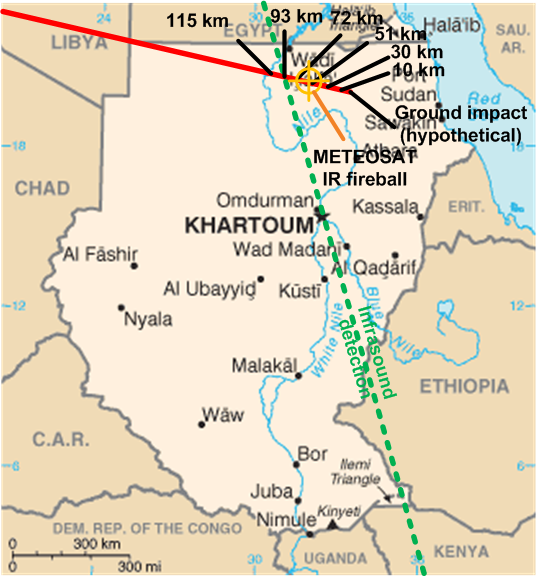
In 1998, NASA formally embraced the goal of finding and cataloging, by 2008, 90% of all near-Earth objects (NEOs) with diameters of 1 km or larger that could represent a collision risk to Earth. The 1 km diameter metric was chosen after considerable study indicated that an impact of an object smaller than 1 km could cause significant local or regional damage but is unlikely to cause a worldwide catastrophe. The impact of an object much larger than 1 km diameter could well result in worldwide damage up to, and potentially including, extinction of the human race. The NASA commitment has resulted in the funding of a number of NEO search efforts, which made considerable progress toward the 90% goal by the target date of 2008 and also produced the first ever successful prediction of an asteroid impact (the 4-meter 2008 TC3 was detected 19 hours before impact). However, the 2009 discovery of several NEOs approximately 2 to 3 kilometers in diameter (e.g. 2009 CR2, 2009 HC82, 2009 KJ, 2009 MS and 2009 OG) demonstrated there were still large objects to be detected.
Three years later, in 2012, the 40 meter diameter asteroid 367943 Duende was discovered and successfully predicted to be on close but non-colliding approach to Earth again just 11 months later. This was a landmark prediction as the object was only 20 m × 40 m, and it was closely monitored as a result. On the day of its closest approach and by coincidence, a smaller asteroid was also approaching Earth, unpredicted and undetected, from a direction close to the Sun. Unlike 367943 Duende it was on a collision course and it impacted Earth 16 hours before 367943 Duende passed, becoming the Chelyabinsk meteor. It injured 1,500 people and damaged over 7,000 buildings, raising the profile of the dangers of even small asteroid impacts if they occur over populated areas. The asteroid is estimated to have been 17 m across.
Hub AI
Asteroid impact prediction AI simulator
(@Asteroid impact prediction_simulator)
Asteroid impact prediction
Asteroid impact prediction is the prediction of the dates and times of asteroids impacting Earth, along with the locations and severities of the impacts.
The process of impact prediction follows three major steps:
The usual purpose of predicting an impact is to direct an appropriate response.
Most asteroids are discovered by a camera on a telescope with a wide field of view. Image differencing software compares a recent image with earlier ones of the same part of the sky, detecting objects that have moved, brightened, or appeared. Those systems usually obtain a few observations per night, which can be linked up into a very preliminary orbit determination. This predicts approximate positions over the next few nights, and follow-ups can then be carried out by any telescope powerful enough to see the newly detected object. Orbit intersection calculations are then carried out by two independent systems, one (Sentry) run by NASA and the other (NEODyS) by ESA.
Current systems only detect an arriving object when several factors are just right, mainly the direction of approach relative to the Sun, the weather, and phase of the Moon. The overall success rate is around 1% and is lower for the smaller objects.[clarification needed] A few near misses by medium-size asteroids have been predicted years in advance, with a tiny chance of striking Earth, and a handful of small impactors have successfully been detected hours in advance. All of the latter struck wilderness or ocean, and hurt no one. The majority of impacts are by small, undiscovered objects. They rarely hit a populated area, but can cause widespread damage when they do. Performance is improving in detecting smaller objects as existing systems are upgraded and new ones come on line, but all current systems have a blind spot around the Sun that can only be overcome by a dedicated space based system or by discovering objects on a previous approach to Earth many years before a potential impact.
In 1992 a report to NASA recommended a coordinated survey (christened Spaceguard) to discover, verify and provide follow-up observations for Earth-crossing asteroids. This survey was scaled to discover 90% of all objects larger than one kilometer within 25 years. Three years later, a further NASA report recommended search surveys that would discover 60–70% of the short-period, near-Earth objects larger than one kilometer within ten years and obtain 90% completeness within five more years.
In 1998, NASA formally embraced the goal of finding and cataloging, by 2008, 90% of all near-Earth objects (NEOs) with diameters of 1 km or larger that could represent a collision risk to Earth. The 1 km diameter metric was chosen after considerable study indicated that an impact of an object smaller than 1 km could cause significant local or regional damage but is unlikely to cause a worldwide catastrophe. The impact of an object much larger than 1 km diameter could well result in worldwide damage up to, and potentially including, extinction of the human race. The NASA commitment has resulted in the funding of a number of NEO search efforts, which made considerable progress toward the 90% goal by the target date of 2008 and also produced the first ever successful prediction of an asteroid impact (the 4-meter 2008 TC3 was detected 19 hours before impact). However, the 2009 discovery of several NEOs approximately 2 to 3 kilometers in diameter (e.g. 2009 CR2, 2009 HC82, 2009 KJ, 2009 MS and 2009 OG) demonstrated there were still large objects to be detected.
Three years later, in 2012, the 40 meter diameter asteroid 367943 Duende was discovered and successfully predicted to be on close but non-colliding approach to Earth again just 11 months later. This was a landmark prediction as the object was only 20 m × 40 m, and it was closely monitored as a result. On the day of its closest approach and by coincidence, a smaller asteroid was also approaching Earth, unpredicted and undetected, from a direction close to the Sun. Unlike 367943 Duende it was on a collision course and it impacted Earth 16 hours before 367943 Duende passed, becoming the Chelyabinsk meteor. It injured 1,500 people and damaged over 7,000 buildings, raising the profile of the dangers of even small asteroid impacts if they occur over populated areas. The asteroid is estimated to have been 17 m across.
Recent media