



Community hub
Recent from talks
Knowledge base stats:
Talk channels stats:
Members stats:
2008 TC3
2008 TC3 (Catalina Sky Survey temporary designation 8TA9D69) was an 80-tonne (80-long-ton; 90-short-ton), 4.1-meter (13 ft) diameter asteroid that entered Earth's atmosphere on October 7, 2008. It exploded at an estimated 37 kilometers (23 mi) above the Nubian Desert in Sudan. Some 600 meteorites, weighing a total of 10.5 kilograms (23.1 lb), were recovered; many of these belonged to a rare type known as ureilites, which contain, among other minerals, nanodiamonds.
It was the first time that an asteroid impact had been predicted before its entry into the atmosphere as a meteor.
The asteroid was discovered by Richard A. Kowalski at the Catalina Sky Survey (CSS) 1.5-meter telescope at Mount Lemmon, north of Tucson, Arizona, US, on October 6, 06:39 UTC, 19 hours before the impact.
It was notable as the first such body to be observed and tracked prior to reaching Earth. The process of detecting and tracking a near-Earth object, an effort sometimes referred to as Spaceguard, was put to the test. In total, 586 astrometric and almost as many photometric observations were performed by 27 amateur and professional observers in less than 19 hours and reported to the Minor Planet Center, which in eleven hours issued 25 Minor Planet Electronic Circulars with new orbit solutions as observations poured in. On October 7, 01:49 UTC, the asteroid entered the shadow of the Earth, which made further observations impossible.
Impact predictions were performed by University of Pisa's CLOMON 2 semi-automatic monitoring system as well as Jet Propulsion Laboratory's Sentry system. Spectral observations that were performed by astronomers at the 4.2 metres (170 in) William Herschel Telescope at La Palma, Canary Islands are consistent with either a C-type or M-type asteroid.
The meteor entered Earth's atmosphere above northern Sudan at 02:46 UTC (05:46 local time) on October 7, 2008, with a velocity of 12.8 kilometers per second (8.0 mi/s) at an azimuth of 281 degrees and an altitude angle of 19 degrees to the local horizon. It exploded tens of kilometers above the ground with the energy of 0.9 to 2.1 kilotons of TNT over a remote area of the Nubian Desert, causing a large fireball or bolide.
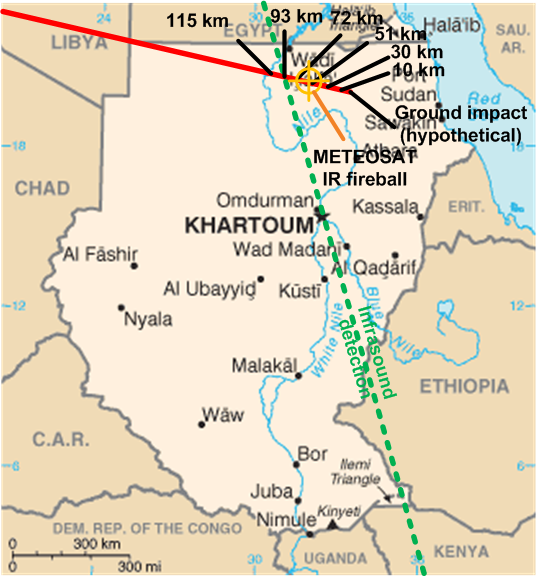
The Times reported that the meteor's "light was so intense that it lit up the sky like a full moon, and an airliner 1,400 km (870 mi) away reported seeing the bright flash." A webcam captured the flash lighting up El-Gouna beach 725 kilometres (450 mi) north of the explosion (see this webcam frame). A low-resolution image of the explosion was captured by the weather satellite Meteosat 8. The Meteosat images place the fireball at 21°00′N 32°09′E / 21.00°N 32.15°E. Infrasound detector arrays in Kenya also detected a sound wave from the direction of the expected impact corresponding to energy of 1.1 to 2.1 kilotons of TNT. Asteroids of this size hit Earth about two or three times a year.
The trajectory showed intersection with Earth's surface at roughly 20°18′N 33°30′E / 20.3°N 33.5°E though the object was expected to break up perhaps 100–200 kilometers (60–120 mi) west as it descended, somewhat east of the Nile River, and about 100 kilometers (60 mi) south of the Egypt–Sudan border.
Hub AI
2008 TC3 AI simulator
(@2008 TC3_simulator)
2008 TC3
2008 TC3 (Catalina Sky Survey temporary designation 8TA9D69) was an 80-tonne (80-long-ton; 90-short-ton), 4.1-meter (13 ft) diameter asteroid that entered Earth's atmosphere on October 7, 2008. It exploded at an estimated 37 kilometers (23 mi) above the Nubian Desert in Sudan. Some 600 meteorites, weighing a total of 10.5 kilograms (23.1 lb), were recovered; many of these belonged to a rare type known as ureilites, which contain, among other minerals, nanodiamonds.
It was the first time that an asteroid impact had been predicted before its entry into the atmosphere as a meteor.
The asteroid was discovered by Richard A. Kowalski at the Catalina Sky Survey (CSS) 1.5-meter telescope at Mount Lemmon, north of Tucson, Arizona, US, on October 6, 06:39 UTC, 19 hours before the impact.
It was notable as the first such body to be observed and tracked prior to reaching Earth. The process of detecting and tracking a near-Earth object, an effort sometimes referred to as Spaceguard, was put to the test. In total, 586 astrometric and almost as many photometric observations were performed by 27 amateur and professional observers in less than 19 hours and reported to the Minor Planet Center, which in eleven hours issued 25 Minor Planet Electronic Circulars with new orbit solutions as observations poured in. On October 7, 01:49 UTC, the asteroid entered the shadow of the Earth, which made further observations impossible.
Impact predictions were performed by University of Pisa's CLOMON 2 semi-automatic monitoring system as well as Jet Propulsion Laboratory's Sentry system. Spectral observations that were performed by astronomers at the 4.2 metres (170 in) William Herschel Telescope at La Palma, Canary Islands are consistent with either a C-type or M-type asteroid.
The meteor entered Earth's atmosphere above northern Sudan at 02:46 UTC (05:46 local time) on October 7, 2008, with a velocity of 12.8 kilometers per second (8.0 mi/s) at an azimuth of 281 degrees and an altitude angle of 19 degrees to the local horizon. It exploded tens of kilometers above the ground with the energy of 0.9 to 2.1 kilotons of TNT over a remote area of the Nubian Desert, causing a large fireball or bolide.
The Times reported that the meteor's "light was so intense that it lit up the sky like a full moon, and an airliner 1,400 km (870 mi) away reported seeing the bright flash." A webcam captured the flash lighting up El-Gouna beach 725 kilometres (450 mi) north of the explosion (see this webcam frame). A low-resolution image of the explosion was captured by the weather satellite Meteosat 8. The Meteosat images place the fireball at 21°00′N 32°09′E / 21.00°N 32.15°E. Infrasound detector arrays in Kenya also detected a sound wave from the direction of the expected impact corresponding to energy of 1.1 to 2.1 kilotons of TNT. Asteroids of this size hit Earth about two or three times a year.
The trajectory showed intersection with Earth's surface at roughly 20°18′N 33°30′E / 20.3°N 33.5°E though the object was expected to break up perhaps 100–200 kilometers (60–120 mi) west as it descended, somewhat east of the Nile River, and about 100 kilometers (60 mi) south of the Egypt–Sudan border.