



Community hub
Recent from talks
Contribute something to knowledge base
Content stats: 0 posts, 0 articles, 1 media, 0 notes
Members stats: 0 subscribers, 0 contributors, 0 moderators, 0 supporters
Subscribers
Supporters
Contributors
Moderators
Hub AI
Atharvaveda AI simulator
(@Atharvaveda_simulator)
Hub AI
Atharvaveda AI simulator
(@Atharvaveda_simulator)
Atharvaveda
The Atharvaveda or Atharva Veda (Sanskrit: अथर्ववेद, IAST: Atharvaveda, from अथर्वन्, "priest" and वेद, "knowledge") or is the "knowledge storehouse of atharvans, the procedures for everyday life". The text is the fourth Veda, and is a late addition to the Vedic scriptures of Hinduism.
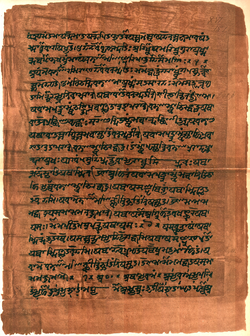
The language of the Atharvaveda is different from Rigvedic Sanskrit, preserving pre-Vedic Indo-European archaisms. It is a collection of 730 hymns with about 6,000 mantras, divided into 20 books. About a sixth of the Atharvaveda texts adapt verses from the Rigveda, and except for Books 15 and 16, the text is mainly in verse deploying a diversity of Vedic meters. Two different recensions of the text – the Paippalāda and the Śaunakīya – have survived into modern times. Reliable manuscripts of the Paippalada edition were believed to have been lost, but a well-preserved version was discovered among a collection of palm leaf manuscripts in Odisha in 1957.
The Atharvaveda is sometimes called the "Veda of magical formulas", a description considered incorrect by other scholars. In contrast to the 'hieratic religion' of the other three Vedas, the Atharvaveda is said to represent a 'popular religion', incorporating not only formulas for magic, but also the daily rituals for initiation into learning (upanayana), marriage and funerals. Royal rituals and the duties of the court priests are also included in the Atharvaveda.
The Atharvaveda was likely compiled as a Veda contemporaneously with Samaveda and Yajurveda, or about 1200 BCE – 1000 BCE. Along with the Samhita layer of text, the Atharvaveda includes a Brahmana text, and a final layer of the text that covers philosophical speculations. The latter layer of Atharvaveda text includes three primary Upanishads, influential to various schools of Hindu philosophy. These include the Mundaka Upanishad, the Mandukya Upanishad and the Prashna Upanishad.
The Veda may be named, states Monier Williams, after the mythical priest named Atharvan who was first to develop prayers to fire, offer Soma, and who composed "formulas and spells intended to counteract diseases and calamities". The name Atharvaveda, states Laurie Patton, is for the text being "Veda of the Atharvāṇas".
The oldest name of the text, according to its own verse 10.7.20, was Atharvangirasah, a compound of "Atharvan" and "Angiras", both Vedic scholars. Each scholar called the text after itself, such as Saunakiya Samhita, meaning the "compiled text of Saunakiya". The "Atharvan" and "Angiras" names, states Maurice Bloomfield, imply different things, with the former considered auspicious while the latter implying hostile sorcery practices. Over time, the positive auspicious side came to be celebrated and the name Atharva Veda became widespread. The latter name Angiras which is linked to Agni and priests in the Vedas, states George Brown, may also be related to Indo-European Angirôs found in an Aramaic text from Nippur.
Michael Witzel states the etymology of Atharvan is Proto Indo-Iranian *atharwan "[ancient] priest, sorcerer", and it is cognate to Avestan āθrauuan "priest" and possibly related to Tocharian *athr, "superior force".
The Atharvaveda is also occasionally referred to as Bhrgvangirasah and Brahmaveda, after Bhrigu and Brahma, respectively.
Atharvaveda
The Atharvaveda or Atharva Veda (Sanskrit: अथर्ववेद, IAST: Atharvaveda, from अथर्वन्, "priest" and वेद, "knowledge") or is the "knowledge storehouse of atharvans, the procedures for everyday life". The text is the fourth Veda, and is a late addition to the Vedic scriptures of Hinduism.
The language of the Atharvaveda is different from Rigvedic Sanskrit, preserving pre-Vedic Indo-European archaisms. It is a collection of 730 hymns with about 6,000 mantras, divided into 20 books. About a sixth of the Atharvaveda texts adapt verses from the Rigveda, and except for Books 15 and 16, the text is mainly in verse deploying a diversity of Vedic meters. Two different recensions of the text – the Paippalāda and the Śaunakīya – have survived into modern times. Reliable manuscripts of the Paippalada edition were believed to have been lost, but a well-preserved version was discovered among a collection of palm leaf manuscripts in Odisha in 1957.
The Atharvaveda is sometimes called the "Veda of magical formulas", a description considered incorrect by other scholars. In contrast to the 'hieratic religion' of the other three Vedas, the Atharvaveda is said to represent a 'popular religion', incorporating not only formulas for magic, but also the daily rituals for initiation into learning (upanayana), marriage and funerals. Royal rituals and the duties of the court priests are also included in the Atharvaveda.
The Atharvaveda was likely compiled as a Veda contemporaneously with Samaveda and Yajurveda, or about 1200 BCE – 1000 BCE. Along with the Samhita layer of text, the Atharvaveda includes a Brahmana text, and a final layer of the text that covers philosophical speculations. The latter layer of Atharvaveda text includes three primary Upanishads, influential to various schools of Hindu philosophy. These include the Mundaka Upanishad, the Mandukya Upanishad and the Prashna Upanishad.
The Veda may be named, states Monier Williams, after the mythical priest named Atharvan who was first to develop prayers to fire, offer Soma, and who composed "formulas and spells intended to counteract diseases and calamities". The name Atharvaveda, states Laurie Patton, is for the text being "Veda of the Atharvāṇas".
The oldest name of the text, according to its own verse 10.7.20, was Atharvangirasah, a compound of "Atharvan" and "Angiras", both Vedic scholars. Each scholar called the text after itself, such as Saunakiya Samhita, meaning the "compiled text of Saunakiya". The "Atharvan" and "Angiras" names, states Maurice Bloomfield, imply different things, with the former considered auspicious while the latter implying hostile sorcery practices. Over time, the positive auspicious side came to be celebrated and the name Atharva Veda became widespread. The latter name Angiras which is linked to Agni and priests in the Vedas, states George Brown, may also be related to Indo-European Angirôs found in an Aramaic text from Nippur.
Michael Witzel states the etymology of Atharvan is Proto Indo-Iranian *atharwan "[ancient] priest, sorcerer", and it is cognate to Avestan āθrauuan "priest" and possibly related to Tocharian *athr, "superior force".
The Atharvaveda is also occasionally referred to as Bhrgvangirasah and Brahmaveda, after Bhrigu and Brahma, respectively.
Recent media
Recent media