
Recent from talks
Augusta Treverorum
Knowledge base stats:
Talk channels stats:
Members stats:
Augusta Treverorum
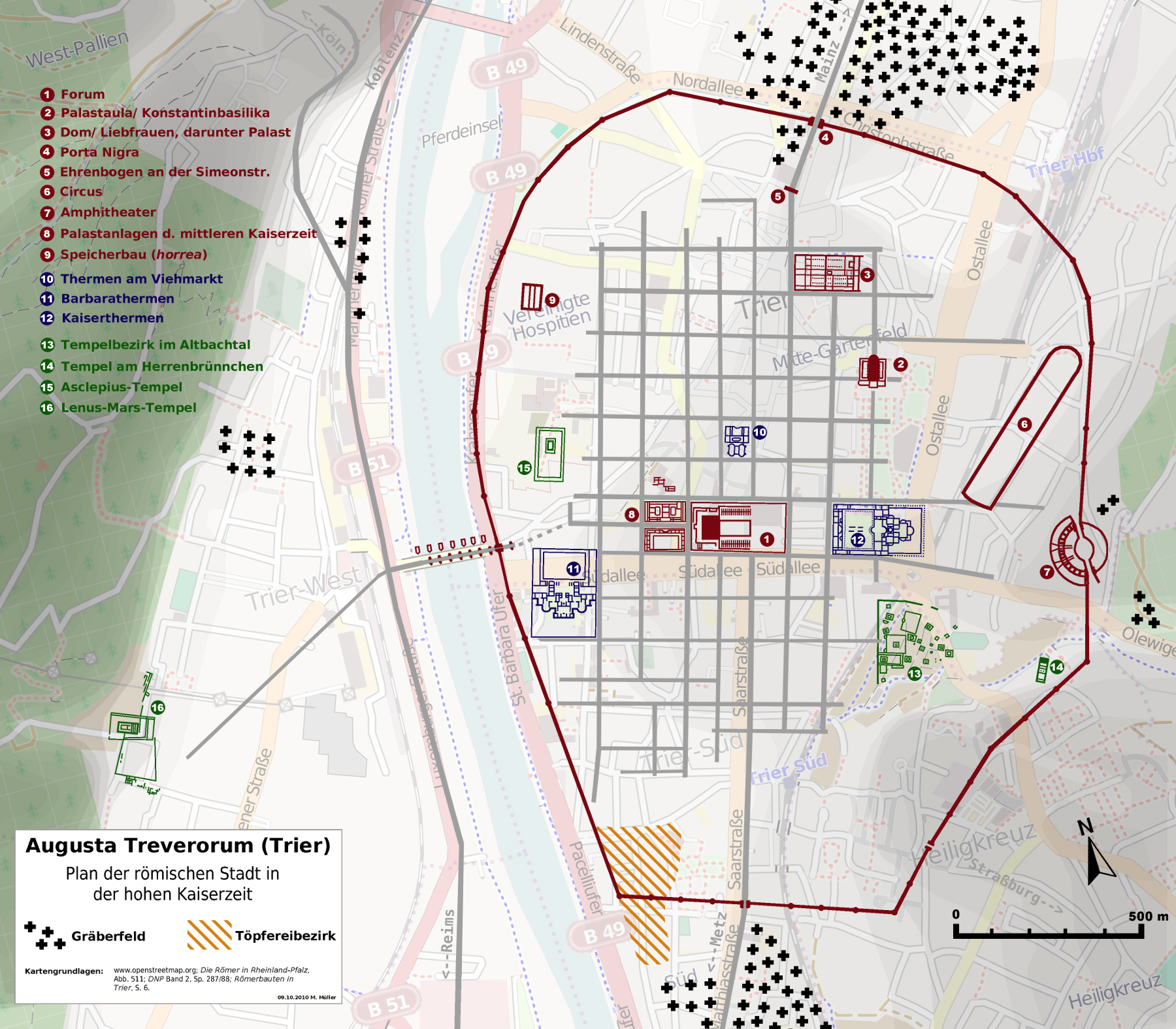
Augusta Treverorum (Latin for "City of Augustus in the Land of the Treveri") was a Roman city on the Moselle River, from which modern Trier emerged.
The date of the city's founding is placed between the construction of the first Roman bridge in Trier (18/17 BC) and the late reign of Augustus († 14 AD). In the Roman Empire, Trier formed the main town of the civitas of the Treverians, where several ten thousand people lived, and belonged to the province of Gallia Belgica. Roman Trier gained particular importance in late antiquity: between the late 3rd and late 4th centuries several rulers, including Constantine the Great, used the city as one of the western imperial residences, sponsoring monumental buildings such as the Trier Imperial Baths and the Basilica of Constantine. With a high five-digit population in 300, Augusta Treverorum, now sometimes called Treveris, was the largest city north of the Alps and thus had the status of a global city.
The Roman buildings, which have survived to the present day, were designated as UNESCO World Heritage Roman Monuments, Cathedral and Church of Our Lady in Trier in 1986.
Unlike almost all other Roman cities in today's Germany, Augusta Treverorum did not belong to one of the two Germanic provinces, but to Gaul. The city is located in a wide bend of the Moselle River, where a wide, flood-free valley plain lies between the river and the surrounding heights of the Hunsrück. Between the confluence of the Saar and the entrance to the entrenched meanders of the Middle and Lower Moselle, the Trier valley width between Konz and Schweich is the largest settlement chamber in the region. The location of the river is not likely to have shifted significantly since the last ice age. The deeply incised stream courses of Olewiger Bach/Altbach, Aulbach and Aveler Bach provided both fresh water and easy access to the surrounding heights. Already since the Paleolithic Age, the area was therefore repeatedly visited by humans.
The earliest settlements on Trier city territory have been proven near the later Roman potteries on the banks of the Pacelli River. These are finds of the Linear Pottery Culture. Already in the pre-Roman Iron Age, the Trier valley may have been largely cleared and settled. Before the first verifiable Roman bridge over the Moselle was built in 17 B.C., there was probably already a ford at the site. In the late Latène period, settlement seems to have been scattered along the right bank of the Moselle. A concentration of settlement features could be found during an area excavation between the Moselle, St. Irminen, Ostallee and Gilbertstraße.
The important centers of this time are not assumed to be in such valley settlements. The Treverian tribe, which gave its name to Trier, is tangible in the region mainly through important hilltop settlements (oppida), among them the oppidum on the Titelberg in Luxembourg, the Castellberg near Wallendorf, the Hillfort of Otzenhausen or the oppidum on the Martberg. The Treverian tribe was the first to settle in the region.
However, the small settlement was reason enough for a Roman military station to be established above the Trier valley width on the Petrisberg a few years after the Roman conquest of Gaul under Gaius Iulius Caesar. Few finds, among them Arretinian terra sigillata as well as a dendrochronologically dated wooden fragment, point to the time around 30 B.C. A connection with Agrippa's road building measures is suspected, which are mostly attributed to his first governorship in Gaul in the years 39/38 B.C.
The city was probably founded in 18/17 BC by Emperor Augustus, which is primarily indicated by the name, but which is documented only in later times. The honor of being called by its name was otherwise only given to Augusta Vindelicum (Augsburg) and Augusta Raurica (Augst) in northern Switzerland in today's German-speaking world. The exact date cannot be determined from the sources and can only be approximated. The following are considered to be fixed historical points:
Hub AI
Augusta Treverorum AI simulator
(@Augusta Treverorum_simulator)
Augusta Treverorum
Augusta Treverorum (Latin for "City of Augustus in the Land of the Treveri") was a Roman city on the Moselle River, from which modern Trier emerged.
The date of the city's founding is placed between the construction of the first Roman bridge in Trier (18/17 BC) and the late reign of Augustus († 14 AD). In the Roman Empire, Trier formed the main town of the civitas of the Treverians, where several ten thousand people lived, and belonged to the province of Gallia Belgica. Roman Trier gained particular importance in late antiquity: between the late 3rd and late 4th centuries several rulers, including Constantine the Great, used the city as one of the western imperial residences, sponsoring monumental buildings such as the Trier Imperial Baths and the Basilica of Constantine. With a high five-digit population in 300, Augusta Treverorum, now sometimes called Treveris, was the largest city north of the Alps and thus had the status of a global city.
The Roman buildings, which have survived to the present day, were designated as UNESCO World Heritage Roman Monuments, Cathedral and Church of Our Lady in Trier in 1986.
Unlike almost all other Roman cities in today's Germany, Augusta Treverorum did not belong to one of the two Germanic provinces, but to Gaul. The city is located in a wide bend of the Moselle River, where a wide, flood-free valley plain lies between the river and the surrounding heights of the Hunsrück. Between the confluence of the Saar and the entrance to the entrenched meanders of the Middle and Lower Moselle, the Trier valley width between Konz and Schweich is the largest settlement chamber in the region. The location of the river is not likely to have shifted significantly since the last ice age. The deeply incised stream courses of Olewiger Bach/Altbach, Aulbach and Aveler Bach provided both fresh water and easy access to the surrounding heights. Already since the Paleolithic Age, the area was therefore repeatedly visited by humans.
The earliest settlements on Trier city territory have been proven near the later Roman potteries on the banks of the Pacelli River. These are finds of the Linear Pottery Culture. Already in the pre-Roman Iron Age, the Trier valley may have been largely cleared and settled. Before the first verifiable Roman bridge over the Moselle was built in 17 B.C., there was probably already a ford at the site. In the late Latène period, settlement seems to have been scattered along the right bank of the Moselle. A concentration of settlement features could be found during an area excavation between the Moselle, St. Irminen, Ostallee and Gilbertstraße.
The important centers of this time are not assumed to be in such valley settlements. The Treverian tribe, which gave its name to Trier, is tangible in the region mainly through important hilltop settlements (oppida), among them the oppidum on the Titelberg in Luxembourg, the Castellberg near Wallendorf, the Hillfort of Otzenhausen or the oppidum on the Martberg. The Treverian tribe was the first to settle in the region.
However, the small settlement was reason enough for a Roman military station to be established above the Trier valley width on the Petrisberg a few years after the Roman conquest of Gaul under Gaius Iulius Caesar. Few finds, among them Arretinian terra sigillata as well as a dendrochronologically dated wooden fragment, point to the time around 30 B.C. A connection with Agrippa's road building measures is suspected, which are mostly attributed to his first governorship in Gaul in the years 39/38 B.C.
The city was probably founded in 18/17 BC by Emperor Augustus, which is primarily indicated by the name, but which is documented only in later times. The honor of being called by its name was otherwise only given to Augusta Vindelicum (Augsburg) and Augusta Raurica (Augst) in northern Switzerland in today's German-speaking world. The exact date cannot be determined from the sources and can only be approximated. The following are considered to be fixed historical points:
Recent media