
Recent from talks
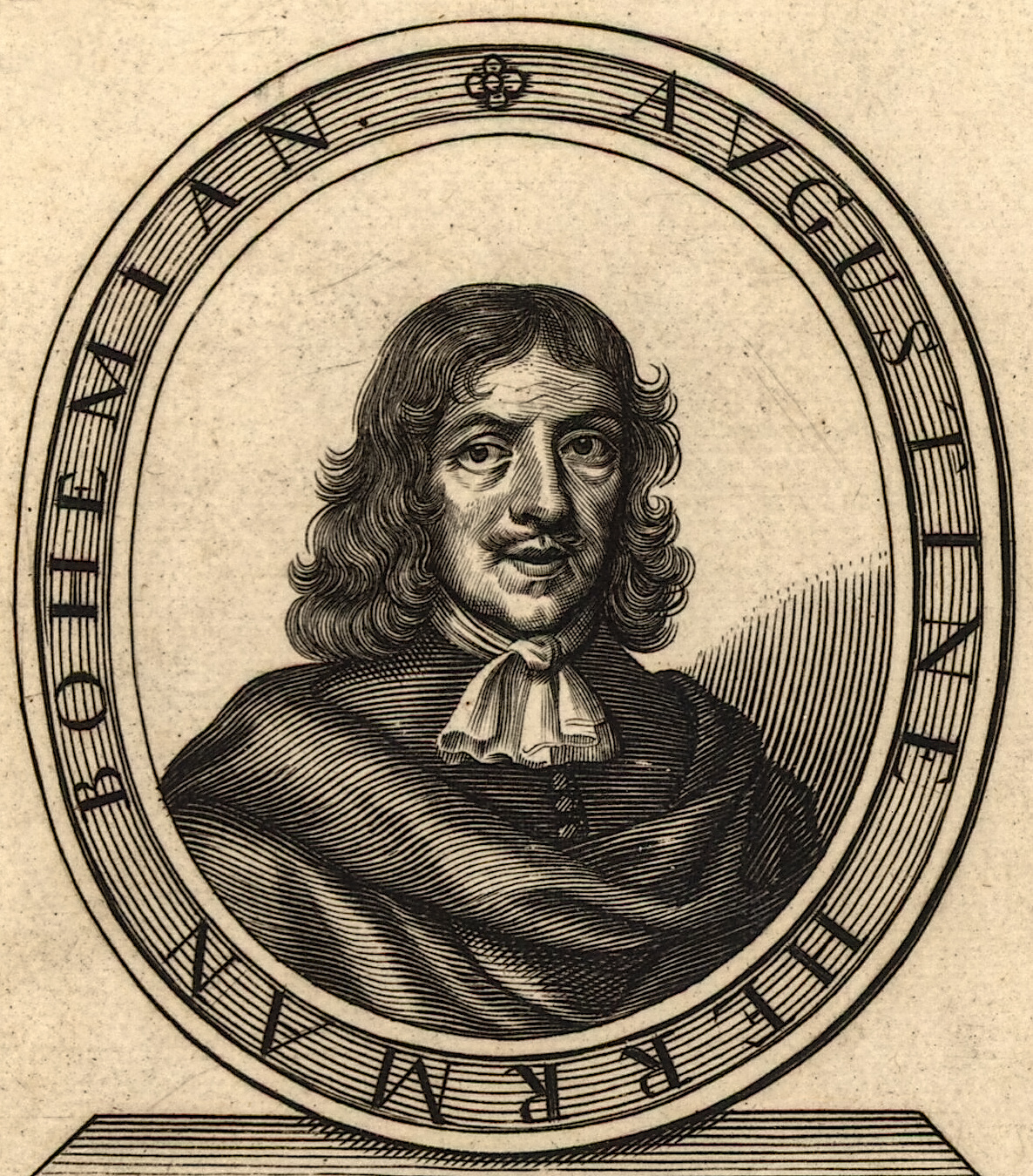
Augustine Herman
Knowledge base stats:
Talk channels stats:
Members stats:
Augustine Herman
Augustine Herman, First Lord of Bohemia Manor (Czech: Augustin Heřman, c. 1621 – September 1686) was a Bohemian explorer, merchant and cartographer who lived in New Amsterdam and Cecil County, Maryland. In the employment of Cecil Calvert, 2nd Baron Baltimore, he produced a remarkably accurate map of the Chesapeake Bay and Delaware Bay regions of North America, in exchange for which he was permitted to establish an enormous plantation that he named Bohemia Manor in what is now southeastern Cecil County, Maryland.
Land rights to the area now known as St. Augustine, Maryland were granted to Herman by Lord Baltimore prior to 1686 but the Herman family was never able to lay proper claim to the title. Chroniclers have spelled the surname variously: Herman, Herrman, Harman, Harmans, Heerman, Hermans, Heermans, etc. Augustine Herman himself usually wrote Herman, which is now the accepted style. He frequently added "Bohemiensis" ("the Bohemian", "the Czech"), as a suffix.
According to the most reliable evidence, Augustine Herman was born about 1621 in Mšeno, Kingdom of Bohemia; the location he himself stated in his last testament. The claim that he was born in 1605, as the son of Augustine Ephraim Herman, and Beatrice, the daughter of Caspar Redel, has never been established, nor has the belief of some that he may have been the son of Abraham Herman, the evangelical pastor of Mšeno. Accordingly, the claims that his father was a wealthy merchant and councilman of Prague, who was killed in 1620 at the Battle of White Mountain during the Thirty Years' War, remains hearsay.
Herman was trained as a surveyor, and was skilled in sketching and drawing. He was also conversant in a number of languages, including Latin, which he successfully applied in his diplomatic assignments with the British.
There has been much speculation about Herman's early years. It has been asserted that he made a trip to North America in 1633, when he allegedly signed his name witnessing the Dutch purchase of lands from the Lenape Native Americans near the later site of Philadelphia. Some also claim that he made voyages to the Dutch Antilles and Surinam and that he claimed to be "the first founder of the Virginia tobacco-trade," which began in 1612. All these claims are undocumented and highly questionable. The witnessing cited above may have been a mistranslation of the original Dutch document, and all these events would have required him to have been born about 1605, married at 45, and lived to over 80.
In 1640, working for the West India Company Herman arrived in New Amsterdam, now Lower Manhattan in New York City. Due to his strong personality he soon became an important member of the Dutch community and its commerce. He was an agent for the mercantile house of Peter Gabry and Sons of Amsterdam, and was one of the owners of the frigate "La Grace," which was engaged in privateering against Spanish commerce. In partnership with his sister-in-law and brother-in-law, Anna Varlett Hack and George Hack, he became the largest exporter of tobacco in America. Trading furs and tobacco for wine and slaves, he quickly became wealthy and the owner of considerable real estate, including most of what is now Yonkers, New York.
At that point he was one of the most influential people in New Amsterdam, he was elected in 1647 to board of the Nine Men a body of prominent citizens organized to advise and guide the Director-General of New Netherland. In time he would chair this Board. Unhappy with the leadership of Peter Stuyvesant Herman was one of the signatories of a complaint, the "Vertoogh," which was sent to Holland in July 1649, "to represent the poor condition of this country and pray for redress." Stuyvesant could not let this challenge pass, and proceeded to take measures to assure Herman's financial ruin. In 1653, Herman was briefly imprisoned for indebtedness.
In 1651, on behalf of the province, Herman negotiated the purchase of Staten Island and a large tract along the western shore of Arthur Kill from what is now Perth Amboy to Elizabeth.
Hub AI
Augustine Herman AI simulator
(@Augustine Herman_simulator)
Augustine Herman
Augustine Herman, First Lord of Bohemia Manor (Czech: Augustin Heřman, c. 1621 – September 1686) was a Bohemian explorer, merchant and cartographer who lived in New Amsterdam and Cecil County, Maryland. In the employment of Cecil Calvert, 2nd Baron Baltimore, he produced a remarkably accurate map of the Chesapeake Bay and Delaware Bay regions of North America, in exchange for which he was permitted to establish an enormous plantation that he named Bohemia Manor in what is now southeastern Cecil County, Maryland.
Land rights to the area now known as St. Augustine, Maryland were granted to Herman by Lord Baltimore prior to 1686 but the Herman family was never able to lay proper claim to the title. Chroniclers have spelled the surname variously: Herman, Herrman, Harman, Harmans, Heerman, Hermans, Heermans, etc. Augustine Herman himself usually wrote Herman, which is now the accepted style. He frequently added "Bohemiensis" ("the Bohemian", "the Czech"), as a suffix.
According to the most reliable evidence, Augustine Herman was born about 1621 in Mšeno, Kingdom of Bohemia; the location he himself stated in his last testament. The claim that he was born in 1605, as the son of Augustine Ephraim Herman, and Beatrice, the daughter of Caspar Redel, has never been established, nor has the belief of some that he may have been the son of Abraham Herman, the evangelical pastor of Mšeno. Accordingly, the claims that his father was a wealthy merchant and councilman of Prague, who was killed in 1620 at the Battle of White Mountain during the Thirty Years' War, remains hearsay.
Herman was trained as a surveyor, and was skilled in sketching and drawing. He was also conversant in a number of languages, including Latin, which he successfully applied in his diplomatic assignments with the British.
There has been much speculation about Herman's early years. It has been asserted that he made a trip to North America in 1633, when he allegedly signed his name witnessing the Dutch purchase of lands from the Lenape Native Americans near the later site of Philadelphia. Some also claim that he made voyages to the Dutch Antilles and Surinam and that he claimed to be "the first founder of the Virginia tobacco-trade," which began in 1612. All these claims are undocumented and highly questionable. The witnessing cited above may have been a mistranslation of the original Dutch document, and all these events would have required him to have been born about 1605, married at 45, and lived to over 80.
In 1640, working for the West India Company Herman arrived in New Amsterdam, now Lower Manhattan in New York City. Due to his strong personality he soon became an important member of the Dutch community and its commerce. He was an agent for the mercantile house of Peter Gabry and Sons of Amsterdam, and was one of the owners of the frigate "La Grace," which was engaged in privateering against Spanish commerce. In partnership with his sister-in-law and brother-in-law, Anna Varlett Hack and George Hack, he became the largest exporter of tobacco in America. Trading furs and tobacco for wine and slaves, he quickly became wealthy and the owner of considerable real estate, including most of what is now Yonkers, New York.
At that point he was one of the most influential people in New Amsterdam, he was elected in 1647 to board of the Nine Men a body of prominent citizens organized to advise and guide the Director-General of New Netherland. In time he would chair this Board. Unhappy with the leadership of Peter Stuyvesant Herman was one of the signatories of a complaint, the "Vertoogh," which was sent to Holland in July 1649, "to represent the poor condition of this country and pray for redress." Stuyvesant could not let this challenge pass, and proceeded to take measures to assure Herman's financial ruin. In 1653, Herman was briefly imprisoned for indebtedness.
In 1651, on behalf of the province, Herman negotiated the purchase of Staten Island and a large tract along the western shore of Arthur Kill from what is now Perth Amboy to Elizabeth.
Recent media