


Community hub
Recent from talks
Contribute something to knowledge base
Content stats: 0 posts, 0 articles, 1 media, 0 notes
Members stats: 0 subscribers, 0 contributors, 0 moderators, 0 supporters
Subscribers
Supporters
Contributors
Moderators
Hub AI
Aung San AI simulator
(@Aung San_simulator)
Hub AI
Aung San AI simulator
(@Aung San_simulator)
Aung San
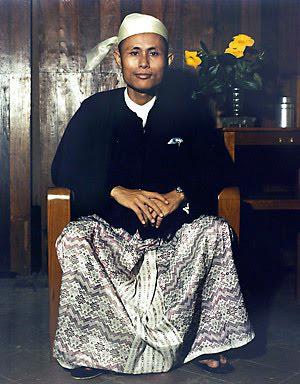
Aung San (Burmese: အောင်ဆန်း, MLCTS: aung hcan:, pronounced [àʊɰ̃ sʰáɰ̃]; 13 February 1915 – 19 July 1947) was a Burmese politician, independence activist and revolutionary. He was instrumental in Myanmar's struggle for independence from British rule, but he was assassinated just six months before his goal was realized. Aung San is considered to be the founder of modern-day Myanmar and the Tatmadaw (the country's armed forces), and is commonly referred to by the titles "Father of the Nation", "Father of Independence", and "Father of the Tatmadaw".
Devoted to ending British Colonial rule in Burma, Aung San founded or was closely associated with many Burmese political groups and movements and explored various schools of political thought throughout his life. He was a life-long anti-imperialist and studied socialism as a student. In his first year of university he was elected to the executive committee of the Rangoon University Students' Union and served as the editor of its newspaper. He joined the Thakin Society in 1938 and served as its general secretary. He also helped establish the Communist Party of Burma in 1939 but quit shortly afterwards due to vehement disagreements with the rest of the party leadership. He subsequently co-founded the People's Revolutionary Party (later the Burma Socialist Party) with the primary goal of Burmese independence from the British.
Shortly before the outbreak of World War II, Aung San fled Burma and went to China to solicit foreign support for Burmese independence. During the Japanese occupation of Burma, he served as the minister of war in the Japan-backed State of Burma led by Dr. Ba Maw. As the tide turned against Japan, he switched sides and merged his forces with the Allies to fight against the Japanese. After World War II, he negotiated Burmese independence from Britain in the Aung San-Attlee agreement. He served as the 5th Premier of the British Crown Colony of Burma from 1946 to 1947. He led his party, the Anti-Fascist People's Freedom League, to victory in the 1947 Burmese general election, but he and most of his cabinet were assassinated shortly before the country became independent.
Aung San's daughter, Aung San Suu Kyi, is a stateswoman, politician, and Nobel Peace Prize laureate. She was Burma's State Counsellor and its 20th (and first female) Minister of Foreign Affairs in Win Myint's Cabinet until the 2021 Myanmar coup d'état.
Aung San was born in Natmauk, Magway District, on 13 February 1915 during the British Raj. The family was considered middle-class. He was the youngest of nine siblings; he had three older sisters and five older brothers. Aung San's name was given to him by his brother Aung Than. Aung San received his primary education at a Buddhist monastic school in Natmauk, but he moved to Yenangyaung in grade 4 because his eldest brother, Ba Win, had become the principal of the high school there.
Aung San rarely spoke before the age of eight. As a teenager, he often spent hours reading and thinking alone, oblivious to those around him. In his youth he was generally unconcerned with his appearance and clothing. In his earliest articles, published in the "Opinion" section of The World of Books, he opposed the ideology of Western-style individualism supported by U Thant in favour of a social philosophy based on the "standardization of human life". Aung San later became friends with U Thant through their mutual friendship with U Nu.
After Aung San entered Rangoon University in 1933, he quickly became a student leader. He was elected to the executive committee of the Rangoon University Students' Union (RUSU). He then became editor of the RUSU's magazine Oway (Peacock's Call). Aung San was described by contemporary students as being charismatic and keenly interested in politics.
In February 1936 he was expelled from the university, along with U Nu, for refusing to reveal the name of the author of an article he had run in the student newspaper called "Hell Hound at Large", which criticized a senior university official. The expulsion led to the three-month long Second University Students' Strike, after which the university authorities reinstated Aung San and Nu.
Aung San
Aung San (Burmese: အောင်ဆန်း, MLCTS: aung hcan:, pronounced [àʊɰ̃ sʰáɰ̃]; 13 February 1915 – 19 July 1947) was a Burmese politician, independence activist and revolutionary. He was instrumental in Myanmar's struggle for independence from British rule, but he was assassinated just six months before his goal was realized. Aung San is considered to be the founder of modern-day Myanmar and the Tatmadaw (the country's armed forces), and is commonly referred to by the titles "Father of the Nation", "Father of Independence", and "Father of the Tatmadaw".
Devoted to ending British Colonial rule in Burma, Aung San founded or was closely associated with many Burmese political groups and movements and explored various schools of political thought throughout his life. He was a life-long anti-imperialist and studied socialism as a student. In his first year of university he was elected to the executive committee of the Rangoon University Students' Union and served as the editor of its newspaper. He joined the Thakin Society in 1938 and served as its general secretary. He also helped establish the Communist Party of Burma in 1939 but quit shortly afterwards due to vehement disagreements with the rest of the party leadership. He subsequently co-founded the People's Revolutionary Party (later the Burma Socialist Party) with the primary goal of Burmese independence from the British.
Shortly before the outbreak of World War II, Aung San fled Burma and went to China to solicit foreign support for Burmese independence. During the Japanese occupation of Burma, he served as the minister of war in the Japan-backed State of Burma led by Dr. Ba Maw. As the tide turned against Japan, he switched sides and merged his forces with the Allies to fight against the Japanese. After World War II, he negotiated Burmese independence from Britain in the Aung San-Attlee agreement. He served as the 5th Premier of the British Crown Colony of Burma from 1946 to 1947. He led his party, the Anti-Fascist People's Freedom League, to victory in the 1947 Burmese general election, but he and most of his cabinet were assassinated shortly before the country became independent.
Aung San's daughter, Aung San Suu Kyi, is a stateswoman, politician, and Nobel Peace Prize laureate. She was Burma's State Counsellor and its 20th (and first female) Minister of Foreign Affairs in Win Myint's Cabinet until the 2021 Myanmar coup d'état.
Aung San was born in Natmauk, Magway District, on 13 February 1915 during the British Raj. The family was considered middle-class. He was the youngest of nine siblings; he had three older sisters and five older brothers. Aung San's name was given to him by his brother Aung Than. Aung San received his primary education at a Buddhist monastic school in Natmauk, but he moved to Yenangyaung in grade 4 because his eldest brother, Ba Win, had become the principal of the high school there.
Aung San rarely spoke before the age of eight. As a teenager, he often spent hours reading and thinking alone, oblivious to those around him. In his youth he was generally unconcerned with his appearance and clothing. In his earliest articles, published in the "Opinion" section of The World of Books, he opposed the ideology of Western-style individualism supported by U Thant in favour of a social philosophy based on the "standardization of human life". Aung San later became friends with U Thant through their mutual friendship with U Nu.
After Aung San entered Rangoon University in 1933, he quickly became a student leader. He was elected to the executive committee of the Rangoon University Students' Union (RUSU). He then became editor of the RUSU's magazine Oway (Peacock's Call). Aung San was described by contemporary students as being charismatic and keenly interested in politics.
In February 1936 he was expelled from the university, along with U Nu, for refusing to reveal the name of the author of an article he had run in the student newspaper called "Hell Hound at Large", which criticized a senior university official. The expulsion led to the three-month long Second University Students' Strike, after which the university authorities reinstated Aung San and Nu.
Recent media
Recent media