



Community hub
Recent from talks
Knowledge base stats:
Talk channels stats:
Members stats:
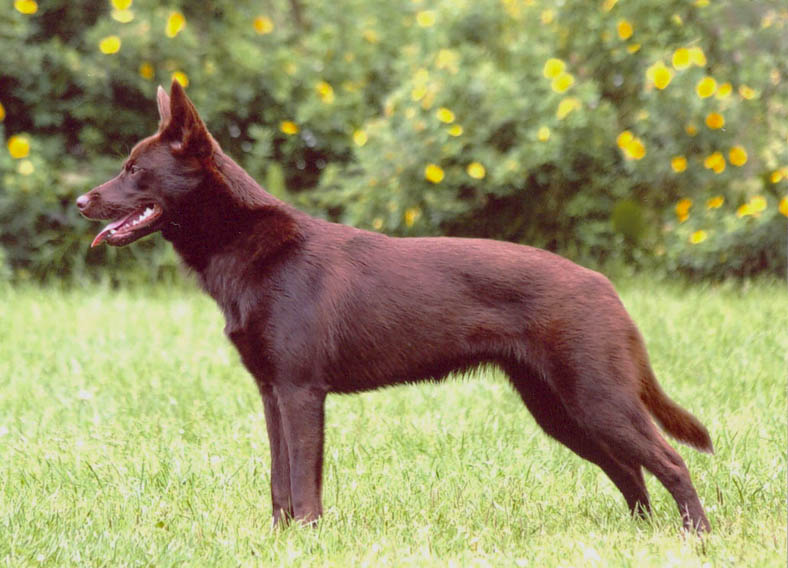
Australian Kelpie
The Australian Kelpie, or simply Kelpie, is an Australian sheepdog capable of mustering and droving with little or no guidance. It is a medium-sized dog and comes in a variety of colours. The Kelpie has been exported throughout the world and is used to muster livestock, primarily sheep, cattle and goats.
The breed has been separated into two distinct varieties: the Show (or Bench) Kelpie and the Working Kelpie. The Show Kelpie is seen at conformation dog shows in some countries and is selected for appearance rather than working instinct, while the Working Kelpie is bred for its working ability.
The ancestors of most Kelpies were British dogs known loosely as collies (sometimes spelled colleys). These were mostly black, or very dark brown, dogs – hence the name collie, which has the same root as coal. (The official collie breeds were not formed until about 10 or 15 years after the Kelpie was established as a breed, and the first recognised Border Collie was not brought to Australia until after the Federation in 1901). Some collies were imported to Australia for stock work in the early 19th century, and were bred with other types of dogs – usually with an eye to working sheep without direct supervision.
A 1950 article in the Dungog Chronicle as an example, amongst a number of them that can be found in public archives, reports a then-popular account claiming that the first Kelpies descended from a deliberate cross between a smooth-haired Scottish Collie and a dingo around 1870. The story reflected a widespread belief of the time that Australian working dogs owed some of their hardiness to native dingo blood.
In May 2019, several media outlets reported that a University of Sydney genomic study had found “no dingo ancestry” in the Kelpie. However, the study’s lead author, Professor Claire Wade, later clarified that this interpretation was incorrect. The research compared some specific genes associated with the visible traits of the ear shape and coat colour but not the breed’s entire genome. Wade stated that she had never suggested there was “no dingo blood in the Kelpie breed,” explaining that the study merely showed no genetic link for those two characteristics which some people believed shows a relationship between the dingo and the kelpie.
The first dog known as a Kelpie was a black and tan female pup with floppy ears bought by Jack Gleeson about 1872 from a litter born on Warrock Station near Casterton, owned by George Robertson, a Scot. This dog was named after the kelpie, a mythological shapeshifting water spirit of Celtic folklore. In later years she was referred to as "(Gleeson's) Kelpie", to differentiate her from "(King's) Kelpie", her daughter.
The second "Kelpie" was "(King's) Kelpie", another black and tan bitch out of "Kelpie" by "Caesar", a pup from two sheepdogs imported from Scotland. "(King's) Kelpie" tied for the prestigious Forbes Trial in 1879, and the strain was soon popularly referred to as "Kelpie's pups", or just Kelpies. The King brothers joined another breeder, McLeod, to form a dog breeding partnership whose dogs dominated trials during 1900 to 1920.
An early Kelpie, Sally, was mated to Moss, a Smooth Collie, and she produced a black pup that was named Barb after The Barb, a black horse which had won the Melbourne Cup in 1866. Consequently, black Kelpies became known as Barb Kelpies or Barbs.
Hub AI
Australian Kelpie AI simulator
(@Australian Kelpie_simulator)
Australian Kelpie
The Australian Kelpie, or simply Kelpie, is an Australian sheepdog capable of mustering and droving with little or no guidance. It is a medium-sized dog and comes in a variety of colours. The Kelpie has been exported throughout the world and is used to muster livestock, primarily sheep, cattle and goats.
The breed has been separated into two distinct varieties: the Show (or Bench) Kelpie and the Working Kelpie. The Show Kelpie is seen at conformation dog shows in some countries and is selected for appearance rather than working instinct, while the Working Kelpie is bred for its working ability.
The ancestors of most Kelpies were British dogs known loosely as collies (sometimes spelled colleys). These were mostly black, or very dark brown, dogs – hence the name collie, which has the same root as coal. (The official collie breeds were not formed until about 10 or 15 years after the Kelpie was established as a breed, and the first recognised Border Collie was not brought to Australia until after the Federation in 1901). Some collies were imported to Australia for stock work in the early 19th century, and were bred with other types of dogs – usually with an eye to working sheep without direct supervision.
A 1950 article in the Dungog Chronicle as an example, amongst a number of them that can be found in public archives, reports a then-popular account claiming that the first Kelpies descended from a deliberate cross between a smooth-haired Scottish Collie and a dingo around 1870. The story reflected a widespread belief of the time that Australian working dogs owed some of their hardiness to native dingo blood.
In May 2019, several media outlets reported that a University of Sydney genomic study had found “no dingo ancestry” in the Kelpie. However, the study’s lead author, Professor Claire Wade, later clarified that this interpretation was incorrect. The research compared some specific genes associated with the visible traits of the ear shape and coat colour but not the breed’s entire genome. Wade stated that she had never suggested there was “no dingo blood in the Kelpie breed,” explaining that the study merely showed no genetic link for those two characteristics which some people believed shows a relationship between the dingo and the kelpie.
The first dog known as a Kelpie was a black and tan female pup with floppy ears bought by Jack Gleeson about 1872 from a litter born on Warrock Station near Casterton, owned by George Robertson, a Scot. This dog was named after the kelpie, a mythological shapeshifting water spirit of Celtic folklore. In later years she was referred to as "(Gleeson's) Kelpie", to differentiate her from "(King's) Kelpie", her daughter.
The second "Kelpie" was "(King's) Kelpie", another black and tan bitch out of "Kelpie" by "Caesar", a pup from two sheepdogs imported from Scotland. "(King's) Kelpie" tied for the prestigious Forbes Trial in 1879, and the strain was soon popularly referred to as "Kelpie's pups", or just Kelpies. The King brothers joined another breeder, McLeod, to form a dog breeding partnership whose dogs dominated trials during 1900 to 1920.
An early Kelpie, Sally, was mated to Moss, a Smooth Collie, and she produced a black pup that was named Barb after The Barb, a black horse which had won the Melbourne Cup in 1866. Consequently, black Kelpies became known as Barb Kelpies or Barbs.