



Community hub
Recent from talks
Contribute something to knowledge base
Content stats: 0 posts, 0 articles, 1 media, 0 notes
Members stats: 0 subscribers, 0 contributors, 0 moderators, 0 supporters
Subscribers
Supporters
Contributors
Moderators
Hub AI
Australian owlet-nightjar AI simulator
(@Australian owlet-nightjar_simulator)
Hub AI
Australian owlet-nightjar AI simulator
(@Australian owlet-nightjar_simulator)
Australian owlet-nightjar
The Australian owlet-nightjar (Aegotheles cristatus) is a nocturnal bird found in open woodland across Australia and in southern New Guinea. It is the smallest nocturnal bird found in Australia, making it prone to predation. It is colloquially known as the moth owl or fairy owl and Jarlajirrpi by the Warlpiri people. It is the most common nocturnal bird in Australia. Despite suffering from predation and competition by introduced species, it is not considered threatened.
The Australian owlet-nightjar was formally described as Caprimulgus cristatus in 1790 by the English naturalist George Shaw based on a specimen collected in New South Wales, Australia. The species was described in the same year by John Latham as Caprimulgus novaehollandiae but Shaw's account is believed to be earlier and thus has precedence. The Australian owlet-nightjar was previously placed in Caprimulgiformes but updated taxonomy now places it in Aegotheliformes. The Australian owlet-nightjar is now one of ten species placed in the genus Aegotheles that was introduced in 1827 by the naturalists Nicholas Vigors and Thomas Horsfield. It is the type species of the genus. The specific epithet cristatus is Latin meaning "crested", "plumed" or "tufted".
Two subspecies are recognised:
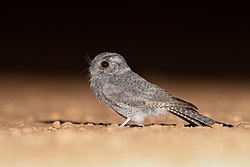
The Australian owlet-nightjar is It is 21–25 cm long, making it a small to medium-sized owlet-nightjar with grey upperparts and a white, barred front and a distinct dark and pale patterning on the head. It has large dark eyes that are non-reflective when a light is shone upon them; unlike many other nocturnal birds. In Northern Australia, females can also have a rufous morph. It is possible that males also have a rufous morph in this area, but it is far less distinct in comparison to the female's. This rufous morph is only in the North of Australia and is not found in coastal South Eastern Australia. Hatchlings are covered in dense white down which is replaced by grey down after about 10 days, this grey down is then replaced with juvenile plumage. Juvenile birds are similar to adults with slightly more spotting, shorter face bristles, and blurred markings on the face and nape. The plumage is overall paler in desert populations.
Australian owlet-nightjars are adapted to live in open woodland, with more pointed wings and larger feet, unlike most of the rest of the family that live in dense forest (though some individuals of this species can and do live in such habitat in Queensland and New Guinea).
Australian owlet-nightjars have an overall higher body temperature in summer and lower body temperature in winter. To combat lower temperatures in winter, Australian owlet-nightjars increase feather insulation to keep warm. During summer, Australian owlet-nightjars build up fat deposits, of which they have fully used up by mid-winter. Australian owlet-nightjars are nocturnal hunters, and in winter they have the advantage of longer periods of darkness for hunting, despite struggling with lower abundance of arthropods to eat. While resting during the day, Australian owlet-nightjars select roosts that are warmed by the sun to lower the energy required to keep them warm.
In hot weather, birds use evaporative cooling to cool their body temperature. This relies on panting and gular fluttering. Being a nocturnal species, Australian owlet-nightjars are reluctant to leave roost sites during the day, and cannot seek out water to rehydrate that lost from panting. In order to conserve water and avoid leaving their roost, Australian owlet-nightjars have an efficient thermoregulation system to prevent excessive moisture loss and dehydration, making them highly heat tolerant. Australian owlet-nightjars roost in hollows which protects them from full exposure to the sun and heat during the day, this is possibly why they are comparatively less heat-tolerant than related species that roost out in the open on arid ground.
Australian owlet-nightjars are well known for frequently entering torpor, and during winter in Australia this often happens daily. They usually enter torpor once a day around dawn for 3–4 hours, if they enter torpor twice in a day it is always a morning bout followed by a bout in the afternoon or night. Australian owlet-nightjars prefer roosting in tree hollows, but will occasionally roost in rock cavities, which are warmer and more temperature stable. In one study, Australian owlet-nightjars that roosted in rocks entered torpor half as often as those roosting in trees, and if they entered a second torpor it was more likely to be in the afternoon, while those in tree crevices were more likely to enter a second torpor at night. Australian owlet-nightjars tend to enter torpor when the atmospheric temperature is below 6.8 °C but may even do so at temperatures as high as 14.5 °C.
Australian owlet-nightjar
The Australian owlet-nightjar (Aegotheles cristatus) is a nocturnal bird found in open woodland across Australia and in southern New Guinea. It is the smallest nocturnal bird found in Australia, making it prone to predation. It is colloquially known as the moth owl or fairy owl and Jarlajirrpi by the Warlpiri people. It is the most common nocturnal bird in Australia. Despite suffering from predation and competition by introduced species, it is not considered threatened.
The Australian owlet-nightjar was formally described as Caprimulgus cristatus in 1790 by the English naturalist George Shaw based on a specimen collected in New South Wales, Australia. The species was described in the same year by John Latham as Caprimulgus novaehollandiae but Shaw's account is believed to be earlier and thus has precedence. The Australian owlet-nightjar was previously placed in Caprimulgiformes but updated taxonomy now places it in Aegotheliformes. The Australian owlet-nightjar is now one of ten species placed in the genus Aegotheles that was introduced in 1827 by the naturalists Nicholas Vigors and Thomas Horsfield. It is the type species of the genus. The specific epithet cristatus is Latin meaning "crested", "plumed" or "tufted".
Two subspecies are recognised:
The Australian owlet-nightjar is It is 21–25 cm long, making it a small to medium-sized owlet-nightjar with grey upperparts and a white, barred front and a distinct dark and pale patterning on the head. It has large dark eyes that are non-reflective when a light is shone upon them; unlike many other nocturnal birds. In Northern Australia, females can also have a rufous morph. It is possible that males also have a rufous morph in this area, but it is far less distinct in comparison to the female's. This rufous morph is only in the North of Australia and is not found in coastal South Eastern Australia. Hatchlings are covered in dense white down which is replaced by grey down after about 10 days, this grey down is then replaced with juvenile plumage. Juvenile birds are similar to adults with slightly more spotting, shorter face bristles, and blurred markings on the face and nape. The plumage is overall paler in desert populations.
Australian owlet-nightjars are adapted to live in open woodland, with more pointed wings and larger feet, unlike most of the rest of the family that live in dense forest (though some individuals of this species can and do live in such habitat in Queensland and New Guinea).
Australian owlet-nightjars have an overall higher body temperature in summer and lower body temperature in winter. To combat lower temperatures in winter, Australian owlet-nightjars increase feather insulation to keep warm. During summer, Australian owlet-nightjars build up fat deposits, of which they have fully used up by mid-winter. Australian owlet-nightjars are nocturnal hunters, and in winter they have the advantage of longer periods of darkness for hunting, despite struggling with lower abundance of arthropods to eat. While resting during the day, Australian owlet-nightjars select roosts that are warmed by the sun to lower the energy required to keep them warm.
In hot weather, birds use evaporative cooling to cool their body temperature. This relies on panting and gular fluttering. Being a nocturnal species, Australian owlet-nightjars are reluctant to leave roost sites during the day, and cannot seek out water to rehydrate that lost from panting. In order to conserve water and avoid leaving their roost, Australian owlet-nightjars have an efficient thermoregulation system to prevent excessive moisture loss and dehydration, making them highly heat tolerant. Australian owlet-nightjars roost in hollows which protects them from full exposure to the sun and heat during the day, this is possibly why they are comparatively less heat-tolerant than related species that roost out in the open on arid ground.
Australian owlet-nightjars are well known for frequently entering torpor, and during winter in Australia this often happens daily. They usually enter torpor once a day around dawn for 3–4 hours, if they enter torpor twice in a day it is always a morning bout followed by a bout in the afternoon or night. Australian owlet-nightjars prefer roosting in tree hollows, but will occasionally roost in rock cavities, which are warmer and more temperature stable. In one study, Australian owlet-nightjars that roosted in rocks entered torpor half as often as those roosting in trees, and if they entered a second torpor it was more likely to be in the afternoon, while those in tree crevices were more likely to enter a second torpor at night. Australian owlet-nightjars tend to enter torpor when the atmospheric temperature is below 6.8 °C but may even do so at temperatures as high as 14.5 °C.
Recent media
Recent media