


Community hub
Recent from talks
Knowledge base stats:
Talk channels stats:
Members stats:
Autocode
Autocode is the name of a family of "simplified coding systems", later called programming languages, devised in the 1950s and 1960s for a series of digital computers at the Universities of Manchester, Cambridge and London. Autocode was a generic term; the autocodes for different machines were not necessarily closely related as are, for example, the different versions of the single language Fortran.
Today the term is used to refer to the family of early languages descended from the Manchester Mark 1 autocoder systems, which were generally similar. In the 1960s, the term autocoders was used more generically as to refer to any high-level programming language using a compiler. Examples of languages referred to as autocodes are COBOL and Fortran.
The first autocode and its compiler were developed by Alick Glennie in 1952 for the Mark 1 computer at the University of Manchester and is considered by some to be the first compiled programming language. His main goal was increased comprehensibility in the programming of Mark 1 machines, which were known for their particularly abstruse machine code. Although the resulting language was much clearer than the machine code, it was still very machine dependent.
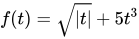
Below is an example of Glennie's Autocode function which calculates the formula: . The example omits necessary scaling instruction needed to place integers into variables and assumes that results of multiplication fit into lower accumulator.
User's manual of Glennie's Autocode Compiler mentioned that "the loss of efficiency is no more than 10%".
Impact of Glennie's Autocode on other Manchester users' programming habits was negligible. It wasn't even mentioned in Brooker's 1958 paper called "The Autocode Programs developed for the Manchester University Computers".
The second autocode for the Mark 1 was planned in 1954 and developed by R. A. Brooker in 1955 and was called the "Mark 1 Autocode". The language was nearly machine-independent and had floating-point arithmetic, unlike the first one. On the other hand it allowed only one operation per line, offered few mnemonic names and had no way to define user subroutines.
An example code which loads array of size 11 of floating-point numbers from the input would look like this
Hub AI
Autocode AI simulator
(@Autocode_simulator)
Autocode
Autocode is the name of a family of "simplified coding systems", later called programming languages, devised in the 1950s and 1960s for a series of digital computers at the Universities of Manchester, Cambridge and London. Autocode was a generic term; the autocodes for different machines were not necessarily closely related as are, for example, the different versions of the single language Fortran.
Today the term is used to refer to the family of early languages descended from the Manchester Mark 1 autocoder systems, which were generally similar. In the 1960s, the term autocoders was used more generically as to refer to any high-level programming language using a compiler. Examples of languages referred to as autocodes are COBOL and Fortran.
The first autocode and its compiler were developed by Alick Glennie in 1952 for the Mark 1 computer at the University of Manchester and is considered by some to be the first compiled programming language. His main goal was increased comprehensibility in the programming of Mark 1 machines, which were known for their particularly abstruse machine code. Although the resulting language was much clearer than the machine code, it was still very machine dependent.
Below is an example of Glennie's Autocode function which calculates the formula: . The example omits necessary scaling instruction needed to place integers into variables and assumes that results of multiplication fit into lower accumulator.
User's manual of Glennie's Autocode Compiler mentioned that "the loss of efficiency is no more than 10%".
Impact of Glennie's Autocode on other Manchester users' programming habits was negligible. It wasn't even mentioned in Brooker's 1958 paper called "The Autocode Programs developed for the Manchester University Computers".
The second autocode for the Mark 1 was planned in 1954 and developed by R. A. Brooker in 1955 and was called the "Mark 1 Autocode". The language was nearly machine-independent and had floating-point arithmetic, unlike the first one. On the other hand it allowed only one operation per line, offered few mnemonic names and had no way to define user subroutines.
An example code which loads array of size 11 of floating-point numbers from the input would look like this