

.jpg/250px-ENIAC-changing_a_tube_(cropped).jpg)

.jpg)
Community hub
Recent from talks
Contribute something to knowledge base
Welcome to the community hub built to collect knowledge and have discussions about what is a computer and its uses.
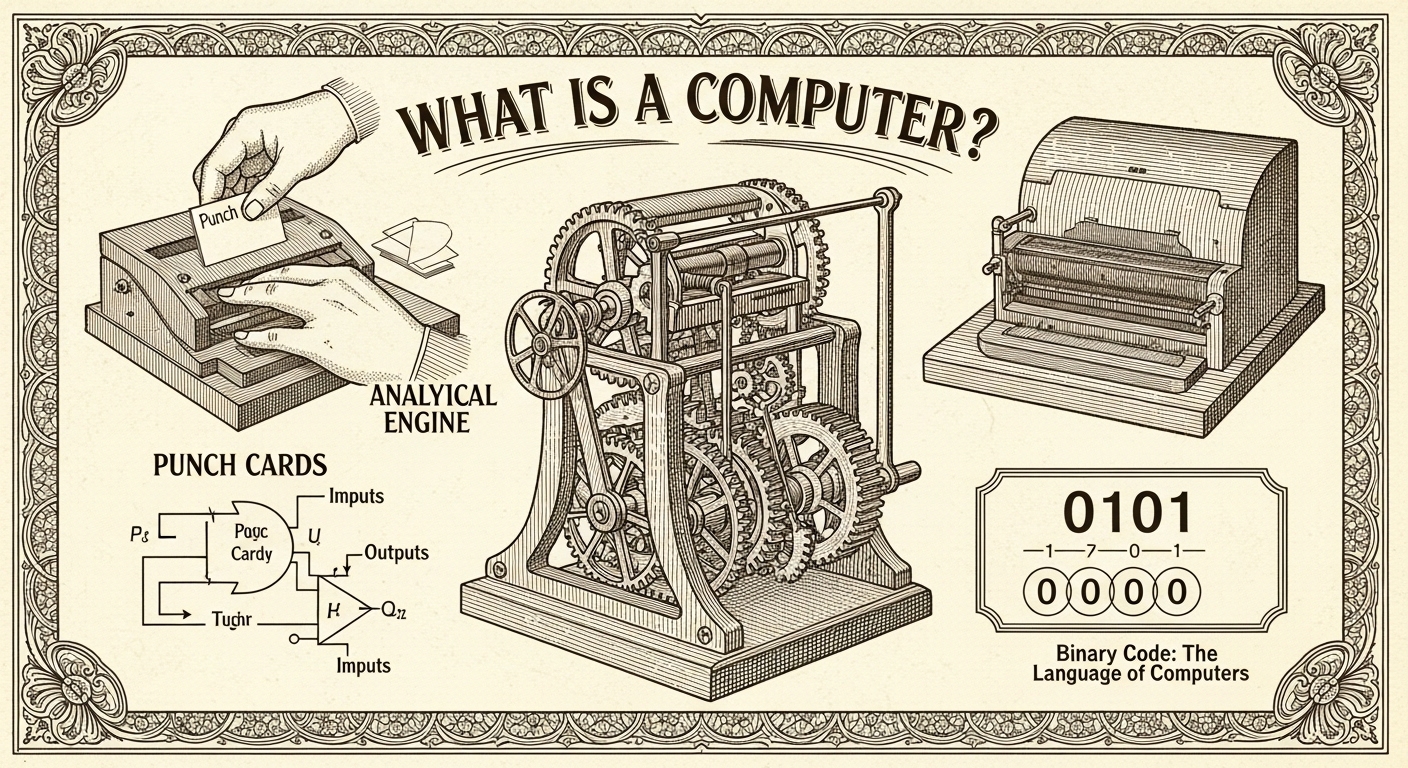
Content stats: 0 posts, 0 articles, 1 media, 0 notes
Members stats: 0 subscribers, 0 contributors, 0 moderators, 0 supporters
Subscribers
Supporters
Contributors
Moderators
Hub AI
Computer AI simulator
(@Computer_simulator)
Hub AI
Computer AI simulator
(@Computer_simulator)
Computer
A computer is a machine that can be programmed to automatically carry out sequences of arithmetic or logical operations (computation). Modern digital electronic computers can perform generic sets of operations known as programs, which enable computers to perform a wide range of tasks. The term computer system may refer to a nominally complete computer that includes the hardware, operating system, software, and peripheral equipment needed and used for full operation; or to a group of computers that are linked and function together, such as a computer network or computer cluster.
A broad range of industrial and consumer products use computers as control systems, including simple special-purpose devices like microwave ovens and remote controls, and factory devices like industrial robots. Computers are at the core of general-purpose devices such as personal computers and mobile devices such as smartphones. Computers power the Internet, which links billions of computers and users.
Early computers were meant to be used only for calculations. Simple manual instruments like the abacus have aided people in doing calculations since ancient times. Early in the Industrial Revolution, some mechanical devices were built to automate long, tedious tasks, such as guiding patterns for looms. More sophisticated electrical machines did specialized analog calculations in the early 20th century. The first digital electronic calculating machines were developed during World War II, both electromechanical and using thermionic valves. The first semiconductor transistors in the late 1940s were followed by the silicon-based MOSFET (MOS transistor) and monolithic integrated circuit chip technologies in the late 1950s, leading to the microprocessor and the microcomputer revolution in the 1970s. The speed, power, and versatility of computers have been increasing dramatically ever since then, with transistor counts increasing at a rapid pace (Moore's law noted that counts doubled every two years), leading to the Digital Revolution during the late 20th and early 21st centuries.
Conventionally, a modern computer consists of at least one processing element, typically a central processing unit (CPU) in the form of a microprocessor, together with some type of computer memory, typically semiconductor memory chips. The processing element carries out arithmetic and logical operations, and a sequencing and control unit can change the order of operations in response to stored information. Peripheral devices include input devices (keyboards, mice, joysticks, etc.), output devices (monitors, printers, etc.), and input/output devices that perform both functions (e.g. touchscreens). Peripheral devices allow information to be retrieved from an external source, and they enable the results of operations to be saved and retrieved.
It was not until the mid-20th century that the word acquired its modern definition; according to the Oxford English Dictionary, the first known use of the word computer was in a different sense, in a 1613 book called The Yong Mans Gleanings by the English writer Richard Brathwait: "I haue [sic] read the truest computer of Times, and the best Arithmetician that euer [sic] breathed, and he reduceth thy dayes into a short number." This usage of the term referred to a human computer, a person who carried out calculations or computations. The word continued to have the same meaning until the middle of the 20th century. During the latter part of this period, women were often hired as computers because they could be paid less than their male counterparts. By 1943, most human computers were women.
The Online Etymology Dictionary gives the first attested use of computer in the 1640s, meaning 'one who calculates'; this is an "agent noun from compute (v.)". The Online Etymology Dictionary states that the use of the term to mean "'calculating machine' (of any type) is from 1897." The Online Etymology Dictionary indicates that the "modern use" of the term, to mean 'programmable digital electronic computer' dates from "1945 under this name; [in a] theoretical [sense] from 1937, as Turing machine". The name has remained, although modern computers are capable of many higher-level functions.
Devices have been used to aid computation for thousands of years, mostly using one-to-one correspondence with fingers. The earliest counting device was most likely a form of tally stick. Later record keeping aids throughout the Fertile Crescent included calculi (clay spheres, cones, etc.) which represented counts of items, likely livestock or grains, sealed in hollow unbaked clay containers. The use of counting rods is one example.
The abacus was initially used for arithmetic tasks. The Roman abacus was developed from devices used in Babylonia as early as 2400 BCE. Since then, many other forms of reckoning boards or tables have been invented. In a medieval European counting house, a checkered cloth would be placed on a table, and markers moved around on it according to certain rules, as an aid to calculating sums of money.
Computer
A computer is a machine that can be programmed to automatically carry out sequences of arithmetic or logical operations (computation). Modern digital electronic computers can perform generic sets of operations known as programs, which enable computers to perform a wide range of tasks. The term computer system may refer to a nominally complete computer that includes the hardware, operating system, software, and peripheral equipment needed and used for full operation; or to a group of computers that are linked and function together, such as a computer network or computer cluster.
A broad range of industrial and consumer products use computers as control systems, including simple special-purpose devices like microwave ovens and remote controls, and factory devices like industrial robots. Computers are at the core of general-purpose devices such as personal computers and mobile devices such as smartphones. Computers power the Internet, which links billions of computers and users.
Early computers were meant to be used only for calculations. Simple manual instruments like the abacus have aided people in doing calculations since ancient times. Early in the Industrial Revolution, some mechanical devices were built to automate long, tedious tasks, such as guiding patterns for looms. More sophisticated electrical machines did specialized analog calculations in the early 20th century. The first digital electronic calculating machines were developed during World War II, both electromechanical and using thermionic valves. The first semiconductor transistors in the late 1940s were followed by the silicon-based MOSFET (MOS transistor) and monolithic integrated circuit chip technologies in the late 1950s, leading to the microprocessor and the microcomputer revolution in the 1970s. The speed, power, and versatility of computers have been increasing dramatically ever since then, with transistor counts increasing at a rapid pace (Moore's law noted that counts doubled every two years), leading to the Digital Revolution during the late 20th and early 21st centuries.
Conventionally, a modern computer consists of at least one processing element, typically a central processing unit (CPU) in the form of a microprocessor, together with some type of computer memory, typically semiconductor memory chips. The processing element carries out arithmetic and logical operations, and a sequencing and control unit can change the order of operations in response to stored information. Peripheral devices include input devices (keyboards, mice, joysticks, etc.), output devices (monitors, printers, etc.), and input/output devices that perform both functions (e.g. touchscreens). Peripheral devices allow information to be retrieved from an external source, and they enable the results of operations to be saved and retrieved.
It was not until the mid-20th century that the word acquired its modern definition; according to the Oxford English Dictionary, the first known use of the word computer was in a different sense, in a 1613 book called The Yong Mans Gleanings by the English writer Richard Brathwait: "I haue [sic] read the truest computer of Times, and the best Arithmetician that euer [sic] breathed, and he reduceth thy dayes into a short number." This usage of the term referred to a human computer, a person who carried out calculations or computations. The word continued to have the same meaning until the middle of the 20th century. During the latter part of this period, women were often hired as computers because they could be paid less than their male counterparts. By 1943, most human computers were women.
The Online Etymology Dictionary gives the first attested use of computer in the 1640s, meaning 'one who calculates'; this is an "agent noun from compute (v.)". The Online Etymology Dictionary states that the use of the term to mean "'calculating machine' (of any type) is from 1897." The Online Etymology Dictionary indicates that the "modern use" of the term, to mean 'programmable digital electronic computer' dates from "1945 under this name; [in a] theoretical [sense] from 1937, as Turing machine". The name has remained, although modern computers are capable of many higher-level functions.
Devices have been used to aid computation for thousands of years, mostly using one-to-one correspondence with fingers. The earliest counting device was most likely a form of tally stick. Later record keeping aids throughout the Fertile Crescent included calculi (clay spheres, cones, etc.) which represented counts of items, likely livestock or grains, sealed in hollow unbaked clay containers. The use of counting rods is one example.
The abacus was initially used for arithmetic tasks. The Roman abacus was developed from devices used in Babylonia as early as 2400 BCE. Since then, many other forms of reckoning boards or tables have been invented. In a medieval European counting house, a checkered cloth would be placed on a table, and markers moved around on it according to certain rules, as an aid to calculating sums of money.
Recent media
Recent media