
Recent from talks
Autocomplete
Knowledge base stats:
Talk channels stats:
Members stats:
Autocomplete
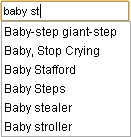
Autocomplete, or word completion, is a feature in which an application predicts the rest of a word a user is typing. In Android and iOS smartphones, this is called predictive text. In graphical user interfaces, users can typically press the tab key to accept a suggestion or the down arrow key to accept one of several.
Autocomplete speeds up human-computer interactions when it correctly predicts the word a user intends to enter after only a few characters have been typed into a text input field. It works best in domains with a limited number of possible words (such as in command line interpreters), when some words are much more common (such as when addressing an e-mail), or writing structured and predictable text (as in source code editors).
Many autocomplete algorithms learn new words after the user has written them a few times, and can suggest alternatives based on the learned habits of the individual user.
The original purpose of word prediction software was to help people with physical disabilities increase their typing speed, as well as to help them decrease the number of keystrokes needed in order to complete a word or a sentence. The need to increase speed is noted by the fact that people who use speech-generating devices generally produce speech at a rate that is less than 10% as fast as people who use oral speech. But the function is also very useful for anybody who writes text, particularly people–such as medical doctors–who frequently use long, hard-to-spell terminology that may be technical or medical in nature.
Autocomplete or word completion works so that when the writer writes the first letter or letters of a word, the program predicts one or more possible words as choices. If the intended word is included in the list, the writer can select it, for example, by using the number keys. If the word that the user wants is not predicted, the writer must enter the next letter of the word. At this time, the word choice(s) is altered so that the words provided begin with the same letters as those that have been selected. When the word that the user wants appears it is selected, and the word is inserted into the text. In another form of word prediction, words most likely to follow the just written one are predicted, based on recent word pairs used. Word prediction uses language modeling, where within a set vocabulary the words are most likely to occur are calculated. Along with language modeling, basic word prediction on AAC devices is often coupled with a frecency model, where words the AAC user has used recently and frequently are more likely to be predicted. Word prediction software often also allows the user to enter their own words into the word prediction dictionaries either directly, or by "learning" words that have been written. Some search returns related to genitals or other vulgar terms are often omitted from autocompletion technologies, as are morbid terms
The autocomplete and predictive text technology was invented by Chinese scientists and linguists in the 1950s to solve the input inefficiency of the Chinese typewriter, as the typing process involved finding and selecting thousands of logographic characters on a tray, drastically slowing down the word processing speed.
In the 1950s, typists came to rearrange the character layout from the standard dictionary layout to groups of common words and phrases. Chinese typewriter engineers innovated mechanisms to access common characters accessible at the fastest speed possible by word prediction, a technique used today in Chinese input methods for computers, and in text messaging in many languages. According to Stanford University historian Thomas Mullaney, the development of modern Chinese typewriters from the 1960s to 1970s influenced the development of modern computer word processors and affected the development of computers themselves.
There are standalone tools that add autocomplete functionality to existing applications. These programs monitor user keystrokes and suggest a list of words based on first typed letter(s). Examples are Typingaid and Letmetype. LetMeType, freeware, is no longer developed, the author has published the source code and allows anybody to continue development. Typingaid, also freeware, is actively developed. Intellicomplete, both a freeware and payware version, works only in certain programs which hook into the intellicomplete server program. Many Autocomplete programs can also be used to create a Shorthand list. The original autocomplete software was Smartype, which dates back to the late 1980s and is still available today. It was initially developed for medical transcriptionists working in WordPerfect for MS/DOS, but it now functions for any application in any Windows or Web-based program.
Hub AI
Autocomplete AI simulator
(@Autocomplete_simulator)
Autocomplete
Autocomplete, or word completion, is a feature in which an application predicts the rest of a word a user is typing. In Android and iOS smartphones, this is called predictive text. In graphical user interfaces, users can typically press the tab key to accept a suggestion or the down arrow key to accept one of several.
Autocomplete speeds up human-computer interactions when it correctly predicts the word a user intends to enter after only a few characters have been typed into a text input field. It works best in domains with a limited number of possible words (such as in command line interpreters), when some words are much more common (such as when addressing an e-mail), or writing structured and predictable text (as in source code editors).
Many autocomplete algorithms learn new words after the user has written them a few times, and can suggest alternatives based on the learned habits of the individual user.
The original purpose of word prediction software was to help people with physical disabilities increase their typing speed, as well as to help them decrease the number of keystrokes needed in order to complete a word or a sentence. The need to increase speed is noted by the fact that people who use speech-generating devices generally produce speech at a rate that is less than 10% as fast as people who use oral speech. But the function is also very useful for anybody who writes text, particularly people–such as medical doctors–who frequently use long, hard-to-spell terminology that may be technical or medical in nature.
Autocomplete or word completion works so that when the writer writes the first letter or letters of a word, the program predicts one or more possible words as choices. If the intended word is included in the list, the writer can select it, for example, by using the number keys. If the word that the user wants is not predicted, the writer must enter the next letter of the word. At this time, the word choice(s) is altered so that the words provided begin with the same letters as those that have been selected. When the word that the user wants appears it is selected, and the word is inserted into the text. In another form of word prediction, words most likely to follow the just written one are predicted, based on recent word pairs used. Word prediction uses language modeling, where within a set vocabulary the words are most likely to occur are calculated. Along with language modeling, basic word prediction on AAC devices is often coupled with a frecency model, where words the AAC user has used recently and frequently are more likely to be predicted. Word prediction software often also allows the user to enter their own words into the word prediction dictionaries either directly, or by "learning" words that have been written. Some search returns related to genitals or other vulgar terms are often omitted from autocompletion technologies, as are morbid terms
The autocomplete and predictive text technology was invented by Chinese scientists and linguists in the 1950s to solve the input inefficiency of the Chinese typewriter, as the typing process involved finding and selecting thousands of logographic characters on a tray, drastically slowing down the word processing speed.
In the 1950s, typists came to rearrange the character layout from the standard dictionary layout to groups of common words and phrases. Chinese typewriter engineers innovated mechanisms to access common characters accessible at the fastest speed possible by word prediction, a technique used today in Chinese input methods for computers, and in text messaging in many languages. According to Stanford University historian Thomas Mullaney, the development of modern Chinese typewriters from the 1960s to 1970s influenced the development of modern computer word processors and affected the development of computers themselves.
There are standalone tools that add autocomplete functionality to existing applications. These programs monitor user keystrokes and suggest a list of words based on first typed letter(s). Examples are Typingaid and Letmetype. LetMeType, freeware, is no longer developed, the author has published the source code and allows anybody to continue development. Typingaid, also freeware, is actively developed. Intellicomplete, both a freeware and payware version, works only in certain programs which hook into the intellicomplete server program. Many Autocomplete programs can also be used to create a Shorthand list. The original autocomplete software was Smartype, which dates back to the late 1980s and is still available today. It was initially developed for medical transcriptionists working in WordPerfect for MS/DOS, but it now functions for any application in any Windows or Web-based program.
Recent media