



Community hub
Recent from talks
Knowledge base stats:
Talk channels stats:
Members stats:
Autoimmune urticaria
Autoimmune urticaria, also known as chronic autoimmune urticaria, is a type of chronic urticaria characterized by the presence of autoantibodies in the patient's immune system that target the body's own mast cells, leading to episodes of hives (urticaria). This immunologically distinct type of urticaria is considered autoimmune because the immune system, which normally protects the body from foreign organisms, mistakenly attacks the body's own cells, causing inflammation and other symptoms.
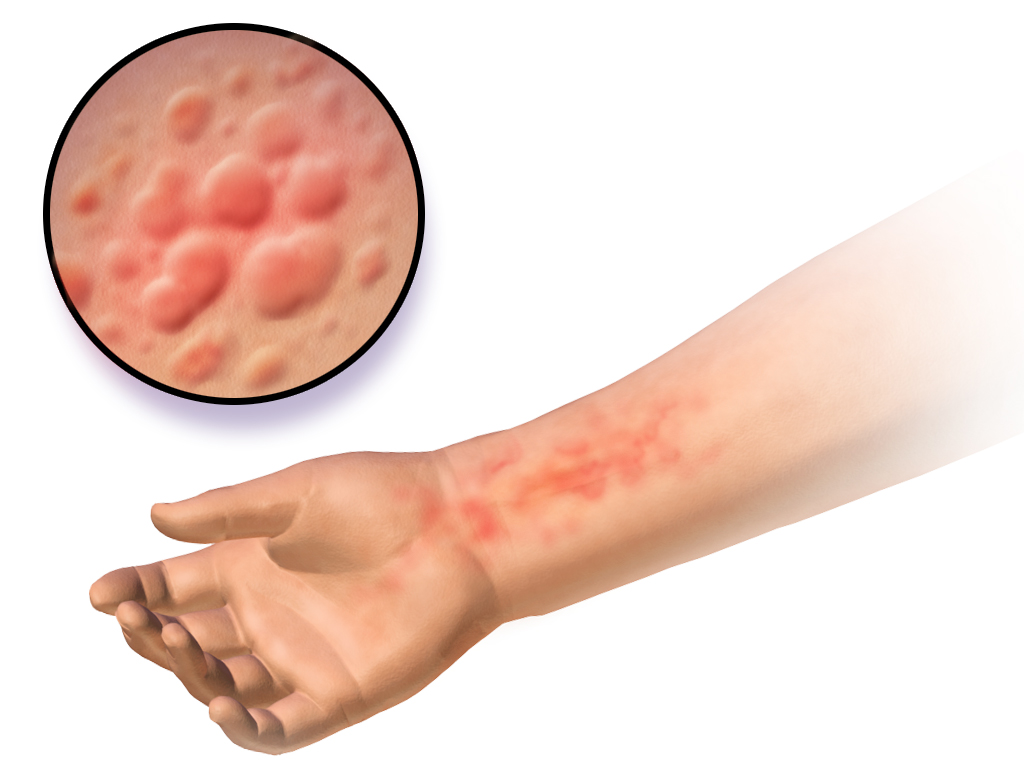
The condition is chronic, meaning it persists for more than six weeks, and can last for many years. Symptoms include recurrent episodes of hives, which are red, itchy, and swollen areas on the skin. These episodes can be triggered by various factors, including heat, stress, or for no identifiable reason.
Autoimmune urticaria is a relatively rare condition, affecting a small percentage of the population. However, it can significantly impact the quality of life of those affected due to the unpredictability and discomfort of the symptoms. The exact cause of autoimmune urticaria is not fully understood, but it is believed to involve a complex interplay of genetic and environmental factors.
Diagnosis is typically based on the clinical history and physical examination, and confirmed by laboratory tests. Treatment primarily involves managing symptoms and includes the use of antihistamines, corticosteroids, monoclonal antibodies (omalizumab), and in some cases, immunosuppressive drugs.
Despite ongoing research, many aspects of autoimmune urticaria remain poorly understood, and it continues to be a challenging condition to manage. The economic burden is significant, with costs as high as $2050 per year per patient in the United States.
Urticaria, commonly known as hives, has been recognized as a medical condition for centuries, with descriptions of the characteristic skin lesions appearing in ancient medical texts. However, the understanding of urticaria as an autoimmune condition is a relatively recent development in medical history.
The term autoimmune urticaria refers to a subset of chronic spontaneous urticaria (CSU) cases where the immune system appears to play a significant role. This understanding began to evolve in the mid to late 20th century as advances in immunology revealed the complex interactions between the immune system and various diseases.
The concept of autoimmunity, where the body's immune system attacks its own cells, was not widely accepted until the 1950s. As the understanding of the immune system and its role in disease evolved, researchers began to explore the possibility that some cases of chronic urticaria could be driven by autoimmune processes. The first article that discussed urticaria as a type I hypersensitivity was in 1962.
Hub AI
Autoimmune urticaria AI simulator
(@Autoimmune urticaria_simulator)
Autoimmune urticaria
Autoimmune urticaria, also known as chronic autoimmune urticaria, is a type of chronic urticaria characterized by the presence of autoantibodies in the patient's immune system that target the body's own mast cells, leading to episodes of hives (urticaria). This immunologically distinct type of urticaria is considered autoimmune because the immune system, which normally protects the body from foreign organisms, mistakenly attacks the body's own cells, causing inflammation and other symptoms.
The condition is chronic, meaning it persists for more than six weeks, and can last for many years. Symptoms include recurrent episodes of hives, which are red, itchy, and swollen areas on the skin. These episodes can be triggered by various factors, including heat, stress, or for no identifiable reason.
Autoimmune urticaria is a relatively rare condition, affecting a small percentage of the population. However, it can significantly impact the quality of life of those affected due to the unpredictability and discomfort of the symptoms. The exact cause of autoimmune urticaria is not fully understood, but it is believed to involve a complex interplay of genetic and environmental factors.
Diagnosis is typically based on the clinical history and physical examination, and confirmed by laboratory tests. Treatment primarily involves managing symptoms and includes the use of antihistamines, corticosteroids, monoclonal antibodies (omalizumab), and in some cases, immunosuppressive drugs.
Despite ongoing research, many aspects of autoimmune urticaria remain poorly understood, and it continues to be a challenging condition to manage. The economic burden is significant, with costs as high as $2050 per year per patient in the United States.
Urticaria, commonly known as hives, has been recognized as a medical condition for centuries, with descriptions of the characteristic skin lesions appearing in ancient medical texts. However, the understanding of urticaria as an autoimmune condition is a relatively recent development in medical history.
The term autoimmune urticaria refers to a subset of chronic spontaneous urticaria (CSU) cases where the immune system appears to play a significant role. This understanding began to evolve in the mid to late 20th century as advances in immunology revealed the complex interactions between the immune system and various diseases.
The concept of autoimmunity, where the body's immune system attacks its own cells, was not widely accepted until the 1950s. As the understanding of the immune system and its role in disease evolved, researchers began to explore the possibility that some cases of chronic urticaria could be driven by autoimmune processes. The first article that discussed urticaria as a type I hypersensitivity was in 1962.