Hubbry Logo
AutoimmunityAutoimmunityMain
Open search
Autoimmunity
Community hub
Autoimmunity
logo
8 pages, 0 posts
0 subscribers
Be the first to start a discussion here.
Contribute something
Autoimmunity
Autoimmunity
from Wikipedia
Autoimmunity
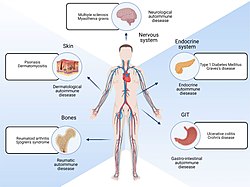
Different locations of the body that are affected by autoimmune diseases
Parts of body affected by autoimmune diseases
SpecialtyImmunology

In immunology, autoimmunity is the system of immune responses of an organism against its own healthy cells, tissues and other normal body constituents.[1][2] Any disease resulting from this type of immune response is termed an "autoimmune disease". Prominent examples include celiac disease, diabetes mellitus type 1, Henoch–Schönlein purpura, systemic lupus erythematosus, Sjögren syndrome, eosinophilic granulomatosis with polyangiitis, Hashimoto's thyroiditis, Graves' disease, idiopathic thrombocytopenic purpura, Addison's disease, rheumatoid arthritis, ankylosing spondylitis, polymyositis, dermatomyositis, and multiple sclerosis. Autoimmune diseases are very often treated with steroids.[3]

Autoimmunity means presence of antibodies or T cells that react with self-protein and is present in all individuals, even in normal health state. It causes autoimmune diseases if self-reactivity can lead to tissue damage.[4]

History

[edit]

In the later 19th century, it was believed that the immune system was unable to react against the body's own tissues. Paul Ehrlich, at the turn of the 20th century, proposed the concept of horror autotoxicus. Ehrlich later adjusted his theory to recognize the possibility of autoimmune tissue attacks, but believed certain innate protection mechanisms would prevent the autoimmune response from becoming pathological.[citation needed]

In 1904, this theory was challenged by the discovery of a substance in the serum of patients with paroxysmal cold hemoglobinuria that reacted with red blood cells. During the following decades, a number of conditions could be linked to autoimmune responses. However, the authoritative status of Ehrlich's postulate hampered the understanding of these findings. Immunology became a biochemical rather than a clinical discipline.[5] By the 1950s, the modern understanding of autoantibodies and autoimmune diseases started to spread.[6]

More recently, it has become accepted that autoimmune responses are an integral part of vertebrate immune systems (sometimes termed "natural autoimmunity").[7] Autoimmunity should not be confused with alloimmunity.

Low-level autoimmunity

[edit]

Autoimmunity may have a role in allowing a rapid immune response in the early stages of an infection when the availability of foreign antigens limits the response (i.e., when there are few pathogens present). In their study, Stefanova et al. (2002) injected an anti-MHC class II antibody into mice expressing a single type of MHC Class II molecule (H-2b) to temporarily prevent CD4+ T cell-MHC interaction. Naive CD4+ T cells (those that have not encountered non-self antigens before) recovered from these mice 36 hours post-anti-MHC administration showed decreased responsiveness to the antigen pigeon cytochrome c peptide, as determined by ZAP70 phosphorylation, proliferation, and interleukin 2 production. Thus Stefanova et al. (2002) demonstrated that self-MHC recognition (which, if too strong may contribute to autoimmune disease) maintains the responsiveness of CD4+ T cells when foreign antigens are absent.[8]

Immunological tolerance

[edit]

Pioneering work by Noel Rose and Ernst Witebsky in New York, and Roitt and Doniach at University College London provided clear evidence that, at least in terms of antibody-producing B cells (B lymphocytes), diseases such as rheumatoid arthritis and thyrotoxicosis are associated with loss of immunological tolerance, which is the ability of an individual to ignore "self", while reacting to "non-self". This breakage leads to the immune system mounting an effective and specific immune response against self antigens. The exact genesis of immunological tolerance is still elusive, but several theories have been proposed since the mid-twentieth century to explain its origin.[9]

Three hypotheses have gained widespread attention among immunologists:

  • Clonal deletion theory, proposed by Burnet, according to which self-reactive lymphoid cells are destroyed during the development of the immune system in an individual. For their work Frank M. Burnet and Peter B. Medawar were awarded the 1960 Nobel Prize in Physiology or Medicine "for discovery of acquired immunological tolerance".
  • Clonal anergy theory, proposed by Nossal, in which self-reactive T- or B-cells become inactivated in the normal individual and cannot amplify the immune response.[10]
  • Idiotype network theory, proposed by Jerne, wherein a network of antibodies capable of neutralizing self-reactive antibodies exists naturally within the body.[11]

In addition, two other theories are under intense investigation:

  • Clonal ignorance theory, according to which autoreactive T cells that are not represented in the thymus will mature and migrate to the periphery, where they will not encounter the appropriate antigen because it is inaccessible tissues. Consequently, auto-reactive B cells, that escape deletion, cannot find the antigen or the specific helper T cell.[12]
  • Suppressor population or Regulatory T cell theory, wherein regulatory T-lymphocytes (commonly CD4+FoxP3+ cells, among others) function to prevent, downregulate, or limit autoaggressive immune responses in the immune system.

Tolerance can also be differentiated into "central" and "peripheral" tolerance, on whether or not the above-stated checking mechanisms operate in the central lymphoid organs (thymus and bone marrow) or the peripheral lymphoid organs (lymph node, spleen, etc., where self-reactive B-cells may be destroyed). It must be emphasised that these theories are not mutually exclusive, and evidence has been mounting suggesting that all of these mechanisms may actively contribute to vertebrate immunological tolerance.

A puzzling feature of the documented loss of tolerance seen in spontaneous human autoimmunity is that it is almost entirely restricted to the autoantibody responses produced by B lymphocytes. Loss of tolerance by T cells has been extremely hard to demonstrate, and where there is evidence for an abnormal T cell response it is usually not to the antigen recognised by autoantibodies. Thus, in rheumatoid arthritis there are autoantibodies to IgG Fc but apparently no corresponding T cell response. In systemic lupus there are autoantibodies to DNA, which cannot evoke a T cell response, and limited evidence for T cell responses implicates nucleoprotein antigens. In Celiac disease there are autoantibodies to tissue transglutaminase but the T cell response is to the foreign protein gliadin. This disparity has led to the idea that human autoimmune disease is in most cases (with probable exceptions including type I diabetes) based on a loss of B cell tolerance which makes use of normal T cell responses to foreign antigens in a variety of aberrant ways.[13]

Immunodeficiency and autoimmunity

[edit]

There are a large number of immunodeficiency syndromes that present clinical and laboratory characteristics of autoimmunity. The decreased ability of the immune system to clear infections in these patients may be responsible for causing autoimmunity through perpetual immune system activation.[14]

One example is common variable immunodeficiency, in which multiple autoimmune diseases are seen, e.g., inflammatory bowel disease, autoimmune thrombocytopenia and autoimmune thyroid disease.[15]

Familial hemophagocytic lymphohistiocytosis, an autosomal recessive primary immunodeficiency, is another example. Pancytopenia, rashes, swollen lymph nodes and enlargement of the liver and spleen are commonly seen in such individuals. Presence of multiple uncleared viral infections due to lack of perforin are thought to be responsible.

In addition to chronic and/or recurrent infections many autoimmune diseases including arthritis, autoimmune hemolytic anemia, scleroderma and type 1 diabetes mellitus are also seen in X-linked agammaglobulinemia (XLA). Recurrent bacterial and fungal infections and chronic inflammation of the gut and lungs are seen in chronic granulomatous disease (CGD) as well. CGD is a caused by decreased production of nicotinamide adenine dinucleotide phosphate (NADPH) oxidase by neutrophils. Hypomorphic RAG mutations are seen in patients with midline granulomatous disease; an autoimmune disorder that is commonly seen in patients with granulomatosis with polyangiitis and NK/T cell lymphomas.Wiskott–Aldrich syndrome (WAS) patients also present with eczema, autoimmune manifestations, recurrent bacterial infections and lymphoma. In autoimmune polyendocrinopathy-candidiasis-ectodermal dystrophy also autoimmunity and infections coexist: organ-specific autoimmune manifestations (e.g., hypoparathyroidism and adrenocortical failure) and chronic mucocutaneous candidiasis. Finally, IgA deficiency is also sometimes associated with the development of autoimmune and atopic phenomena.[16]

Causes

[edit]

Genetic factors

[edit]

Certain individuals are genetically susceptible to developing autoimmune diseases. This susceptibility is associated with multiple genes plus other risk factors. Genetically predisposed individuals do not always develop autoimmune diseases. Three main sets of genes are suspected in many autoimmune diseases. These genes are related to:[17]

The first two, which are involved in the recognition of antigens, are inherently variable and susceptible to recombination. These variations enable the immune system to respond to a very wide variety of invaders, but may also give rise to lymphocytes capable of self-reactivity.

Fewer correlations exist with MHC class I molecules. The most notable and consistent is the association between HLA B27 and spondyloarthropathies like ankylosing spondylitis and reactive arthritis. Correlations may exist between polymorphisms within class II MHC promoters and autoimmune disease.

The contributions of genes outside the MHC complex remain the subject of research, in animal models of disease (Linda Wicker's extensive genetic studies of diabetes in the NOD mouse)[clarification needed], and in patients (Brian Kotzin's linkage analysis of susceptibility to lupus erythematosus).

In recent studies, the gene PTPN22 has emerged as a significant factor linked to various autoimmune diseases, such as Type I diabetes, rheumatoid arthritis, systemic lupus erythematosus, Hashimoto's thyroiditis, Graves' disease, Addison's disease, Myasthenia Gravis, vitiligo, systemic sclerosis, juvenile idiopathic arthritis, and psoriatic arthritis.[19] PTPN22 is involved in regulating the activity of immune cells, and so variations in this gene can lead to dysregulation of the immune response, making individuals more susceptible to autoimmune diseases.[20][21]

Existential Factors (a.k.a Endogenous Environmental)

[edit]
Ratio of female/male incidence
of autoimmune diseases
Hashimoto's thyroiditis 10:1[22]
Graves' disease 7:1[22]
Multiple sclerosis (MS) 2:1[22]
Myasthenia gravis 2:1[22]
Systemic lupus erythematosus 9:1[22]
Rheumatoid arthritis 5:2[22]
Primary sclerosing cholangitis 1:2

Sex

[edit]

Most autoimmune diseases are sex-related; as a whole, women are much more likely to develop autoimmune disease than men. Being female is the single greatest risk factor for developing autoimmune disease than any other genetic or environmental risk factor yet discovered.[23][24] Autoimmune conditions overrepresented in women include: lupus, primary biliary cholangitis, Graves' disease, Hashimoto's thyroiditis, and multiple sclerosis, among many others. A few autoimmune diseases that men are just as or more likely to develop as women include: ankylosing spondylitis, type 1 diabetes mellitus, granulomatosis with polyangiitis, primary sclerosing cholangitis, and psoriasis.

The reasons for the sex role in autoimmunity vary. Women appear to generally mount larger inflammatory responses than men when their immune systems are triggered, increasing the risk of autoimmunity. Involvement of sex steroids is indicated by that many autoimmune diseases tend to fluctuate in accordance with hormonal changes, for example: during pregnancy, in the menstrual cycle, or when using oral contraception. A history of pregnancy also appears to leave a persistent increased risk for autoimmune disease. It has been suggested that the slight, direct exchange of cells between mothers and their children during pregnancy may induce autoimmunity.[25] This would tip the gender balance in the direction of the female.

Another theory suggests the female high tendency to get autoimmunity is due to an imbalanced X-chromosome inactivation.[26] The X-inactivation skew theory, proposed by Princeton University's Jeff Stewart, has recently been confirmed experimentally in scleroderma and autoimmune thyroiditis.[27] Other complex X-linked genetic susceptibility mechanisms are proposed and under investigation.

Environmental factors

[edit]

Infectious diseases and parasites

[edit]

An interesting inverse relationship exists between infectious diseases and autoimmune diseases. In areas where multiple infectious diseases are endemic, autoimmune diseases are quite rarely seen. The reverse, to some extent, seems to hold true. The hygiene hypothesis attributes these correlations to the immune-manipulating strategies of pathogens. While such an observation has been variously termed as spurious and ineffective, according to some studies, parasite infection is associated with reduced activity of autoimmune disease.[28][29][30]

The putative mechanism is that the parasite attenuates the host immune response in order to protect itself. This may provide a serendipitous benefit to a host that also has autoimmune disease. The details of parasite immune modulation are not yet known, but may include secretion of anti-inflammatory agents or interference with the host immune signaling.

A paradoxical observation has been the strong association of certain microbial organisms with autoimmune diseases. For example, Klebsiella pneumoniae and coxsackievirus B have been strongly correlated with ankylosing spondylitis and diabetes mellitus type 1, respectively. This has been explained by the tendency of the infecting organism to produce super-antigens that are capable of polyclonal activation of B-lymphocytes, and production of large amounts of antibodies of varying specificities, some of which may be self-reactive (see below).

Chemical agents and drugs

[edit]

Certain chemical agents and drugs can also be associated with the genesis of autoimmune conditions, or conditions that simulate autoimmune diseases. The most striking of these is the drug-induced lupus erythematosus. Usually, withdrawal of the offending drug cures the symptoms in a patient.

Cigarette smoking is now established as a major risk factor for both incidence and severity of rheumatoid arthritis. This may relate to abnormal citrullination of proteins, since the effects of smoking correlate with the presence of antibodies to citrullinated peptides.

Pathogenesis of autoimmunity

[edit]

Several mechanisms are thought to be operative in the pathogenesis of autoimmune diseases, against a backdrop of genetic predisposition and environmental modulation. It is beyond the scope of this article to discuss each of these mechanisms exhaustively, but a summary of some of the important mechanisms have been described:

  • T-cell bypass – A normal immune system requires the activation of B cells by T cells before the former can undergo differentiation into plasma B-cells and subsequently produce antibodies in large quantities. This requirement of a T cell can be bypassed in rare instances, such as infection by organisms producing super-antigens, which are capable of initiating polyclonal activation of B-cells, or even of T-cells, by directly binding to the β-subunit of T-cell receptors in a non-specific fashion.
  • T-cell–B-cell discordance – A normal immune response is assumed to involve B and T cell responses to the same antigen, even if we know that B cells and T cells recognise very different things: conformations on the surface of a molecule for B cells and pre-processed peptide fragments of proteins for T cells. However, there is nothing as far as we know that requires this. All that is required is that a B cell recognising antigen X endocytoses and processes a protein Y (normally =X) and presents it to a T cell. Roosnek and Lanzavecchia showed that B cells recognising IgGFc could get help from any T cell responding to an antigen co-endocytosed with IgG by the B cell as part of an immune complex. In coeliac disease it seems likely that B cells recognising tissue transglutamine are helped by T cells recognising gliadin.
  • Aberrant B cell receptor-mediated feedback – A feature of human autoimmune disease is that it is largely restricted to a small group of antigens, several of which have known signaling roles in the immune response (DNA, C1q, IgGFc, Ro, Con. A receptor, Peanut agglutinin receptor(PNAR)). This fact gave rise to the idea that spontaneous autoimmunity may result when the binding of antibody to certain antigens leads to aberrant signals being fed back to parent B cells through membrane bound ligands. These ligands include B cell receptor (for antigen), IgG Fc receptors, CD21, which binds complement C3d, Toll-like receptors 9 and 7 (which can bind DNA and nucleoproteins) and PNAR. More indirect aberrant activation of B cells can also be envisaged with autoantibodies to acetyl choline receptor (on thymic myoid cells) and hormone and hormone binding proteins. Together with the concept of T-cell–B-cell discordance this idea forms the basis of the hypothesis of self-perpetuating autoreactive B cells.[31] Autoreactive B cells in spontaneous autoimmunity are seen as surviving because of subversion both of the T cell help pathway and of the feedback signal through B cell receptor, thereby overcoming the negative signals responsible for B cell self-tolerance without necessarily requiring loss of T cell self-tolerance.
  • Molecular mimicry – An exogenous antigen may share structural similarities with certain host antigens; thus, any antibody produced against this antigen (which mimics the self-antigens) can also, in theory, bind to the host antigens, and amplify the immune response. The idea of molecular mimicry arose in the context of rheumatic fever, which follows infection with Group A beta-haemolytic streptococci. Although rheumatic fever has been attributed to molecular mimicry for half a century no antigen has been formally identified (if anything too many have been proposed). Moreover, the complex tissue distribution of the disease (heart, joint, skin, basal ganglia) argues against a cardiac specific antigen. It remains entirely possible that the disease is due to e.g. an unusual interaction between immune complexes, complement components and endothelium.
  • Idiotype cross-reactionIdiotypes are antigenic epitopes found in the antigen-binding portion (Fab) of the immunoglobulin molecule. Plotz and Oldstone presented evidence that autoimmunity can arise as a result of a cross-reaction between the idiotype on an antiviral antibody and a host cell receptor for the virus in question. In this case, the host-cell receptor is envisioned as an internal image of the virus, and the anti-idiotype antibodies can react with the host cells.
  • Cytokine dysregulationCytokines have been recently divided into two groups according to the population of cells whose functions they promote: Helper T-cells type 1 or type 2. The second category of cytokines, which include IL-4, IL-10 and TGF-β (to name a few), seem to have a role in prevention of exaggeration of pro-inflammatory immune responses.
  • Dendritic cell apoptosis – immune system cells called dendritic cells present antigens to active lymphocytes. Dendritic cells that are defective in apoptosis can lead to inappropriate systemic lymphocyte activation and consequent decline in self-tolerance.[32]
  • Epitope spreading or epitope drift – when the immune reaction changes from targeting the primary epitope to also targeting other epitopes.[33] In contrast to molecular mimicry, the other epitopes need not be structurally similar to the primary one.
  • Epitope modification or Cryptic epitope exposure – this mechanism of autoimmune disease is unique in that it does not result from a defect in the hematopoietic system. Instead, disease results from the exposure of cryptic N-glycan (polysaccharide) linkages common to lower eukaryotes and prokaryotes on the glycoproteins of mammalian non-hematopoietic cells and organs[34] This exposure of phylogenically primitive glycans activates one or more mammalian innate immune cell receptors to induce a chronic sterile inflammatory state. In the presence of chronic and inflammatory cell damage, the adaptive immune system is recruited and self–tolerance is lost with increased autoantibody production. In this form of the disease, the absence of lymphocytes can accelerate organ damage, and intravenous IgG administration can be therapeutic. Although this route to autoimmune disease may underlie various degenerative disease states, no diagnostics for this disease mechanism exist at present, and thus its role in human autoimmunity is currently unknown.

The roles of specialized immunoregulatory cell types, such as regulatory T cells, NKT cells, γδ T-cells in the pathogenesis of autoimmune disease are under investigation.

Classification

[edit]

Autoimmune diseases can be broadly divided into systemic and organ-specific or localised autoimmune disorders, depending on the principal clinico-pathologic features of each disease.

Using the traditional "organ specific" and "non-organ specific" classification scheme, many diseases have been lumped together under the autoimmune disease umbrella. However, many chronic inflammatory human disorders lack the telltale associations of B and T cell driven immunopathology. In the last decade[clarification needed] it has been firmly established that tissue "inflammation against self" does not necessarily rely on abnormal T and B cell responses.[35]

This has led to the recent proposal that the spectrum of autoimmunity should be viewed along an "immunological disease continuum", with classical autoimmune diseases at one extreme and diseases driven by the innate immune system at the other extreme. Within this scheme, the full spectrum of autoimmunity can be included. Many common human autoimmune diseases can be seen to have a substantial innate immune mediated immunopathology using this new scheme. This new classification scheme has implications[clarification needed] for understanding disease mechanisms and for therapy development.[35]

Diagnosis

[edit]

Diagnosis of autoimmune disorders largely rests on accurate history and physical examination of the patient, and high index of suspicion[clarification needed] against a backdrop of certain abnormalities in routine laboratory tests (example, elevated C-reactive protein).[citation needed]

In several systemic disorders,[clarification needed] serological assays which can detect specific autoantibodies can be employed.[citation needed] Localised disorders are best diagnosed by immunofluorescence of biopsy specimens.[citation needed]

Autoantibodies are used to diagnose many autoimmune diseases.[clarification needed] The levels of autoantibodies are measured to determine the progress of the disease.[citation needed]

Treatments

[edit]

Treatments for autoimmune disease have traditionally been immunosuppressive, anti-inflammatory, or palliative.[12] Managing inflammation is critical in autoimmune diseases.[36] Non-immunological therapies, such as hormone replacement in Hashimoto's thyroiditis or Type 1 diabetes mellitus treat outcomes of the autoaggressive response, thus these are palliative treatments. Dietary manipulation limits the severity of celiac disease. Steroidal or NSAID treatment limits inflammatory symptoms of many diseases. IVIG is used for CIDP and GBS. Specific immunomodulatory therapies, such as the TNFα antagonists (e.g. etanercept), the B cell depleting agent rituximab, the anti-IL-6 receptor tocilizumab and the costimulation blocker abatacept have been shown to be useful in treating RA. Some of these immunotherapies may be associated with increased risk of adverse effects, such as susceptibility to infection.

Helminthic therapy is an experimental approach that involves inoculation of the patient with specific parasitic intestinal nematodes (helminths). There are currently two closely related treatments available, inoculation with either Necator americanus, commonly known as hookworms, or Trichuris Suis Ova, commonly known as Pig Whipworm Eggs.[37][38][39][40][41]

T-cell vaccination is also being explored as a possible future therapy for autoimmune disorders.[42]

Nutrition and autoimmunity

[edit]

Vitamin D/Sunlight

  • Because most human cells and tissues have receptors for vitamin D, including T and B cells, adequate levels of vitamin D can aid in the regulation of the immune system.[43] Vitamin D plays a role in immune function by acting on T cells and natural killer cells.[44]  Research has demonstrated an association between low serum vitamin D and autoimmune diseases, including multiple sclerosistype 1 diabetes, and Systemic Lupus Erythematosus (commonly referred to simply as lupus).[44][45][46]  However, since photosensitivity occurs in lupus, patients are advised to avoid sunlight which may be responsible for vitamin D deficiency seen in this disease.[44][45][46] Polymorphisms in the vitamin D receptor gene are commonly found in people with autoimmune diseases, giving one potential mechanism for vitamin D's role in autoimmunity.[44][45] There is mixed evidence on the effect of vitamin D supplementation in type 1 diabetes, lupus, and multiple sclerosis.[44][45][46] 

Omega-3 Fatty Acids

  • Studies have shown that adequate consumption of omega-3 fatty acids counteracts the effects of arachidonic acids, which contribute to symptoms of autoimmune diseases. Human and animal trials suggest that omega-3 is an effective treatment modality for many cases of Rheumatoid Arthritis, Inflammatory Bowel Disease, Asthma, and Psoriasis.[47]
  • While major depression is not necessarily an autoimmune disease, some of its physiological symptoms are inflammatory and autoimmune in nature. Omega-3 may inhibit production of interferon gamma and other cytokines which cause the physiological symptoms of depression. This may be due to the fact that an imbalance in omega-3 and omega-6 fatty acids, which have opposing effects, is instrumental in the etiology of major depression.[47]

Probiotics/Microflora

  • Various types of bacteria and microflora present in fermented dairy products, especially Lactobacillus casei, have been shown to both stimulate immune response to tumors in mice and to regulate immune function, delaying or preventing the onset of nonobese diabetes. This is particularly true of the Shirota strain of L. casei (LcS). The LcS strain is mainly found in yogurt and similar products in Europe and Japan, and rarely elsewhere.[48]

Antioxidants

  • It has been theorized that free radicals contribute to the onset of type-1 diabetes in infants and young children, and therefore that the risk could be reduced by high intake of antioxidant substances during pregnancy. However, a study conducted in a hospital in Finland from 1997 to 2002 concluded that there was no statistically significant correlation between antioxidant intake and diabetes risk.[49] This study involved monitoring of food intake through questionnaires, and estimated antioxidant intake on this basis, rather than by exact measurements or use of supplements.

See also

[edit]

References

[edit]
[edit]
Revisions and contributorsEdit on WikipediaRead on Wikipedia
from Grokipedia
Autoimmunity is a pathological condition in which the fails to distinguish self from non-self antigens, resulting in the production of autoantibodies and autoreactive T cells that attack the body's own healthy cells and tissues, often leading to chronic and tissue damage. This aberrant underlies a diverse group of disorders known as autoimmune diseases, which can manifest systemically across multiple organs or be confined to specific tissues. Autoimmune diseases represent a significant burden, affecting an estimated 8% of the U.S. population, or approximately 24 to 50 million individuals, with women disproportionately impacted—comprising about 78% of cases due to potential hormonal and genetic factors. More than 80 distinct autoimmune disorders have been identified, ranging from common conditions like and systemic lupus erythematosus to organ-specific diseases such as mellitus and . These diseases often develop insidiously over time, with symptoms varying widely based on the affected tissues, including joints, skin, endocrine glands, and blood vessels, and they frequently coexist in individuals with genetic predispositions. The of autoimmunity is multifactorial, involving a complex interplay of genetic susceptibility—such as specific (HLA) alleles—environmental triggers like infections, toxins, drugs, and light exposure, and hormonal influences that may explain the female predominance. Pathophysiologically, autoimmunity arises from breakdowns in mechanisms, including central tolerance in the and , and in lymphoid organs, allowing autoreactive lymphocytes to escape regulation and initiate self-directed immune attacks. While the precise triggers remain under investigation, recent studies indicate a rising global prevalence, potentially linked to lifestyle changes, pollution, and microbiome alterations, underscoring the need for ongoing into prevention and targeted therapies.

Introduction and Fundamentals

Definition and Overview

Autoimmunity is a pathological condition in which the fails to distinguish self-antigens from foreign ones, resulting in an aberrant against the body's own tissues and cells. This failure leads to the production of autoantibodies—such as IgG and IgM directed against self-components—or the of autoreactive T lymphocytes, which mediate and to host structures. Unlike the , which provides rapid, non-specific defense against pathogens through mechanisms like and complement , the relies on antigen-specific recognition by B and T cells to generate targeted responses; in autoimmunity, this specificity is misdirected toward self, often due to a breakdown in immunological tolerance. Core to autoimmunity are autoreactive lymphocytes, including B cells that secrete autoantibodies and T cells that orchestrate cellular attacks, which can form immune complexes that deposit in tissues and perpetuate damage. Autoantibodies, particularly IgG isotypes, are often pathogenic by binding to self-antigens and activating complement or recruiting inflammatory cells, while IgM autoantibodies may play roles in both protective and harmful contexts depending on the disease stage. Globally, autoimmune diseases affect approximately 5-10% of the population, manifesting in over 80 distinct conditions that disproportionately impact women and vary by ethnicity and geography. From an evolutionary standpoint, low-level autoimmunity may represent a byproduct of the immune system's for robust defense against diverse pathogens, where heightened reactivity to foreign threats inadvertently increases the risk of self-reactivity. This trade-off ensures survival advantages in pathogen-rich environments but predisposes modern populations to autoimmune disorders when regulatory mechanisms falter. The consequences of autoimmunity include chronic inflammation, which drives ongoing tissue injury, and progressive organ destruction, as seen in the thyroid gland during autoimmune thyroiditis or in synovial joints affected by . These processes can lead to functional impairments, such as or joint deformities, underscoring the need for mechanisms like central and to prevent such erroneous responses.

Low-Level Autoimmunity

Low-level autoimmunity refers to the physiological presence of transient, low-affinity autoreactive antibodies and T cells that play an essential role in maintaining immune without causing tissue damage. These natural autoantibodies, primarily of the IgM class and encoded by genes, exhibit polyreactivity and moderate affinity for self-antigens, enabling them to bind altered or damaged cellular components. A key example is their involvement in the clearance of apoptotic cells, where they opsonize debris to facilitate and prevent the release of intracellular contents that could trigger . These autoreactive elements contribute to several beneficial functions, including tissue repair, the removal of senescent or damaged cells, and immune surveillance against potential threats. In tissue repair, natural autoantibodies promote regeneration by recognizing oxidation-specific epitopes on injured cells, aiding in the resolution of and . For immune surveillance, they act as a sentinel system, binding both self-molecules and microbial patterns to bridge innate and adaptive immunity. Notably, anti-nuclear antibodies (), often present at low titers in healthy individuals with a of up to 20-30%, exemplify this non-pathogenic autoreactivity, as they rarely lead to clinical manifestations in the absence of other factors.31313-0/fulltext) Evidence from comparative studies highlights the basal nature of this autoreactivity. In conventional mice, natural autoantibodies against self-antigens like phosphorylcholine are readily detectable, whereas germ-free mice show significantly reduced levels, underscoring the influence of environmental in shaping physiological autoreactivity without inducing . These low-level responses remain contained and do not progress to pathology in healthy hosts, as demonstrated by the absence of autoimmune symptoms in animals with intact regulatory mechanisms despite detectable autoreactive clones. The distinction between physiological and pathological autoimmunity can be understood through a , where low-affinity, low-level autoreactivity maintains immune balance and , while escalation beyond a critical threshold—due to genetic, environmental, or factors—leads to high-affinity, persistent responses and disease. This model posits that autoreactive cells operate within a tolerable range in healthy states, supported by regulatory checkpoints like T regulatory cells, preventing unchecked expansion. Seminal work on affinity has shown that affinities below this threshold pose minimal risk of autoimmunity, reinforcing the adaptive value of controlled basal autoreactivity.

Historical Development

Early Observations

Ancient medical texts contain some of the earliest descriptions of conditions now recognized as autoimmune diseases, though without understanding of their immune-mediated nature. Around 400 BCE, documented , referring to it as "leuce" or white skin, characterized by depigmented patches (now known to result from autoimmune destruction of melanocytes). Similarly, goiter—an enlargement of the gland—was observed by and later by in the 1st century CE, often attributed to environmental factors like consumption of snowmelt water, but representing early clinical recognition of thyroid pathology later linked to autoimmunity. In the late 19th and early 20th centuries, clinical observations began hinting at immune self-attack mechanisms. In 1900, , in his Croonian Lecture to the Royal Society, coined the term "horror autotoxicus" to describe the immune system's inherent prohibition against producing antibodies that harm the body's own tissues, warning of the potential for self-poisoning if this barrier failed. This concept underscored the prevailing view that autoimmunity was theoretically impossible, yet emerging cases challenged it. For instance, the 1906 for , developed by August von Wassermann and colleagues, detected serum antibodies (reagins) that reacted with beef heart extract containing —a self-lipid—demonstrating cross-reactive autoantibodies in an infectious context. Early 20th-century case reports further illustrated immune-mediated self-damage. Acquired hemolytic anemia, involving destruction of red blood cells, had been noted in clinical descriptions since the late , with cases like those reported by Georges Hayem in 1878 suggesting non-inherited forms of potentially due to toxic or immune factors. By the 1910s, thyroid pathology provided clearer examples; in 1912, described "struma lymphomatosa," a chronic lymphocytic infiltration of the leading to and , based on four surgical cases—findings later confirmed as autoimmune . A pivotal observation came in 1904, when Julius Donath and identified a biphasic in paroxysmal cold (PCH), a rare hemolytic disorder. Their thermal amplitude test showed that patient serum, when incubated with normal red cells at cold temperatures followed by warming, caused complement-mediated —marking the first demonstrated human directly causing disease. These pre-1930s clinical insights, though not framed in modern immunological terms, laid the groundwork for recognizing autoimmunity through patterns of unexplained self-tissue damage.

Key Milestones and Discoveries

In the 1940s, researchers developed experimental models of in rabbits by immunizing them with autologous red blood cells, revealing immune-mediated and the role of the in disease progression. This work laid foundational insights into antibody-dependent destruction of self-cells. In 1948, Harry M. Rose and colleagues identified through differential agglutination tests using sera from patients, demonstrating autoantibodies that bind the Fc region of IgG and advancing recognition of humoral autoimmunity in joint disease. The 1950s brought experimental validation of autoimmunity as a mechanism. In 1956, Noel R. Rose and Ernest Witebsky induced in rabbits and guinea pigs by immunizing them with extracts, overturning Ehrlich's "horror autotoxicus" and providing the first proof that autoimmunity could be deliberately provoked in healthy animals. This breakthrough established organ-specific autoimmunity models. In 1957, George Friou developed the immunofluorescent test for antinuclear antibodies (ANA), facilitating the detection of autoantibodies in systemic lupus erythematosus (SLE) and other autoimmune conditions. Complementing this, Frank Macfarlane Burnet's 1959 proposed that lymphocytes are pre-committed to specific antigens during development, with self-reactive clones eliminated to maintain tolerance; failures in this process could thus trigger autoimmunity. During the 1970s, genetic links to autoimmunity emerged through identification of (HLA) associations with diseases such as (HLA-B27) and (HLA-DR4), underscoring MHC molecules' role in presenting self-antigens to T cells. These findings culminated in the 1980 Nobel Prize in or awarded to George D. Snell, Jean Dausset, and for discoveries concerning MHC structure and function, which elucidated how genetic variations in MHC genes influence immune responses and susceptibility to autoimmune disorders. From the 1980s onward, diagnostic advancements included the 1982 American College of Rheumatology criteria for systemic lupus erythematosus, which incorporated autoantibody panels such as anti-dsDNA and anti-Sm testing to improve classification accuracy. More recently, studies up to 2025 have highlighted the gut microbiome's influence on autoimmunity, particularly in non-obese diabetic (NOD) mice models of type 1 diabetes, where specific bacteria like Akkermansia muciniphila remodel the microbiota to suppress islet autoimmunity via the gut-pancreas axis.

Mechanisms of Immune Regulation

Immunological Tolerance

Immunological tolerance refers to the array of mechanisms that enable the to distinguish self from non-self antigens, thereby preventing autoimmune responses while allowing effective defense against pathogens. These processes are essential for maintaining and occur primarily through central and peripheral pathways. Central tolerance eliminates self-reactive lymphocytes during their development in primary lymphoid organs, while acts on mature lymphocytes that escape central mechanisms, ensuring that low-level autoimmunity remains regulated without causing harm. Central tolerance for T cells takes place in the , where developing thymocytes undergo negative selection to delete those with high-affinity recognition of self-antigens presented by (MHC) molecules. This process involves of self-reactive thymocytes in the thymic medulla, triggered by strong TCR signaling upon encounter with self-peptides on antigen-presenting cells such as dendritic cells and medullary thymic epithelial cells. For B cells, central tolerance occurs in the , where immature B cells expressing self-reactive B cell receptors (BCRs) are subjected to or receptor editing to alter their antigen specificity and avoid autoreactivity. These mechanisms collectively purge the majority of potentially autoreactive clones before they enter circulation. Peripheral tolerance mechanisms complement central tolerance by inactivating or suppressing any remaining self-reactive lymphocytes in secondary lymphoid organs and tissues. A key process is T cell anergy, a state of functional unresponsiveness induced when self-antigens engage the (TCR) without adequate , leading to inhibited proliferation and cytokine production. Regulatory T cells (Tregs), characterized by expression of the transcription factor , play a central role in active suppression by interacting with effector T cells and dendritic cells to dampen inflammatory responses. Their discovery and elucidation of their role in peripheral tolerance were recognized by the 2025 in Physiology or Medicine, awarded to Mary E. Brunkow, Fred Ramsdell, and Shimon Sakaguchi. Tregs exert their effects through cell-contact-dependent mechanisms and of immunosuppressive cytokines such as interleukin-10 (IL-10) and transforming growth factor-β (TGF-β), which inhibit activation and promote tissue repair. Additional peripheral checkpoints include requirements for , where T cell activation demands engagement of on T cells with B7 molecules (/) on antigen-presenting cells; absence of this signal promotes anergy or . The Fas-Fas ligand (FasL) pathway further enforces tolerance by inducing in activated self-reactive T cells, particularly during repeated stimulation, preventing their accumulation and potential autoaggression. Breakdown of these tolerance mechanisms can lead to autoimmunity, as exemplified by defects in the (AIRE) gene, which is crucial for promiscuous expression of tissue-specific self-antigens in the thymic medulla to facilitate negative selection. Mutations in AIRE impair this presentation, resulting in the autoimmune polyendocrinopathy-candidiasis-ectodermal (APECED) syndrome, characterized by multi-organ autoimmunity due to failure of central T cell tolerance.

Role of Immunodeficiency in Autoimmunity

Autoimmunity paradoxically arises in states of immunodeficiency, where defects in immune regulation fail to prevent self-reactive responses despite overall immune compromise. Primary immunodeficiencies, such as common variable immunodeficiency (CVID), exhibit autoimmunity in 20-30% of cases, often due to impaired regulatory T cells (Tregs) that normally maintain immunological tolerance. This high prevalence highlights how the loss of suppressor mechanisms can tip the balance toward autoreactivity, even as antibody production or other immune functions are diminished. Key mechanisms include the depletion or dysfunction of suppressor cells, such as Tregs, which disrupts central and to self-antigens. Additionally, chronic infections prevalent in immunodeficient states can drive autoimmunity through molecular mimicry, where persistent microbial antigens resemble self-proteins, eliciting cross-reactive immune responses. In primary immunodeficiencies like Wiskott-Aldrich syndrome, this manifests as autoimmune cytopenias, including and , affecting up to 72% of patients through combined defects in T- and B-cell regulation. Similarly, selective IgA deficiency is associated with an increased risk of celiac disease, where mucosal immune dysregulation overlaps with gluten-induced autoimmunity. Secondary immunodeficiencies further illustrate this link, as acquired immune suppression can unmask or provoke autoimmune phenomena. In , progressive T-cell depletion leads to SLE-like syndromes characterized by autoantibodies, cytopenias, and inflammatory features, mimicking systemic due to dysregulated B-cell hyperactivity. Post-chemotherapy states, involving transient secondary from myelosuppression, have also been linked to emergent autoimmunity, such as or , as immune reconstitution favors autoreactive clones amid antigen release from damaged tissues.

Etiology and Risk Factors

Autoimmune diseases exhibit a substantial genetic component, as evidenced by twin studies demonstrating higher concordance rates in monozygotic (MZ) twins compared to dizygotic twins. For (RA), MZ twin concordance rates are approximately 15%, while for (MS), they range from 20% to 25%. These patterns indicate estimates of 50-60% for RA and around 50% for MS, underscoring the role of genetic factors in susceptibility without full . Among the most prominent genetic risk factors are variants in the (HLA) genes, which encode molecules critical for . For instance, alleles, particularly those carrying the shared , confer increased risk for RA with odds ratios of 3 to 5. Similarly, is strongly associated with , present in 90% of affected individuals but only 5-8% of the general population. Non-HLA genes also contribute significantly; PTPN22 encodes a phosphatase that inhibits T-cell activation, and its risk variant (rs2476601) is linked to multiple autoimmune conditions including RA and . CTLA4, which regulates T-cell co-stimulation by acting as a negative regulator, has polymorphisms (e.g., rs3087243) associated with diseases such as systemic lupus erythematosus (SLE) and autoimmune thyroiditis. Genome-wide association studies (GWAS) have further illuminated the polygenic architecture of autoimmunity, identifying over 100 susceptibility loci for SLE as of 2025, many of which overlap with other autoimmune disorders and involve immune regulation pathways. These studies highlight shared genetic risks across diseases, explaining up to 50% of SLE . Epigenetic modifications, such as differences observed in MZ twins discordant for SLE or , also modulate and contribute to disease discordance despite identical genomes, with hypomethylation in immune-related genes like IFI44L noted in affected twins. Autoimmunity typically follows a polygenic pattern, where multiple low-effect variants cumulatively increase risk rather than a single dominating. This is compounded by incomplete , as illustrated by , where only about 1-5% of carriers develop despite the allele's strong association. Such incomplete reflects interactions with other genetic and non-genetic factors in disease manifestation.

Endogenous Factors

Endogenous factors encompass internal physiological processes within the host that modulate the risk and progression of autoimmunity, independent of genetic inheritance or external exposures. These include sex-based differences, hormonal fluctuations, age-related changes, and metabolic states, each contributing to dysregulated immune responses through influences on immune cell function and tolerance mechanisms. Sex differences play a prominent role in autoimmunity, with females exhibiting a higher prevalence across most diseases, typically at a female-to-male ratio of approximately 4:1, and up to 9:1 or more in conditions like systemic lupus erythematosus (SLE). This disparity arises partly from X-chromosome dosage effects, where genes escaping inactivation in females can lead to overexpression of immune-related proteins, and the long non-coding RNA Xist, which coats the inactive X chromosome and has been shown to trigger innate immune sensing and autoantibody production in murine models of SLE. Additionally, estrogen enhances B-cell survival, activation, and autoantibody secretion, promoting humoral autoimmunity in females. Hormonal influences further shape autoimmune susceptibility, with dynamic changes across life stages affecting immune regulation. During , (RA) enters remission in 60-80% of cases, attributed to elevated levels of , progesterone, and , which expand regulatory T cells (Tregs) and shift cytokine profiles toward anti-inflammatory Th2 dominance. Conversely, marks an increased risk for autoimmune onset, particularly in females, as surging and levels post- drive pro-inflammatory immune shifts, including enhanced B- and T-cell responses that may initiate or exacerbate diseases like SLE and . Aging contributes to autoimmunity through progressive immune dysregulation, notably via inflammaging—a state of chronic, low-grade driven by accumulated senescent cells and persistent production, such as IL-6 and TNF-α. A key mechanism is , where the atrophies significantly by age 50, reducing output of naïve T cells and impairing central tolerance through defective negative selection of self-reactive clones and diminished Treg diversity, thereby elevating autoimmunity risk in older adults. Metabolic factors, such as , act as endogenous amplifiers of autoimmunity by altering adipose-derived signals. Excess adiposity induces a pro-inflammatory milieu through adipokines like , which is elevated in obesity and promotes Th1/Th17 polarization while suppressing Tregs, thereby facilitating disease progression in conditions like RA and SLE.

Environmental Triggers

Environmental triggers play a significant role in initiating or exacerbating autoimmune diseases by disrupting through mechanisms such as molecular , where microbial antigens resemble self-antigens, leading to cross-reactive immune responses. Infections are prominent examples; Epstein-Barr virus (EBV) infection has been strongly linked to (MS), with seroconversion increasing MS risk by 32-fold, often mediated by molecular between EBV nuclear antigen 1 and neuronal proteins like anoctamin 2. Similarly, group A Streptococcus infections trigger acute via molecular , where streptococcal antigens cross-react with cardiac and neuronal tissues, resulting in autoimmune-mediated valvular damage. Alterations in the gut microbiome, or , contribute to autoimmunity by impairing mucosal barrier function and promoting pro-inflammatory responses. In (IBD), is characterized by reduced microbial diversity, particularly a decline in Firmicutes phyla such as and Roseburia, which produce that maintain regulatory T cells and suppress . The hygiene hypothesis posits that reduced exposure to parasites and microbes in modern environments diminishes immune regulatory mechanisms, increasing susceptibility to both allergies and autoimmune conditions like and MS, as evidenced by protective effects of helminth infections in models. Chemical exposures and drugs can induce autoimmunity by altering immune cell function or promoting production. , an antiarrhythmic drug, is a classic trigger for , with 80-90% of long-term users developing antinuclear antibodies (ANA) over two years, though only a subset progress to clinical symptoms resembling systemic . Occupational exposure to silica dust is associated with systemic sclerosis (), particularly in patients, where the risk is increased up to 28-fold due to silica's adjuvant-like effects that enhance responses against antigens. Other environmental factors include (UV) radiation and . UV exposure, especially UVB, exacerbates systemic by inducing apoptotic cells that release autoantigens, triggering flares and photosensitive rashes in up to 70% of patients. elevates rheumatoid arthritis (RA) risk, particularly for anti-citrullinated protein antibody-positive disease, with ever-smokers facing approximately 1.7- to 2-fold increased odds compared to non-smokers, mediated by smoke-induced of proteins that breaks self-tolerance; this risk is amplified in genetically susceptible individuals carrying HLA-DRB1 shared alleles.

Pathophysiology

Initiation of Autoimmune Responses

The initiation of autoimmune responses begins with the breakdown of immunological tolerance, where self-antigens that are normally ignored or suppressed by regulatory mechanisms become targets of adaptive immune activation. This process often stems from failures in antigen presentation, where professional antigen-presenting cells (APCs) such as dendritic cells (DCs) fail to maintain tolerogenic signals, instead promoting proinflammatory responses. In particular, defects in DC maturation can lead to inadequate expression of costimulatory molecules or altered cytokine profiles, resulting in the priming of autoreactive T cells rather than their deletion or anergy. Such maturation defects have been linked to excessive DC activation in models of autoimmunity, exacerbating the loss of peripheral tolerance. A key stage in this initiation is the failure of proper , where self-peptides are displayed by (MHC) molecules in a context that drives effector T cell responses instead of tolerance. This can occur due to dysregulated loading or insufficient negative selection in the , allowing low-affinity autoreactive T cells to persist and expand upon encountering self-antigens in inflamed tissues. Once initiated, the response can broaden through epitope spreading, in which an initial immune reaction to a dominant self- releases additional sequestered antigens from damaged cells, leading to diversification of the autoreactive repertoire. This phenomenon has been observed in chronic inflammatory settings, where T and responses shift from a focused to a polyclonal attack on multiple epitopes. Infections play a pivotal role in triggering these events via bystander activation, where innate immune responses to pathogens—such as cytokine storms involving IL-6 and IL-23—nonspecifically activate nearby autoreactive lymphocytes without direct recognition. This mechanism allows self-reactive T cells to proliferate and infiltrate tissues during the inflammatory milieu created by . Complementing this, neoantigen formation arises from post-translational modifications of self-proteins, altering their to evade tolerance checkpoints; for instance, converts to in synovial proteins during (RA), generating novel epitopes that elicit anti-citrullinated protein antibodies (ACPAs). These modified antigens are particularly immunogenic in genetically susceptible individuals, bridging environmental insults to adaptive autoimmunity. At the cellular level, Th17 polarization emerges as a critical event in tissue-specific initiation, driven by TGF-β and IL-6 signaling that skews naïve + T cells toward IL-17 production, promoting recruitment and chronic . This polarization is amplified in barrier tissues like the gut or , where microbial signals intersect with self-antigen presentation to sustain autoreactivity. Experimental autoimmune (EAE), a mouse model mimicking (MS) initiation, illustrates these dynamics: immunization with (MOG) peptide leads to DC-mediated priming of Th17 cells, followed by blood-brain barrier breach and epitope spreading to other myelin antigens, recapitulating early autoimmunity.

Effector Mechanisms and Tissue Damage

In autoimmune diseases, once self-reactive lymphocytes escape tolerance mechanisms, effector arms of the drive pathological and tissue destruction. These processes involve coordinated actions of humoral and cellular immunity, often amplified by complement activation, leading to acute and chronic damage in affected organs. For instance, following the initiation of autoimmunity, persistent sustains these effectors, resulting in cycles of that culminate in and organ dysfunction. Humoral effector mechanisms primarily involve autoantibodies that form immune complexes with self-antigens, depositing in tissues and triggering reactions. In systemic (SLE), anti-nuclear antibodies bind to DNA and other nuclear components, forming complexes that deposit in glomerular basement membranes, activating local inflammation and causing . This process leads to and progressive renal failure if unchecked. Similarly, in rheumatoid arthritis (RA), autoantibodies target IgG, forming complexes in synovial tissues that exacerbate joint swelling and erosion. Cellular effectors, particularly T lymphocytes, play a central role in directing tissue-specific damage through release and direct . + T helper cells, differentiated into Th1 or Th17 subsets, secrete pro-inflammatory s such as interferon-gamma (IFN-γ) and interleukin-17 (IL-17), which recruit neutrophils and macrophages to inflamed sites. In , Th17 cells infiltrate synovial joints, where IL-17 promotes activation and degradation, contributing to bone erosion. + cytotoxic T cells, meanwhile, recognize autoantigens on target cells and induce via perforin and granzyme release; this is evident in , where + T cells destroy pancreatic beta cells, leading to insulin deficiency. Complement activation serves as a critical amplifier of both humoral and cellular effectors, enhancing opsonization and membrane attack complex formation that lyses target cells. In , autoantibodies against the at neuromuscular junctions activate the , depositing C3 fragments and causing muscle weakness through synaptic destruction. This deposition not only recruits inflammatory cells but also perpetuates a feedback loop of autoantibody production. Complement inhibition has shown therapeutic promise in reducing such damage. Chronic effector activity culminates in irreversible tissue remodeling, including and organ failure, as repeated inflammatory insults replace functional with . In , persistent Th2 cytokine-driven activation leads to excessive deposition in skin and lungs, impairing organ function. Likewise, in , ongoing beta-cell destruction by CD8+ T cells and associated results in and complete loss of insulin production. These long-term effects underscore the need for early intervention to halt effector progression.

Classification of Autoimmune Diseases

Organ-Specific vs. Systemic Autoimmunity

Autoimmune diseases are broadly classified into organ-specific and systemic categories based on the scope of immune-mediated damage. Organ-specific autoimmunity targets a single organ or tissue, leading to localized , whereas systemic autoimmunity involves multiple organs and tissues, resulting in widespread . This taxonomic framework aids in understanding disease patterns, though the distinction is not always absolute. In organ-specific autoimmune diseases, the is directed primarily against antigens in a particular organ, often driven by T cell-mediated mechanisms that infiltrate and destroy target tissues. For instance, mellitus involves autoreactive T cells attacking pancreatic beta cells, leading to insulin deficiency, while features T cell infiltration and subsequent of the gland. These conditions typically manifest with symptoms confined to the affected organ, such as hyperglycemia in or in Hashimoto's. The predominance of T cells in these diseases underscores their role in direct and within the target tissue. Systemic autoimmune diseases, by contrast, feature dysregulated immune responses that produce autoantibodies and immune complexes affecting diverse organs through vascular and involvement. Systemic lupus erythematosus (SLE), for example, targets skin, kidneys, joints, and other sites via anti-nuclear antibodies, causing multisystemic symptoms like , , and . Similarly, Sjögren's syndrome initially affects exocrine glands but often extends to extra-glandular sites such as lungs and , involving both T and hyperactivity. These disorders frequently require immunosuppressive therapies due to their diffuse impact. The boundary between organ-specific and systemic autoimmunity exists on a spectrum rather than as a strict binary, with some diseases exhibiting overlaps based on criteria such as the number of affected organ systems or the presence of circulating autoantibodies. For example, diseases initially classified as organ-specific may progress to involve additional sites, or vice versa, influenced by shared genetic and environmental factors. This continuum complicates precise categorization but highlights the interconnected nature of autoimmune processes. Systemic autoimmune diseases tend to be rarer and more severe than organ-specific ones, with higher morbidity due to multi-organ involvement. The annual incidence of SLE, a prototypical systemic disorder, is approximately 5.1 per 100,000 person-years globally, compared to higher rates for organ-specific conditions like (0.3–1.5 per 1,000 annually) or (15 per 100,000). Overall, autoimmune diseases affect approximately 5–10% of the global population, with organ-specific forms comprising the majority due to their higher prevalence in common targets like the and .

Major Autoimmune Disorders

Autoimmune disorders can be broadly categorized into organ-specific and systemic types, with numerous prominent examples illustrating the diversity of immune-mediated damage to targeted tissues.

Organ-Specific Autoimmune Disorders

Organ-specific autoimmune diseases primarily affect a single organ or tissue, leading to localized pathology. is characterized by immune-mediated demyelination in the , resulting in neurological deficits such as vision loss and motor impairment. involves autoantibodies against gastric parietal cells, impairing production and absorption, which causes . features stimulating autoantibodies against the receptor, leading to and symptoms like and . , encompassing conditions like , features immune attacks on the gut barrier, leading to chronic inflammation, ulceration, and complications such as strictures.

Systemic Autoimmune Disorders

Systemic autoimmune diseases involve widespread immune dysregulation affecting multiple organs. (RA) is marked by chronic synovial inflammation driven by autoantibodies such as and anti-citrullinated protein antibodies, causing joint erosion and deformity. , also known as , entails progressive fibrosis of connective tissues due to autoimmune activation, resulting in skin thickening and potential visceral involvement like . Recent reports from the 2020s have highlighted potential autoimmune links in , where post-viral infection with triggers the production of functional autoantibodies targeting neural and other tissues, contributing to persistent symptoms like and . Incidence trends for certain autoimmune disorders are rising; for instance, celiac disease prevalence doubled in from the late to around , with continued modest increases thereafter attributed to environmental and diagnostic factors.

Autoimmune Clusters

Autoimmune polyendocrine syndromes represent clusters of organ-specific autoimmunities affecting multiple endocrine glands. (APS-1), a rare caused by AIRE mutations, typically includes , , and chronic mucocutaneous due to T-cell dysregulation. (APS-2), more common and polygenic, combines with autoimmune or , often presenting in adulthood with overlapping endocrine failures.

Clinical Diagnosis

Diagnostic Criteria and Tests

Diagnosing autoimmune diseases relies on a combination of clinical evaluation and laboratory tests that detect autoantibodies, assess immune cell profiles, and visualize tissue damage, with an emphasis on tests offering high specificity to confirm autoimmunity. Autoantibody detection is a cornerstone, starting with screening assays like the antinuclear antibody (ANA) test, which exhibits high sensitivity of 95-99% for systemic lupus erythematosus (SLE) via indirect immunofluorescence on HEp-2 cells. More specific autoantibodies, such as anti-double-stranded DNA (anti-dsDNA) antibodies, provide diagnostic confirmation for SLE with specificities ranging from 90% to 98%, particularly when using assays like Crithidia luciliae immunofluorescence. In rheumatoid arthritis (RA), rheumatoid factor (RF) and anti-cyclic citrullinated peptide (anti-CCP) antibodies are key; anti-CCP demonstrates superior specificity (up to 98% when combined with RF positivity), aiding early diagnosis and distinguishing RA from other arthritides. Imaging and cellular analyses complement serological tests by providing direct evidence of immune-mediated damage. (MRI) is essential for (MS), where it identifies characteristic T2-hyperintense lesions in the brain and spinal cord, supporting the 2024 with over 90% sensitivity for demyelinating pathology and incorporating advanced features like the central vein sign for improved specificity. quantifies T-cell subsets, such as CD4+ helper and regulatory T cells, to evaluate imbalances in autoimmune conditions like SLE or , offering insights into disease activity through phenotypic profiling of naive, memory, and activated lymphocytes. Tissue biopsies provide definitive histopathological confirmation; for instance, in suspected reveals immune complex deposition and glomerular changes, guiding classification into stages I-VI per the International Society of Nephrology/Renal Pathology Society system. Standardized classification criteria integrate these tests with clinical features to achieve diagnostic certainty. The 2010 ACR/EULAR criteria for RA use a scoring system across joint involvement, serology (RF or anti-CCP), acute-phase reactants, and symptom duration, classifying RA if the total score reaches ≥6 out of 10 in patients with synovitis and no alternative diagnosis. For SLE, the 2019 EULAR/ACR criteria require an entry of ANA titer ≥1:80 by immunofluorescence, followed by a weighted score of ≥10 points across clinical domains (e.g., constitutional, hematologic, neuropsychiatric, mucocutaneous, serosal, musculoskeletal, renal; maximum 10 points) and immunologic domains (e.g., anti-dsDNA, anti-Smith; maximum 6 points), improving both sensitivity and specificity over prior criteria. Recent advances enhance diagnostic precision through technology integration. As of 2025, AI-assisted in ANA immunofluorescence, using systems like akiron® NEO, achieves moderate to very good agreement with manual interpretation, automating classification of HEp-2 cell patterns to reduce subjectivity and improve throughput in screening for diseases. Multiplex assays, such as bead-based Luminex platforms, simultaneously detect panels of autoantibodies (e.g., ANA, anti-CCP, anti-dsDNA) from a single sample, offering higher efficiency and specificity compared to traditional single-analyte ELISAs for broad autoimmune profiling.

Differential Diagnosis

Differentiating autoimmune diseases from their mimics is essential, as conditions such as infections and malignancies can present with overlapping clinical features, leading to diagnostic delays or errors. Infections, particularly viral and bacterial, often simulate organ-specific autoimmunity through mechanisms like molecular mimicry, where microbial antigens trigger cross-reactive immune responses against self-tissues. Similarly, paraneoplastic syndromes associated with cancers can induce autoantibodies that mimic systemic autoimmune disorders, such as or , due to tumor-driven immune dysregulation. These syndromes occur in up to 10-20% of cancer patients and may feature autoantibodies like anti-Hu or anti-Yo, simulating or cerebellar degeneration; examples include mimicking undifferentiated with positive ANA and . These mimics complicate evaluation, especially in early disease stages where symptoms like and predominate. Common infectious mimics include viral arthritis resembling (RA), where causes symmetric small-joint in up to 60% of cases, often with low-titer positivity. Bacterial infections like , caused by , can present with mimicking (MS), including , , and white matter lesions on MRI. For malignancies, paraneoplastic syndromes may feature autoantibodies like anti-Hu or anti-Yo, simulating or cerebellar degeneration; examples include mimicking undifferentiated with positive ANA and . Diagnostic challenges arise from symptom overlap and serological pitfalls, such as (ANA) positivity in up to 20% of healthy individuals, which can lead to false positives without clinical correlation. , , and nonspecific inflammation further blur distinctions, particularly when infections lack fever or when cancers present with constitutional symptoms before overt tumor detection. Drug reactions versus drug-induced autoimmunity pose another hurdle; syndromes may cause rash and mimicking , but true drug-induced lupus erythematosus (DILE), affecting 15,000-30,000 annually and linked to drugs like , features antihistone antibodies and resolves upon discontinuation. Strategies for differentiation emphasize clinical patterns and targeted testing. Temporal progression aids distinction: acute onset with fever suggests , while chronic relapsing courses favor autoimmunity. Response to empiric antibiotics (e.g., improvement in within weeks) or lack of response to steroids can guide exclusion of infectious etiologies. For suspected paraneoplastic mimics, imaging like PET-CT and tumor marker screening are crucial, alongside autoantibody panels to identify onconeural antibodies. is valuable for monogenic mimics, such as autoimmune polyendocrinopathy-candidiasis-ectodermal dystrophy (APECED), which presents with multi-organ autoimmunity due to AIRE mutations and can be confirmed via sequencing to differentiate from polygenic forms. Illustrative cases highlight these issues. In Lyme disease versus MS, overlapping neurological symptoms like numbness and cognitive impairment occur, but Lyme typically follows tick exposure with erythema migrans rash in 70-80% of cases, confirmed by two-tier serology, whereas MS shows multifocal demyelination on MRI without infectious markers. For drug reactions versus DILE, a patient on procainamide developing arthralgia and positive ANA requires temporal association with drug initiation (symptoms after 1-3 months) and exclusion of hypersensitivity via skin biopsy, with DILE improving post-discontinuation unlike persistent idiopathic autoimmunity. These approaches underscore the need for multidisciplinary evaluation to avoid misattribution.

Management and Therapies

Pharmacological Interventions

Pharmacological interventions for autoimmunity primarily involve immunosuppressive agents, biologics, and targeted therapies designed to modulate dysregulated immune responses while minimizing off-target effects. These treatments vary by type, with organ-specific autoimmunity often requiring localized suppression and systemic conditions demanding broader immune modulation. Immunosuppressants form the cornerstone of therapy for many autoimmune diseases, providing rapid control of inflammation and flares. Corticosteroids, such as , are widely used for acute flares due to their potent and immunosuppressive effects, achieved by inhibiting pro-inflammatory production and modulating immune cell functions. In conditions like (RA) and systemic lupus erythematosus (SLE), prednisone doses of 5-60 mg daily effectively induce remission, though long-term use is tapered to avoid complications. Disease-modifying antirheumatic drugs (DMARDs), including , serve as first-line maintenance therapy for RA by inhibiting , thereby disrupting metabolism and reducing T-cell proliferation and release. Methotrexate, typically dosed at 7.5-25 mg weekly, achieves clinical remission in approximately 30-40% of RA patients when used early. Biologic therapies target specific immune components, offering precision over traditional immunosuppressants. Anti-tumor necrosis factor (TNF) agents, such as , are approved for and other inflammatory bowel diseases, where they neutralize TNF-α to halt cytokine-driven inflammation and promote mucosal healing. , administered intravenously at 5 mg/kg every 8 weeks after induction, induces remission in up to 60% of moderate-to-severe cases. Monoclonal antibodies like rituximab deplete B cells by binding , reducing production; it is effective in ANCA-associated , achieving remission in 60-70% of patients to standard . Rituximab dosing involves two 1 g infusions two weeks apart, with maintenance every 6 months. Targeted small-molecule therapies and cellular approaches address intracellular signaling pathways. Janus kinase (JAK) inhibitors, such as , block JAK-STAT signaling downstream of multiple cytokines (e.g., IL-6, IL-12), suppressing synovial inflammation in RA. , at 5-10 mg twice daily, improves disease activity scores in 50-70% of RA patients inadequately responsive to . Emerging chimeric antigen receptor (CAR) T-cell therapies, targeting on B cells, show promise for refractory SLE; phase 1/2 trials in the 2020s demonstrated complete remission in 70-100% of severe cases, with durable responses up to 2 years post-infusion. Common side effects of these interventions include heightened infection risk due to immune suppression, with serious infections occurring 2- to 5-fold more frequently in treated patients compared to the general . Corticosteroids and biologics particularly elevate susceptibility to opportunistic pathogens like . Monitoring protocols involve baseline screening for latent infections (e.g., , ), regular complete blood counts, and prophylactic antibiotics or vaccinations as needed; for example, rituximab recipients require immunoglobulin level checks every 3-6 months. , including anti-drug antibody assays, guides dose adjustments to optimize efficacy and safety.

Lifestyle and Nutritional Approaches

Lifestyle modifications, including dietary changes and physical activity, play a supportive role in managing autoimmune diseases by potentially reducing and symptom severity. The , rich in fruits, vegetables, whole grains, fish, and olive oil, has been associated with decreased inflammatory activity in () patients. One demonstrated improvements in disease activity scores following a 12-week intervention compared to a control group. For celiac disease, a remains the cornerstone of management, effectively alleviating intestinal damage and symptoms by preventing immune-mediated responses to . supplementation is recommended for (MS) patients, where deficiency is prevalent and linked to increased disease risk; typical doses range from 1000 to 4000 IU daily to maintain sufficient serum levels and potentially mitigate clinical activity. Regular exercise can alleviate and enhance overall well-being in autoimmune conditions. Moderate aerobic activity, such as walking or swimming for 150 minutes per week, has been shown to reduce in systemic lupus erythematosus (SLE) patients, with meta-analyses confirming improvements in physical function and . Mind-body practices like further support management by lowering stress levels, which are tied to elevations that may trigger flares; an eight-week program reduced pain and altered profiles in women with chronic pain conditions akin to autoimmune flares. Beyond diet and exercise, other behavioral interventions offer benefits. significantly lowers disease activity and cardiovascular risk in , with studies indicating that quitting leads to reduced progression compared to continued . Adequate , aiming for 7-9 hours nightly, helps regulate production and curb , as disruptions exacerbate pro-inflammatory responses in autoimmune disorders. Probiotics show promise for modulating and reducing in autoimmune diseases, but evidence remains inconsistent. Recent 2025 meta-analyses highlight modest improvements in disease activity and immune markers for conditions like MS and SLE, though results vary by strain and patient population, underscoring the need for further standardized trials.

References

Add your contribution
Related Hubs
Contribute something
User Avatar
No comments yet.