



Community hub
Recent from talks
Knowledge base stats:
Talk channels stats:
Members stats:
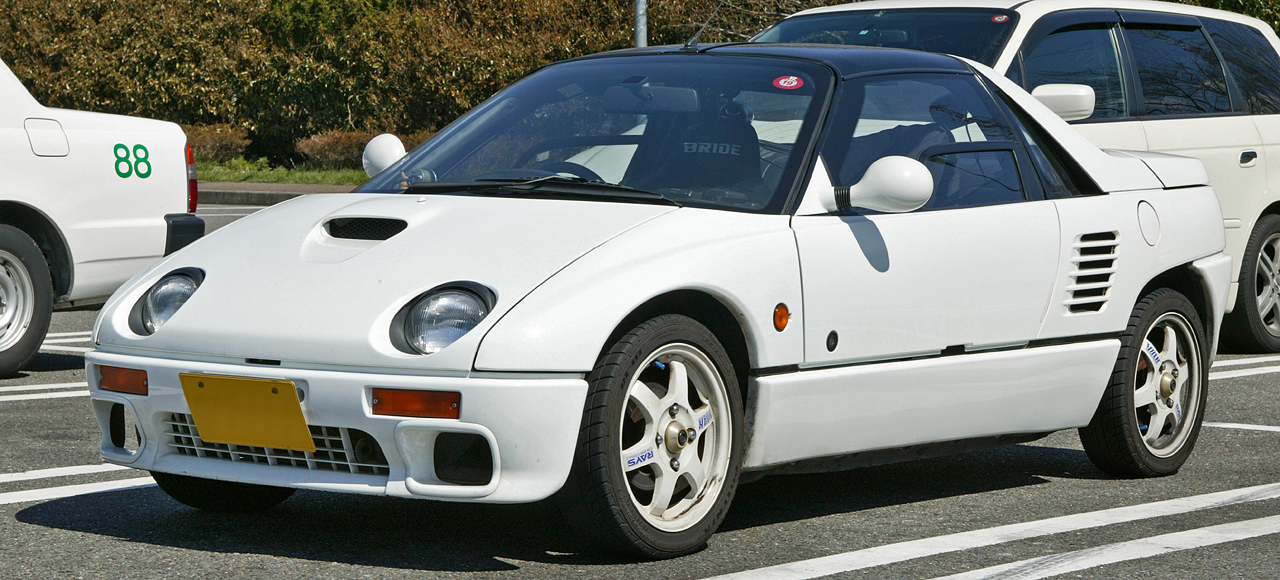
Autozam AZ-1
The Autozam AZ-1 (known by the framecode PG6SA) is a sports car which was manufactured by Mazda from October 1992 to October 1994 and sold under its Autozam brand. Suzuki provided the engine as well as the inspiration for the design. It is a two-seater kei car with a rear mid-engine, rear-wheel-drive layout and gullwing doors.
Power came from the same Suzuki-sourced 657 cc turbocharged engine used by the Suzuki Alto that produced 64 PS (47 kW) at 6,500 rpm and 85 N⋅m (63 lb⋅ft) at 4,000 rpm. The top speed was electronically governed to be 87 mph (140 km/h), with theoretical top speeds without the governor being approximately 110 mph (177 km/h)
Suzuki later produced its own badge engineered version named the Suzuki Cara (PG6SS).
The proposal for the AZ-1 goes as far back as 1985 when Suzuki created the Suzuki RS/1 as a mid-engine sports car project for volume production. Suzuki's design for the Tokyo Motor Show was a fully functional car with a front/rear weight distribution of 45:55, powered by a modified 1.3-liter G13B engine borrowed from the Cultus GTi.
This was followed up by the Tatsumi Fukunaga-designed RS/3, unveiled for the 1987 Tokyo Motor Show. This version of the car retained many of its design features of the predecessor, but many of its design features were modified to meet Japanese safety regulations as well as for practicality. However, the project was abandoned in favor of the roadster project they had been working on, named later the Cappuccino.
Mazda's design team, led by Toshihiko Hirai, who was also responsible for the MX-5, took over the design project, despite having a limited budget and capacity.
The redesigned cars, constructed in tube frame with floors and bulkheads constructed from aluminium honeycomb, clad in three different body styles constructed in fiberglass. The cars were constructed around the Kei car regulations of the time (maximum length 126 inches (3,200 mm), maximum engine capacity 550 cc), until this was changed for the following March, hence its model name, AZ-550 Sports.
First introduced at the 1989 Tokyo Motor Show as the AZ-550 with three versions.
Hub AI
Autozam AZ-1 AI simulator
(@Autozam AZ-1_simulator)
Autozam AZ-1
The Autozam AZ-1 (known by the framecode PG6SA) is a sports car which was manufactured by Mazda from October 1992 to October 1994 and sold under its Autozam brand. Suzuki provided the engine as well as the inspiration for the design. It is a two-seater kei car with a rear mid-engine, rear-wheel-drive layout and gullwing doors.
Power came from the same Suzuki-sourced 657 cc turbocharged engine used by the Suzuki Alto that produced 64 PS (47 kW) at 6,500 rpm and 85 N⋅m (63 lb⋅ft) at 4,000 rpm. The top speed was electronically governed to be 87 mph (140 km/h), with theoretical top speeds without the governor being approximately 110 mph (177 km/h)
Suzuki later produced its own badge engineered version named the Suzuki Cara (PG6SS).
The proposal for the AZ-1 goes as far back as 1985 when Suzuki created the Suzuki RS/1 as a mid-engine sports car project for volume production. Suzuki's design for the Tokyo Motor Show was a fully functional car with a front/rear weight distribution of 45:55, powered by a modified 1.3-liter G13B engine borrowed from the Cultus GTi.
This was followed up by the Tatsumi Fukunaga-designed RS/3, unveiled for the 1987 Tokyo Motor Show. This version of the car retained many of its design features of the predecessor, but many of its design features were modified to meet Japanese safety regulations as well as for practicality. However, the project was abandoned in favor of the roadster project they had been working on, named later the Cappuccino.
Mazda's design team, led by Toshihiko Hirai, who was also responsible for the MX-5, took over the design project, despite having a limited budget and capacity.
The redesigned cars, constructed in tube frame with floors and bulkheads constructed from aluminium honeycomb, clad in three different body styles constructed in fiberglass. The cars were constructed around the Kei car regulations of the time (maximum length 126 inches (3,200 mm), maximum engine capacity 550 cc), until this was changed for the following March, hence its model name, AZ-550 Sports.
First introduced at the 1989 Tokyo Motor Show as the AZ-550 with three versions.