Hubbry Logo
search
logo
B-CAS
B-CAS
current hub
2066920

B-CAS

logo
Community Hub0 Subscribers
Read side by side
from Wikipedia
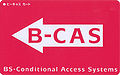
B-CAS cards in a Toshiba Cell Regza set-top box

B-CAS (BS Conditional Access Systems Co., Ltd.) is a vendor and operator of the ISDB CAS system in Japan, largely owned by the public broadcaster NHK with some other electronics companies and broadcasters airing in BSAT. It also refers to the reception method (B-CAS method) that this company offers.

All ISDB receiving apparatus such as DTT TV, tuner, and DVD recorder except 1seg-only devices require a B-CAS card under regulation and B-CAS cards are supplied with most units at purchase. B-CAS cards cannot be purchased separately, except in cases of damage, loss, purchase of used equipment, or theft. As of February 2025, replacement B-CAS cards cost ¥2,310.[1]

Implementations of ISDB-T and ISDB-T International (SBTVD) outside Japan do not use the B-CAS system at all as they do not employ the Copy-Once encryption method used on ISDB broadcasts in Japan. For these countries, some operators may choose to implement their own copy protection system.

[edit]

See also

[edit]

References

[edit]
[edit]
Revisions and contributorsEdit on WikipediaRead on Wikipedia
from Grokipedia
B-CAS, formally known as the BS Conditional Access System, is a digital rights management and conditional access technology integral to Japan's Integrated Services Digital Broadcasting (ISDB) standard, used to encrypt and control access to satellite (BS), cable (CS), and terrestrial television signals for copyright protection and subscription management.[1][2] The system requires viewers to insert a proprietary IC card—commonly red in color—into compatible receivers, tuners, or recording devices to decrypt full-resolution content (such as 1080i or 1080p); without the card, signals cannot be decrypted, preventing viewing of protected content.[3][4] Operated by BS Conditional Access Systems Co., Ltd., a Tokyo-based company founded on February 22, 2000, and primarily owned by public broadcaster NHK along with private broadcasters and electronics firms, B-CAS was developed to standardize access control across Japan's transition to digital broadcasting.[5][6] The CAS specification became operational in December 2000 for satellite and terrestrial services, employing dynamic encryption keys that change every few seconds, transmitted as "viewing licenses" to authenticated cards via a low-bandwidth multiplexed signal (initially 300 kbps).[2][1] This setup not only secures paid premium channels but also applies to free-to-air broadcasts since April 2004, enforcing recording restrictions to combat piracy in the digital era.[7] Over time, B-CAS has supported key policy shifts in content usage, evolving from a strict "copy once" rule—limiting digital recordings to a single copy on the same device—to the more flexible "dubbing 10" standard in July 2008, allowing up to ten copies across compatible devices while maintaining encryption.[7] The system's IC cards, distributed free with new devices, have become ubiquitous in Japanese households, with over 100 million units issued by the mid-2010s to align with the nationwide digital switchover completed in July 2011.[3] As of 2025, B-CAS remains the cornerstone of Japan's broadcast security, though research into next-generation CAS technologies—aiming for reduced bandwidth (to dozens of kbps) and enhanced mobile compatibility—continues to address evolving needs like 4K/8K ultra-high-definition and IP-integrated delivery.[1]

Overview

Definition and Purpose

B-CAS, or BS Conditional Access System, is a proprietary conditional access system designed specifically for Japan's Integrated Services Digital Broadcasting (ISDB) standard. It functions as the core mechanism for securing digital television signals across broadcast satellite (BS), communications satellite (CS), and terrestrial digital broadcasting platforms. By implementing scrambling at the transmission end and descrambling at the receiver, B-CAS ensures that broadcast content remains encrypted until authorized by a valid subscription, thereby restricting access to paid or protected services.[8][9] The primary purpose of B-CAS is to enable secure reception of digital broadcasts while protecting copyrights and enabling fee-based services. It achieves this through a combination of conditional access (CAS) for controlling viewer subscriptions—via entitlement control messages (ECMs) and entitlement management messages (EMMs) that deliver decryption keys—and rights management and protection (RMP) for regulating content usage, such as copy restrictions on recorded material. This dual approach not only prevents unauthorized viewing but also enforces copy control descriptors to limit duplication, ensuring broadcasters can monetize content and safeguard intellectual property.[8][1] B-CAS is mandatory for all ISDB-compliant receivers, with the exception of 1seg mobile devices, which operate under a simplified framework. This requirement underscores its role in maintaining a secure ecosystem for digital TV in Japan, where it integrates directly with the ISDB transport stream to scramble signals using algorithms like MULTI2, updated periodically to thwart circumvention. By mandating tamper-resistant hardware and software in receivers, B-CAS effectively blocks illegal access and unauthorized copying, supporting the integrity of the national broadcasting infrastructure.[8][9]

Role in Japanese Broadcasting

B-CAS serves as the primary conditional access system (CAS) integrated into Japan's Integrated Services Digital Broadcasting (ISDB) standards, encompassing ISDB-T for terrestrial transmission, ISDB-S for broadcast satellite (BS), and ISDB-C for cable distribution, ensuring secure signal decryption across these platforms since the full digital transition in 2011.[10] This integration allows for unified content protection and access control in multimedia services, including high-definition video, audio, and data broadcasting, while maintaining interoperability through common transport stream interfaces.[11] The system is mandated by the Ministry of Internal Affairs and Communications (MIC) for all digital television receivers and tuners sold in Japan, with requirements established alongside the rollout of digital broadcasting starting in 2003, to enforce copy protection and prevent unauthorized reception.[10] Compliance with ARIB STD-B25, which outlines B-CAS specifications, is enforced through MIC ordinances, making the B-CAS card essential for operational legality in the broadcasting ecosystem. (Note: This is a representative MIC announcement on digital TV rollout; specific B-CAS mandate aligns with post-2003 device regulations.) In the broader broadcasting landscape, B-CAS facilitates access to free-to-air channels from NHK, including its BS services, by providing basic decryption for public content, while enabling subscription-based pay-TV offerings such as WOWOW through additional authorization modules that unlock premium channels on BS and communications satellite (CS) platforms.[12] This dual functionality supports Japan's hybrid model of public and commercial broadcasting, balancing open access with revenue protection for specialized services. B-CAS underpins digital TV reception in over 99% of Japanese households as of 2024, reflecting near-universal adoption post-analog shutdown.[13] Despite ISDB's adoption abroad, such as in Brazil, B-CAS remains exclusive to Japan, with international implementations like Brazil's SBTVD (ISDB-Tb) employing alternative CAS solutions, such as NAGRAVISION, to suit local regulatory and market needs without Japan's card-based copy control.[14]

History

Establishment of the Company

BS Conditional Access Systems Co., Ltd. (B-CAS), officially known in Japanese as Kabushiki-gaisha Bī Esu Kondishonaru Akusesu Shisutemuzu, was established on February 22, 2000, as a joint venture to manage the conditional access system (CAS) for BS digital broadcasting in Japan.[15] The company was formed in anticipation of the BS digital broadcasting launch on December 1, 2000, with the primary goal of developing, operating, and maintaining the infrastructure necessary to secure and control access to digital satellite broadcasts.[16] The founding was driven by a consortium of broadcasters and electronics manufacturers to ensure a unified CAS framework that could support the transition from analog to digital BS services. Initial capital was set at 1 billion yen, which was later increased to 1.5 billion yen to support ongoing operations.[17] This structure allowed for collaborative investment in technology that integrates encryption keys and IC cards to prevent unauthorized viewing, aligning with the regulatory requirements for limited reception systems under Japan's Broadcasting Law.[16] Ownership is shared among key stakeholders in the broadcasting and technology sectors, with the Japan Broadcasting Corporation (NHK) holding a significant stake as the public broadcaster, alongside private entities such as WOWOW Co., Ltd., BS Fuji Inc., BS Asahi Corporation, BS-TBS Inc., BS Japan Corporation, and BS TV Tokyo Inc. Electronics firms including Toshiba Corporation, Panasonic Holdings Corporation, and Hitachi, Ltd., also participate as shareholders, providing expertise in hardware integration for CAS-enabled devices.[15] This diverse ownership reflects a public-private partnership aimed at fostering the widespread adoption of secure digital broadcasting while distributing the responsibilities for system management and card issuance.[17]

Introduction and Adoption

The B-CAS system was developed in the early 2000s as a conditional access mechanism to secure digital broadcasts in Japan, with the company behind it established in February 2000 to support the impending launch of BS digital broadcasting. Card distribution began in May 2000, coinciding with the start of BS digital services in December 2000, where B-CAS cards were essential for decoding paid BS content and NHK-BS messaging services. Initial testing and regulatory adjustments paved the way for broader application; in June 2002, an amendment to the Ministry of Internal Affairs and Communications ordinance permitted scrambling for free digital broadcasts, enabling preparatory trials. This set the stage for terrestrial digital broadcasting (ISDB-T), which launched experimentally in Tokyo in December 2003, followed by nationwide rollout. By April 2004, B-CAS cards were adopted for content protection in both terrestrial and free BS digital broadcasts, marking a key milestone in the system's integration across platforms. In October 2005, terrestrial digital-specific cards were introduced, and under a consortium agreement among broadcasters and manufacturers, all new digital TVs and tuners sold in Japan were required to include B-CAS card readers, accelerating device compatibility. Expansion continued with CATV-specific cards from November 2000 and further adaptations for cable television (ISDB-C) operations around 2008, supporting retransmission of digital signals. For BS and CS digital services, while initial launches occurred in 2000 and 2002 respectively, full integration with B-CAS for comprehensive satellite broadcasting solidified by the mid-2000s. In December 2018, the system expanded to support 4K/8K satellite broadcasting with the introduction of a new conditional access system (ACAS).[16] The system's widespread adoption was driven by Japan's analog-to-digital transition, culminating in the shutdown of analog terrestrial broadcasts on July 24, 2011 (with completion in disaster-affected areas by March 2012), making B-CAS mandatory for receiving digital TV signals. This shift enabled digital broadcasting to reach nearly 99% of households, as virtually all televisions and tuners required B-CAS cards for decryption. Cumulative card distribution surpassed 100 million by May 2010 and exceeded 200 million by August 2013, reflecting multiple devices per household and replacements amid the digital ecosystem's growth.[16]

Technical Specifications

System Architecture

The B-CAS system employs a client-server architecture in which head-end servers at broadcasters serve as the central encryption and key management entities, encrypting digital broadcast signals and transmitting associated control messages via MPEG-2 transport streams. The IC card inserted into the receiver functions as the client, handling authentication, decryption of control messages, and derivation of session keys to enable secure descrambling at the receiver end. This model ensures centralized control over content access while distributing decryption capabilities to end-user devices compliant with Japanese digital broadcasting standards.[18] Encryption in B-CAS utilizes a three-layer symmetric key structure comprising the scrambling key (Ks) for short-term payload protection, the work key (Kw) for intermediate encryption, and the master key (Km) for overarching security. The transport stream packets are scrambled using the proprietary MULTI2 cipher algorithm, which operates on 64-bit blocks in cipher block chaining (CBC) or output feedback (OFB) modes, effectively functioning as a stream cipher for video and audio data. DES and 3DES algorithms are applied specifically to encrypt Entitlement Control Messages (ECMs) and Entitlement Management Messages (EMMs), with partial encryption employed on free-to-air channels to scramble only proprietary elements while allowing basic signal reception, in contrast to full encryption on pay-TV services that protects the entire payload.[18] The decryption process begins with mutual authentication between the IC card and receiver via a challenge-response protocol, verifying device compliance and copyright protection measures before proceeding. Upon receiving an encrypted transport stream, the receiver extracts ECMs and EMMs; the IC card then decrypts the ECM using the current Kw (derived from Km and subscription data) to obtain Ks, which is securely transferred to the receiver's descrambler for real-time payload recovery. Keys are renewed periodically through broadcast EMMs to maintain security, with work keys updated approximately every two weeks per broadcaster group and scrambling keys refreshed every 1-2 seconds via ECMs, which are transmitted at least every 100 ms.[18] ECMs and EMMs form the core of access control in B-CAS, with ECMs delivering transient Ks values alongside program-specific restrictions (transmitted in sections identified by table ID 0x82 at least every 100 ms), and EMMs managing subscriber entitlements, long-term keys, and contract updates (using table ID 0x84 for EMMs and 0x85 for common and individual messages with specific extensions, multiplexed for efficiency with minimum intervals of 1 second per receiver). This messaging framework integrates seamlessly with ARIB STD-B25, which defines the scrambling specifications, receiver interfaces, and compatibility with related standards such as STD-B10 for program-specific information and STD-B21 for broadcast transmission parameters.[18]

Card Types and Functionality

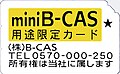
B-CAS cards are available in two primary color-coded variants to accommodate different broadcasting services: the blue card, intended solely for terrestrial digital broadcasting receivers, and the red card, which supports integrated reception of terrestrial digital, BS digital, and 110-degree CS digital broadcasts, commonly known as the three-wave configuration for its multi-service capability. Both variants are issued free with compatible receiving devices, such as televisions and recorders, and ownership remains with B-CAS Co., Ltd., while users are granted usage rights under a contract.[19][20][21] Physically, standard cards measure approximately credit card dimensions (85.6 mm × 54 mm) with an embedded IC chip featuring eight gold contacts for electrical connection to the host device. Mini cards, available for both blue and red types, adopt a compact plug-in SIM card form factor (25 mm × 15 mm) to suit portable recorders, car navigation systems, or space-constrained equipment. These cards have no strictly defined service life but are engineered to endure the typical operational span of associated consumer electronics, with replacement available if malfunction occurs outside of user-induced damage.[19][22][23] In terms of core operations, each B-CAS card embeds a unique 20-digit identification number printed on the reverse side, which facilitates user registration, authentication, and linkage to services like NHK or pay-TV providers. The card's IC chip executes conditional access system (CAS) functions to decrypt scrambled digital broadcast signals, ensuring only authorized users can view protected content across supported services. Blue cards provide basic CAS decryption limited to terrestrial signals, whereas red cards extend this to full-spectrum broadcasts. Complementing CAS, red cards incorporate the Recording Management Protocol (RMP) to manage content rights by interpreting embedded copy control descriptors in the broadcast stream, such as enforcing "Copy-Once" rules that permit a single recording but prohibit further duplication; this is typically realized through integration with CPRM (Content Protection for Recordable Media) on compatible storage devices like DVD-R or hard disks. These mechanisms collectively safeguard copyrights while enabling compliant recording and playback.[24][25][26]

Operations and Usage

Card Distribution and Replacement

B-CAS cards are distributed free of charge, bundled with all compliant digital televisions, tuners, and recorders manufactured and sold in Japan since the introduction of digital broadcasting in 2003.[27] These cards are pre-installed or included in the packaging to ensure immediate usability for receiving terrestrial, BS, and CS broadcasts upon device activation. Cards cannot be purchased separately from retailers or online marketplaces for new devices, as distribution is exclusively handled through licensed manufacturers to maintain system integrity and licensing compliance.[21] For second-hand or used devices lacking a functional card, users must obtain a replacement through the official reissuance process, which effectively serves as the acquisition method for such cases.[28] This approach prevents unauthorized sales and ensures that each card is associated with a specific reception device. Replacement of B-CAS cards is required in cases of damage, loss, or theft, and the process begins with an application submitted via the B-CAS official website or by contacting the customer center by phone.[21] Applicants must provide the 20-digit card number from the back of the existing card (if available) and details such as the device serial number as proof of ownership, particularly for used equipment. The fee for reissuance is ¥2,310 per card, inclusive of shipping and consumption tax, as of February 2025, and payment is handled via cash on delivery.[28] Processing typically takes 2 to 3 days from application to delivery.[29] During the replacement application, users provide their address for delivery. For full BS functionality, separate registration of the B-CAS card number with NHK is required, including address details, to assess satellite broadcasting reception fees and remove confirmation messages.[30] B-CAS cards are personalized to the registered user and device, rendering them non-transferable without formal reissuance; transfers necessitate a separate user change application through the customer center to update ownership details.[21] No refunds are available for paid reissuance fees once processing has begun, emphasizing the importance of careful handling to avoid unnecessary costs.[28]

Integration with Devices

B-CAS cards are physically integrated into a range of consumer electronics essential for receiving digital broadcasts in Japan, primarily through dedicated IC card slots compliant with ARIB standards. These include flat-panel televisions, set-top boxes for cable and satellite services, DVD and hard disk drive (HDD) recorders for time-shifting content, and personal computers fitted with ISDB-T tuners. Since the launch of digital terrestrial broadcasting in December 2003, all such post-2003 models are required by regulation to incorporate B-CAS slots to enable decryption of encrypted signals, ensuring that free-to-air and pay-TV content can be accessed only with a valid card inserted.[31][32] Device compatibility hinges on adherence to ARIB specifications, particularly ARIB STD-B25, which defines the conditional access module interface for secure integration. Certified slots facilitate communication between the card and the receiver's descrambler, supporting high-definition outputs via HDMI interfaces protected by HDCP to safeguard copyrighted material during transmission to external displays or recorders. Imported televisions and tuners from non-Japanese markets typically lack these ARIB-certified B-CAS slots, leading to incompatibility issues; users must resort to external Japanese ISDB-T tuners with built-in slots to view domestic broadcasts.[31][33] To use a B-CAS card, consumers insert it into the device's slot, where it activates automatically upon power-on, enabling the receiver to detect, descramble, and decode incoming ISDB signals without manual configuration. The system processes broadcasts in real-time, applying copy control flags to restrict recording or output as needed. B-CAS cards support standard digital broadcasts, including high-definition content.[34][31] Backward compatibility for pre-2011 analog televisions is achieved via digital-to-analog converter adapters that include B-CAS slots, bridging older cathode-ray tube sets with contemporary ISDB-T signals while maintaining decryption functionality. These adapters output standard-definition video to legacy tuners, facilitating the full analog-to-digital transition completed in July 2011.[32]

Controversies and Issues

Security Vulnerabilities

The B-CAS system, which relies on the MULTI2 block cipher for scrambling digital broadcasts in Japan's ISDB standard, has faced theoretical vulnerabilities identified through cryptanalysis. Researchers demonstrated linear attacks on reduced-round versions of MULTI2 (up to 20 rounds out of 32), exploiting weaknesses in the key schedule and non-surjective round functions, potentially reducing effective security by at least 128 bits of entropy.[35] However, these attacks remain impractical for the full 32-round implementation used in B-CAS, with no reported real-world exploitation of the cipher itself.[35] Practical security issues arose from vulnerabilities in the B-CAS card's subscription management rather than the core encryption. Between 2006 and 2012, hackers exploited backdoors in certain card models (e.g., Toshiba and Panasonic types) to modify entitlement control messages (ECMs) and extend free trial periods indefinitely, often to 2038, using affordable card readers and software tools like CardTool.exe.[36] These modifications allowed unauthorized access to pay-TV channels such as WOWOW and BS Animax without affecting free-to-air broadcasts, which are unencrypted. Modified "Black B-CAS" cards, cloned or reprogrammed versions sold online for around 48,800 yen, further enabled circumvention of paywalls.[36] In 2012, reports emerged of widespread unauthorized decoders, including reprogrammed B-CAS cards sold via websites like tvblackcard.com and auction platforms. Two Taiwanese brothers reportedly purchased legal B-CAS cards, decrypted them using specialized devices, and sold approximately 3,000 units at prices ranging from 20,000–30,000 yen in Japan and 2,000–3,000 TWD in Taiwan, generating significant illicit profits.[37] This led to legal actions, with Japanese broadcasters filing copyright complaints; the suspects were arrested in Taiwan on August 26, 2015, under the Copyright Act, with over 800 cards and tools seized.[37] To address these flaws, B-CAS implemented countermeasures starting post-2014, including periodic key rotations and signal updates to invalidate modified cards, rendering hacks like trial extensions ineffective by 2015.[38] Further enhancements involved transitioning toward stronger mechanisms, such as downloadable conditional access systems (D-CAS) with tamper detection and message authentication, aimed at supporting secure updates and replacing vulnerable legacy components by around 2016.[38] These measures have prevented widespread breaches, limiting impacts to pay-TV circumvention rather than free channels.

Relation to NHK Reception Fees

The B-CAS system plays a central role in enforcing NHK's reception fees for satellite (BS) and cable (CS) broadcasts by linking card registration to household addresses, enabling broadcasters to verify receiver ownership and ensure compliance with mandatory payments. When users acquire a BS or CS tuner, they must register their B-CAS card with the B-CAS company, providing personal details including address to activate full unscrambling capabilities; this registration data is shared with NHK, allowing the broadcaster to detect signal reception and confirm whether households with capable devices have entered the required satellite contract.[39][40] NHK leverages this mechanism to impose annual fees of ¥13,600 for terrestrial reception and ¥24,090 for BS (satellite) reception (total, covering both terrestrial and satellite), targeting owners of compatible receivers regardless of actual viewing habits, as stipulated under Article 64 of the Broadcasting Act.[41][42] If a household fails to pay, the B-CAS card can display on-screen "receipt messages" during NHK BS broadcasts, prompting users to settle outstanding fees and promoting a "fair burden" among subscribers; this feature underscores the system's integration with fee collection efforts.[40] Opting out of BS fees is possible by not registering the card, which disables satellite reception and avoids the satellite contract obligation, though households remain liable for terrestrial fees if they possess any TV-capable device and face potential fines or legal action if non-compliance is proven.[39] As of fiscal year 2023, around 40 million Japanese households paid NHK reception fees, reflecting a national payment rate of approximately 78.6%; however, collection rates have remained low, leading to deficits of ¥57 billion in FY2024 and projected ¥40 billion in FY2025.[43][41] The linkage between B-CAS and NHK fees has sparked significant controversies, particularly in the 2010s, when multiple lawsuits challenged the system's constitutionality on grounds that it compelled payments from non-viewers, infringing on freedom of contract and property rights.[44] In a landmark 2017 Supreme Court ruling, the Grand Bench upheld the reception fee system as constitutional, affirming its role in funding impartial public broadcasting and supporting freedom of expression, but imposed limitations by rejecting automatic contract formation—requiring NHK to actively solicit agreements and pursue collections only through individual court cases rather than unilateral enforcement.[45][46] This decision, while validating the framework, highlighted NHK's responsibility to demonstrate public value and avoid overreach, with a five-year statute of limitations on unpaid fees applying only after judicial finality.[45] Public resistance to the B-CAS-enabled fee enforcement has manifested in "NHK refusal" movements, including the formation of the Party to Protect the People from NHK in 2013, which campaigned against mandatory payments and gathered supporters by arguing the fees constituted unfair taxation without opt-out options.[47] These efforts have led to ongoing debates over policy, with NHK sharing B-CAS registration data for compliance verification while facing criticism for aggressive collection tactics, such as door-to-door visits and lawsuits against non-payers.[39] In October 2025, NHK launched the NHK ONE streaming service, charging ¥1,100 monthly for internet-only access (aligned with terrestrial fees), raising new concerns about fee obligations for non-TV households and whether B-CAS integration extends to IP delivery. The surcharge system, doubling unpaid fees since 2023, has intensified public backlash and legal challenges.[48] Despite such pushback, the system remains integral to NHK's funding, comprising about 96% of its revenue from over 40 million paying households.[42]

Future Developments

Next-Generation Systems

In 2014, NHK announced the development of a next-generation conditional access system (CAS) to succeed B-CAS, focusing on enhanced security for future broadcasting services including software update capabilities to address evolving threats.[38][49] This system, later designated as the Advanced Conditional Access System (ACAS), employs a chip-based architecture embedded directly into receivers, eliminating the need for a removable IC card and thereby mitigating risks associated with physical theft or tampering seen in B-CAS.[50][51] ACAS utilizes 128-bit AES or Camellia encryption, a significant upgrade from B-CAS's 64-bit keys, to provide robust content protection and access control across free and paid broadcasts.[51] The compact chip, measuring approximately 5 × 6 × 1 mm, integrates seamlessly into 4K and 8K tuners, supporting rights management for high-resolution content while incorporating backward compatibility with B-CAS functions for legacy 2K broadcasts.[50][51] This design enables downloadable updates via broadcast or communication networks, allowing remote enhancements to security without hardware replacement.[51] ACAS operations commenced in September 2018, coinciding with preparations for new 4K/8K satellite broadcasting launched in December 2018, marking its initial rollout for Super Hi-Vision services.[51] As of 2025, B-CAS remains the primary system for standard 2K digital broadcasts, but newer 4K/8K receivers increasingly feature dual ACAS and B-CAS support to ensure broad compatibility during the transition period.[50][51]

Transition Plans

The Ministry of Internal Affairs and Communications (MIC) has outlined guidelines for the gradual replacement of the B-CAS system with the advanced conditional access system (ACAS), emphasizing a phased approach to minimize consumer impact while enhancing security for 4K and 8K broadcasting.[52] Introduced in September 2018, ACAS integrates IC chip technology directly into receivers, eliminating the need for separate B-CAS cards and supporting both legacy 2K broadcasts and new high-definition formats.[52] This transition aligns with broader regulatory reforms aimed at reducing operational costs and improving fault tolerance, with ACAS demonstrating a failure rate approximately 1/1000th that of B-CAS.[52] Costs are shared among broadcasters, manufacturers, and consumers through collaborations. Dual-mode compatibility—allowing ACAS-equipped devices to process B-CAS signals—supports seamless service during the rollout.[52] International comparisons note that while countries like South Korea and Europe use encryption for broadcasts, Japan integrates CAS and rights management protection (RMP) in ACAS, with efforts to promote interoperability in ISDB-adopted regions such as Brazil and the Philippines.[52] Significant challenges involve the high cost of replacing over 100 million existing B-CAS cards and devices, with ACAS components estimated to be 3-4 times more expensive than predecessors, potentially adding ¥1,000-2,000 to new receiver prices. Ensuring no service disruptions is critical, particularly as broadcasters manage fault recoveries without the physical card replacement delays common in B-CAS systems.[52] The B-CAS company, BS Conditional Access Systems Co., Ltd., continues to support legacy operations while contributing to ACAS through shared expertise in key management.[52] As of 2025, the transition to ACAS continues, with increasing adoption in 4K/8K equipment while B-CAS persists for standard broadcasts.

References

User Avatar
No comments yet.