


Community hub
Recent from talks
Contribute something
Nothing was collected or created yet.
BATRAL-class landing ship
View on Wikipedia BATRAL Francis Garnier | |
| Class overview | |
|---|---|
| Builders |
|
| Succeeded by | Bâtiment Multimission (B2M)[1] |
| General characteristics | |
| Type | Landing ship tank |
| Displacement | 770 t, 1,330 t fully loaded |
| Length | 80 m (262 ft 6 in) |
| Beam | 13 m (42 ft 8 in) |
| Draught | 3 m (9 ft 10 in) |
| Installed power | |
| Propulsion | 2 × 4-bladed propellers |
| Speed | 16 knots (30 km/h; 18 mph) |
| Range | 4,500 nmi (8,300 km; 5,200 mi) at 13 knots (24 km/h; 15 mph) |
| Complement |
|
| Sensors & processing systems |
|
| Armament |
|
| Aviation facilities | Helicopter landing deck |
The Bâtiment de Transport Léger (abbreviated BATRAL; "Light ferry ship") are small landing ships of the French Navy. Also known as Champlain class by the lead ship,[2] they have been used for regional transport and patrol needs in French Overseas Departments and Territories since the 1970s.[1] On 9 January 2014 it was announced that the two remaining Batrals in French service would be replaced in 2015/16 by three (subsequently four) 1500-tonne Bâtiments Multimission (B2M) at a cost of ~€100m (US$136m).[1]
Design
[edit]The BATRALs can ferry over 400 tons of matériel, in the hangar and on the deck. Loading and unloading can be done from a harbour or on a beach. Two flat-bottom vessels allow unloading fifty men and light vehicles each. The accommodations are designed for a Guépard-type intervention unit (five officers, fifteen petty officers and 118 men), or for typical company-sized armoured units. A helicopter landing deck allows landing for light helicopters, and transfer to and from heavy helicopters.
History
[edit]The Chilean Navy purchased the plans and built three ships in the ASMAR shipyards in the early 1980s.
Ships
[edit]- Champlain decommissioned
- Francis Garnier decommissioned
- Dumont D'Urville decommissioned in July 2017
- Jacques Cartier decommissioned[3]
- La Grandière decommissioned in 2016
- Maipo (LST-91) 1982–1998
- Rancagua (LST-92) 1983–present
- Chacabuco (LST-95) 1986–present
- L'Elephant
- President el Hadj Omar Bongo (L05)
- Daoud Ben Aicha (402)
- Ahmed Es Skali (403)
- Abou Abdallah El Ayachi (404)
-
 Francis Garnier at sea
 -
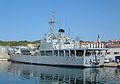 Francis Garnier in port
 -
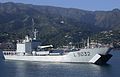 Dumont D'Urville with her landing bow opened


References
[edit]- ^ a b c Pape, Alex (9 January 2014). "France orders three new multimission vessels". IHS Jane's Defence Weekly.
- ^ Champlain class
- ^ "Le Batral Jacques Cartier est rentré en France" [The landing ship Jacques Cartier returned to France]. Marine Nationale (in French). Ministère de la Défense. 15 July 2013.



BATRAL-class landing ship
View on GrokipediaDesign
Specifications
The BATRAL-class landing ships are compact amphibious vessels designed for versatile transport and beaching operations, featuring a shallow draught that enables direct unloading onto unprepared beaches. These ships measure 80 meters in length overall, with a beam of 13 meters and a draught of 3 meters, allowing access to littoral zones while maintaining stability for cargo handling.[2][1]| Category | Specification |
|---|---|
| Displacement | 770 tonnes (standard); 1,330 tonnes (full load) |
| Dimensions | Length: 80 m; Beam: 13 m; Draught: 3 m |
| Propulsion | 2 × SACM Wärtsilä UD 33 V12 M4 diesel engines (3,600 hp / 2,700 kW total), driving 2 × controllable-pitch propellers via 2 shafts |
| Performance | Maximum speed: 16 knots; Range: 4,500 nautical miles at 13 knots |
| Complement | 52 (4 officers, 5 senior petty officers, 20 petty officers, 23 crewmen); expandable to 138 including a full motorized infantry company |
Armament and capabilities
The BATRAL-class landing ships are equipped with a modest armament suited to their primary logistics role, featuring two 40 mm Bofors anti-aircraft guns for medium-range defense against aerial threats, two 12.7 mm machine guns for close-in protection, and two 81 mm mortars for indirect fire support.[4][2] These weapons provide limited anti-air and anti-surface capabilities, prioritizing self-defense during transport operations rather than engaging in sustained combat, with electronic systems including a Decca 1226 navigation radar to support situational awareness.[2][1] In terms of mission capabilities, the ships excel in amphibious logistics, enabling beach landings through a bow ramp that facilitates the offloading of vehicles and troops directly onto unprepared shores, while also supporting harbor operations.[1] They can accommodate a Guépard-type motorized infantry company, consisting of 5 officers, 15 non-commissioned officers, and 118 infantrymen, along with associated light vehicles, making them ideal for regional patrols, troop rotations, and supply transport in overseas territories.[2] Their propulsion system allows for sustained operations over extended ranges, enabling reliable support for these logistics-focused missions.[2] Adaptations for versatility include a stern helicopter deck capable of operating light helicopters such as the Alouette III for utility tasks like reconnaissance or cargo transfer, though the absence of a hangar limits sustained aviation support to temporary landings and takeoffs.[2][1] This configuration enhances the ships' flexibility for humanitarian aid, training exercises, and enforcement of sovereignty in remote areas without compromising their core transport function.[1]Development and construction
Origins and development
The BATRAL-class landing ships, known as Bâtiments de Transport Léger (Light Transport Ships), were conceived in the late 1960s to address the French Navy's requirements for versatile amphibious vessels suited to low-intensity operations, including troop and vehicle transport as well as logistics support in the French Overseas Departments and Territories.[5] These ships were specifically designed to carry a full infantry company, such as the 140-man "GUÉPARD" intervention unit along with 12 vehicles and associated equipment, enabling direct beach landings or mooring for rapid deployment in remote or underdeveloped coastal areas.[4] The design drew from post-colonial strategic needs following the decolonization era, emphasizing shallow-draft capabilities for accessing shallow waters and beaches in overseas regions, while scaling down from larger World War II-era Landing Ship, Tank (LST) concepts to create more economical, regionally focused platforms for patrol, humanitarian aid, and presence missions.[5] This evolution reflected France's shift toward maintaining influence in distant territories through flexible, multi-role vessels rather than heavy amphibious forces, prioritizing endurance for long-range operations up to 4,500 nautical miles at 13 knots.[4] Key milestones in the program's development included the ordering and keel-laying of the lead ship, Champlain (L9030), and the second unit, Francis Garnier (L9031), in 1973 at the Brest naval shipyard, with both commissioning in 1974.[2] Subsequent ships followed in the early 1980s, with the class ultimately comprising five vessels named after prominent French explorers and navigators, such as Dumont d'Urville and Jacques Cartier, to evoke France's historical maritime legacy.[2] Due to the fleet's aging infrastructure and evolving mission demands, the French Ministry of Defense announced on 9 January 2014 that the remaining BATRAL ships would be replaced by the Bâtiment Multimission (B2M) class, with initial contracts awarded to Kership (a Piriou-DCNS joint venture) for three units valued at approximately €100 million each, and deliveries commencing in late 2015 or early 2016 to sustain overseas support roles.[6]Shipbuilding
The BATRAL-class landing ships were constructed primarily in French shipyards during the 1970s and early 1980s, with the French Navy's units built at facilities including the Direction des Constructions Navales (DCN) in Brest and the Chantiers de Normandie in Grand-Quevilly.[2] The lead ship, Champlain (L9030), was laid down in 1973 at DCN Brest, launched on 17 November 1973, and commissioned on 5 October 1974, marking the start of production for the class.[7] A total of five vessels were produced for the French Navy between 1973 and 1984, with subsequent ships like Francis Garnier (L9031) also built at DCN Brest in the same year as Champlain, while later units such as Dumont d'Urville (L9032), Jacques Cartier (L9033), and La Grandière (L9034) were constructed at Grand-Quevilly with laydowns ranging from 1980 to 1984.[7][4] Construction cycles for these ships generally spanned 12 to 18 months, enabling efficient output of the standardized hull form derived from earlier amphibious transport requirements.[7] For export production, the Chilean Navy acquired the design plans through an agreement with France and built three units—Maipo (LST-91), Rancagua (LST-92), and Chacabuco (LST-95)—at the ASMAR shipyards in Talcahuano during the early 1980s.[8][9] These represented the only licensed constructions outside France, as other international operators, including Morocco, received their BATRALs built directly in French yards such as Chantiers Dubigeon in Nantes.[10]Operational history
French Navy service
The BATRAL-class landing ships served primarily in the French Navy for logistics support, troop transport, and patrol duties across overseas territories in the Pacific, Indian Ocean, and Caribbean regions.[1][2] These vessels facilitated the projection of infantry companies along with their vehicles and equipment, enabling beaching operations and sovereignty enforcement in remote areas.[4] Their design supported routine rotations to bases such as Papeete in French Polynesia, Nouméa in New Caledonia, Réunion in the Indian Ocean, and Fort-de-France in Martinique, maintaining French presence through the 1970s to the early 2000s.[1] Key operational deployments included participation in Opération Daguet during the Gulf War (1990–1991), where vessels like La Grandière provided logistical support, transiting from Yanbu in Saudi Arabia to Djibouti in the Red Sea region.[11] The class also contributed to humanitarian efforts, including disaster relief in the Pacific during the 1980s, delivering aid and equipment to isolated communities affected by natural disasters.[1] These missions underscored the BATRALs' versatility in low-intensity operations, including disaster response and regional stability.[12] Decommissioning began progressively in the mid-2000s due to aging infrastructure and evolving naval needs, with the first unit, Champlain, retired in 2004 and subsequently sunk as a target in October of that year.[2][1] The process continued through the 2010s, culminating in the retirement of the final two vessels, La Grandière and Dumont d'Urville, in 2016 and 2017, respectively, marking the full withdrawal of the class by 2017 after over 40 years of service for the earliest units.[2] Later years saw increasing maintenance challenges from obsolescence, limiting operational availability.[13] The BATRALs were replaced by four Bâtiment Multi-Mission (B2M) vessels, designed for enhanced logistical support and patrol in overseas territories.[14][13]Service with other operators
The BATRAL-class design proved attractive for export, with French-built vessels including three transferred to Morocco in 1977–1978, one to Gabon commissioned in 1984, and one new build for Côte d'Ivoire commissioned in 1977.[15] In addition, Chile licensed the design and constructed three vessels locally at the ASMAR Talcahuano shipyard between 1982 and 1986, known as the Maipo class, with minor hull modifications adapted for southern hemispheric operating conditions such as enhanced stability for rough seas.[16] Chilean operators integrated the ships into amphibious and logistics roles, with LST-92 Rancagua (commissioned 1983) supporting Antarctic expeditions, including transport to remote bases and construction aid for facilities like Cruz de los Mares from 1983 to 1993, before transferring to broader national and overseas missions such as troop deployments to Isla de Pascua and the Juan Fernández Islands.[17] The vessels also participated in disaster relief efforts, notably following the 2010 earthquake, where heavy usage contributed to accelerated wear on the fleet.[18] Morocco employed its three units—Daoud Ben Aicha (ex-Balny), Ahmed Es Skkali (ex-Rance), and Abou Abdallah El Ayachi (ex-Ourka)—primarily for coastal patrols in the Mediterranean and logistical support in the Western Sahara region.[10] These ships underwent upgrades to modern electronics and sensors during the 2000s to enhance surveillance capabilities amid regional security demands.[15] The Gabonese Navy's Président El Hadj Omar Bongo (commissioned 1984) focused on Gulf of Guinea security operations, including anti-piracy patrols and maritime interdiction until its decommissioning in 2016.[19] Côte d'Ivoire's L'Éléphant (commissioned 1977) served in coastal defense roles, protecting economic exclusion zones and supporting littoral operations before being decommissioned in the 2010s.[3] As of 2025, the three Moroccan and two surviving Chilean ships (Rancagua and Chacabuco) remain in active service, though Chile anticipates replacements for its aging amphibious fleet by the 2030s as part of broader naval modernization.[17][20]Ships
French ships
The French Navy commissioned five BATRAL-class landing ships between 1974 and 1987, primarily for logistics and amphibious support in overseas territories.[2] These vessels were constructed by French shipyards, including the Direction des Constructions Navales (DCN) in Brest and Chantiers de Normandie in Le Trait (formerly Grand-Quevilly).[5]| Name | Pennant Number | Builder | Commissioned | Decommissioned | Fate |
|---|---|---|---|---|---|
| Champlain | L9030 | DCN, Brest | 5 October 1974 | 30 August 2004 | Sunk as a target off Martinique on 27 October 2004.[2] |
| Francis Garnier | L9031 | DCN, Brest | 21 June 1974 | 16 February 2011 | Laid up in Brest (2011–2017); dismantled in Ghent, Belgium, in 2017.[2] |
| Dumont d'Urville | L9032 | Chantiers de Normandie | 5 February 1983 | July 2017 | Laid up in Brest (2017–2021); placed in the Landévennec ship cemetery since 2021.[2] |
| Jacques Cartier | L9033 | Chantiers de Normandie | 28 September 1983 | 9 July 2013 | Laid up in Brest (2013–2016); dismantled in Ghent, Belgium, in 2016.[2] |
| La Grandière | L9034 | Chantiers de Normandie | 20 January 1987 | 11 July 2016 | Laid up in Brest (2016–2018); converted to breakwater in Lanvéoc-Poulmic since 2018.[2] |