Recent from talks
Nothing was collected or created yet.
Nantes
View on Wikipedia
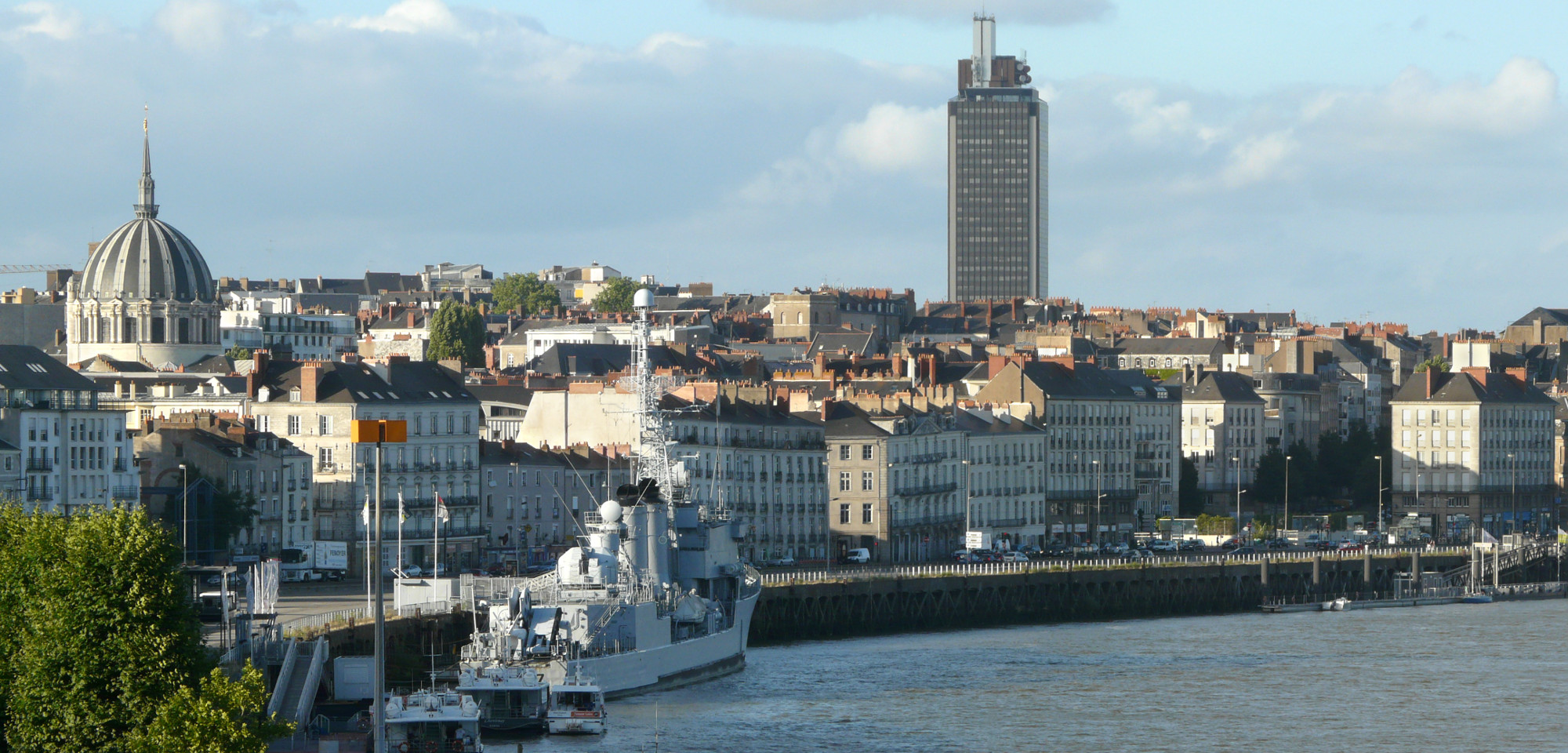
Nantes (/nɒ̃t/, US also /nɑːnt(s)/;[3][4][5] French: [nɑ̃t] ⓘ; Gallo: Naunnt or Nantt [nɑ̃(ː)t];[6] Breton: Naoned [ˈnãunət])[7] is a city in the Loire-Atlantique department of France on the Loire, 50 km (31 mi) from the Atlantic coast. The city is the sixth largest in France, with a population of 320,732 in Nantes proper and a metropolitan area of nearly 1 million inhabitants (2020).[8] With Saint-Nazaire, a seaport on the Loire estuary, Nantes forms one of the main north-western French metropolitan agglomerations.
Key Information
It is the administrative seat of the Loire-Atlantique department and the Pays de la Loire region, one of 18 regions of France. Nantes belongs historically and culturally to Brittany, a former duchy and province, and its omission from the modern administrative region of Brittany is controversial.
Nantes was identified during classical antiquity as a port on the Loire. It was the seat of a bishopric at the end of the Roman era before it was captured by the Bretons in 851 with the help of Lambert II of Nantes. Although Nantes was the primary residence of the 15th-century dukes of Brittany, Rennes became the provincial capital after the 1532 union of Brittany and France.
During the 17th century, after the establishment of the French colonial empire, Nantes gradually became the largest port in France and was responsible for nearly half of the 18th-century French Atlantic slave trade. The French Revolution resulted in an economic decline, but Nantes developed robust industries after 1850 (chiefly in shipbuilding and food processing). Deindustrialization in the second half of the 20th century spurred the city to adopt a service economy.
In 2020, the Globalization and World Cities Research Network ranked Nantes as a Gamma world city. It is the third-highest-ranking city in France, after Paris and Lyon. The Gamma category includes cities such as Algiers, Orlando, Porto, Turin and Leipzig.[9] Nantes has been praised for its quality of life, and it received the European Green Capital Award in 2013.[10] The European Commission noted the city's efforts to reduce air pollution and CO2 emissions, its high-quality and well-managed public transport system and its biodiversity, with 3,366 hectares (8,320 acres) of green space and several protected Natura 2000 areas.[11]
Etymology
[edit]
Nantes is named after a tribe of Gaul, the Namnetes, who established a settlement between the end of the second century and the beginning of the first century BC on the north bank of the Loire near its confluence with the Erdre. The origin of the name Namnetes is uncertain, but is thought to come from the Gaulish root *nant- 'river, stream'[12] (from the pre-Celtic root *nanto 'valley')[13] or from Amnites, another tribal name possibly meaning 'men of the river'.[14]
Its first recorded name was by the Greek writer Ptolemy, who referred to the settlement as Κονδηούινκον (Kondēoúinkon) and Κονδιούινκον (Kondioúinkon)[A]—which might be read as Κονδηούικον (Kondēoúikon)—in his treatise, Geography.[15] The name was Latinised during the Gallo-Roman period as Condevincum (the most common form), Condevicnum,[16] Condivicnum and Condivincum.[17] Although its origins are unclear, Condevincum seems to be related to the Gaulish word condate 'confluence'.[18]
The Namnete root of the city's name was introduced at the end of the Roman period, when it became known as Portus Namnetum "port of the Namnetes"[19] and civitas Namnetum 'city of the Namnetes'.[18] Like other cities in the region (including Paris), its name was replaced during the fourth century with a Gaulish one: Lutetia became Paris (city of the Parisii), and Darioritum became Vannes (city of the Veneti).[20] Nantes's name continued to evolve, becoming Nanetiæ and Namnetis during the fifth century and Nantes after the sixth, via syncope (suppression of the middle syllable).[21]
Modern pronunciation and nicknames
[edit]Nantes is pronounced [nɑ̃t], and the city's inhabitants are known as Nantais [nɑ̃tɛ]. In Gallo, the oïl language traditionally spoken in the region around Nantes, the city is spelled Naunnt or Nantt and pronounced identically to French, although northern speakers use a long [ɑ̃].[6] In Breton, Nantes is known as Naoned or an Naoned,[22] the latter of which is less common and reflects the more-frequent use of articles in Breton toponyms than in French ones.[23]
Nantes's historical nickname was "Venice of the West" (French: la Venise de l'Ouest), a reference to the many quays and river channels in the old town before they were filled in during the 1920s and 1930s.[24] The city is commonly known as la Cité des Ducs "the City of the Dukes [of Brittany]" for its castle and former role as a ducal residence.[25]
History
[edit]Prehistory and antiquity
[edit]
The first inhabitants of what is now Nantes settled during the Bronze Age, later than in the surrounding regions (which have Neolithic monuments absent from Nantes). Its first inhabitants were apparently attracted by small iron and tin deposits in the region's subsoil.[26] The area exported tin, mined in Abbaretz and Piriac, as far as Ireland.[27] After about 1,000 years of trading, local industry appeared around 900 BC; remnants of smithies dated to the eighth and seventh centuries BC have been found in the city.[28] Nantes may have been the major Gaulish settlement of Corbilo, on the Loire estuary, which was mentioned by the Greek historians Strabo and Polybius.[28]
Its history from the seventh century to the Roman conquest in the first century BC is poorly documented, and there is no evidence of a city in the area before the reign of Tiberius in the first century AD.[29] During the Gaulish period it was the capital of the Namnetes people, who were allied with the Veneti[30] in a territory extending to the northern bank of the Loire. Rivals in the area included the Pictones, who controlled the area south of the Loire in the city of Ratiatum (present-day Rezé) until the end of the second century AD. Ratiatum, founded under Augustus, developed more quickly than Nantes and was a major port in the region. Nantes began to grow when Ratiatum collapsed after the Germanic invasions.[31]
Because tradesmen favoured inland roads rather than Atlantic routes,[32] Nantes never became a large city under Roman occupation. Although it lacked amenities such as a theatre or an amphitheatre, the city had sewers, public baths and a temple dedicated to Mars Mullo.[29] After an attack by German tribes in 275, Nantes's inhabitants built a wall; this defense also became common in surrounding Gaulish towns.[33] The wall in Nantes, enclosing 16 hectares (40 acres), was one of the largest in Gaul.[34]
Christianity was introduced during the third century. The first local martyrs (Donatian and Rogatian) were executed in 288–290,[35] and a cathedral was built during the fourth century.[36][31]
Middle Ages
[edit]
Like much of the region, Nantes was part of the Roman Empire during the early Middle Ages. Although many parts of Brittany experienced significant Breton immigration (loosening ties to Rome), Nantes remained allied with the empire until its collapse in the fifth century.[37] Around 490, the Franks under Clovis I captured the city (alongside eastern Brittany) from the Visigoths after a sixty-day siege;[38] it was used as a stronghold against the Bretons.
Under Charlemagne in the eighth century the town was the capital of the Breton March, a buffer zone protecting the Carolingian Empire from Breton invasion. The first governor of the Breton March was Roland, whose feats were mythologized in the body of literature known as the Matter of France.[39]
After Charlemagne's death in 814, Breton armies invaded the March and fought the Franks. Nominoe (a Breton) became the first duke of Brittany, seizing Nantes in 850. Discord marked the first decades of Breton rule in Nantes as Breton lords fought among themselves, making the city vulnerable to Viking incursions. The most spectacular Viking attack in Nantes occurred in 843, when Viking warriors killed the bishop but did not settle in the city at that time.[39] Nantes became part of the Viking realm in 919, but the Norse were expelled from the town in 937 by Alan II, Duke of Brittany.[40]
Feudalism took hold in France during the 10th and 11th centuries, and Nantes was the seat of a county founded in the ninth century. Until the beginning of the 13th century, it was the subject of succession crises which saw the town pass several times from the Dukes of Brittany to the counts of Anjou (of the House of Plantagenet).[41] During the 14th century, Brittany experienced a war of succession which ended with the accession of the House of Montfort to the ducal throne. The Montforts, seeking emancipation from the suzerainty of the French kings, reinforced Breton institutions. They chose Nantes, the largest town in Brittany (with a population of over 10,000), as their main residence and made it the home of their council, their treasury and their chancery.[42][43] Port traffic, insignificant during the Middle Ages, became the city's main activity.[44] Nantes began to trade with foreign countries, exporting salt from Bourgneuf,[44] wine, fabrics and hemp (usually to the British Isles).[45]
The 15th century is considered Nantes's first golden age.[46][47] The reign of Francis II saw many improvements to a city in dire need of repair after the wars of succession and a series of storms and fires between 1387 and 1415. Many buildings were built or rebuilt (including the cathedral and the castle), and the University of Nantes, the first in Brittany, was founded in 1460.[48]
Modern era
[edit]

The marriage of Anne of Brittany to Charles VIII of France in 1491 began the unification of the duchy of Brittany with the French crown which was ratified by Francis I of France in 1532. The union ended a long feudal conflict between France and Brittany, reasserting the king's suzerainty over the Bretons. In return for surrendering its independence, Brittany retained its privileges.[49] Although most Breton institutions were maintained, the unification favoured Rennes (the site of ducal coronations). Rennes received most legal and administrative institutions, and Nantes kept a financial role with its Chamber of Accounts.[50]
During the French Wars of Religion from 1562 to 1598, the city was a Catholic League stronghold. The Duke of Mercœur, governor of Brittany, strongly opposed the succession of the Protestant Henry IV of France to the throne of France in 1589. The Duke created an independent government in Nantes, allying with Spain and pressing for independence from France. Despite initial successes with Spanish aid, in 1598 he submitted to Henry IV (who had by then converted to Catholicism); the Edict of Nantes (legalising Protestantism in France) was signed in the town, concluding the French wars of religion. Nonetheless, the town remained fervently Catholic (by contrast to nearby La Rochelle), and the local Protestant community did not number more than 1,000.[51]
Coastal navigation and the export of locally produced goods (salt, wine and fabrics) dominated the local economy around 1600.[45] During the mid-17th century, the siltation of local salterns and a fall in wine exports compelled Nantes to find other activities.[52] Local shipowners began importing sugar from the French West Indies (Martinique, Guadeloupe and Saint-Domingue) in the 1640s, which became very profitable after protectionist reforms implemented by Jean-Baptiste Colbert prevented the import of sugar from Spanish colonies (which had dominated the market).[53]
In 1664 Nantes was France's eighth-largest port, and it was the largest by 1700.[54] Plantations in the colonies needed labour to produce sugar, rum, tobacco, indigo dye, coffee and cocoa, and Nantes shipowners began trading African slaves in 1706.[55] The port was part of the triangular trade: ships went to West Africa to buy slaves, slaves were sold in the French West Indies, and the ships returned to Nantes with sugar and other exotic goods.[45] From 1707 to 1793, Nantes was responsible for 42 percent of the French slave trade; its merchants sold about 450,000 African slaves in the West Indies.[56]
Manufactured goods were more lucrative than raw materials during the 18th century. There were about fifteen sugar refineries in the city around 1750 and nine cotton mills in 1786.[57] Nantes and its surrounding area were the main producers of French printed cotton fabric during the 18th century,[58] and the Netherlands was the city's largest client for exotic goods.[57] Although trade brought wealth to Nantes, the city was confined by its walls; their removal during the 18th century allowed it to expand. Neoclassical squares and public buildings were constructed, and wealthy merchants built sumptuous hôtels particuliers.[59][60]
French Revolution
[edit]
The French Revolution initially received some support in Nantes, a bourgeois city rooted in private enterprise. On 18 July 1789, locals seized the Castle of the Dukes of Brittany in an imitation of the storming of the Bastille.[61] Rural western France, Catholic and conservative, strongly opposed the abolition of the monarchy and the submission of the clergy.[62] A rebellion in the neighbouring Vendée began in 1793, quickly spreading to surrounding regions.
Nantes was an important Republican garrison on the Loire en route to England. On 29 June 1793, 30,000 Royalist troops from Vendée attacked the city on their way to Normandy (where they hoped to receive British support). Twelve thousand Republican soldiers resisted and the Battle of Nantes resulted in the death of Royalist leader Jacques Cathelineau.[63] Three years later another Royalist leader, François de Charette, was executed in Nantes.[64]
After the Battle of Nantes, the National Convention (which had founded the First French Republic) decided to purge the city of its anti-revolutionary elements. Nantes was seen by the convention as a corrupt merchant city; the local elite was less supportive of the French Revolution, since its growing centralisation reduced their influence.[61] From October 1793 to February 1794, deputy Jean-Baptiste Carrier presided over a revolutionary tribunal notorious for cruelty and ruthlessness. Between 12,000 and 13,000 people (including women and children) were arrested, and 8,000 to 11,000 died of typhus or were executed by the guillotine, shooting or drowning. The Drownings at Nantes were intended to kill large numbers of people simultaneously, and Carrier called the Loire "the national bathtub".[61]
The French Revolution was disastrous for the local economy. The slave trade nearly disappeared because of the abolition of slavery and the independence of Saint-Domingue, and Napoleon's Continental Blockade decimated trade with other European countries. Nantes never fully recovered its 18th-century wealth; the port handled 43,242 tons of goods in 1807, down from 237,716 tons in 1790.[45]
Industries
[edit]
Outlawed by the French Revolution, the slave trade re-established itself as Nantes's major source of income in the first decades of the 19th century.[45] It was the last French port to conduct the illegal Atlantic trade, continuing it until about 1827.[65] The 19th-century slave trade may have been as extensive as that of the previous century, with about 400,000 slaves deported to the colonies.[66] Businessmen took advantage of local vegetable production and Breton fishing to develop a canning industry during the 1820s,[67] but canning was eclipsed by sugar imported from Réunion in the 1840s and 1850s. Nantes tradesmen received a tax rebate on Réunion sugar, which was lucrative until disease devastated the cane plantations in 1863.[68]
By the mid-19th century, Le Havre and Marseille were the two main French ports; the former traded with America and the latter with Asia. They had embraced the Industrial Revolution, thanks to Parisian investments; Nantes lagged behind, struggling to find profitable activities. Nostalgic for the pre-revolutionary golden age, the local elite had been suspicious of political and technological progress during the first half of the 19th century. In 1851, after much debate and opposition, Nantes was connected to Paris by the Tours–Saint-Nazaire railway.[65]
Nantes became a major industrial city during the second half of the 19th century with the aid of several families who invested in successful businesses. In 1900, the city's two main industries were food processing and shipbuilding. The former, primarily the canning industry, included the biscuit manufacturer LU and the latter was represented by three shipyards which were among the largest in France. These industries helped maintain port activity and facilitated agriculture, sugar imports, fertilizer production, machinery and metallurgy, which employed 12,000 people in Nantes and its surrounding area in 1914.[69] Because large, modern ships had increased difficulty traversing the Loire to reach Nantes, a new port in Saint-Nazaire had been established at the mouth of the estuary in 1835. Saint-Nazaire, primarily developed for goods to be transhipped before being sent to Nantes, also built rival shipyards. Saint-Nazaire surpassed Nantes in port traffic for the first time in 1868.[70] Reacting to the growth of the rival port, Nantes built a 15-kilometre-long (9.3 mi) canal parallel to the Loire to remain accessible to large ships. The canal, completed in 1892, was abandoned in 1910 because of the efficient dredging of the Loire between 1903 and 1914.[71]
Land reclamation
[edit]
At the beginning of the 20th century, the river channels flowing through Nantes were increasingly perceived as hampering the city's comfort and economic development. Sand siltation required dredging, which weakened the quays; one quay collapsed in 1924. Embankments were overcrowded with railways, roads and tramways. Between 1926 and 1946, most of the channels were filled in and their water diverted. Large thoroughfares replaced the channels, altering the urban landscape. Feydeau and Gloriette Islands in the old town were attached to the north bank, and the other islands in the Loire were formed into the Isle of Nantes.[72]
When the land reclamation was almost complete, Nantes was shaken by the air raids of the Second World War. The city was captured by Nazi Germany on 18 June 1940, during the Battle of France.[73] Forty-eight civilians were executed in Nantes in 1941 in retaliation for the assassination of German officer Karl Hotz. They are remembered as "the 50 hostages" because the Germans initially planned to kill 50 people.[74] Allied bombing raids first hit the city in August 1941 and May 1942. The main attacks occurred on 16 and 23 September 1943, when most of Nantes's industrial facilities and portions of the city centre and its surrounding area were destroyed by American bombs.[72] About 20,000 people were left homeless by the 1943 raids, and 70,000 subsequently left the city. Allied raids killed 1,732 people and destroyed 2,000 buildings in Nantes, leaving a further 6,000 buildings unusable.[75] The Germans abandoned the city on 12 August 1944, and it was recaptured without a fight by the French Forces of the Interior and the U.S. Army.[76]
Postwar
[edit]The postwar years were a period of strikes and protests in Nantes. A strike organised by the city's 17,500 metallurgists during the summer of 1955 to protest salary disparities between Paris and the rest of France deeply impacted the French political scene, and their action was echoed in other cities.[77] Nantes saw other large strikes and demonstrations during the May 1968 events, when marches drew about 20,000 people into the streets.[78] The 1970s global recession brought a large wave of deindustrialisation to France, and Nantes saw the closure of many factories and the city's shipyards.[79] The 1970s and 1980s were primarily a period of economic stagnation for Nantes. During the 1980s and 1990s its economy became service-oriented and it experienced economic growth under Jean-Marc Ayrault, the city's mayor from 1989 to 2012. Under Ayrault's administration, Nantes used its quality of life to attract service firms. The city developed a rich cultural life, advertising itself as a creative place near the ocean. Institutions and facilities (such as its airport) were re-branded as "Nantes Atlantique" to highlight this proximity. Local authorities have commemorated the legacy of the slave trade, promoting dialogue with other cultures.[80]
Nantes has been noted in recent years for its climate of social unrest, marked by frequent and often violent clashes between protesters and police. Tear gas is frequently deployed during protests.[81] The city has a significant ultra-left radical scene, owing in part to the proximity of the ZAD de Notre-Dame-des-Landes.[82] Masked rioters have repeatedly ransacked shops, offices and public transport infrastructure.[83][84][85][86] The death of Steve Maia Caniço in June 2019 has led to accusations of police brutality and cover-ups.[87]
Geography
[edit]Location
[edit]
Nantes is in northwestern France, near the Atlantic Ocean and 340 kilometres (210 miles) southwest of Paris. Bordeaux, the other major metropolis of western France, is 275 kilometres (171 miles) south. Nantes and Bordeaux share positions at the mouth of an estuary, and Nantes is on the Loire estuary.[88]
The city is at a natural crossroads between the ocean in the west, the centre of France (towards Orléans) in the east, Brittany in the north and Vendée (on the way to Bordeaux) in the south.[89] It is an architectural junction; northern French houses with slate roofs are north of the Loire, and Mediterranean dwellings with low terracotta roofs dominate the south bank.[90][91] The Loire is also the northern limit of grape culture.
Land north of Nantes is dominated by bocage and dedicated to polyculture and animal husbandry, and the south is renowned for its Muscadet vineyards and market gardens.[92] The city is near the geographical centre of the land hemisphere, identified in 1945 by Samuel Boggs as near the main railway station (around 47°13′N 1°32′W / 47.217°N 1.533°W).[93]
Hydrology
[edit]
The Loire is about 1,000 kilometres (620 miles) long and its estuary, beginning in Nantes, is 60 kilometres (37 miles) in length.[89] The river's bed and banks have changed considerably over a period of centuries. In Nantes the Loire had divided into a number of channels, creating a dozen islands and sand ridges. They facilitated crossing the river, contributing to the city's growth. Most of the islands were protected with levees during the modern era, and they disappeared in the 1920s and 1930s when the smallest waterways were filled in. The Loire in Nantes now has only two branches, one on either side of the Isle of Nantes.[90]
The river is tidal in the city, and tides are observed about 30 kilometres (19 miles) further east.[89] The tidal range can reach 6 metres (20 feet) in Nantes, larger than at the mouth of the estuary.[94] This is the result of 20th-century dredging to make Nantes accessible by large ships; tides were originally much weaker. Nantes was at the point where the river current and the tides cancelled each other out, resulting in siltation and the formation of the original islands.[95][96][97]
The city is at the confluence of two tributaries. The Erdre flows into the Loire from its north bank, and the Sèvre Nantaise flows into the Loire from its south bank. These two rivers initially provided natural links with the hinterland. When the channels of the Loire were filled, the Erdre was diverted in central Nantes and its confluence with the Loire was moved further east. The Erdre includes Versailles Island, which became a Japanese garden during the 1980s. It was created in the 19th century with fill from construction of the Nantes–Brest canal.[98]
Geology
[edit]
Nantes is built on the Armorican Massif, a range of weathered mountains which may be considered the backbone of Brittany. The mountains, stretching from the end of the Breton peninsula to the outskirts of the sedimentary Paris Basin, are composed of several parallel ridges of Ordovician and Cadomian rocks. Nantes is where one of these ridges, the Sillon de Bretagne, meets the Loire. It passes through the western end of the old town, forming a series of cliffs above the quays.[99] The end of the ridge, the Butte Sainte-Anne, is a natural landmark 38 metres (125 feet) above sea level; its foothills are at an elevation of 15 metres (49 feet).[100]
The Sillon de Bretagne is composed of granite; the rest of the region is a series of low plateaus covered with silt and clay, with mica schist and sediments found in lower areas. Much of the old town and all of the Isle of Nantes consist of backfill.[99] Elevations in Nantes are generally higher in the western neighbourhoods on the Sillon, reaching 52 metres (171 feet) in the north-west.[100] The Erdre flows through a slate fault.[90] Eastern Nantes is flatter, with a few hills reaching 30 metres (98 feet).[100] The city's lowest points, along the Loire, are 2 metres (6.6 feet) above sea level.[100]
Climate
[edit]Nantes has an oceanic climate (Köppen: Cfb)[101][102] influenced by its proximity to the Atlantic Ocean. West winds produced by cyclonic depressions in the Atlantic dominate, and north and north-west winds are also common.[103] Slight variations in elevation make fog common in valleys, and slopes oriented south and south-west have good insolation. Winters are cool and rainy, with an average temperature of 6 °C (43 °F); snow is rare. Summers are warm, with an average temperature of 20 °C (68 °F). Rain is abundant throughout the year, with an annual average of 820 millimetres (32 inches). The climate in Nantes is suitable for growing a variety of plants, from temperate vegetables to exotic trees and flowers imported during the colonial era.[92][104]
| Climate data for Nantes-Bouguenais (Nantes Atlantique Airport), elevation: 27 m or 89 ft, 1991–2020 normals, extremes 1945–present | |||||||||||||
|---|---|---|---|---|---|---|---|---|---|---|---|---|---|
| Month | Jan | Feb | Mar | Apr | May | Jun | Jul | Aug | Sep | Oct | Nov | Dec | Year |
| Record high °C (°F) | 18.2 (64.8) |
22.6 (72.7) |
24.2 (75.6) |
28.3 (82.9) |
32.8 (91.0) |
39.1 (102.4) |
42.0 (107.6) |
39.6 (103.3) |
35.4 (95.7) |
30.4 (86.7) |
21.8 (71.2) |
18.4 (65.1) |
42.0 (107.6) |
| Mean maximum °C (°F) | 14.3 (57.7) |
15.9 (60.6) |
19.9 (67.8) |
23.4 (74.1) |
27.7 (81.9) |
31.7 (89.1) |
33.1 (91.6) |
33.0 (91.4) |
29.0 (84.2) |
23.3 (73.9) |
18.0 (64.4) |
14.5 (58.1) |
35.0 (95.0) |
| Mean daily maximum °C (°F) | 9.3 (48.7) |
10.5 (50.9) |
13.5 (56.3) |
16.2 (61.2) |
19.6 (67.3) |
23.0 (73.4) |
25.1 (77.2) |
25.4 (77.7) |
22.4 (72.3) |
17.6 (63.7) |
12.9 (55.2) |
9.8 (49.6) |
17.1 (62.8) |
| Daily mean °C (°F) | 6.4 (43.5) |
6.7 (44.1) |
9.2 (48.6) |
11.4 (52.5) |
14.7 (58.5) |
17.8 (64.0) |
19.7 (67.5) |
19.8 (67.6) |
17.1 (62.8) |
13.5 (56.3) |
9.4 (48.9) |
6.7 (44.1) |
12.7 (54.9) |
| Mean daily minimum °C (°F) | 3.4 (38.1) |
3.0 (37.4) |
4.9 (40.8) |
6.6 (43.9) |
9.8 (49.6) |
12.7 (54.9) |
14.3 (57.7) |
14.2 (57.6) |
11.8 (53.2) |
9.5 (49.1) |
5.9 (42.6) |
3.7 (38.7) |
8.3 (46.9) |
| Mean minimum °C (°F) | −4.3 (24.3) |
−3.6 (25.5) |
−1.3 (29.7) |
0.3 (32.5) |
3.7 (38.7) |
7.1 (44.8) |
9.6 (49.3) |
8.9 (48.0) |
5.9 (42.6) |
2.3 (36.1) |
−1.3 (29.7) |
−3.7 (25.3) |
−6.0 (21.2) |
| Record low °C (°F) | −13.0 (8.6) |
−15.6 (3.9) |
−9.6 (14.7) |
−2.8 (27.0) |
−1.5 (29.3) |
3.8 (38.8) |
5.8 (42.4) |
5.6 (42.1) |
2.8 (37.0) |
−3.3 (26.1) |
−6.8 (19.8) |
−10.8 (12.6) |
−15.6 (3.9) |
| Average precipitation mm (inches) | 87.9 (3.46) |
67.5 (2.66) |
58.4 (2.30) |
58.3 (2.30) |
61.0 (2.40) |
48.5 (1.91) |
44.2 (1.74) |
50.3 (1.98) |
59.5 (2.34) |
88.8 (3.50) |
94.1 (3.70) |
101.0 (3.98) |
819.5 (32.26) |
| Average precipitation days (≥ 1.0 mm) | 12.5 | 10.6 | 9.4 | 9.7 | 9.6 | 7.6 | 7.1 | 7.2 | 7.8 | 11.8 | 13.0 | 13.5 | 119.7 |
| Average snowy days | 1.3 | 2.0 | 0.3 | 0.0 | 0.0 | 0.0 | 0.0 | 0.0 | 0.0 | 0.0 | 0.3 | 0.9 | 4.7 |
| Average relative humidity (%) | 88 | 84 | 80 | 77 | 78 | 76 | 75 | 76 | 80 | 86 | 88 | 89 | 81 |
| Mean monthly sunshine hours | 72.6 | 102.3 | 147.3 | 182.7 | 203.4 | 213.1 | 229.0 | 232.6 | 198.7 | 122.7 | 91.3 | 77.6 | 1,873.3 |
| Source: Meteo France[105][106] Infoclimat (relative humidity 1961-1990)[107][108] | |||||||||||||
| Climate data for Nantes-Bouguenais (Nantes Atlantique Airport), elevation: 27 m or 89 ft, 1961–1990 normals and extremes | |||||||||||||
|---|---|---|---|---|---|---|---|---|---|---|---|---|---|
| Month | Jan | Feb | Mar | Apr | May | Jun | Jul | Aug | Sep | Oct | Nov | Dec | Year |
| Record high °C (°F) | 17.6 (63.7) |
19.5 (67.1) |
23.2 (73.8) |
27.4 (81.3) |
30.3 (86.5) |
36.7 (98.1) |
36.3 (97.3) |
37.4 (99.3) |
34.3 (93.7) |
27.0 (80.6) |
20.9 (69.6) |
18.2 (64.8) |
37.4 (99.3) |
| Mean maximum °C (°F) | 11.3 (52.3) |
13.8 (56.8) |
15.4 (59.7) |
17.7 (63.9) |
23.5 (74.3) |
28.6 (83.5) |
28.5 (83.3) |
28.0 (82.4) |
24.6 (76.3) |
20.7 (69.3) |
14.6 (58.3) |
11.6 (52.9) |
28.6 (83.5) |
| Mean daily maximum °C (°F) | 9.2 (48.6) |
9.8 (49.6) |
12.4 (54.3) |
14.8 (58.6) |
17.9 (64.2) |
21.6 (70.9) |
24.1 (75.4) |
23.8 (74.8) |
21.8 (71.2) |
17.0 (62.6) |
12.1 (53.8) |
9.5 (49.1) |
16.2 (61.1) |
| Daily mean °C (°F) | 6.0 (42.8) |
6.5 (43.7) |
8.2 (46.8) |
10.3 (50.5) |
13.5 (56.3) |
16.8 (62.2) |
18.9 (66.0) |
18.5 (65.3) |
16.9 (62.4) |
13.3 (55.9) |
8.5 (47.3) |
6.3 (43.3) |
12.0 (53.5) |
| Mean daily minimum °C (°F) | 2.9 (37.2) |
3.2 (37.8) |
4.2 (39.6) |
5.8 (42.4) |
8.8 (47.8) |
11.8 (53.2) |
13.6 (56.5) |
13.3 (55.9) |
12.1 (53.8) |
9.1 (48.4) |
5.1 (41.2) |
3.4 (38.1) |
7.8 (46.0) |
| Mean minimum °C (°F) | −3.6 (25.5) |
−3.4 (25.9) |
1.2 (34.2) |
4.0 (39.2) |
7.4 (45.3) |
9.4 (48.9) |
11.5 (52.7) |
11.8 (53.2) |
9.4 (48.9) |
5.1 (41.2) |
2.7 (36.9) |
−0.3 (31.5) |
−3.6 (25.5) |
| Record low °C (°F) | −13.0 (8.6) |
−12.3 (9.9) |
−7.0 (19.4) |
−2.6 (27.3) |
−0.9 (30.4) |
3.8 (38.8) |
6.1 (43.0) |
5.8 (42.4) |
2.9 (37.2) |
−0.2 (31.6) |
−5.9 (21.4) |
−10.2 (13.6) |
−13.0 (8.6) |
| Average precipitation mm (inches) | 90.7 (3.57) |
59.9 (2.36) |
73.6 (2.90) |
44.7 (1.76) |
60.7 (2.39) |
37.8 (1.49) |
39.1 (1.54) |
35.5 (1.40) |
65.1 (2.56) |
66.0 (2.60) |
84.4 (3.32) |
77.0 (3.03) |
734.5 (28.92) |
| Average precipitation days (≥ 1.0 mm) | 13.0 | 11.0 | 11.5 | 9.5 | 10.5 | 7.5 | 6.5 | 6.0 | 8.0 | 10.5 | 10.5 | 11.5 | 116 |
| Average snowy days | 1.0 | trace | trace | 0 | 0 | 0 | 0 | 0 | 0 | 0 | trace | 1.0 | 2 |
| Average relative humidity (%) | 88 | 84 | 80 | 77 | 78 | 76 | 75 | 76 | 80 | 86 | 88 | 89 | 81 |
| Mean monthly sunshine hours | 72.2 | 99.3 | 148.4 | 187.0 | 211.3 | 239.5 | 266.8 | 238.9 | 191.3 | 140.5 | 91.2 | 69.9 | 1,956.3 |
| Percentage possible sunshine | 27.0 | 35.0 | 41.0 | 46.0 | 46.0 | 51.0 | 56.0 | 55.0 | 51.0 | 42.0 | 33.0 | 27.0 | 42.5 |
| Source 1: NOAA[109] | |||||||||||||
| Source 2: Infoclimat.fr (humidity)[110] | |||||||||||||
Urban layout
[edit]Nantes's layout is typical of French towns and cities. It has a historical centre with old monuments, administrative buildings and small shops, surrounded by 19th-century faubourgs surrounded by newer suburban houses and public housing. The city centre has a medieval core (corresponding to the former walled town) and 18th-century extensions running west and east. The northern extension, Marchix, was considered squalid and nearly disappeared during the 20th century. The old town did not extend south before the 19th century, since it would have meant building on the unsteady islands in the Loire.[111]
The medieval core has narrow streets and a mixture of half-timbered buildings, more recent sandstone buildings, post-World War II reconstruction and modern redevelopment. It is primarily a student neighbourhood, with many bars and small shops. The eastern extension (behind Nantes Cathedral) was traditionally inhabited by the aristocracy, and the larger western extension along the Loire was built for the bourgeoisie. It is Nantes's most-expensive area, with wide avenues, squares such as the Place Saint-Pierre and hôtels particuliers.[112] The area was extended towards the Parc de Procé during the 19th century. The other faubourgs were built along the main boulevards and the plateaus, turning the valleys into parks.[113] Outside central Nantes several villages, including Chantenay, Doulon, L'Eraudière and Saint-Joseph-de-Porterie, were absorbed by urbanisation.[114]

After World War II, several housing projects were built to accommodate Nantes's growing population. The oldest, Les Dervallières, was developed in 1956 and was followed by Bellevue in 1959 and Le Breil and Malakoff in 1971.[114] Once areas of poverty, they are experiencing regeneration since the 2000s.[115] The northern outskirts of the city, along the Erdre, include the main campus of the University of Nantes and other institutes of higher education. During the second half of the 20th century, Nantes expanded south into the communes of Rezé, Vertou and Saint-Sébastien-sur-Loire (across the Loire but near the city centre) and north-bank communes including Saint-Herblain, Orvault and Sainte-Luce-sur-Loire.[114]
The 4.6-square-kilometre (1.8 sq mi) Isle of Nantes is divided between former shipyards on the west, an old faubourg in its centre and modern housing estates on the east. Since the 2000s, it has been subject to the conversion of former industrial areas into office space, housing and leisure facilities. Local authorities intend to make it an extension of the city centre. Further development is also planned on the north bank along an axis linking the train station and the Loire.[111]
Parks and environment
[edit]Nantes has 100 public parks, gardens and squares covering 218 hectares (540 acres).[116] The oldest is the Jardin des Plantes, a botanical garden created in 1807. It has a large collection of exotic plants, including a 200-year-old Magnolia grandiflora and the national collection of camellia.[117] Other large parks include the Parc de Procé, Parc du Grand Blottereau and Parc de la Gaudinière, the former gardens of country houses built outside the old town. Natural areas, an additional 180 hectares (440 acres), include the Petite Amazonie (a Natura 2000 protected forest) and several woods, meadows and marshes. Green space (public and private) makes up 41 percent of Nantes's area.[116]
The city adopted an ecological framework in 2007 to reduce greenhouse gases and promote energy transition.[118] Nantes has three ecodistricts (one on the Isle of Nantes, one near the train station and the third in the north-east of the city), which aim to provide affordable, ecological housing and counter urban sprawl by redeveloping neglected areas of the city.[119]
Governance
[edit]Local government
[edit]

Nantes is the préfecture (capital city) of the Loire-Atlantique département and the Pays de la Loire région. It is the residence of a région and département prefect, local representatives of the French government. Nantes is also the meeting place of the région and département councils, two elected political bodies.
The city is administered by a mayor and a council, elected every six years. The council has 65 councillors.[120] It originated in 1410, when John V, Duke of Brittany created the Burghers's Council. The assembly was controlled by wealthy merchants and the Lord Lieutenant. After the union of Brittany and France, the burghers petitioned the French king to give them a city council which would enhance their freedom; their request was granted by Francis II in 1559. The new council had a mayor, ten aldermen and a crown prosecutor. The first council was elected in 1565 with Nantes's first mayor, Geoffroy Drouet.[121] The present city council is a result of the French Revolution and a 4 December 1789 act. The current mayor of Nantes is Johanna Rolland (Socialist Party), who was elected on 4 April 2014. The party has held a majority since 1983, and Nantes has become a left-wing stronghold.[122] The city council is based at the Hôtel de Ville (City Hall).[123]
Since 1995, Nantes has been divided into 11 neighbourhoods (quartiers), each with an advisory committee and administrative agents. City-council members are appointed to each quartier to consult with the local committees. The neighbourhood committees, existing primarily to facilitate dialogue between citizens and the local government, meet twice a year.[124]
Like most French municipalities, Nantes is part of an intercommunal structure which combines the city with 24 smaller, neighbouring communes. Called Nantes Métropole, it encompasses the city's metropolitan area and had a population of 609,198 in 2013. Nantes Métropole administers urban planning, transport, public areas, waste disposal, energy, water, housing, higher education, economic development, employment and European topics.[125] As a consequence, the city council's mandates are security, primary and secondary education, early childhood, social aid, culture, sport and health.[126] Nantes Métropole, created in 1999, is administered by a council consisting of the 97 members of the local municipal councils. According to an act passed in 2014, beginning in 2020, the metropolitan council will be elected by the citizens of Nantes Métropole. The council is currently overseen by Rolland.[127]
Heraldry
[edit]
Local authorities began using official symbols in the 14th century, when the provost commissioned a seal on which the Duke of Brittany stood on a boat and protected Nantes with his sword. The present coat of arms was first used in 1514; its ermines symbolise Brittany, and its green waves suggest the Loire.[128]
Nantes's coat of arms had ducal emblems before the French Revolution: the belt cord of the Order of the Cord (founded by Anne of Brittany) and the city's coronet. The coronet was replaced by a mural crown during the 18th century, and during the revolution a new emblem with a statue of Liberty replaced the coat of arms. During Napoleon's rule the coat of arms returned, with bees (a symbol of his empire) added to the chief. The original coat of arms was readopted in 1816, and the Liberation Cross and the 1939–45 War Cross were added in 1948.[128]
Before the revolution, Nantes's motto was "Oculi omnium in te sperant, Domine" ("The eyes of all wait upon thee, O Lord", a line from a grace). It disappeared during the revolution, and the city adopted its current motto—"Favet Neptunus eunti" ("Neptune favours the traveller")[128]—in 1816. Nantes's flag is derived from the naval jack flown by Breton vessels before the French Revolution. The flag has a white cross on a black one; its quarters have Breton ermines except for the upper left, which has the city's coat of arms. The black and white crosses are historic symbols of Brittany and France, respectively.[129]
Nantes and Brittany
[edit]
Nantes and the Loire-Atlantique département were part of the historic province of Brittany, and the city and Rennes were its traditional capitals. In the 1789 replacement of the historic provinces of France, Brittany was divided among five départements. The administrative region of Brittany did not exist during the 19th and early 20th centuries, although its cultural heritage remained.[130] Nantes and Rennes are in Upper Brittany (the Romance-speaking part of the region), and Lower Brittany in the west is traditionally Breton-speaking and more Celtic in culture. As a large port whose outskirts encompassed other provinces, Nantes has been Brittany's economic capital and a cultural crossroads. Breton culture in Nantes is not necessarily characteristic of Lower Brittany's, although the city experienced substantial Lower Breton immigration during the 19th century.[131][132]
In the mid-20th century, several French governments considered creating a new level of local government by combining départements into larger regions.[133] The regions, established by acts of parliament in 1955 and 1972, loosely follow the pre-revolutionary divisions and Brittany was revived as Region Brittany. Nantes and the Loire-Atlantique département were not included, because each new region centred on one metropolis.[134] Region Brittany was created around Rennes, similar in size to Nantes; the Loire-Atlantique département formed a new region with four other départements, mainly portions of the old provinces of Anjou, Maine and Poitou. The new region was called Pays de la Loire ("Loire Countries") although it does not include most of the Loire Valley. It has often been said that the separation of Nantes from the rest of Brittany was decided by Vichy France during the Second World War. Philippe Pétain created a new Brittany without Nantes in 1941, but his region disappeared after the liberation.[135][136][137]
Debate continues about Nantes's place in Brittany, with polls indicating a large majority in Loire-Atlantique and throughout the historic province favouring Breton reunification.[138] In a 2014 poll, 67 percent of Breton people and 77 percent of Loire-Atlantique residents favoured reunification.[139] Opponents, primarily Pays de la Loire officials, say that their region could not exist economically without Nantes. Pays de la Loire officials favour a union of Brittany with the Pays de la Loire, but Breton politicians oppose the incorporation of their region into a Greater West region.[140] Nantes's city council has acknowledged the fact that the city is culturally part of Brittany, but its position on reunification is similar to that of the Pays de la Loire.[141] City officials tend to consider Nantes an open metropolis with its own personality, independent of surrounding regions.[142]
Twin towns – sister cities
[edit]Cooperation agreements
[edit]Partnership agreements have been signed with cities in developing countries, including:[152]
Population
[edit]
|
| |||||||||||||||||||||||||||||||||||||||||||||||||||||||||||||||||||||||||||||||||||||||||||||||||||||||||||||||
| Source: EHESS[153] and INSEE (1968–2020)[154] | ||||||||||||||||||||||||||||||||||||||||||||||||||||||||||||||||||||||||||||||||||||||||||||||||||||||||||||||||
Nantes had 320,732 inhabitants in 2020, the largest population in its history.[154] Although it was the largest city in Brittany during the Middle Ages, it was smaller than three other north-western towns: Angers, Tours and Caen.[155] Nantes has experienced consistent growth since the Middle Ages, except during the French Revolution and the reign of Napoleon I (when it experienced depopulation, primarily due to the Continental System).[156] In 1500, the city had a population of around 14,000.[155] Nantes's population increased to 25,000 in 1600 and to 80,000 in 1793.[156] In 1800 it was the sixth-largest French city, behind Paris (550,000), Lyon, Marseille, Bordeaux and Rouen (all 80,000 to 109,000).[155] Population growth continued through the 19th century; although other European cities experienced increased growth due to industrialisation, in Nantes growth remained at its 18th-century pace.[156] Nantes reached the 100,000 mark about 1850, and 130,000 around 1900. In 1908 it annexed the neighbouring communes of Doulon and Chantenay, gaining almost 30,000 inhabitants. Population growth was slower during the 20th century, remaining under 260,000 from the 1960s to the 2000s primarily because urban growth spread to surrounding communes. Since 2000 the population of Nantes began to rise due to redevelopment,[157] and its urban area has continued to experience population growth. The Nantes metropolitan area had a population of 907,995 in 2013, nearly doubling since the 1960s. Its population is projected to reach one million by 2030, based on the fertility rate.[158]
The population of Nantes is younger than the national average, with 44.3 percent under age 29 (France 35.3 percent). People over age 60 account for 18.7 percent of the city's population (France 26.4 percent).[154] Single-person households are 53.1 percent of the total, and 16.4 percent of households are families with children.[159] Young couples with children tend to move outside the city because of high property prices, and most newcomers are students (37 percent) and adults moving for professional reasons (49 percent). Students generally come from within the region, and working people are often from Paris.[111] In 2020, the unemployment rate was 10.5 percent of the active population (France 9.5 percent, Loire-Atlantique 7.9 percent).[160] The poorest council estates had unemployment rates of 22 to 47 percent.[111] Of those employed, 59.5 percent were in intermediate or management positions, 24.1 percent were employees and 11.4 percent were workers in 2020.[160] In 2020, 39.7 percent of the population over 15 had a higher-education degree and 12.9 percent had no diploma.[161]
Ethnicity and languages
[edit]Nantes has long had ethnic minorities. Spanish, Portuguese and Italian communities were mentioned during the 16th century, and an Irish Jacobite community appeared a century later. However, immigration has always been lower in Nantes than in other large French cities. The city's foreign population has been stable since 1990, half the average for other French cities of similar size.[111] France does not have ethnic or religious categories in its census, but counts the number of people born in a foreign country. In 2013 this category had 24,949 people in Nantes, or 8.5 percent of the total population. The majority (60.8 percent) were 25 to 54 years old. Their primary countries of origin were Algeria (13.9 percent), Morocco (11.4 percent) and Tunisia (5.8 percent). Other African countries accounted for 24.9 percent, the European Union 15.6 percent, the rest of Europe 4.8 percent and Turkey 4.3 percent.[162]
The city is part of the territory of the langues d'oïl, a dialect continuum which stretches across northern France and includes standard French. The local dialect in Nantes is Gallo, spoken by some in Upper Brittany. Nantes, as a large city, has been a stronghold of standard French. A local dialect (parler nantais) is sometimes mentioned by the press, but its existence is dubious and its vocabulary mainly the result of rural emigration.[163] As a result of 19th-century Lower Breton immigration, Breton was once widely spoken in parts of Nantes.[164] Nantes signed the charter of the Public Office for the Breton Language in 2013. Since then, the city has supported its six bilingual schools and introduced bilingual signage.[165]
Economy
[edit]For centuries, Nantes's economy was linked to the Loire and the Atlantic; the city had France's largest harbour in the 18th century.[54] Food processing predominated during the Industrial Age, with sugar refineries (Beghin-Say), biscuit factories (LU and BN), canned fish (Saupiquet and Tipiak) and processed vegetables (Bonduelle and Cassegrain); these brands still dominate the French market. The Nantes region is France's largest food producer; the city has recently become a hub of innovation in food security, with laboratories and firms such as Eurofins Scientific.[166]
Nantes experienced deindustrialisation after port activity in Saint-Nazaire largely ceased, culminating in the 1987 closure of the shipyards. At that time, the city attempted to attract service firms. Nantes capitalised on its culture and proximity to the sea to present itself as creative and modern. Capgemini (management consulting), SNCF (rail) and Bouygues Telecom opened large offices in the city, followed by smaller companies.[167] Since 2000 Nantes has developed a business district, Euronantes, with 500,000 m2 (5.4 million sq ft) of office space and 10,000 jobs.[168] Although its stock exchange was merged with that of Paris in 1990,[169] Nantes is the third-largest financial centre in France after Paris and Lyon.[170]

The city has one of the best-performing economies in France, producing €55 billion annually; €29 billion returns to the local economy.[171] Nantes has over 25,000 businesses with 167,000 jobs,[172] and its metropolitan area has 42,000 firms and 328,000 jobs.[173] The city is one of France's most dynamic in job creation, with 19,000 jobs created in Nantes Métropole between 2007 and 2014 (outperforming larger cities such as Marseille, Lyon and Nice).[173] The communes surrounding Nantes have industrial estates and retail parks, many along the region's ring road. The metropolitan area has ten large shopping centres; the largest, Atlantis in Saint-Herblain, is a mall with 116 shops and several superstores (including IKEA).[174] The shopping centres threaten independent shops in central Nantes, but it remains the region's largest retail area[175] with about 2,000 shops.[176] Tourism is a growing sector and Nantes, with two million visitors annually, is France's seventh-most-visited city.[177]
In 2021, 79.8 percent of the city's businesses were involved in trade, transport and services; 12.2 percent in public administration, education and health; 4.4 percent in construction, and 3.6 percent in industry.[178] Although industry is less significant than it was before the 1970s, Nantes is France's second-largest centre for aeronautics.[179] The European company Airbus produces its fleet's wingboxes and radomes in Nantes, employing about 2,000 people.[180] The city's remaining port terminal still handles wood, sugar, fertiliser, metals, sand and cereals, ten percent of the total Nantes–Saint-Nazaire harbour traffic (along the Loire estuary).[181] The Atlanpole technopole, in northern Nantes on its border with Carquefou, intends to develop technological and science sectors throughout the Pays de la Loire. With a business incubator, it has 422 companies and 71 research and higher-education facilities and specialises in biopharmaceuticals, information technology, renewable energy, mechanics, food production and naval engineering.[182] Creative industries in Nantes had over 9,000 architectural, design, fashion, media, visual-arts and digital-technology companies in 2016, a 15 percent job-creation rate between 2007 and 2012 and have a hub under construction on the Isle of Nantes.[183]
Architecture
[edit]
Nantes's cityscape is primarily recent, with more buildings built during the 20th century than in any other era.[184] The city has 127 buildings listed as monuments historiques, the 19th-ranked French city.[185] Most of the old buildings were made of tuffeau stone (a light, easily sculpted sandstone typical of the Loire Valley) and cheaper schist. Because of its sturdiness, granite was often used for foundations. Old buildings on the former Feydeau Island and the neighbouring embankments often lean because they were built on damp soil.[186]
Nantes has a few structures dating to antiquity and the early Middle Ages. Remnants of the third-century Roman city wall exist in the old town.[187] The Saint-Étienne chapel, in the Saint-Donatien cemetery outside the city centre, dates to 510 and was originally part of a Roman necropolis.[188] The Roman city walls were largely replaced during the 13th and 15th centuries. Although many of the walls were destroyed in the 18th century, some segments (such as Porte Saint-Pierre, built in 1478) survived.[189]

Several 15th- and 16th-century half-timbered houses still stand in Le Bouffay, an ancient area corresponding to Nantes's medieval core[190] which is bordered by Nantes Cathedral and the Castle of the Dukes of Brittany. The large, Gothic cathedral replaced an earlier Romanesque church. Its construction took 457 years, from 1434 to 1891. The cathedral's tomb of Francis II, Duke of Brittany and his wife is an example of French Renaissance sculpture.[191] The Psallette, built next to the cathedral about 1500, is a late-Gothic mansion.[189] The Gothic castle is one of Nantes's chief landmarks. Begun in 1207, many of its current buildings date to the 15th century. Although the castle had a military role, it was also a residence for the ducal court. Granite towers on the outside hide delicate tuffeau-stone ornaments on its inner facades, designed in Flamboyant style with Italianate influence.[192] The Counter-Reformation inspired two baroque churches: the 1655 Oratory Chapel and Sainte-Croix Church, rebuilt in 1670. A municipal belfry clock (originally on a tower of Bouffay Castle, a prison demolished after the French Revolution) was added to the church in 1860.[193]

After the Renaissance, Nantes developed west of its medieval core along new embankments. Trade-derived wealth permitted the construction of many public monuments during the 18th century, most designed by the neoclassical architects Jean-Baptiste Ceineray and Mathurin Crucy. They include the Chamber of Accounts of Brittany (now the préfecture, 1763–1783); the Graslin Theatre (1788); Place Foch, with its column and statue of Louis XVI (1790), and the stock exchange (1790–1815). Place Royale was completed in 1790, and the large fountain added in 1865. Its statues represent the city of Nantes, the Loire and its main tributaries. The city's 18th-century heritage is also reflected in the hôtels particuliers and other private buildings for the wealthy, such as the Cours Cambronne (inspired by Georgian terraces).[194] Although many of the 18th-century buildings have a neoclassical design, they are adorned with sculpted rococo faces and balconies. This architecture has been called "Nantais baroque".[195]

Most of Nantes's churches were rebuilt during the 19th century, a period of population growth and religious revival after the French Revolution. Most were rebuilt in Gothic Revival style, including the city's two basilicas: Saint-Nicolas and Saint-Donatien. The first, built between 1844 and 1869, was one of France's first Gothic Revival projects. The latter was built between 1881 and 1901, after the Franco-Prussian War (which triggered another Catholic revival in France). Notre-Dame-de-Bon-Port, near the Loire, is an example of 19th-century neoclassicism. Built in 1852, its dome was inspired by that of Les Invalides in Paris.[196] The Passage Pommeraye, built in 1840–1843, is a multi-storey shopping arcade typical of the mid-19th century.[197]
Industrial architecture includes several factories converted into leisure and business space, primarily on the Isle of Nantes. The former Lefèvre-Utile factory is known for its Tour Lu, a publicity tower built in 1909. Two cranes in the former harbour, dating to the 1950s and 1960s, have also become landmarks. Recent architecture is dominated by postwar concrete reconstructions, modernist buildings and examples of contemporary architecture such as the courts of justice, designed by Jean Nouvel in 2000.[198][199]
Culture
[edit]Museums
[edit]Nantes has several museums. The Fine Art Museum is the city's largest. Opened in 1900, it has an extensive collection ranging from Italian Renaissance paintings to contemporary sculpture. The museum includes works by Tintoretto, Brueghel, Rubens, Georges de La Tour, Ingres, Monet, Picasso, Kandinsky and Anish Kapoor.[200] The Historical Museum of Nantes, in the castle, is dedicated to local history and houses the municipal collections. Items include paintings, sculptures, photographs, maps and furniture displayed to illustrate major points of Nantes history such as the Atlantic slave trade, industrialisation and the Second World War.[201]
The Dobrée Museum houses the département's archaeological and decorative-arts collections. The building is a Romanesque Revival mansion facing a 15th-century manor. Collections include a golden reliquary made for Anne of Brittany's heart, medieval statues and timber frames, coins, weapons, jewellery, manuscripts and archaeological finds.[202] The Natural History Museum of Nantes is one of the largest of its kind in France. It has more than 1.6 million zoological specimens and several thousand mineral samples.[203] The Machines of the Isle of Nantes, opened in 2007 in the converted shipyards, has automatons, prototypes inspired by deep-sea creatures and a 12-metre-tall (39 ft) walking elephant. With 620,000 visitors in 2015, the Machines were the most-visited non-free site in Loire-Atlantique.[204] Smaller museums include the Jules Verne Museum (dedicated to the author, who was born in Nantes) and the Planetarium. The HAB Galerie, located in a former banana warehouse on the Loire, is Nantes's largest art gallery. Owned by the city council, it is used for contemporary-art exhibitions.[205] The council manages four other exhibition spaces, and the city has several private galleries.[206]
Venues
[edit]
Le Zénith Nantes Métropole, an indoor arena in Saint-Herblain, has a capacity of 9,000 and is France's largest concert venue outside Paris.[207] Since its opening in 2006, Placebo, Supertramp, Snoop Dogg and Bob Dylan have performed on its stage. Nantes's largest venue is La Cité, Nantes Events Center, a 2,000-seat auditorium.[208] It hosts concerts, congresses and exhibitions, and is the primary venue of the Pays de la Loire National Orchestra. The Graslin Theatre, built in 1788, is home to the Angers-Nantes Opéra. The former LU biscuit factory, facing the castle, has been converted into Le Lieu unique. It includes a Turkish bath, restaurant and bookshop and hosts art exhibits, drama, music and dance performances.[209] The 879-seat Grand T is the Loire-Atlantique département theatre,[210] and the Salle Vasse is managed by the city. Other theatres include the Théâtre universitaire and several private venues. La Fabrique, a cultural entity managed by the city, has three sites which include music studios and concert venues. The largest is Stereolux, specialising in rock concerts, experimental happenings and other contemporary performances. The 140-seat Pannonica specialises in jazz, and the nearby 503-seat Salle Paul-Fort is dedicated to contemporary French singers.[211][212] Nantes has five cinemas, with others throughout the metropolitan area.[213]
Events and festivals
[edit]
The Royal de Luxe street theatre company moved to Nantes in 1989, and has produced a number of shows in the city. The company is noted for its large marionettes (including a giraffe, the Little Giant and the Sultan's Elephant), and has also performed in Lisbon, Berlin, London and Santiago.[214] Former Royal de Luxe machine designer François Delarozière created the Machines of the Isle of Nantes and its large walking elephant in 2007. The Machines sponsor theatre, dance, concerts, ice-sculpting shows and performances for children in the spring and fall and at Christmastime.[215]
Estuaire contemporary-art exhibitions were held along the Loire estuary in 2007, 2009 and 2012.[216] They left several permanent works of art in Nantes and inspired the Voyage à Nantes, a series of contemporary-art exhibitions across the city which has been held every summer since 2012. A route (a green line painted on the pavement) helps visitors make the voyage between the exhibitions and the city's major landmarks. Some works of art are permanent, and others are used for a summer.[217] Permanent sculptures include Daniel Buren's Anneaux (a series of 18 rings along the Loire reminiscent of Atlantic slave trade shackles) and works by François Morellet and Dan Graham.[218]
La Folle Journée (The Mad Day, an alternate title of Pierre Beaumarchais' play The Marriage of Figaro) is a classical music festival held each winter. The original one-day festival now lasts for five days. Its programme has a main theme (past themes have included exile, nature, Russia and Frédéric Chopin), mixing classics with lesser-known and -performed works. The concept has been exported to Bilbao, Tokyo and Warsaw, and the festival sold a record 154,000 tickets in 2015.[219] The September Rendez-vous de l'Erdre couples a jazz festival with a pleasure-boating show on the Erdre,[220] exposing the public to a musical genre considered elitist; all concerts are free. Annual attendance is about 150,000.[221] The Three Continents Festival is an annual film festival dedicated to Asia, Africa and South America, with a Mongolfière d'or (Golden Hot-air Balloon) awarded to the best film. Nantes also hosts Univerciné (festivals dedicated to films in English, Italian, Russian and German) and a smaller Spanish film festival. The Scopitone festival is dedicated to digital art, and Utopiales is an international science fiction festival.[222]
Slavery Memorial
[edit]A path along the Loire river banks, between the Anne-de-Bretagne Bridge and the Victor-Schoelcher footbridge begins the Nantes slavery memorial. The path is covered in 2,000 spaced glass inserts, with 1,710 of them commemorating the names of slave ships and their port dates in Nantes. The other 290 inserts name ports in Africa, the Americas, and the area around the Indian Ocean. The path and surrounding 1.73-acre park lead to the under-the-docks part of the memorial which opens with a staircase, leading visitors underground closer to the water level of the river, which can be seen through the gaps between the support pillars. Upon entry, visitors are greeted with The Universal Declaration of Human Rights and the word "freedom" written in 47 different languages from areas affected by the slave trade. Other etchings of quotes by figures like Nelson Mandela and Dr. Martin Luther King Jr. appear on the slanted frosted glass wall which lined the memorial wall opposite the pillars which open to the river. These quotes come from across the globe, from all four continents affected by the slave trade, and span over five centuries, from the 17th to the 21st. At the end of the hall, toward the exit, is a room with the timeline of slavery as it became abolished in various countries around the world.[223]
In the arts
[edit]
Nantes has been described as the birthplace of surrealism, since André Breton (leader of the movement) met Jacques Vaché there in 1916.[224] In Nadja (1928), André Breton called Nantes "perhaps with Paris the only city in France where I have the impression that something worthwhile may happen to me".[225] Fellow surrealist Julien Gracq wrote The Shape of a City, published in 1985, about the city. Nantes also inspired Stendhal (in his 1838 Mémoires d'un touriste); Gustave Flaubert (in his 1881 Par les champs et par les grèves, where he describes his journey through Brittany); Henry James, in his 1884 A Little Tour in France; André Pieyre de Mandiargues in Le Musée noir (1946), and Paul-Louis Rossi in Nantes (1987).[226]
The city is the hometown of French New Wave film director Jacques Demy. Two of Demy's films were set and shot in Nantes: Lola (1964) and A Room in Town (1982). The Passage Pommeraye appears briefly in The Umbrellas of Cherbourg. Other films set (or filmed) in Nantes include God's Thunder by Denys de La Patellière (1965), The Married Couple of the Year Two by Jean-Paul Rappeneau (1971), Day Off by Pascal Thomas (2001) and Black Venus by Abdellatif Kechiche (2010). Jean-Luc Godard's Keep Your Right Up was filmed at its airport in 1987.[213]
Nantes appears in a number of songs, the best-known to non-French audiences being 2007's "Nantes" by the American band Beirut. French-language songs include "Nantes" by Barbara (1964) and "Nantes" by Renan Luce (2009). The city is mentioned in about 50 folk songs, making it the most-sung-about city in France after Paris. "Dans les prisons de Nantes" is the most popular, with versions recorded by Édith Piaf, Georges Brassens, Tri Yann and Nolwenn Leroy. Other popular folk songs include "Le pont de Nantes" (recorded by Guy Béart in 1967 and Nana Mouskouri in 1978), "Jean-François de Nantes" (a sea shanty) and the bawdy "De Nantes à Montaigu".[227]
British painter J. M. W. Turner visited Nantes in 1826 as part of a journey in the Loire Valley, and later painted a watercolour view of Nantes from Feydeau Island. The painting was bought by the city in 1994, and is on exhibit at the Historical Museum in the castle.[228] An engraving of this work was published in The Keepsake annual for 1831, with an illustrative poem entitled
The Return. by Letitia Elizabeth Landon. Turner also made two sketches of the city, which are in collections at Tate Britain.[229]
Cuisine
[edit]
During the 19th century Nantes-born gastronome Charles Monselet praised the "special character" of the local "plebeian" cuisine, which included buckwheat crepes, caillebotte fermented milk and fouace brioche.[230] The Nantes region is renowned in France for market gardens and is a major producer of corn salad, leeks, radishes and carrots.[231] Nantes has a wine-growing region, the Vignoble nantais, primarily south of the Loire. It is the largest producer of dry white wines in France, chiefly Muscadet and Gros Plant (usually served with fish, langoustines and oysters).[232]
Local fishing ports such as La Turballe and Le Croisic mainly offer shrimp and sardines, and eels, lampreys, zander and northern pike are caught in the Loire.[230] Local vegetables and fish are widely available in the city's eighteen markets, including the Talensac covered market (Nantes's largest and best known). Although local restaurants tend to serve simple dishes made with fresh local products, exotic trends have influenced many chefs in recent years.[230]
Beurre blanc is Nantes's most-famous local specialty. Made with Muscadet, it was invented around 1900 in Saint-Julien-de-Concelles (on the south bank of the Loire) and has become a popular accompaniment for fish.[230] Other specialties are the LU and BN biscuits, including the Petit-Beurre (produced since 1886), berlingot (sweets made with flavoured melted sugar) and similar rigolette sweets with marmalade filling, gâteau nantais (a rum cake invented in 1820), Curé nantais and Mâchecoulais cheeses and fouace, a star-shaped brioche served with new wine in autumn.[231]
Education
[edit]
The University of Nantes was first founded in 1460 by Francis II, Duke of Brittany, but it failed to become a large institution during the Ancien Régime. It disappeared in 1793 with the abolition of French universities. During the 19th century, when many of the former universities reopened, Nantes was neglected and local students had to go to Rennes and Angers. In 1961 the university was finally recreated, but Nantes has not established itself as a large university city.[233] The university had about 30,000 students during the 2013–2014 academic year, and the metropolitan area had a total student population of 53,000. This was lower than in nearby Rennes (64,000), and Nantes is the ninth-largest commune in France in its percentage of students.[234] The university is part of the EPSCP Bretagne-Loire Université, which joins seven universities in western France to improve the region's academic and research potential.[citation needed]
In addition to the university, Nantes has a number of colleges and other institutes of higher education. Audencia, a private management school, is ranked as one of the world's best by the Financial Times and The Economist.[235][236] The city has five engineering schools: Oniris (veterinary medicine and food safety), École centrale de Nantes (mechanical and civil engineering), Polytech Nantes (digital technology and civil engineering), École des mines de Nantes (now IMT Atlantique) (information technology, nuclear technology, safety and energy) and ICAM (research and logistics). Nantes has three other grandes écoles: the École supérieure du bois (forestry and wood processing), the School of Design and Exi-Cesi (computing). Other institutes of higher education include a national merchant navy school, a fine-arts school, a national architectural school and Epitech and Supinfo (computing).[237]
Sport
[edit]
Nantes has several large sports facilities. The largest is the Stade de la Beaujoire, built for UEFA Euro 1984. The stadium, which also hosted matches during the 1998 FIFA World Cup and the 2007 Rugby World Cup, has 37,473 seats. The second-largest venue is the Hall XXL, an exhibition hall on the Stade de la Beaujoire grounds. The 10,700-seat stadium was selected as a venue for the 2017 World Men's Handball Championship. Smaller facilities include the 4,700-seat indoor Palais des Sports, a venue for EuroBasket 1983. The nearby Mangin Beaulieu sports complex has 2,500 seats and Pierre Quinon Stadium, an athletics stadium within the University of Nantes, has 790 seats. La Trocardière, an indoor 4,238-seat stadium, is in Rezé.[238] The Erdre has a marina and a centre for rowing, sailing and canoeing, and the city has six swimming pools.[239]
Six teams in Nantes play at a high national or international level. Best known is FC Nantes, which is a member of Ligue 1 for the 2018–19 season. Since its formation in 1943, the club has won eight Championnat titles and three Coupes de France. FC Nantes has several French professional football records, including the most consecutive seasons in the elite division (44), most wins in a season (26), consecutive wins (32) and consecutive home wins (92 games, nearly five years). In handball, volleyball and basketball, Nantes's men's and women's clubs play in the French first division: HBC Nantes and Nantes Loire Atlantique Handball (handball), Nantes Rezé Métropole Volley and Neptunes de Nantes Volley-ball (volleyball), Hermine de Nantes Atlantique and Nantes Rezé Basket (basketball). The men's Nantes Métropole Futsal (futsal) team plays in the Championnat de France de Futsal, and the main athletics team (Nantes Métropole Athlétisme) includes some of France's best athletes.[240]
Transport
[edit]
The city is linked to Paris by the A11 motorway, which passes through Angers, Le Mans and Chartres. Nantes is on the Way of the Estuaries, a network of motorways connecting northern France and the Spanish border in the south-west while bypassing Paris. The network serves Rouen, Le Havre, Rennes, La Rochelle and Bordeaux. South of Nantes, the road corresponds to the A83 motorway; north of the city (towards Rennes) it is the RN137, a free highway. These motorways form a 43-kilometre (27 mi) ring road around the city, France's second longest after the ring in Bordeaux.[241]
Nantes's central railway station is connected by TGV trains to Paris, Lille, Lyon, Marseille and Strasbourg. The LGV Atlantique high-speed railway reaches Paris in two hours, ten minutes (compared with four hours by car). With almost 12 million passengers each year, the Nantes station is the sixth-busiest in France outside Paris.[242] In addition to TGV trains, the city is connected by Intercités trains to Rennes, Vannes, Quimper, Tours, Orléans, La Rochelle and Bordeaux.[243] Local TER trains serve Pornic, Cholet or Saint-Gilles-Croix-de-Vie.[244]
Nantes Atlantique Airport in Bouguenais, 8 kilometres (5 miles) south-west of the city centre, serves about 80 destinations in Europe (primarily in France, Spain, Italy, the United Kingdom and Greece) and connects airports in Africa, the Caribbean and Canada.[245] Air traffic has increased from 2.6 million passengers in 2009 to 4.1 million in 2014, while its capacity has been estimated at 3.5 million passengers per year.[246] A new Aéroport du Grand Ouest in Notre-Dame-des-Landes, 20 kilometres (12 miles) north of Nantes, was projected from the 1970s, to create a hub serving north-western France. Its construction was however strongly opposed, primarily by green and anti-capitalist activists. The potential construction site was long occupied and the project became a political topic on the national scale. The French government eventually decided to renounce to the project in 2018.[247][248][249]
Public transport in Nantes is managed by Semitan, also known as "Tan". One of the world's first horsebus transit systems was developed in the city in 1826. Nantes built its first compressed-air tram network in 1879, which was electrified in 1911. Like most European tram networks, Nantes's disappeared during the 1950s in the wake of automobiles and buses. However, in 1985 Nantes was the first city in France to reintroduce trams.[250] The city has an extensive public-transport network consisting of trams, buses and river shuttles. The Nantes tramway has three lines and a total of 43.5 kilometres (27 miles) of track. Semitan counted 132.6 million trips in 2015, of which 72.3 million were by tram.[251] Navibus, the river shuttle, has two lines: one on the Erdre and the other on the Loire. The latter has 520,000 passengers annually and succeeds the Roquio service, which operated on the Loire from 1887 to the 1970s.[252]
Nantes has also developed a tram-train system, the Nantes tram-train, which would allow suburban trains to run on tram lines; the system already exists in Mulhouse (in eastern France) and Karlsruhe, Germany. The city has two tram-train lines: Nantes-Clisson (southern) and Nantes-Châteaubriant (northern). Neither is yet connected to the existing tram network, and resemble small suburban trains more than tram-trains. The Bicloo bicycle-sharing system has 880 bicycles at 103 stations.[253]
Nantes Public Transportation statistics
[edit]The average amount of time people spend commuting with public transit in Nantes and Saint-Nazaire, for example to and from work, on a weekday is 40 minutes. 7.1% of public transit riders, ride for more than 2 hours every day. The average amount of time people wait at a stop or station for public transit is 12 minutes, while 16.8% of riders wait for over 20 minutes on average every day. The average distance people usually ride in a single trip with public transit is 5 km, while 2% travel for over 12 km in a single direction.[254]
Media
[edit]The local press is dominated by the Ouest-France group, which owns the area's two major newspapers: Ouest-France and Presse-Océan. Ouest-France, based in Rennes, covers north-western France and is the country's best-selling newspaper. Presse-Océan, based in Nantes, covers Loire-Atlantique. The Ouest-France group is also a shareholder of the French edition of 20 Minutes, one of two free newspapers distributed in the city. The other free paper is Direct Matin, which has no local edition. The news agency Médias Côte Ouest publishes Wik and Kostar, two free magazines dedicated to local cultural life. Nantes has a satirical weekly newspaper, La Lettre à Lulu, and several specialised magazines. Places publiques is dedicated to urbanism in Nantes and Saint-Nazaire; Brief focuses on public communication; Le Journal des Entreprises targets managers; Nouvel Ouest is for decision-makers in western France, and Idîle provides information on the local creative industry. Nantes is home to Millénaire Presse—the largest French publishing house dedicated to professional entertainers—which publishes several magazines, including La Scène.[255] The city publishes a free monthly magazine, Nantes Passion, and five other free magazines for specific areas: Couleur locale (Les Dervallières), Écrit de Bellevue, Malakocktail (Malakoff), Mosaïques (Nantes-Nord) and Zest for the eastern neighbourhoods.[256]
National radio stations FIP and Fun Radio have outlets in Nantes. Virgin Radio has a local outlet in nearby Basse-Goulaine, and Chérie FM and NRJ have outlets in Rezé. Nantes is home to France Bleu Loire-Océan, the local station of the Radio France public network, and several private local stations: Alternantes, dedicated to cultural diversity and tolerance; Euradionantes, a local- and European-news station; Fidélité, a Christian station; Hit West and SUN Radio, two music stations; Prun, dedicated to students, and Radio Atlantis (focused on the local economy).[257]
Nantes is the headquarters of France 3 Pays de la Loire, one of 24 local stations of the France Télévisions national public broadcaster. France 3 Pays de la Loire provides local news and programming for the region.[258] The city is also home to Télénantes, a local, private television channel founded in 2004. Primarily a news channel, it is available in Loire-Atlantique and parts of neighbouring Vendée and Maine-et-Loire.[259]
Notable residents
[edit]
- Arthur I, Duke of Brittany (1187–probably 1203), was born in Nantes
- Duchess Anne of Brittany (1477–1514), twice queen consort, was born in Nantes
- Jacques Cassard (1679–1740), General
- Joseph Fouché (1763–1820), statesman, was educated there
- Pierre Cambronne (1770–1842), naval officer
- Floresca Guépin (1813–1889), feminist, teacher, school founder
- Jules Verne (1828–1905), science fiction writer
- Jules Vallès (1832–1885), journalist and activist
- Athanase-Charles-Marie Charette de la Contrie (1832–1911), a French royalist military commander
- Georges Clemenceau (1841–1929), statesman
- Pierre Waldeck-Rousseau (1846–1904), statesman, 29th Prime Minister of France
- Antoinette Van Leer Polk (1847–1919), baroness
- Jules-Albert de Dion (1856–1946), automotive pioneer
- Aristide Briand (1862–1932), 1926 Nobel Peace Prize co-laureate
- Claude Cahun (1894–1954), surrealist
- André Breton (1896–1996), writer and poet, studied medicine in the city
- Paul Nizan (1905–1940), philosopher and writer
- Olivier Messiaen (1908–1992), composer
- Julien Gracq (1910–2007), writer
- Denys de La Patellière (1921–2013), film director
- Robert Badinter (1928–2024), lawyer, politician and author
- Jacques Demy (1931–1990), film director
- Éric Tabarly (1931–1998), yachtsman
- Claire Bretécher (1940–2020), cartoonist
- Jean-Paul Corbineau (1948–2022), musician
- Jean-Loup Hubert (born 1949), film director
- Loïck Peyron (born 1959), yachtsman
- François Bégaudeau (born 1971), author
- Jeanne Cherhal (born 1978), singer
- Christine and the Queens (born 1988), singer, songwriter and record producer, born and raised in Nantes
- Madeon (born 1994), disc jockey
- Clara Matéo (born 1997), football player for Paris FC and the France national team[260]
- C2C, band of DJs
See also
[edit]References
[edit]Footnotes
- ^ See Ptolemy, Geography, 214, 9.
Citations
- ^ "Répertoire national des élus: les maires" (in French). data.gouv.fr, Plateforme ouverte des données publiques françaises. 13 September 2022.
- ^ "Populations de référence 2022" (in French). National Institute of Statistics and Economic Studies. 19 December 2024.
- ^ "Nantes". The American Heritage Dictionary of the English Language (5th ed.). HarperCollins. Retrieved 30 April 2019.
- ^ "Nantes". Collins English Dictionary. HarperCollins. Retrieved 30 April 2019.
- ^ "Nantes" (US) and "Nantes". Lexico UK English Dictionary. Oxford University Press. Archived from the original on 22 March 2020.
- ^ a b Chubendret – Dictionnaire.
- ^ Naoned.
- ^ "Comparateur de territoire". INSEE. Retrieved 31 July 2023.
- ^ Gawc - World.
- ^ European Green Capital 2013.
- ^ Claire Iochum.
- ^ Delamarre 2003.
- ^ Vial 1983.
- ^ Jean-Marie Cassagne and Mariola Korsak 2002, p. 88.
- ^ Billy 1993.
- ^ L. Pirault 1999, pp. 10–19.
- ^ Condivincum.
- ^ a b Deroy & Mulon 1992, pp. 330b–331a.
- ^ Historique de la.
- ^ Rostaing 1980.
- ^ Travers 1836, p. &4.
- ^ KerOfis.
- ^ Favereau 1997, p. 27.
- ^ Cornet 1996, p. 5.
- ^ Julie Postolec 2016.
- ^ Pétré-Grenouilleau 2008, p. 17.
- ^ Decours 2006, p. 9.
- ^ a b Decours 2006, p. 10.
- ^ a b Pétré-Grenouilleau 2008, p. 19.
- ^ Bois 1977, p. 31.
- ^ a b Pétré-Grenouilleau 2008, p. 20.
- ^ Bois 1977, p. 39.
- ^ Lelièvre 2000, p. 19.
- ^ Bois 1977, p. 41.
- ^ Bois 1977, p. 43.
- ^ Bois 1977, p. 44.
- ^ Bois 1977, p. 47.
- ^ Mathisen, Ralph W. (2012). "The First Franco-Visigothic War and the Prelude to the Battle of Vouillé". The Battle of Vouillé, 507 Ce: 5.
- ^ a b Pétré-Grenouilleau 2008, p. 25.
- ^ Pétré-Grenouilleau 2008, p. 26.
- ^ Pétré-Grenouilleau 2008, p. 27.
- ^ Pétré-Grenouilleau 2008, pp. 48–49.
- ^ Le Page 2014, pp. 22–23.
- ^ a b Decours 2006, p. 26.
- ^ a b c d e Histoire du Port.
- ^ Pétré-Grenouilleau 2008, p. 32.
- ^ Bois 1977, p. 90.
- ^ Pétré-Grenouilleau 2008, p. 31.
- ^ Pétré-Grenouilleau 2008, p. 49.
- ^ Le Page 2014, p. 46.
- ^ Pétré-Grenouilleau 2008, p. 56.
- ^ Decours 2006, p. 58.
- ^ Decours 2006, p. 64.
- ^ a b Decours 2006, p. 59.
- ^ Decours 2006, p. 77.
- ^ Pétré-Grenouilleau 2008, p. 92.
- ^ a b Decours 2006, p. 84.
- ^ Pétré-Grenouilleau 2008, p. 87.
- ^ Decours 2006, p. 85.
- ^ Lelièvre 2000, p. 50.
- ^ a b c Pétré-Grenouilleau 2008, p. 106.
- ^ Pétré-Grenouilleau 2008, p. 114.
- ^ Pétré-Grenouilleau 2008, p. 115.
- ^ Chauveau 1993, p. 150.
- ^ a b Pétré-Grenouilleau 2008, p. 138.
- ^ Decours 2006, p. 103.
- ^ Pétré-Grenouilleau 2008, p. 139.
- ^ Pétré-Grenouilleau 2008, p. 146.
- ^ Pétré-Grenouilleau 2008, p. 164.
- ^ Pétré-Grenouilleau 2008, p. 149.
- ^ Decours 2006, p. 109.
- ^ a b Pétré-Grenouilleau 2008, p. 188.
- ^ Bois 1977, p. 391.
- ^ Dictionnaire de Nantes 2013, p. 242.
- ^ Bois 1977, p. 393.
- ^ Il y a 70 ans.
- ^ Pétré-Grenouilleau 2008, p. 238.
- ^ Mai 68.
- ^ Pétré-Grenouilleau 2008, p. 250.
- ^ Pétré-Grenouilleau 2008, pp. 271–277.
- ^ "Une violence récurrente: enquête sur les manifestations à Nantes" (in French). France Info. 27 September 2018.
- ^ "A Nantes, le centre-ville saccagé par l'ultra-gauche". Le Parisien (in French). 23 February 2014.
- ^ "Nantes: une manifestation "antifa" dérape, les réactions pleuvent et une polémique enfle" (in French). France Bleu. 22 January 2022.
- ^ "Nantes, une ville blessée dans l'étau de la contestation". Le Temps (in French). 17 September 2019.
- ^ "Nantes: Le centre-ville se réveille groggy après les violences de Samedi". 20 Minutes (in French). 8 December 2019.
- ^ "Nantes: Il y a une "montée en puissance" de la violence", reconnait un policier" (in French). RTL. 23 April 2019.
- ^ "Steve Maia Caniço rally: French police clashes erupt in Nantes". BBC. 3 August 2019.
- ^ Pétré-Grenouilleau 2008, p. 12.
- ^ a b c Lelièvre 2000, p. 15.
- ^ a b c Lelièvre 2000, p. 14.
- ^ Bois 1977, p. 9.
- ^ a b Pétré-Grenouilleau 2008, p. 15.
- ^ Boggs 1945, pp. 345–355.
- ^ Les amplitudes de 2013.
- ^ Decours 2006, p. 7.
- ^ Rééquilibrage du lit.
- ^ Dictionnaire de Nantes 2013, p. 989.
- ^ Corbé 2003, pp. 26–28.
- ^ a b M. Ters, J. Marchand & G. Weecksteen 1970.
- ^ a b c d D. Janjou & avec collaboration de M. Gruet et C. Penecki 1998.
- ^ Muller, M. J. (6 December 2012). Selected climatic data for a global set of standard stations for vegetation science. Springer Science & Business Media. ISBN 9789400980402.
- ^ Bonnefoy, C.; Quenol, H.; Bonnardot, V.; Barbeau, G.; Madelin, M.; Planchon, O.; Neethling, E. (2013). "Temporal and spatial analyses of temperature in a French wine-producing area: the Loire Valley". International Journal of Climatology. 33 (8): 1849–1862. Bibcode:2013IJCli..33.1849B. doi:10.1002/joc.3552. ISSN 1097-0088. S2CID 129475783.
- ^ "Westerlies | meteorology". Encyclopædia Britannica. Retrieved 31 March 2019.
- ^ Géographie.
- ^ "Nantes–Bouguenais (44)" (PDF). Fiche Climatologique: Statistiques 1991–2020 et records (in French). Meteo France. Archived from the original (PDF) on 24 January 2022. Retrieved 14 July 2022.
- ^ "World Meteorological Organization Climate Normals for 1991–2020". World Meteorological Organization. Retrieved 2 August 2023.
- ^ "Climatologie de l'année à Nantes-Atlantique" (in French). Infoclimat. Retrieved 12 September 2023.
- ^ "Normes et records 1961–1990: Nantes-Atlantique (44) – altitude 26 metres (85 feet)" (in French). Infoclimat. Retrieved 10 December 2014.
- ^ "Nantes-Bouguenais (07222) - WMO Weather Station". NOAA (FTP). Retrieved 31 March 2019. (To view documents see Help:FTP) Archived 31 March 2019, at the Wayback Machine.
- ^ "Normes et records 1961–1990: Nantes-Atlantique (44) – altitude 26 metres (85 feet)" (in French). Infoclimat. Retrieved 10 December 2014.
- ^ a b c d e Plan local d'urbanisme 2007.
- ^ Pierre Falga 2007.
- ^ Dictionnaire de Nantes 2013, p. 991.
- ^ a b c Dictionnaire de Nantes 2013, p. 83.
- ^ Julie Urbach 2016.
- ^ a b Les parcs et.
- ^ Jardin des plantes.
- ^ La qualité de 2014.
- ^ Les nouveaux quartiers 2010.
- ^ Vos 65 élu-e-s.
- ^ Le pouvoir municipal.
- ^ Antoine Gazeau 2013.
- ^ "Hôtel-de-Ville – Hôtel de Derval". PSS Architecture. Retrieved 16 October 2024.
- ^ Le dialogue citoyen.
- ^ Les compétences de.
- ^ Compétences de la.
- ^ Une organisation au.
- ^ a b c Historique des armoiries.
- ^ Drapeau de la.
- ^ Reviews of Life.
- ^ Le Page 2014, p. 71.
- ^ Le Page 2014, p. 76.
- ^ Le Page 2014, p. 83.
- ^ Le Page 2014, pp. 93–94.
- ^ Alain Déniel 1976.
- ^ Bodineau 1995.
- ^ Le Page 2014, p. 95.
- ^ Le Page 2014, p. 124.
- ^ La réunification de 2015.
- ^ Bretagne: la bataille de la réunification.
- ^ Le Page 2014, p. 134.
- ^ Le Page 2014, p. 135.
- ^ "Déclaration d'amitié Nantes-Cardiff" (in French). Nantes. Retrieved 5 December 2022.
- ^ Orase infratite.
- ^ Nantes-USA.
- ^ Jumelage entre les villes.
- ^ Atlas français de la coopération décentralisée.
- ^ Nantes-Sarrebruck.
- ^ Nantes, France.
- ^ Liste des jumelages.
- ^ Tbilisi Sister Cities.
- ^ "Solidarité et coopérations internationales" (in French). Nantes. Retrieved 5 December 2022.
- ^ Des villages de Cassini aux communes d'aujourd'hui: Commune data sheet Nantes, EHESS (in French).
- ^ a b c Évolution et structure de la population en 2020, INSEE
- ^ a b c Bairouch, Latou & Chèvre 1988, p. 28.
- ^ a b c Dictionnaire de Nantes 2013, p. 797.
- ^ Dictionnaire de Nantes 2013, p. 798.
- ^ Lionel Kerdommarec & Patrick Pailloux 2011.
- ^ Couples - Familles - Ménages en 2020, INSEE
- ^ a b Population active, emploi et chômage au sens du recensement en 2020, INSEE
- ^ Diplômes - Formation en 2020, INSEE
- ^ Img1B.
- ^ Dictionnaire de Nantes 2013, p. 753.
- ^ Le Page 2014, p. 70.
- ^ Nantes signe la 2013.
- ^ Industries agroalimentaires.
- ^ Comment Nantes est 2015.
- ^ Euronantes, projet emblématique 2011.
- ^ Philippe Audureau.
- ^ La deuxième place.
- ^ Quiriet 2016.
- ^ Économie.
- ^ a b L’Emploi dans la.
- ^ Nantes. Le nouveau 2012.
- ^ Schéma directeur de 2012, p. 12.
- ^ Un centre ville.
- ^ Nantes en 7ème.
- ^ Caractéristiques des établissements fin 2021, INSEE
- ^ Les filières économiques.
- ^ Travailler pour Airbus.
- ^ Les multiples facettes.
- ^ Presentation.
- ^ Industries créatives et.
- ^ Dictionnaire de Nantes 2013, p. 44.
- ^ Monuments historiques à.
- ^ La ville rivulaire.
- ^ Le patrimoine des 1999, p. 651.
- ^ Le patrimoine des 1999, p. 652.
- ^ a b Le patrimoine des 1999, p. 682.
- ^ Le patrimoine des 1999, p. 664.
- ^ Le patrimoine des 1999, p. 669.
- ^ Le patrimoine des 1999, p. 656.
- ^ Le patrimoine des 1999, p. 693.
- ^ Le patrimoine des 1999, p. 714.
- ^ Gilles Bienvenu & Françoise Lelièvre 1992, p. 41.
- ^ Le patrimoine des 1999, p. 715.
- ^ Le patrimoine des 1999, p. 717.
- ^ Laissez-Vous conter Nantes.
- ^ Dictionnaire de Nantes 2013, pp. 48–49.
- ^ Le Musée d'arts.
- ^ Collections et recherches.
- ^ Les collections.
- ^ Aperçu des collections.
- ^ Machines de l'île.
- ^ HAB Galerie.
- ^ Autres lieux d'exposition.
- ^ Le Zénith Nantes.
- ^ La Cité Nantes.
- ^ Le lieu unique.
- ^ Le Grand T.
- ^ Pannonica.
- ^ La Bouche d'Air.
- ^ a b Dictionnaire de Nantes 2013, pp. 238–239.
- ^ Royal de Luxe.
- ^ Programmation culturelle.
- ^ Estuaire.
- ^ Voyage à Nantes.
- ^ Dictionnaire de Nantes 2013, p. 56.
- ^ Record de fréquentation 2015.
- ^ Dictionnaire de Nantes 2013, p. 422.
- ^ Aurélien Tiercin 2016.
- ^ Dictionnaire de Nantes 2013, p. 423.
- ^ "Discovery". Mémorial de l'abolition de l'esclavage – Nantes. Retrieved 12 December 2018.
- ^ Pétré-Grenouilleau 2008, p. 200.
- ^ J. H. Matthews 1986, p. 52.
- ^ Au fil des pages de "Nantes dans la littérature".
- ^ Dictionnaire de Nantes 2013, p. 203.
- ^ Sur les traces 2014.
- ^ Hervouët 2014.
- ^ a b c d Qu'Est-Ce que la 2008.
- ^ a b Cuisine et vin.
- ^ Le terroir nantais.
- ^ Dictionnaire de Nantes 2013, p. 988.
- ^ Atlas régional.
- ^ Audencia Nantes School of Management.
- ^ Business Education.
- ^ Des formations d'excellence.
- ^ Les stades et.
- ^ Les piscines à.
- ^ Les clubs d'élite.
- ^ Chantal Boutry & Joël Bigorgne 2013.
- ^ La gare de 2013.
- ^ Carte des destinations 2015.
- ^ Carte du réseau 2015.
- ^ Liste des destinations.
- ^ Résultats d’activité des 2015.
- ^ Marie Conquy 2012.
- ^ Pascal Perry 2016.
- ^ Rémi Barroux 2016.
- ^ Nantes - Tramways.
- ^ Les chiffres clés.
- ^ Transport fluvial : 2015.
- ^ Nantes: L'été radieux 2016.
- ^ "Nantes & Saint-Nazaire Public Transportation Statistics". Global Public Transit Index by Moovit. Retrieved 19 June 2017.
Material was copied from this source, which is available under a Creative Commons Attribution 4.0 International License.
- ^ Presse écrite.
- ^ Journaux de quartier.
- ^ Radios.
- ^ TV.
- ^ La télévision de.
- ^ "Footballer and engineer, the double life of Clara Mateo, the Blue striker at Euro 2022".
Sources
[edit]- "2013 – Nantes | European Green Capital". European Commission. Retrieved 12 March 2013.
- Alain Déniel (1976). Le mouvement breton [The Breton movement] (in French). François Maspero.
- Antoine Gazeau (3 December 2013). "Municipales à Nantes: la droite peut-elle vraiment y croire?" [Municipalities in Nantes: can the right believe it?]. L'Express (in French).
- "Aperçu des collections" [Overview of collections] (in French). Natural History Museum of Nantes. Archived from the original on 10 May 2016. Retrieved 10 December 2016.
- "Atlas français de la coopération décentralisée et des autres actions extérieures" [French atlas of decentralized cooperation and other external actions] (in French). Commission nationale de la coopération décentralisée. Retrieved 11 December 2016.
- "Atlas régional - Effectifs d'étudiants en 2013-2014" [Regional Atlas - Student enrollment in 2013-2014] (PDF) (in French). French Ministry of Education. June 2015. Archived from the original (PDF) on 21 October 2021. Retrieved 31 December 2016.
- "Au fil des pages de "Nantes dans la littérature"" [Within the pages of "Nantes in literature"] (in French). L'Internaute. Archived from the original on 4 August 2020. Retrieved 30 December 2016.
- "Audencia Nantes School of Management". The Economist. Retrieved 31 December 2016.
- Aurélien Tiercin (27 August 2016). "Les 30 ans des Rendez-Vous de l'Erdre: un succès malgré la menace terroriste" [The 30th anniversary of the Rendez-Vous de l'Erdre: a success despite the terrorist threat] (in French). France Bleu. Retrieved 14 January 2017.
- "Autres lieux d'exposition municipaux" [Other municipal exhibition venues] (in French). City of Nantes. Retrieved 21 January 2017.
- Billy, Pierre-Henri (1 January 1993). Thesaurus linguae Gallicae. Olms-Weidmann. ISBN 978-3-487-09746-6.
- Bodineau, Pierre (1995). La Régionalisation (in French). Presses Universitaires de France - PUF. ISBN 978-2-13-047101-1.
- Boggs, Samuel Whittemore (December 1945). "This Hemisphere". Journal of Geography. 44 (9): 345–355. doi:10.1080/00221344508986498.
- Bois, Paul (1977). Histoire de Nantes [History of Nantes]. Univers de la France et des pays francophones: Série Histoire des villes (in French). Toulouse: Privat. ISBN 2708947176.
- "Bretagne: la bataille de la réunification" [Brittany: The battle for reunification]. L'Express (in French). 12 October 2014. Retrieved 6 December 2016.
- "Business Education". Financial Times. Archived from the original on 25 December 2015. Retrieved 31 December 2016.
- "Carte des destinations Intercités" [Map of intercity destinations] (PDF) (in French). SNCF. 3 February 2015. Retrieved 26 December 2016.
- "Carte du réseau de transport de la région Pays de la Loire" [Map of the transport network in the Pays de la Loire region] (PDF) (in French). Pays de la Loire. September 2015. Archived from the original (PDF) on 28 December 2016. Retrieved 26 December 2016.
- Chantal Boutry; Joël Bigorgne (27 September 2013). "Le périphérique, une ceinture de 43 km autour de Nantes" [The ring road, a belt of 43 km around Nantes]. Ouest-France (in French).
- Chauveau, Jacqueline (1993). Charette et l'époṕee vendéenne [Charette and the Vendean saga] (in French). Nouvelles Editions Latines. ISBN 9782723304672.
- "ChubEndret – Dictionnaire de noms de lieux" [ChubEndret - Place names dictionary] (in French). Chubri. Retrieved 9 December 2016.
- Claire Iochum. "Energy Cities – Nantes – European Green Capital in 2013". Energy-cities.eu. Archived from the original on 26 May 2013. Retrieved 12 March 2013.
- "Collections et recherches" [Collections and research] (in French). Château des Ducs de Bretagne. Retrieved 10 December 2016.
- "Comment Nantes est devenue le nouvel éden des bobos" [How Nantes has become the new Eden for the bobos (hipsters)] (in French). Challenges. 14 July 2015. Retrieved 6 December 2016.
- "Compétences de la Ville de Nantes" [Competences of the City of Nantes] (in French). City of Nantes. Archived from the original on 28 August 2016. Retrieved 6 December 2016.
- "Condivincum / Portanamnetum=Portensis Vicus / Namnetes=Civ. Namnetum". University of South California. Archived from the original on 13 June 2010. Retrieved 6 December 2016.
- Corbé, Isabelle (April 2003). "Île de Versailles - Un ancien quartier d'artisans transformé en jardin japonais" [Island of Versailles - An ancient craftsman's area transforms into a Japanese garden] (PDF). Nantes au quotidien (in French). No. 134. pp. 26–28. Archived from the original (PDF) on 27 December 2016.
- Cornet, Chantal (1996). Nantes, le comblement de la Venise de l'Ouest [Nantes, the filling up of the Venice of the West]. Découverte d'un patrimoine disparu (in French). Montreuil-Bellay: Éditions CMD.
- "Where to eat in Nantes ?". Le Voyage à Nantes. Retrieved 1 January 2022.
- D. Janjou; avec collaboration de M. Gruet et C. Penecki (1998). Carte géol. France (1/50 000), feuille Nantes (481) [Geological map of France (1/50 000 resolution), leaf on Nantes (481)] (in French). Orléans: BRGM.
- Decours, Catherine (2006) [First published 1995]. Le port de Nantes a 3000 ans [The port of Nantes at 3000 years old] (in French). Nantes: Giotto. ISBN 2910561240.
- Delamarre, X. (2003). Dictionnaire de la langue gauloise: Une approche linguistique du vieux-celtique continental [Dictionary of the Gaulish language: A linguistic approach to the continental ancient Celts] (in French). Editions Errance. ISBN 978-2-87772-237-7.
- Deroy, Louis; Mulon, Marianne (1992). Dictionnaire de noms de lieux. Paris: Dictionnaires Le Robert.
- "Des formations d'excellence" [Training for Excellence] (in French). Nantes - Saint-Nazaire Développement. Retrieved 31 December 2016.
- Dictionnaire de Nantes [Dictionary of Nantes] (in French). Rennes: Presses universitaires de Rennes. 2013. ISBN 978-2-7535-2821-5.
- "Drapeau de la ville de Nantes" [Flag of the town of Nantes] (PDF) (in French). La Ventrèche. Archived from the original (PDF) on 4 January 2017. Retrieved 3 January 2017.
- "Estuaire". City of Nantes. Retrieved 30 December 2016.
- "Euronantes, projet emblématique d'un développement économique maîtrisé et partagé" [Euronantes, an emblematic project of controlled and shared economic development] (in French). Nantes Métropole. 2011. Archived from the original on 29 May 2014. Retrieved 6 December 2016.
- Favereau, Frañses (1997). Yezhadur ar brezhoneg a-vremañ. Morlaix: Skol Vreizh. ISBN 9782911447129.
- "The World According to GaWC 2020". GaWC - Research Network. Globalization and World Cities. Archived from the original on 24 August 2020. Retrieved 31 August 2020.
- Gilles Bienvenu; Françoise Lelièvre (1992). Nantes Loire-Atlantique: L'île Feydeau, Nantes. L'inventaire Images du patrimoine. Nantes: Association pour le Développement de l'Inventaire Général des Pays de la Loire. ISBN 2-906344-39-7.
- "Géographie" [Geography] (in French). City of Nantes. Retrieved 26 December 2016.
- Guiffan, Jean; Barreau, Joël; Liters, Jean-Louis (2008). Le Lycée Clemenceau. 200 ans d'histoire. Nantes: Éditions Coiffard. ISBN 978-2-910366-85-8.
- "HAB Galerie". City of Nantes. Retrieved 21 January 2017.
- Hervouët, Philippe (2014). Nantes de mémoire de peintres. Nantes: SNER. ISBN 978-2-9509746-6-2.
- "Histoire du Port". Port de Nantes-Saint-Nazaire.
- "Historique de la ville de Nantes". City of Nantes. Archived from the original on 5 May 2017. Retrieved 30 December 2016.
- "Historique des armoiries de la ville de Nantes". Archives municipales de Nantes. Archived from the original on 25 March 2016. Retrieved 6 December 2016.
- "Il y 70 ans Nantes libérée, le 12 août 1944" [It has been 70 years since Nantes was freed, 12 August 1944] (PDF) (in French). City of Nantes. Archived from the original (PDF) on 11 June 2017. Retrieved 14 March 2017.
- "IMG1B – Population immigrée par sexe, âge et pays de naissance en 2013. Commune de Nantes (44109)". Insee. Retrieved 6 December 2016.
- "Industries agroalimentaires". Nantes - Saint-Nazaire Développement. Retrieved 26 December 2016.
- "Industries créatives et culturelles" [Creative and cultural industries] (in French). Nantes - Saint-Nazaire Développement. Retrieved 26 December 2016.
- J. H. Matthews (1986). André Breton: Sketch for an Early Portrait. John Benjamins Publishing.
- "Jardin des plantes" [Garden of the plants] (in French). City of Nantes. Retrieved 28 December 2016.
- Jean-Marie Cassagne and Mariola Korsak (2002). Origine des noms de villes et villages – Loire-Alantique. Éditions Boudessoules.
- "Journaux de quartier". Retrieved 2 January 2017.
- Julie Postolec (4 February 2016). "Nantes: la cité des ducs, meilleure destination d'Europe ?" [Nantes: the city of the dukes, best destination of Europe?] (in French). France 3 Pays de la Loire. Retrieved 26 December 2016.
- Julie Urbach (5 October 2016). "Nantes: Une nouvelle étape pour la transformation des Dervallières". 20 Minutes.
- "Jumelage entre les villes de Nantes (France) et Niigata (Japon)" [Twinning between the towns of Nantes (France) and Niigata (Japan)] (PDF) (in French). City of Nantes. Retrieved 15 March 2017.
- "KerOfis". Public Office for Breton Language. Retrieved 5 January 2017.
- L. Pirault (1999). "Condevicnum. Nantes à l'époque gallo-romaine". Ar Men. No. 109. pp. 10–19.
- "La Bouche d'Air". City of Nantes. Retrieved 30 December 2016.
- "La Cité Nantes Events Center". City of Nantes. Retrieved 30 December 2016.
- "La deuxième place financière en région". Agence de développement économique de Nantes métropole. Archived from the original on 16 October 2011. Retrieved 7 December 2016.
- "La gare de Nantes demain" (PDF). Pays de la Loire. 2013. Retrieved 26 December 2016.
- Bairouch, Paul; Latou, Jean; Chèvre, Pierre (1988). La population des villes européennes de 800 à 1850 [The population of European towns from 800 to 1850] (in French). Geneva: Droz.
- "La qualité de vie d'une Capitale verte" [Quality of life in a green capital] (in French). Nantes Métropole. 27 November 2014. Retrieved 28 December 2016.
- "La réunification de la Bretagne: une constante des sondages". Ouest-France. 27 November 2015. Retrieved 6 December 2016.
- "La télévision de Nantes Saint-Nazaire et de Loire-Atlantique". Télénantes. 17 June 2014. Retrieved 2 January 2017.
- "La ville rivulaire - les composantes physiques identitaires". Atlas des paysages de la Loire-Atlantique. Retrieved 22 January 2017.
- "Laissez-vous conter Nantes - Architecture XXème siècle" (PDF). City of Nantes. Retrieved 8 December 2016.
- "Le Grand T". City of Nantes. Retrieved 30 December 2016.
- "Le Musée d'arts à Nantes" [The Nantes Museum of Arts] (in French). City of Nantes. Retrieved 10 December 2016.
- Le Page, Dominique (2014). Nantes en Bretagne ? Nantes et la Bretagne du Moyen Âge à nos jours [Nantes in Brittany? Nantes and Brittany in the Middle Ages and today] (in French). Morlaix: Skol Vreizh. ISBN 978-2-36758-034-0.
- "Le Zénith Nantes Métropole: première salle de spectacles en province". Nantes Métropole. Archived from the original on 4 February 2014.
- "Le dialogue citoyen de quartier". Retrieved 6 December 2016.
- "Le lieu unique". City of Nantes. Retrieved 30 December 2016.
- Le patrimoine des communes de la Loire-Atlantique [The heritage of the Loire-Atlantique communes]. Musées secrets (in French). Vol. 2. Grandvilliers: Flohic. 1999. ISBN 978-2842340407.
- "Le pouvoir municipal". Archives municipales de Nantes. Archived from the original on 5 March 2016. Retrieved 6 December 2016.
- "Le terroir nantais et sa gastronomie" [The Nantes terroir and its gastronomy] (in French). Nantes Métropole. Retrieved 30 January 2017.
- Lelièvre, Pierre (2000) [First published 1942]. Nantes au XVIIIe siècle. Urbanisme, architecture [Nantes in the 18th century. Town planning, architecture.] (in French). Paris: Picard. ISBN 2708403516.
- "Les amplitudes de l'onde de marée" [The amplitudes of the tidal waves] (PDF) (in French). Groupement d'intérêt public Loire Estuaire. May 2013. Archived from the original (PDF) on 29 December 2016. Retrieved 28 December 2016.
- "Les chiffres clés 2015" [Key figures for 2015] (in French). Semitan. Archived from the original on 24 September 2016. Retrieved 26 December 2016.
- "Les clubs d'élite" [The elite clubs] (in French). City of Nantes. Retrieved 2 January 2017.
- "Les collections" [Collections] (in French). Grand Patrimoine de Loire-Atlantique. Retrieved 30 December 2016.
- "Les compétences de Nantes Métropole". Nantes Métropole. Retrieved 6 December 2016.
- "Les filières économiques nantaises". Agence de développement économique de Nantes métropole. Archived from the original on 29 July 2010. Retrieved 7 December 2016.
- "Les multiples facettes des sites amont". Port Atlantique Nantes Saint-Nazaire.
- "Les nouveaux quartiers durables". Nantes Métropole. 1 December 2010. Retrieved 28 December 2016.
- "Les parcs et jardins à Nantes" [Parks and gardens of Nantes] (in French). City of Nantes. Retrieved 28 December 2016.
- "Les partenariats thématiques". City of Nantes. Retrieved 11 December 2016.
- "Les piscines à Nantes" [Swimming pools in Nantes] (in French). City of Nantes. Retrieved 2 January 2017.
- "Les stades et grands équipements". City of Nantes. Retrieved 2 January 2017.
- Lionel Kerdommarec; Patrick Pailloux (17 November 2011). "L'aire urbaine de Nantes pourrait dépasser le million d'habitants d'ici 2030". Insee. Retrieved 29 December 2016.
- "Liste des destinations". Nantes Atlantique Airport. Archived from the original on 28 March 2013. Retrieved 26 December 2016.
- "Liste des jumelages et partenariats entre collectivités locales françaises et coréennes" [List of twinnings and partnerships between French and Korean local authorities] (in French). French Embassy in South Korea. Retrieved 18 March 2017.
- "L'emploi dans la Métropole" (PDF). Nantes Métropole. Retrieved 26 December 2016.
- M. Ters; J. Marchand; G. Weecksteen (1970). Notice explicative, Carte géol. France (1/50 000), feuille Nantes (481) (PDF). Orléans: BRGM. Retrieved 6 December 2016.
- "Machines de l'île: une fréquentation en hausse cet été". City of Nantes. Retrieved 30 December 2016.
- Marie Conquy (23 November 2012). "Notre-Dame-des-Landes: pourquoi le futur aéroport fait polémique ?". Ca m'intéresse. Retrieved 26 December 2016.
- Erwan Chartier (30 December 2008). "Mai 68. Le feu embrase aussi l'Ouest - Mai 68 en Bretagne". Le Télégramme. Retrieved 15 March 2017.
- "Monuments historiques à Nantes" [Historical monuments of Nantes] (in French). Base Mérimée. Retrieved 6 January 2021.
- "Nantes - Tramways". AMTUIR - Musée de transports urbains. Archived from the original on 22 April 2017. Retrieved 26 December 2016.
- "Nantes en 7ème position" [Nantes in seventh position] (in French). Nantes.maville.com. Archived from the original on 19 July 2017. Retrieved 7 December 2016.
- "Nantes signe la charte Ya d'ar brezhoneg". Public Office for Breton Language. 8 April 2013. Retrieved 29 December 2016.
- "Qui sommes-nous?" [Who are we?] (in French). Nantes-USA. Archived from the original on 16 March 2017. Retrieved 15 March 2017.
- "Nantes, France". Seattle.gov. Retrieved 11 December 2016.
- "Nantes. Le nouveau visage du centre Atlantis". Le Télégramme. 10 November 2012.
- "Nantes: L'été radieux des vélos Bicloo". 20 Minutes. 23 September 2016. Retrieved 26 December 2016.
- "Nantes-Sarrebruck 50 ans". Retrieved 11 December 2016.
- "Naoned". Brezhoneg Bro-Vear. Archived from the original on 19 January 2021. Retrieved 28 January 2017.
- "Pannonica". City of Nantes. Retrieved 30 December 2016.
- Pascal Perry (29 June 2016). "Notre-Dame-des-Landes: une idéologie radicale derrière la ZAD" [Notre-Dame-des-Landes: a radical ideology behind the ZAD]. Le Figaro (in French). Retrieved 26 December 2016.
- Philippe Audureau. "Le mot du président" [A word from the president] (in French). NAPF. Archived from the original on 18 December 2018. Retrieved 26 December 2016.
- Pierre Falga (5 July 2007). "Onze quartiers passés au crible". L'Express.
- "Plan local d'urbanisme - 2. Rapport de présentation" (PDF). Nantes Métropole. 9 March 2007. Retrieved 8 December 2016.
- Polizzotti, Mark (1999). André Breton. Gallimard. p. 38.
- "Presentation". Blue Cluster. Archived from the original on 19 March 2017. Retrieved 18 March 2017.
- "Presse écrite". Club Presse Nantes Atlantique. Retrieved 2 January 2017.
- "Programmation culturelle". Les Machines de l'Île. Retrieved 14 January 2017.
- "Programme DANK (Dschang, AMAGA, Nantes Métropole, Kindia)". Commission nationale de la coopération décentralisée. Retrieved 11 December 2016.
- Pétré-Grenouilleau, Olivier (2008) [First published 2003]. Nantes. Histoire et géographie contemporaine. Plomelin: Éditions Palantines. ISBN 978-2356780003.
- "Orase infratite" [Twin cities] (in Romanian). City of Cluj-Napoca. Retrieved 15 March 2017.
- "Qu'est-ce que la cuisine nantaise ?" [What is the "cuisine of Nantes"?]. Le Point (in French). 20 March 2008. Archived from the original on 2 February 2017. Retrieved 30 January 2017.
- Quiriet, Matthieu (22 September 2016). "Le palmarès des territoires champions de l'économie locale". Les Echos. Paris. Retrieved 26 December 2016.
- "Radios". Club Presse Nantes Atlantique. Retrieved 2 January 2017.
- "Record de fréquentation pour la Folle Journée à Nantes". Le Parisien. 1 February 2015. Archived from the original on 16 January 2017. Retrieved 14 January 2017.
- "Reviews of The Life and Science of Léon Foucault. The Man who Proved the Earth Rotates". .phys.canterbury.ac.nz. Retrieved 8 July 2009.
- Rostaing, Charles (1980). Les noms de lieux. Presses universitaires de France.
- "Histoire de la compagnie". Royal de Luxe. Archived from the original on 12 May 2019. Retrieved 18 March 2017.
- Rémi Barroux (10 December 2016). "Le gouvernement repousse l'évacuation de la ZAD de Notre-Dame-des-Landes". Le Monde. Retrieved 26 December 2016.
- "Résultats d'activité des aéroports français 2014" (PDF). Union des aéroports français. 12 February 2015. Retrieved 24 July 2015.
- "Rééquilibrage du lit de la Loire" [Rebalancing the bed of the Loire] (in French). Groupement d'intérêt public Loire Estuaire. Retrieved 28 December 2016.
- "Schéma directeur de l'urbanisme commercial de Nantes Métropole" [Master plan of the commercial urban development of Nantes Metropolis] (PDF) (in French). Nantes Métropole. 6 July 2012. p. 12.
- "Sur les traces de Mr. Turner, amoureux de la Loire" [In the footprints of Mr. Turner, in love with the Loire]. Ouest-France (in French). 29 November 2014. Retrieved 10 December 2016.
- "TV" (in French). Club Presse Nantes Atlantique. Retrieved 2 January 2017.
- "Tbilisi Sister Cities". Tbilisi City Hall. Archived from the original on 24 July 2013. Retrieved 5 August 2013.
- "Transport fluvial: le Navibus a 10 ans !" [River transport: the Navibus is 10 years old!] (in French). City of Nantes. 28 December 2015. Archived from the original on 4 May 2016. Retrieved 26 December 2016.
- "Travailler pour Airbus Group à Nantes" [Work for the Airbus Group in Nantes] (in French). Airbus. Archived from the original on 27 December 2016. Retrieved 26 December 2016.
- Travers, Nicolas (1836). Histoire civile, politique et religieuse de la ville et du comté de Nantes [Civil, political and religious history of the city and county of Nantes] (in French). Savagner.
- "Un centre-ville actif" [An active town centre] (in French). Nantes Métropole. 30 November 2016. Retrieved 18 March 2017.
- "Une organisation au service de l'intercommunalité" [An organisation at the service of intercommuniality] (in French). Nantes Métropole. Retrieved 6 December 2016.
- Vial, Éric (1983). Les noms de villes et de villages [Names of the towns and villages] (in French). Vol. 7. Paris: Belin.
- "Vos 65 élu-e-s" [Your 65 elected officials] (in French). City of Nantes. Retrieved 6 December 2016.
- "Voyage à Nantes" [Travel to Nantes] (in French). City of Nantes. Retrieved 30 December 2016.
- "Économie" [Economy] (in French). City of Nantes. Retrieved 26 December 2016.
External links
[edit]- Official website of the City and Métropole of Nantes (in French)
- Nantes tourist office (in French, English, German, Spanish, Portuguese, Italian, and Dutch)
- Web archive of Nantes Métropole (the old website) (in French)
- View of Nantes, ca. 1725 Archived 12 May 2021 at the Wayback Machine, Historic Cities site, from the Eran Laor Collection, The National Library of Israel
- An engraving by James Tibbitts Willmore of a painting of a view of Nantes from Feydeau Island by J. M. W. Turner published in The Keepsake annual for 1831, with a poetical illustration entitled
The Return. by Letitia Elizabeth Landon.
Nantes
View on GrokipediaEtymology
Name Origins and Evolution
The name Nantes derives from the ancient Gallic tribe known as the Namnetes, who inhabited the region around the Loire River estuary during the Iron Age and established their principal settlement there by the late 2nd or early 1st century BCE.[10] The tribal name itself likely originates from the Gaulish root nanto-, denoting "valley" or "stream," reflecting the area's geography defined by the Loire and its tributaries, consistent with pre-Celtic substrate influences in toponymic formations across Armorica.[11] During the Roman period, following the conquest of Gaul under Julius Caesar in 56 BCE, the settlement served as the civitas capital of the Namnetes and was designated Portus Namnetum ("Port of the Namnetes") in Latin administrative records, emphasizing its role as a fluvial harbor; an earlier form, Condevicnum, appears in some sources as the initial Gallo-Roman designation before standardization to the tribal-derived name.[4][12] This adaptation followed standard Roman practices of latinizing indigenous tribal names for provincial governance, preserving the core Namnet- element while integrating it into imperial nomenclature. By late antiquity, the name underwent phonetic simplification amid the transition from Latin to emerging Romance vernaculars, with attested variants including Nanetia and Namnetis in 5th-century texts, progressing to Nantes by the 6th century through syncope—the loss of unstressed medial syllables—a common linguistic shift in Vulgar Latin evolution toward Old French.[13] Medieval charters and chronicles, such as the 11th-century Chronicle of Nantes, document the form Nantes in ecclesiastical and ducal records, confirming its stabilization by the early Middle Ages under Frankish and Breton influence, without significant further alteration despite regional dialectal pressures. This evolution reflects broader Gallo-Roman naming conventions, where tribal ethnonyms persisted as toponyms, minimally altered by post-Roman standardization efforts in Carolingian-era documentation.Pronunciations and Nicknames
In standard French, Nantes is pronounced [nɑ̃t], featuring a nasalized open "a" vowel followed by a lightly articulated "t", with the final "s" remaining silent as per typical liaison rules in the language.[14] [15] Historically tied to Brittany, the city retains the Breton exonym Naoned, pronounced approximately [ˈnãunət] or [ˈnãwnət], reflecting Celtic phonetic traits such as initial nasalization and a schwa ending.[16] Local Gallo variants, spoken in the surrounding Nantes dialect zone, render it as Naunnt or Nantt [nɑ̃(ː)t], with potential vowel lengthening but aligning closely with standard French.[17] Mid-20th-century policies enforcing French monolingualism in schools and public life accelerated a shift away from Breton-influenced accents, which featured distinct prosody and vowel qualities; by the late 1940s onward, standard Parisian norms predominated, diminishing regional phonetic markers among younger generations.[18] [19] Nantes bears the longstanding nickname "Venice of the West" (la Venise de l'Ouest), originating from its 18th- and 19th-century urban layout of interconnected quays, bridges, and channels along the Loire, Erdre, and Sèvre rivers, which facilitated trade and mimicked Venetian waterways prior to 20th-century infillings.[20] [21] This moniker gained traction in tourism promotions during the city's industrial peak, symbolizing its maritime vibrancy, and persists in modern media depictions of its riverine heritage.[22]History
Prehistory and Antiquity
Archaeological surveys reveal sparse direct evidence of prehistoric human activity within modern Nantes boundaries, but the surrounding Loire Valley and Brittany host numerous Neolithic sites featuring megalithic dolmens, menhirs, and passage tombs dating from approximately 4500 to 2500 BCE, indicative of early agricultural communities exploiting riverine resources.[23][24] In the late Iron Age, the Namnètes, a Celtic tribe allied with the Romans during Caesar's Gallic Wars, controlled the region around the Loire-Erdre confluence, establishing an oppidum whose location is inferred from toponymic and artifactual evidence including La Tène-period pottery and metalwork.[25][26] Roman integration began post-conquest circa 56 BCE, with the development of Portus Namnetum as a Loire estuary harbor by the 1st century CE, evidenced by quay remnants, imported amphorae, and trade goods reflecting commerce in salt, wine, and ceramics along Atlantic routes.[27][28] The nearby vicus of Ratiatum at Rezé featured urban infrastructure including baths, temples, workshops, and port basins, with excavations yielding over 70 wooden domestic artifacts from 1st–4th century CE wells, alongside coins and mosaics attesting to economic vitality.[29][30] Roman decline accelerated after 400 CE amid barbarian incursions, leading to site abandonment and ruralization; by mid-5th century, Frankish expansion under Childeric and Clovis incorporated the area into Merovingian domains, with continuity suggested by reused Roman materials in early medieval structures and the persistence of the Nantes bishopric.[13][31]Medieval Period
The Treaty of Verdun in 843 divided the Carolingian Empire among Charlemagne's grandsons, weakening central Frankish control over peripheral regions including Brittany, which enabled local Breton leaders to assert greater autonomy.[32] Nominoë, recognized as king of Brittany in 845, expanded Breton territory by conquering Nantes around 851, integrating the county into the emerging Breton polity and establishing it as a key frontier against Frankish influence.[33] This incorporation marked Nantes' transition from Frankish-appointed rule to Breton ducal oversight, with the city serving as a strategic county seat under feudal lords who owed homage to the dukes.[33] Under the Montfort dynasty from 1364, ducal rule in Brittany, including Nantes, developed into a coherent princely state with centralized institutions that balanced feudal vassalage and royal aspirations toward France.[34] The dukes maintained control through a network of loyal nobles and administrative officials, fostering stability amid Anglo-French conflicts like the Hundred Years' War, during which Nantes remained a loyal Breton stronghold. Feudal structures emphasized military obligations from vassals, land grants in fief, and customary rights, with ducal charters regulating inheritance and justice to prevent fragmentation.[34] The construction of the Château des Ducs de Bretagne, initiated in 1207 by Guy of Thouars and significantly rebuilt in the late 14th and 15th centuries, symbolized ducal authority and provided defensive capabilities against external threats.[35] Originally a wooden fort from the 10th century, the stone fortress evolved into a fortified residence, with major expansions under Francis II (1465–1488) incorporating advanced Gothic elements for both residence and bastion.[35] This development anchored Nantes as the political heart of Brittany, linking administrative functions to military preparedness. Urban growth in medieval Nantes stemmed from ducal encouragement of markets and artisanal production, laying economic foundations through regulated trade fairs and emerging craft organizations akin to guilds elsewhere in medieval Europe.[36] Chronicles and charters document periodic markets along the Loire, which attracted merchants and stimulated local crafts like textile and metalwork, contributing to population expansion amid feudal stability.[37] By the late 14th century, these activities supported a burgeoning urban economy, with tax assessments indicating sustained demographic increase tied to ducal protections and regional commerce.[38]Early Modern Era and Atlantic Trade
During the 17th century, Nantes transitioned from a regional river port to a major Atlantic hub under French mercantilist policies initiated by Jean-Baptiste Colbert, who promoted colonial trade through royal charters and monopolies. The city's strategic location at the Loire estuary facilitated exports of wine, textiles, and salt, while imports of sugar, coffee, and indigo grew, positioning Nantes as France's leading merchant port by the early 1700s, handling approximately 75% of national maritime commerce.[39][27] This expansion aligned with state-driven efforts to accumulate bullion via triangular trade routes, though Nantes merchants operated largely independently after the French East India Company's monopolies waned post-1719, allowing private armateurs to dominate long-distance voyages.[39] The 18th century marked Nantes' peak involvement in the transatlantic slave trade, which empirically drove economic growth amid mercantilist imperatives viewing human cargoes as commodities essential for plantation labor in French Caribbean colonies. From roughly 1707 to 1793, Nantes-equipped vessels accounted for about 42-43% of all French slave-trading expeditions, with over 1,700 documented voyages departing the port and transporting approximately 500,000-550,000 enslaved Africans across the Atlantic, per records in the Trans-Atlantic Slave Trade Database.[5] These operations yielded profits from slave sales in the Americas, return cargoes of tropical goods, and ancillary trades like provisioning ships, contributing 10-33% of the city's long-haul shipping income during the period.[5] Profits from this commerce causally underpinned Nantes' urban and industrial transformation, financing neoclassical infrastructure such as Place Royale, constructed between 1754 and 1780 as a symbol of elite prosperity funded by armateur fortunes. The trade stimulated shipbuilding, with Nantes yards expanding to construct larger, specialized vessels—averaging 200-300 tons by mid-century—supporting a fleet that grew internationally competitive and employed thousands in related industries like rope-making and sailcloth production.[39][5] While the trade's brutality—encompassing high mortality rates of 10-20% during Middle Passages due to overcrowding and disease—was decried by some European observers as early as the 1780s, it conformed to prevailing mercantilist norms prioritizing state revenue and colonial output over humanitarian concerns. In Nantes, abolitionist sentiments emerged tentatively among intellectuals and peripheral merchants by the decade's end, influenced by Enlightenment critiques, though the city's economic dependence delayed widespread local opposition until external pressures mounted.[40][41]French Revolution: Revolution, Terror, and Local Resistance
In spring 1793, the Vendée uprising erupted in western France against Republican conscription and dechristianization policies, rapidly escalating into a civil war that threatened Nantes as a strategic Republican stronghold. On June 29, 1793, Vendéen forces under General Cathelineau laid siege to the city, aiming to sever supply lines and rally local royalist sympathizers, but the assault faltered after Cathelineau's mortal wounding, allowing Republican defenders to repel the attackers.[42] This failure preserved Nantes under central control, yet intensified fears of counter-revolutionary infiltration amid broader federalist revolts in the region opposing Parisian Montagnard dominance.[43] To suppress suspected royalist elements and secure the city, the National Convention dispatched Jean-Baptiste Carrier as representative on mission in October 1793, granting him broad powers during the Reign of Terror. Carrier authorized the noyades, mass drownings in the Loire River, beginning November 16, 1793, where prisoners—often loaded onto sealed barges or chained in the holds of sunken ships—were executed en masse, targeting clergy, nobles, women, and children deemed unreliable. These operations continued until February 1794, with historical estimates of victims ranging from 1,800 in documented batches to over 4,000, though some audits suggest up to 11,000 when including attendant shootings and disease in overcrowded prisons.[44][45] Carrier's methods exemplified Terror's escalatory logic, justified as necessary retribution against Vendéen threats but later condemned in trials for their indiscriminate brutality.[46] Local resistance persisted despite the Terror, fueled by federalist sentiments rejecting centralized Jacobin rule and manifesting in Chouannerie guerrilla actions around Nantes in the Loire-Inférieure department. Chouan bands, drawing on rural Catholic and monarchist networks, conducted sabotage and ambushes, complicating Republican hold even as urban elites largely conformed under duress. Post-Thermidor revelations in 1794 prompted Carrier's arrest and trial before the Revolutionary Tribunal, where survivor testimonies exposed the noyades' scale, leading to his execution on December 16, 1794, and highlighting Nantes' divergence from sanitized revolutionary hagiography.[47] The Terror inflicted severe demographic scars on Nantes, with executions and related mortality exceeding national guillotine averages—estimated at several thousand beyond noyades—depleting elites and fostering lingering cultural antagonism toward Paris, as evidenced by disproportionate emigration and vendetta violence in the White Terror's aftermath. These events underscored causal tensions between revolutionary centralization and regional autonomist impulses, with empirical records from trials debunking claims of unanimous local fervor for the Republic.[48]19th-Century Industrialization
Following the economic disruptions of the French Revolution, Nantes underwent a transition toward manufacturing in the 19th century, with shipbuilding emerging as a primary sector along the Loire River and food processing—particularly biscuits, tinned goods, and sugar refining—gaining prominence through entrepreneurial investments from eastern France.[49] This shift supplemented the city's longstanding port activities, though it lagged behind more mechanized centers like those in northern France due to reliance on traditional maritime crafts and limited adoption of steam-powered heavy industry.[50] Urban expansion accompanied these developments, drawing migrant labor and increasing population density; records show growth from 71,739 residents in 1825 to 77,992 by 1830, straining housing and sanitation amid rudimentary infrastructure.[51] Worker conditions in these nascent industries were often harsh, with long hours in damp shipyards and factories contributing to health risks in overcrowded quarters, a reality obscured by narratives emphasizing unalloyed progress. Shipyards, such as those evolving into the Ateliers et Chantiers de la Loire in the late century, focused on wooden and early iron vessels for trade routes, but output remained vulnerable to raw material shortages and fluctuating demand post-Napoleonic Wars. By the 1870s, broader European economic pressures, including the Long Depression, exposed these dependencies, with port silting and competition from deeper-water harbors eroding viability and foreshadowing deindustrialization.[4][52][53]World Wars and Interwar Period
The port of Nantes played a logistical role in World War I, serving as a discharge point for American storeships carrying supplies to support the Allied forces in France.[54] American Expeditionary Forces personnel managed operations there, facilitating the influx of materiel amid broader French mobilization efforts that drew millions into service nationwide.[55] Local shipbuilding and naval activities contributed to the war economy, though precise figures for Nantais enlistment remain elusive in military records, reflecting the city's integration into national recruitment drives. In the interwar years, economic contraction hit Nantes' maritime sector hard, with shipyards like Chantiers de la Loire in Nantes and nearby Saint-Nazaire facing reduced demand after naval demobilization and global trade slumps.[56] Unemployment rose as post-war naval cuts diminished orders, exacerbating industrial downturns that had begun in the late 19th century and persisted through the 1920s and 1930s.[57] This vulnerability stemmed from over-reliance on military contracts, leaving workers exposed to cyclical fluctuations without diversified alternatives. German forces occupied Nantes from June 1940 until its liberation, imposing controls that spurred early resistance actions, including spontaneous networks forming against the regime.[58] The nearby U-boat base at Saint-Nazaire, operational from 1941, drew Allied attention to the Loire estuary, intensifying regional aerial campaigns and indirect pressures on Nantes through supply disruptions and reprisals. Notable resistance included the October 1941 assassination of the local German commander, triggering hostage executions that underscored occupation brutality. Allied bombings in September 1943 targeted industrial sites, inflicting heavy damage on infrastructure like the Hôtel-Dieu hospital and port facilities, with civilian deaths numbering in the hundreds and rendering key buildings unusable.[27] These raids, aimed at disrupting German logistics, causally compounded occupation-era sabotage by destroying transport nodes and utilities, which later impeded rapid resupply post-liberation. U.S. Third Army units entered Nantes on August 12, 1944, encountering minimal opposition as German forces withdrew toward fortified pockets like Saint-Nazaire.[59] The cumulative structural losses—estimated to affect port quays, warehouses, and urban core—delayed economic reactivation by prioritizing emergency repairs over expansion, as damaged hydrology and rail links bottlenecked aid flows.[27]Post-World War II Reconstruction
Following the Allied bombings of September 1943, which destroyed around 700 buildings and damaged thousands more in central Nantes, reconstruction efforts commenced in 1945 under architect Michel Roux-Spitz, who was appointed to oversee the city's canton-wide plan.[60][61] This state-directed initiative, officially launched in 1948, emphasized modernization to accommodate postwar population pressures and vehicular traffic, reconstructing key areas like the city center over approximately 15 years while prioritizing functional urban adaptation over strict historical replication.[62] Infrastructure projects, such as the 679-meter provisional bridge over the Loire to restore inter-bank connectivity, exemplified early priorities in reestablishing basic mobility amid widespread devastation from 28 aerial attacks.[63] In the 1950s and 1960s, national policies under France's dirigiste framework drove expansive housing initiatives, including grands ensembles—large-scale high-rise complexes—to address acute shortages amid the baby boom and rural-to-urban migration. In Nantes, the Malakoff district saw construction of such developments in the 1960s, integrating mid- and high-rise blocks into mixed-era neighborhoods to house growing numbers; these were part of broader efforts that housed millions nationally but later faced critiques for fostering social isolation, inadequate amenities, and maintenance failures due to top-down planning detached from local needs.[64][65] The city's population expanded significantly, reaching approximately 259,000 by the 1968 census through internal migration drawn by industrial opportunities, effectively doubling from mid-century levels and straining resources despite the scale of state interventions.[66] Industrial policies initially bolstered employment via shipbuilding and manufacturing, but deindustrialization emerged in the 1970s amid global recession and sector-specific declines, with Nantes' shipyards—employing up to 8,000 workers across sites like Dubigeon in the 1960s—facing closures and layoffs, including 350-400 jobs cut at Dubigeon-Normandie by 1976 as mergers failed to stem losses from reduced orders.[67][68] This shift, documented in census trends toward services, highlighted vulnerabilities in centralized industrial strategies reliant on heavy sectors like naval construction, which proved uncompetitive post-1973 oil crisis.[69] Factories contributed to Loire River pollution through metal discharges and effluents, with sediment records showing peak polymetallic contamination from early 20th-century industry persisting into the 1970s; initial abatement via national water laws in 1964 and expanded controls by the decade's end aimed to mitigate effluents, though enforcement lagged and environmental costs of unchecked expansion were evident in degraded water quality.[70]Late 20th and Early 21st Century Developments
In the late 1980s, Nantes shifted toward a service-oriented economy amid deindustrialization, with Mayor Jean-Marc Ayrault, elected in 1989, spearheading a cultural revival through public art installations, street theater, and events to foster urban vitality and attract visitors.[71][72] This approach, influenced by collaborations with artists like Royal de Luxe, emphasized temporary uses of spaces to test redevelopment and engage residents, marking a departure from profit-driven planning.[73][74] The Île de Nantes redevelopment, launched in the early 2000s by SAMOA (Société d'Aménagement de l'Île de Nantes), transformed 337 hectares of former shipyards into a mixed-use district with housing, offices, and cultural facilities such as Les Machines de l'Île, integrating industrial heritage into contemporary design through incremental, participatory urbanism.[75][76] The project has supported Nantes' population resurgence, with the city proper reaching 325,070 residents by 2022, driven by metropolitan growth averaging 1.4% annually.[77] Recent infrastructure advances include the May 23, 2025, opening of a 1.4 km extension to Tram Line 1 from Ranzay to Babinière station, improving interurban links and soft mobility as part of EU-backed sustainable transport upgrades.[78][79] Concurrently, construction of the new Nantes University Hospital on the Île de Nantes progresses toward 2026 completion, encompassing 220,000 m² for medical, surgical, and obstetrics services at a cost of 1.25 billion euros.[80][81] The local office market showed an 18% rebound in take-up during the first half of 2025, signaling recovery amid broader European trends.[82] In social developments, a April 24, 2025, stabbing at Notre-Dame-de-Toutes-Aides high school by a 15-year-old student killed one girl and injured three others, reflecting national patterns of escalating school violence that prompted government calls for enhanced security measures.[83][84]Geography
Location and Administrative Context
Nantes is located in western France at geographic coordinates 47°13′05″N 1°33′10″W.[85] It functions as the prefecture and largest commune of the Loire-Atlantique department, which forms part of the Pays de la Loire administrative region established in 1972 as part of France's regionalization reforms.[86] Historically the ducal capital of Brittany, Nantes and the surrounding Loire-Atlantique department were administratively severed from the modern Brittany (Bretagne) region during Vichy-era regional delineations in 1941, a division upheld in post-war planning structures by 1956 and formalized in the exclusion from Bretagne's four-department configuration.[87] [86] This separation reflected central government efforts to balance economic and demographic influences across regions rather than punitive measures against local collaboration, prioritizing Nantes' role as an industrial and port hub integrated with Loire Valley dynamics over Breton ethnic continuity.[86] As of 2022 INSEE data, the commune of Nantes records a population of 320,732 residents, while the broader Nantes Métropole intercommunal structure covers 24 communes with approximately 650,000 inhabitants; the urban agglomeration and aire d'attraction extend to nearly 1 million people, reflecting suburban expansion and commuter patterns tracked by national statistics.[88] [89] The metropolitan area continues to grow at about 0.7% annually, driven by post-1960s urban planning that positioned Nantes as a counterbalance to Paris, incorporating peripheral growth without major recent communal annexations beyond early 20th-century expansions like the 1908 incorporations of Doulon and Chantenay.[89][88]Physical Features: Hydrology and Geology
Nantes occupies the Hercynian basement of the Armorican Massif, an ancient block of metamorphic and magmatic rocks deformed during the Variscan orogeny between 400 and 280 million years ago, overlain by Quaternary alluvial and estuarine sediments from Holocene infilling of the Loire Valley.[90][91] These fine-grained soils derive from fluvial and tidal deposits rather than glacial till, consistent with the region's limited Pleistocene ice cover and tectonic stability.[92] Seismic hazard remains low, with Nantes in a zone of moderate but diffuse activity featuring only minor earthquakes across the broader Armorican domain.[93][94] The city's hydrology centers on its position at the Loire-Erdre confluence within the macrotidal Loire estuary, where tidal propagation extends upstream to Nantes, yielding ranges up to 6 meters amplified by dredging and funneling effects.[95] This estuarine dynamics, including sediment-laden flows forming a characteristic muddy plug, have historically driven flood risks, as seen in major events like the 1980 Loire flood that caused widespread damage through overflow interactions with tides.[96][97] Urban development has been enabled by extensive land reclamations via infilling of river arms and marshes, progressively reclaiming over 10 km² of former estuarine terrain since medieval times to expand habitable and port areas on the sedimentary substrate.[98] These modifications, alongside 19th- and 20th-century channeling and port engineering, have reduced mudflat extents by approximately 28% over the past century, shifting estuarine ecology from diverse polyhaline habitats to more constrained systems with altered macrobenthic biodiversity and productivity.[99][100]Climate Patterns
Nantes experiences an oceanic climate classified as Cfb under the Köppen-Geiger system, characterized by mild temperatures, high humidity, and evenly distributed precipitation throughout the year.[101] The annual mean temperature averages approximately 12°C, with monthly highs reaching 24°C in July and lows around 5°C in January, while annual precipitation totals about 820 mm, spread across roughly 140 rainy days.[102] These patterns derive from long-term observations at local stations, including data from Météo-France-affiliated records dating back to the mid-19th century, which document consistent maritime influences from the Atlantic, moderating extremes compared to inland France.[103] Historical meteorological variability includes notable flood events tied to the Loire and Erdre rivers, such as the 1856 Loire inundation, which caused widespread displacement and infrastructure damage across the basin, including Nantes, where river levels surged due to prolonged spring rains. Such episodes highlight the region's susceptibility to heavy autumn and winter downpours, with records showing peak flows exceeding 3,000 cubic meters per second on the Loire at Nantes. Mild winters, with rare freezes below -5°C since systematic tracking began, have historically supported early-season agriculture, enabling extended growing periods for crops like vegetables and vines in the surrounding Loire Valley, where the temperate conditions reduce frost risk relative to northern Europe.[104] Observational data from 1950 to 2024 indicate a slight warming trend, with average annual temperatures rising by about 1.2°C over this period, alongside minor increases in winter minima but no uniform shift in precipitation totals.[105] This variability aligns with broader Atlantic oscillation patterns, allowing human adaptation through flood defenses and crop selection, as evidenced by stable agricultural outputs despite episodic extremes like the 2010 cold snap or 2022 heatwave.[106] Local records emphasize resilience, with infrastructure adjustments post-19th-century floods mitigating repeat displacements.[107]Urban Layout and Environmental Management
Nantes features a compact medieval core in the Bouffay district at its historic heart, originally enclosed by Gallo-Roman walls and later expanded with 18th-century extensions running west and east along embankments in a distinctive local baroque style.[108] [109] 20th-century developments shifted toward radial expansion northward from this center, incorporating post-industrial zones into broader residential and commercial layouts, with zoning policies prioritizing infill and rehabilitation over unchecked sprawl.[93] Modern urban planning emphasizes mixed-use districts along the Loire, exemplified by Euronantes near the main railway station, where high-density blocks integrate offices, housing, retail, and parking—such as the 18-story Block 5B completed in 2021—to connect historic areas with riverfront regeneration while adhering to sustainable density targets.[110] [111] Green space management supports over 100 municipal parks and gardens, equating to 57 m² per capita across public and private areas, enabling near-universal resident access within walking distance; however, verifiable public green coverage hovers around 20-30% of urban land when excluding private plots, tempering claims of exceptional sustainability against metrics from denser European peers.[112] [113] Environmental strategies address urban heat islands—exacerbated in Nantes' built-up core with summer temperature elevations up to several degrees—through tree canopy enhancements, where empirical models indicate vegetation reduces local air temperatures via shading and evapotranspiration, though overall canopy density remains modest compared to northern cities.[114] [115] Waste handling incorporates a new energy-from-waste plant operational by 2025, processing municipal refuse into energy per EU circular economy directives, yet Nantes' recycling rates trail leaders like those in Germany, highlighting gaps in efficiency despite green capital accolades.[116][9]Demographics
Population Trends Over Time
The population of Nantes grew from approximately 133,000 inhabitants in the city proper in 1906 to 259,208 by 1968, reflecting expansion driven by post-war recovery and urbanization.[117][118] This upward trend continued, reaching 320,000 in 2020 and 325,070 in 2022 according to INSEE census data, marking Nantes as France's sixth-largest commune by population.[119][120] Growth accelerated after the 1990s, with annual increases averaging around 1-2%, though rates have moderated since the early 2010s amid broader French demographic patterns.[119] The metropolitan area, encompassing Nantes Métropole, expanded from about 562,000 residents in 1968 to 683,981 in 2022, with the broader urban area surpassing 986,000 by 2018, indicating sustained peri-urban development.[121][122] Post-World War II censuses captured peak influxes tied to reconstruction and industrial pull factors, but population gains have since stabilized relative to earlier decades, with net migration offsetting natural decrease in some intervals.[77] Nantes exhibits an aging profile, with a median age around 38 years derived from age pyramid distributions showing 15.8% under 15 and significant shares in 30-59 brackets.[123] Fertility rates remain below replacement levels, aligning with regional figures of 1.68 children per woman in Pays de la Loire, lower in urban cores like Nantes due to delayed childbearing and smaller family sizes per INSEE vital statistics.[124][120] Suburbanization has diffused population outward, lowering metropolitan densities to approximately 454 inhabitants per km² in the arrondissement while the city proper maintains 4,987 per km², as infill development balances sprawl-induced thinning in peripheral zones.[125][123] This shift, evident in census evolutions since the 1970s, reflects preferences for larger housing amid economic migrations to commuter belts without altering core urban vitality.[120]Ethnic Composition and Immigration Patterns
Nantes exhibits a relatively moderate level of ethnic diversity compared to larger French metropolises like Paris, where the immigrant population exceeds 20%. According to census-derived data, approximately 12.1% of Nantes' residents are immigrants (foreign-born individuals), totaling around 39,229 people in the commune as of the latest available figures.[123] This proportion aligns closely with the national average of 10.3% for metropolitan France but remains lower in terms of overall immigrant-origin population, estimated at about 11.6% with immigrant background versus higher concentrations in Île-de-France.[126] Surveys and demographic analyses indicate that roughly 88% of the population lacks recent immigrant ancestry, reflecting a majority of native French lineage without foreign-born parents.[2] Immigration to Nantes accelerated in the post-1960s era, driven by labor recruitment during France's industrial expansion, initially drawing workers from Portugal, Spain, and Italy, followed by inflows from North Africa and sub-Saharan Africa amid economic ties and family reunification.[127] Among immigrants, origins from Africa constitute a significant share, with regional data for Pays de la Loire showing 44% born there, predominantly Maghreb countries (e.g., Algeria, Morocco, Tunisia) accounting for much of this group, alongside smaller contingents from sub-Saharan nations.[127] Annual net inflows to Nantes have been lower than the national rate, contributing to a stock growth slower than in Paris or Marseille, with foreign-born residents comprising under 10% of the total in recent decades.[126] Integration challenges persist, particularly for second-generation descendants in concentrated neighborhoods, where youth unemployment rates reach 30% or higher in priority urban areas (quartiers prioritaires de la ville, often with elevated immigrant-origin populations), compared to the metropolitan average of around 15%.[128] DARES analyses highlight elevated joblessness among non-European origin groups, with descendants of immigrants facing a 9% unemployment rate versus lower figures for native populations, attributed to factors like skill mismatches and spatial segregation rather than overt policy failures.[129] These patterns fuel debates on assimilation, evidenced by persistent employment gaps and the formation of cultural enclaves in peripheral districts like Nantes Nord, where immigrant-origin communities maintain distinct social networks, though overall economic participation exceeds national lows for similar cohorts.[130]Linguistic Diversity and Cultural Integration
French became the overwhelmingly dominant language in Nantes following the French Revolution's Jacobin emphasis on central linguistic unification, which viewed regional languages as barriers to national integration and rational governance.[131] This policy, rooted in causal efforts to standardize administration and education amid revolutionary upheaval, led to active suppression of "patois" through decrees like Abbé Grégoire's 1794 survey and report advocating French exclusivity.[132] Subsequent 19th-century reforms, including Jules Ferry's 1880s laws mandating French-only schooling, accelerated erosion by prioritizing monolingual proficiency for civic participation, rendering local variants functionally obsolete in urban settings like Nantes.[133] In modern Nantes, French prevails as the sole everyday language for over 95% of residents, with Breton—a Celtic language historically confined to western Brittany—spoken fluently by fewer than 5% in the broader region during the 2020s, and negligible numbers in the city itself due to its eastern, Gallo-influenced position.[134] Gallo, the indigenous Romance dialect akin to Norman and Picard, lingers primarily among elderly speakers in rural Loire-Atlantique hinterlands, but regional surveys estimate only 132,000 users across eastern Brittany as of 2025, underscoring steady decline from intergenerational transmission failure.[134] These figures reflect empirical vitality metrics: Breton daily speakers dropped from 214,000 in 2018 to 107,000 in 2024, driven by aging demographics and lack of institutional reinforcement beyond sporadic cultural initiatives.[134] Immigration since the mid-20th century has diversified school linguistics, introducing non-European languages like Arabic from Maghrebi communities and Wolof from Senegalese migrants into primary classrooms, where they appear in multilingual support programs amid French immersion mandates.[135] Integration emphasizes French acquisition as the assimilation vector, with regional policies trialing bilingual signage in French alongside Breton or Gallo on select public markers since the 1980s, yet adoption remains marginal—confined to western Breton heartlands and yielding low visibility in Nantes due to speakers' under 1% urban density and policy prioritization of national unity over revival.[136] Such efforts, while symbolically restorative, fail to reverse causal decline from historical centralism, as evidenced by sociolinguistic surveys showing passive comprehension without active transmission.[137]Governance and Politics
Local Administration Structure
Nantes operates under a municipal council comprising 69 elected members, responsible for local policies including housing, culture, and primary education within the city limits. The council is led by the mayor, Johanna Rolland of the Parti Socialiste, who assumed office on April 4, 2014, following her election in the municipal vote, and was reelected in the second round of the 2020 elections with 64.78% of the vote against challengers from center-right and green coalitions.[138][139][140] The broader metropolitan area is governed by Nantes Métropole, an intercommunal authority established in 2001 that coordinates services across 24 communes, including public transportation, water supply, and urban development planning. This entity features a metropolitan council of 97 members drawn proportionally from the communes' councils, with Rolland also serving as president since 2014, enabling integrated decision-making that transcends individual municipal boundaries.[141][142] France's decentralization reforms, initiated in the 1980s, have empowered such métropoles with fiscal tools like dedicated taxes on businesses and residences, fostering pragmatic resource allocation for shared infrastructure while maintaining central oversight on major expenditures. Voter participation in Nantes' 2020 municipal elections stood at 54.5% in the first round, lower than historical averages but reflective of national declines influenced by the COVID-19 pandemic, underscoring steady yet challenged civic involvement in local governance.[143][144]Breton Identity and Reunification Debates
The administrative separation of Nantes and Loire-Atlantique from Brittany, originating in the Vichy regime's 1941 regional reforms that limited the official Brittany region to four departments and persisted through post-war Republican consolidations in the 1950s, has sustained debates over historical partition and regional cohesion.[145] Proponents of reunification emphasize cultural continuity and economic logic, while critics point to practical integration within Pays de la Loire. Opinion polls consistently indicate majority support for reattaching Loire-Atlantique to Brittany, with surveys in the department showing 62% approval in 1998, 68% in 1999, 75% in 2001, and 67% in 2006, alongside more recent estimates around 44% regionally.[146] In contrast, support for full Breton independence remains low, at 18% according to a 2013 poll and similarly under 20% in subsequent surveys up to 2021, underscoring the marginal nature of outright separatist fringes.[147] In 2021, the Nantes municipal council adopted a motion urging the French government to hold a referendum on transferring the city from Pays de la Loire to Brittany, drawing parallels to enhanced autonomy measures extended to Corsica in recent years.[148] This initiative reflects broader advocacy for devolved powers, though it faced resistance from regional stakeholders concerned about disrupting established administrative frameworks. Debates often highlight cultural markers of Breton identity in Nantes, such as fest-noz gatherings—traditional evening dance events featuring collective Breton choreography and music, recognized by UNESCO in 2012 as intangible cultural heritage—which sustain ethnic ties despite longstanding French assimilation policies that diminished Breton language use.[149] These events foster community identity without widespread calls for secession, as assimilation has integrated much of the population into national norms. Economic arguments for reunification posit that incorporating Nantes—Brittany's historical capital and economic hub—would enhance regional parity, given the area's contributions to trade and industry, potentially strengthening a unified Brittany's GDP currently at around 76 billion euros.[150] Opponents counter that centralization under the current system secures superior infrastructure funding from Paris, including transport and development grants, which have supported polycentric growth across Pays de la Loire without the risks of redrawing boundaries.[151] These tensions underscore a pragmatic regionalism over radical independence, with reunification polls reflecting cultural affinity more than separatist momentum.[152]Heraldry, Symbols, and International Ties
The coat of arms of Nantes consists of an ermine field, a heraldic symbol derived from the Dukes of Brittany, reflecting the city's role as the historic capital of the duchy.[153] This design, featuring repeated black ermine spots on a white background, was first documented in use by the city in 1514, though ermine motifs trace back to medieval Breton sovereignty.[153] The city's motto, "Favet Neptunus eunti" (Neptune favors the traveler), adopted post-French Revolution, underscores Nantes' longstanding maritime orientation, replacing an earlier religious phrase "Oculi omnium in te sperant, Domine" from before 1789. This shift aligns with the port's economic prominence in Atlantic trade routes during the 18th and 19th centuries.[154] Nantes' flag integrates the black cross of Saint Yves, emblematic of Brittany, overlaid with the white cross of France and quartered ermine cantons, symbolizing layered historical allegiances between regional Breton heritage and national French identity.[155] Locally, it appears on municipal buildings and during civic events to evoke ducal legacy, while in broader contexts, it coexists with the tricolor to affirm integration into the French republic since the 1790s annexation of Brittany.[156] Nantes pursues international ties through twinning agreements with foreign municipalities, prioritizing pragmatic exchanges in commerce, education, and urban planning over ideological alignment.[157] Notable partnerships include Cardiff, Wales, established in 1964 to foster trade links across the English Channel, marked by joint initiatives in sustainable development and youth mobility programs as of 2024.[157] Similar accords with cities like Rostock, Germany (since 1986), emphasize economic collaboration, drawing on shared post-industrial revitalization experiences without endorsing supranational political agendas. These arrangements, totaling around a dozen as of recent records, facilitate direct business delegations and technical knowledge transfers, contributing to Nantes' export-oriented economy.[158]Economy
Historical Economic Drivers Including Trade and Slavery
Nantes' strategic location at the confluence of the Loire and Erdre rivers facilitated its emergence as a key Atlantic port from the 16th century onward, driving economic growth through maritime trade.[5] The city's involvement in the triangular trade—exporting goods to Africa, transporting enslaved Africans to the Americas, and returning with colonial products like sugar and cotton—became particularly prominent in the 18th century, when Nantes handled approximately 43% of France's slave trading voyages.[39] This activity underpinned a substantial portion of the local economy, with merchants investing nearly 10 million livres annually in slave trade expeditions by 1789.[159] Profits from these ventures were reinvested into local banking and commerce, fostering merchant fortunes that peaked in the 1770s and supported broader economic diversification.[160] The slave trade's organization within Nantes' commercial oligarchy from 1730 to 1755 concentrated wealth and spurred ancillary industries, including ship construction to meet demand for trade vessels.[50] Although exact vessel output figures vary, the port's shipyards expanded to sustain the fleet required for transatlantic routes, linking directly to the prosperity that enabled elite investments in urban development and arts patronage. The initial abolition of slavery in 1794 during the French Revolution disrupted these flows, though reinstatement under Napoleon in 1802 prolonged involvement until the definitive ban in 1848.[41] This transition imposed adjustment costs, including capital losses from disrupted colonial ties—estimated at over 90 million livres following the Haitian Revolution—and a shift toward alternative trades, contributing to temporary economic contraction before industrial recovery post-1850. Empirical evidence from profitability analyses indicates that while slave trade returns were comparable to other long-distance commerce, their cessation necessitated reallocation of mercantile resources amid wartime blockades.[161]Industrial Transformation and Challenges
Following the decline of traditional maritime trade in the mid-20th century, Nantes experienced severe deindustrialization, particularly in shipbuilding, as global competition intensified from lower-cost producers in Asia and elsewhere, leading to the closure of major facilities. The last significant shipyard shut down in 1986, exacerbating job losses in a sector that had employed thousands and contributing to widespread layoffs driven by structural shifts in international markets rather than localized policy shortcomings.[162] Unemployment in Nantes surged to nearly 20% during the 1980s, reflecting the acute impact of these closures on a workforce heavily reliant on heavy industry, with ripple effects crowding out local labor markets. While the pre-existing aerospace sector, including the Airbus facility in nearby Bouguenais established in 1936, provided a partial offset through expansion into aircraft assembly and components—employing around 5,900 by later decades—it could not fully absorb the displaced shipyard workers amid globalization's pressures.[163] The city underwent a gradual pivot toward services, with tourism beginning to emerge as shipbuilding waned, yet manufacturing employment continued to erode, mirroring broader European trends where approximately 26,000 industrial jobs were lost across the Pays de la Loire region over two decades ending around 2012, underscoring persistent challenges from offshoring and technological displacement. In the 1990s, EU-supported restructuring efforts, including modernization funds, yielded mixed results, aiding some diversification but failing to reverse the net loss of industrial capacity amid ongoing global competitive forces.[164]Contemporary Sectors and Recent Growth
Nantes' economy in the contemporary era emphasizes tertiary sectors such as advanced services, information technology, and high-value manufacturing, with aerospace and biotechnology as standout pillars. The aerospace cluster, anchored by Airbus facilities and supporting firms, contributes substantially to regional employment, positioning Nantes as a key hub in Western France's aerotech ecosystem.[8] Biotechnology thrives in districts like Chantrerie-Atlanpôle, fostering innovation in pharma, e-health, and related fields through dedicated facilities and academic-industry linkages.[165][166] In 2025 rankings, Nantes secured a top-5 position among France's most dynamic cities, driven by robust economic indicators and urban vitality.[167] The metropolitan area's GDP per capita, estimated around €40,000 in recent assessments, exceeds national medians, underscoring productivity in these sectors.[168] Unemployment hovers near 7%, lower than France's 7.5% national rate as of mid-2025, reflecting resilient labor demand amid service-led growth.[169] Commercial real estate signals recovery, with office transaction volumes rebounding 18% in the first half of 2025 after prior stagnation, though analysts note potential fragility in sustained demand.[170] Infrastructure investments bolster expansion: tram line extensions, including a 1.4 km addition to line 1 inaugurated in May 2025, enhance multimodal connectivity under EU-backed sustainable mobility strategies.[171] Concurrently, the €274 million healthcare campus on Île de Nantes, integrating the new university hospital by 2026, advances medical innovation while supporting biotech synergies.[172] These developments align with green transition efforts, yet face scrutiny over fiscal burdens; public discourse highlights risks of elevated costs from energy and mobility shifts exacerbating inequalities without commensurate productivity gains.[173] Overall, Nantes' sectoral focus sustains above-average growth trajectories into 2025.[3]Cultural Heritage
Architectural Landmarks and Preservation
The Château des Ducs de Bretagne, originating in the 13th century under Guy de Thouars and substantially rebuilt in the late 15th century by Duke François II, exemplifies medieval fortifications adapted for Renaissance residence. Classified as a monument historique in 1840, it underwent major restoration from the 1990s, culminating in reopening after 15 years of work in 2007, with facade restorations commencing in 2000 to revive 15th-century white tufa elements.[35][174][175] The Cathédrale Saint-Pierre-et-Saint-Paul, a Gothic structure initiated in 1434 on the site of a prior Romanesque church and completed in 1891 after 457 years, features intricate Flamboyant tracery and a western facade blending styles from multiple eras. Designated a monument historique in 1862, it sustained damage from Allied bombings on June 15, 1944, a 1972 roof fire, and an arson-induced blaze on July 15, 2020, prompting phased restorations including a projected 20.9 million euros investment by its September 2025 reopening.[176][177][178] Nineteenth-century urban renewal in Nantes introduced boulevards and terraces echoing Haussmannian principles of wide avenues and uniform facades, seen in areas like Place Royale, which was severely damaged in the September 1943 Allied bombings and meticulously reconstructed between 1945 and 1961 to preserve neoclassical symmetry.[179] Post-World War II reconstruction adhered to France's 1962 Malraux Law, establishing protected sectors (secteurs sauvegardés) for heritage zones, which facilitated ongoing maintenance of Nantes' built environment amid suburban expansion that precluded UNESCO World Heritage inscription.[180] These efforts, governed by the Heritage Code mandating owner responsibility for classified sites, have drawn over 1.15 million annual visitors to the Château des Ducs alone, bolstering tourism revenue.[181][182]Museums, Monuments, and Memorials
The Château des Ducs de Bretagne serves as the home of the Nantes History Museum, which houses a collection of artifacts documenting the city's pivotal role in the Atlantic slave trade from the 18th century, including ship manifests, trade goods like ceramics and textiles funded by profits, and portraits of merchants involved in expeditions that embarked roughly 500,000 enslaved Africans from Africa to the Americas between 1707 and 1869.[183][6] Exhibitions such as "The Abyss" highlight how this commerce enriched Nantes, contributing to urban development while entailing human costs estimated at 10-15% mortality rates on voyages departing the port.[184] The nearby Mémorial de l'abolition de l'esclavage, inaugurated on March 25, 2012, extends this acknowledgment through a subterranean gallery and 400-meter quai promenade inscribed with names of abolitionists and victims, marking Nantes as France's primary slave-trading hub with over 1,700 documented voyages.[185] This site, the world's largest dedicated to abolition, lists elements of the trade's machinery but has drawn critique from historians for its focused narrative on transatlantic exploitation, which some argue underemphasizes contemporaneous local atrocities like the noyades de Nantes—executions by drowning ordered by revolutionary representative Jean-Baptiste Carrier in 1793-1794, claiming 1,800 to 11,000 lives, predominantly Vendée insurgents and clergy deemed counter-revolutionary.[183] Such selectivity reflects institutional priorities in French public memory, where slave trade memorials proliferate amid post-2001 Taubira Law recognitions, while Vendée victim commemorations remain marginal in Nantes despite the events' scale equaling or exceeding many slaving voyages' fatalities.[5] Les Machines de l'Île, housed in former naval workshops on the Île de Nantes, functions as an immersive mechanical museum blending art and engineering, featuring walkable installations like the 12-meter-high Grand Éléphant and the Carrousel des Mondes Marins; it drew 738,579 visitors in 2019, underscoring its draw as a modern monument to invention over historical reckoning.[186][187] Vendée-related memorials in Nantes are sparse, constrained by the city's alignment with revolutionary forces; sites like plaques at the Loire quays evoke the noyades' victims, but no grand monument rivals the slavery memorial, fueling debates on historical equity—exacerbated in 2020 when national iconoclasm waves targeted colonial figures elsewhere in France, prompting local reflections on balanced tributes without verified statue defacements in Nantes itself.[183]Festivals, Arts, and Culinary Traditions
Nantes maintains a dynamic festival calendar that integrates musical traditions with local geography. The Rendez-vous de l'Erdre, held annually from late August to early September along the Erdre River, combines jazz performances across multiple genres with displays of traditional boats, positioning it as one of France's largest free jazz festivals and a rare nautical gathering.[188][189] La Folle Journée, an annual classical music event, draws international performers and audiences, establishing Nantes as a key venue for orchestral and chamber works.[190] Complementing these, Le Voyage à Nantes unfolds each summer from early July to early September as a contemporary art trail weaving through public spaces, emphasizing site-specific installations that engage urban heritage without overshadowing regional identity.[191] In the arts, Nantes fosters street-level spectacles that echo its industrial legacy and imaginative engineering. Les Machines de l'Île, an ongoing project on the Île de Nantes since 2007, features kinetic installations like mechanical animals and marine carousels, crafted by artists François Delarozière and Pierre Orefice to blend mechanics, theater, and public interaction in a manner reminiscent of Jules Verne's visions.[192] This ensemble operates as an open-air laboratory, testing prototypes in a gallery setting and drawing visitors into participatory experiences that prioritize mechanical ingenuity over abstract cosmopolitanism.[193] Breton cultural elements persist in the broader scene, evident in bilingual signage and motifs reflecting the city's historical ties to the duchy, though contemporary expressions often adapt rather than strictly revive folk traditions.[194] Culinary traditions in Nantes root in Breton peasant fare, favoring hearty, land-and-sea preparations over refined gastronomy. Kig ha farz, a slow-simmered stew of meats like pork and beef with vegetables and buckwheat flour dumplings, exemplifies regional authenticity, originating from Brittany's Léon area and prepared for communal meals.[195] Local wines, particularly Muscadet from vineyards surrounding Nantes, provide crisp, mineral-driven pairings for seafood, produced via the sur lie method to enhance freshness.[196] The scarcity of Michelin-starred venues—fewer than a handful in the metropolitan area—highlights a preference for unpretentious eateries serving these staples, resisting trends toward international fusion in favor of terroir-driven simplicity.[197]Education and Research
Higher Education Institutions
Nantes Université, the primary public higher education institution in the city, traces its modern origins to 1961, following the refoundation of earlier structures disrupted by the French Revolution, and currently enrolls approximately 37,000 students across diverse disciplines including sciences, humanities, and law.[198][199] This large-scale enrollment, which includes over 4,000 international students from more than 140 nationalities, reflects the university's role as a regional hub, though French public universities' open-admission policies contribute to high student numbers without stringent selectivity.[200] Engineering education is emphasized through Polytech Nantes, a graduate school affiliated with Nantes Université and part of the national Polytech network, offering specialized programs in fields like information and communication sciences and technology, as well as energy and materials, preparing students for technical roles in local industries.[201] Complementing Nantes Université are several grandes écoles and specialized institutions, such as Centrale Nantes, an elite engineering school focused on mechanical and civil engineering with around 2,000 students, and Audencia Business School, a private management institution enrolling about 6,000 in business and finance programs.[202] These entities collectively support a student population exceeding 50,000 in Nantes, fostering outputs like alumni integration into the region's tech and maritime sectors, though global rankings place Nantes Université in the mid-tier, such as 501-600 in the Shanghai Academic Ranking of World Universities for 2024, indicating solid but not elite performance relative to top international peers.[203][204] Post-2007 reforms under the Liberties and Responsibilities of Universities (LRU) law granted French public universities, including Nantes Université, greater financial autonomy through multi-year block grants and reduced state micromanagement, enabling targeted investments in infrastructure and programs amid a national funding increase of €15 billion from 2007 to 2012. This shift has supported enrollment growth and program diversification, yet persistent challenges in funding adequacy and performance metrics highlight variability in graduate employability and research translation to industry, as evidenced by the university's mid-range positions in employability-focused rankings.[205][206]Research Hubs and Innovations
Nantes hosts CNRS-affiliated laboratories specializing in biotechnology and oceanography, integrated within institutions such as Nantes Université and Centrale Nantes. These include joint research units focused on marine renewable energies, ocean engineering, and marine biotechnology, leveraging the region's coastal access for studies in biodiversity and sustainable technologies.[207][208] Research in biotechnology emphasizes immunotherapies, radiopharmaceuticals, and regenerative medicine, supported by interdisciplinary collaborations.[209] The Île de Nantes functions as a central innovation district, incubating startups via Atlanpole, which drives multidisciplinary advancements in the Greater Nantes area.[210] This ecosystem has seen nearly 2,000 digital firms emerge or relocate over the past decade, with notable ventures in hydrogen energy like Lhyfe and software solutions like Akeneo.[211][212] Industry partnerships amplify these efforts, particularly with Airbus, whose Atlantic Technocentre in Nantes develops composite materials and related technologies.[213] Airbus has also sited a ZEROe development center here for hydrogen aircraft components, including metallic tanks, fostering open innovation through labs at IMT Atlantique.[214][215][216] EU funding underpins many initiatives, such as the NExT program co-financing public research centers and networking.[217] While enabling scale, this public grant dependence—evident in Horizon Europe allocations—may constrain resilience, as shifts in EU priorities could disrupt ongoing projects without commensurate private sector substitution.[218] Patent filings from these hubs, particularly in aerospace and biotech, serve as key metrics of output, though comprehensive regional data underscore strengths in applied technologies over raw volume.[219]Primary and Secondary Education
Nantes hosts over 200 primary and secondary schools serving its approximately 320,000 residents, with public institutions comprising around 80% of the total, reflecting the national French emphasis on state-funded education. Primary education includes about 103 écoles élémentaires and additional maternelles, while secondary encompasses 14 collèges and roughly 20 lycées, many specializing in vocational paths aligned with local industries such as aeronautics and manufacturing.[220][221] Student performance aligns with national PISA results, where France scored 474 in overall proficiency in 2022, with 71% of students reaching at least Level 2 in mathematics and 73% in reading—slightly below OECD averages in some domains but stable post-2018. Literacy rates approach 99% among native populations, yet significant gaps persist for children of immigrants, who exhibit lower academic outcomes due to socioeconomic factors and language barriers, as evidenced by national studies showing underperformance relative to native peers across metrics like baccalauréat attainment.[222][223] Vocational secondary tracks, such as baccalauréat professionnel in industrial maintenance and usinage at institutions like Lycée La Joliverie, directly link to Nantes' economic drivers, including aerospace firms, fostering employability with curricula emphasizing practical skills over general academics. Post-2020, teacher shortages have intensified, with national data indicating over 3,000 unfilled public posts in 2023 and local académie reductions of up to 2,165 positions by 2024, exacerbating class sizes and reliance on substitutes amid declining recruitment.[224][225][226] Debates on parental choice center on carte scolaire restrictions, prompting some families to opt for private schools to avoid perceived segregation in public collèges like La Durantière, where socioeconomic sorting leads to uneven mixité sociale; proposed redistricting in 2023 aimed to enhance equity but risked pushing more toward the 20% private sector.[227][228]Sports and Recreation
Professional Sports Clubs
Football Club de Nantes (FC Nantes), established in 1943 through the merger of local clubs, is the city's flagship professional sports entity and competes in Ligue 1, France's top football division.[229] The team, nicknamed Les Canaris for its yellow kit, has secured eight Ligue 1 titles, with victories in 1965, 1966, 1970, 1973, 1977, 1980, 1983, and 2001, marking a dominant era from the 1960s through the early 2000s before transitioning to consistent mid-table finishes in recent seasons.[230] Its fanbase reflects strong local loyalty, with average home attendance exceeding 30,000 spectators per match in the 2024–25 Ligue 1 campaign at capacity crowds nearing 35,000.[231] [232] Ultras groups like Brigade Loire drive much of this atmosphere through choreographed tifos and chants, though they have faced scrutiny for sporadic violence, including clashes prompting government threats of dissolution in 2024 and 2025 amid broader French supporter tensions.[233] [234] Handball Club de Nantes (HBC Nantes), a professional men's team founded in 1944, has emerged as a European contender, reaching the EHF Champions League FINAL4 three times, including in 2025, while dominating domestically with multiple Ligue Nationale de Handball titles and Coupe de France wins.[235] The club has achieved consistent quarter-final appearances in the EHF Champions League since the 2010s, underscoring Nantes' handball prowess alongside its football heritage.[236] Other professional outfits, such as Hermine Nantes Basket in LNB Pro B basketball's second tier, contribute to the scene but lack the top-division prominence of FC Nantes and HBC Nantes. Rugby efforts like Stade Nantais operate at semi-professional levels in Fédérale 1, without elite status.Facilities and Major Events
The Stade de la Beaujoire, Nantes's principal multi-purpose stadium, opened on May 8, 1984, with an original capacity exceeding 52,000 spectators before conversion to an all-seater configuration in 1998, reducing it to 37,473 seats.[237] Equipped with undersoil heating and renovated in 2017 to modernize facilities, it supports track events, concerts, and athletics alongside its core uses, reflecting significant municipal investments in infrastructure to accommodate diverse programming.[238] [237] This venue has established Nantes's record for hosting high-profile international competitions, including group stage matches at the 1984 UEFA European Championship, three fixtures during the 1998 FIFA World Cup, and seven football events—four men's and three women's—at the 2024 Summer Olympics, drawing global attention and necessitating targeted upgrades for Olympic standards.[239] [240] The stadium's versatility has also enabled local endurance events, such as the annual Abalone Marathon de Nantes, a 42.195 km certified course through urban and riverside routes that has expanded since its inception to include half-marathon, relay, and 10 km options, with over 10,000 participants in recent editions held in late April.[241] [242] Complementary facilities include cycling infrastructure integrated into the Beaujoire sports campus, supporting track and BMX events, as demonstrated by Nantes hosting the 2022 UCI BMX World Championships, which utilized local venues for racing and training amid broader territorial investments in non-motorized sports.[243] Maintenance of these assets, however, poses ongoing challenges; the Beaujoire's aging structure incurs substantial annual upkeep costs relative to intermittent peak usage for major events, prompting evaluations of underutilization during off-seasons and fueling proposals for replacement with a new 40,000-capacity stadium estimated at €200 million, though construction has not advanced beyond planning stages as of 2025.[244]Transportation and Infrastructure
Public Transit Expansions
The SEMITAN-operated public transit network in Nantes Métropole has expanded its tramway infrastructure to improve urban connectivity, with the Line 1 extension inaugurated on May 22, 2025, adding a 1.4-kilometer northern branch from Ranzay to Babinière that crosses the Loire River via bridge.[171][78] This EU-funded project enhanced access to northern suburbs and supported a targeted capacity increase of around 20% on the extended route through upgraded signaling and vehicle deployment, though post-opening ridership gains remain modest amid broader French urban recovery trends where transit usage has risen but not fully offset pre-pandemic levels.[171][245] Complementing tram expansions, SEMITAN's Busway system—Nantes' bus rapid transit network—features dedicated corridors totaling 13 kilometers, serving approximately 47,400 passengers daily with priority lanes and high-frequency service to reduce congestion on key radials.[246] Cycling integration has advanced via the Bicloo bike-sharing program, linked to transit hubs, alongside over 400 kilometers of dedicated paths and lanes promoting multimodal shifts, though usage data highlights variable adoption tied to weather and infrastructure density.[247] Fares remain subsidized by Nantes Métropole, with standard single tickets at €1.80 and weekend free access implemented to encourage ridership, yet operational efficiency faces scrutiny as national subsidies strain budgets without proportional gains in load factors or cost recovery, contributing to a looming funding crisis in French public transit systems where expenditures outpace revenue despite modal shifts.[248][249] Pre-2025 tram ridership hovered at 70-74 million annual passengers, with expansions projected to sustain growth but reliant on sustained fiscal support amid critiques that heavy subsidization distorts incentives and inflates costs without addressing underlying demand inefficiencies.[250][249]Road, Rail, and Maritime Links
Nantes maintains robust road connections to major French cities and Europe, primarily via the A11 autoroute, which links the city directly to Paris over a distance of 380 km, with typical driving times of 3 hours and 40 minutes to 3 hours and 53 minutes depending on traffic and conditions.[251][252] This route forms part of the broader European road network, facilitating access to western France and beyond, though peak-hour congestion in the Nantes metropolitan area has contributed to incremental increases in travel times, such as a reported 10-second rise in average delays per ranking update in recent assessments.[253] Rail links emphasize high-speed passenger services, with TGV trains connecting Nantes to Paris in as little as 1 hour and 58 minutes, covering 342 km at speeds up to 320 km/h, operated by SNCF with up to 27 daily departures.[254][255] Freight rail volumes from Nantes, integrated into France's national network and the Atlantic Corridor extending to Iberian ports and northern France, have stagnated amid broader trends of economic slowdowns and competition from road transport, with French rail freight showing flat or declining tonne-kilometers in 2024.[256][257] Maritime connectivity centers on the Port of Nantes-Saint-Nazaire, France's leading Atlantic hub, which processed 28.4 million tonnes of cargo in 2023, including bulk liquids, containers, and specialized goods like wind turbine components, with multimodal links by rail, road, and river to European networks.[258][259] The port supports regular services to Mediterranean, North Sea, and transatlantic destinations, handling over 120 calls for energy-related imports alone in recent years, though overall rail freight integration reflects national declines in volume.[260][256]Airport and Urban Mobility Trends
Nantes Atlantique Airport handled approximately 7 million passengers in 2024, marking a recovery and growth phase following pandemic disruptions, with October alone seeing 690,257 passengers, up 3.59% from the prior year.[261][262] This volume positions the airport as a key regional hub, driven by short-haul routes, though capacity constraints have prompted discussions on infrastructure upgrades rather than a full relocation, as previously debated in the canceled Notre-Dame-des-Landes project aimed partly at alleviating noise from the existing site.[263] The airport's operator, VINCI Airports, has invested €40 million from 2024 to 2026 in terminal refurbishments, runway extensions, and commercial expansions, including 16 renovated retail outlets to enhance passenger experience without major new runway construction.[264] Low-cost carriers dominate operations, accounting for 74-81% of seat capacity, with Volotea overtaking easyJet as the leading operator by 2023, reflecting a broader European trend toward budget aviation that prioritizes high-frequency, point-to-point flights over legacy network models.[265][266] Noise concerns persist for nearby residents, managed through curfews prohibiting landings and takeoffs from midnight to 6 a.m., though empirical data on exposure levels indicate regulated zones above 55 decibels remain limited.[267] Urban mobility trends at the airport emphasize electrification, with over 100 EV charging points installed airside for ground vehicles, buses, and equipment, alongside public parking stations, aiming to cut indirect emissions by powering airport operations with renewables.[268][269] The facility claims a 50% reduction in Scope 1 and 2 CO₂ emissions to achieve Airport Carbon Accreditation Level 4, targeting 90% cuts by 2030 via energy efficiency and sustainable aviation fuels, though independent verification of total aviation-related emissions—dominated by aircraft operations—highlights that ground measures address only a fraction of the footprint.[270][261] This integration supports broader Nantes trends toward multimodal access, but growth in low-cost traffic underscores tensions between accessibility gains and environmental pressures.Media Landscape
Local Print and Broadcast Media
The dominant local print outlet in Nantes is Ouest-France, a daily newspaper with a dedicated Nantes edition that emphasizes regional news alongside national coverage.[271] Overall circulation for Ouest-France stood at approximately 637,000 copies in 2022, making it France's largest regional daily and surpassing many national titles in reach, particularly in western France including the Nantes metropolitan area.[272] Founded in 1944 amid post-World War II reconstruction, it reflects a historically Catholic-influenced, moderately conservative editorial stance rooted in Breton regionalism, though it incorporates broader French perspectives without overt nationalistic dominance.[273] Earlier 19th-century presses in Nantes emerged alongside the city's industrialization and port expansion, with local gazettes covering trade, politics, and events like the 1830s urban developments, though specific titles such as precursors to modern regional papers faced censorship under varying regimes.[274] By the late 1800s, print media in Nantes balanced local maritime and economic reporting with national debates, influenced more by regional merchant interests than centralized Parisian narratives. Post-2010, print circulation for outlets like Ouest-France experienced declines due to broader industry shifts toward multimedia, yet the Nantes edition maintained focus on verifiable local data such as urban infrastructure updates and economic metrics.[275] Broadcast media features France 3 Pays de la Loire as the primary regional television provider for Nantes, delivering localized news segments on city governance, events, and Loire Valley issues within the national public framework.[276] This outlet contrasts with purely national channels by prioritizing empirical regional data, such as traffic volumes or flood risks along the Loire and Erdre rivers, though its public funding introduces occasional alignment with state narratives over contrarian local viewpoints. In retrospectives on the French Revolution's Nantes phase—particularly the 1793-1794 noyades orchestrated by Representative Carrier—local coverage in Ouest-France and France 3 has drawn scrutiny for underemphasizing Republican excesses relative to Vendéan resistance, reflecting a pattern of institutional caution toward narratives challenging centralized revolutionary historiography.[277] Such tendencies align with broader French media patterns where empirical archival evidence of local atrocities is sometimes subordinated to ideologically favored framings of the Terror.[278]Digital Platforms and Cultural Coverage
The digital platform of Presse Océan, integrated within the Ouest-France network, delivers real-time coverage of Nantes' cultural events, heritage sites, and local festivals, reaching audiences through web articles and multimedia content tailored to Loire-Atlantique residents.[279] As part of a larger regional media ecosystem, the Ouest-France portal, which encompasses Presse Océan's output, recorded approximately 2.7 million monthly visits as of May 2025, with traffic primarily from direct and search-based access reflecting sustained interest in localized cultural reporting.[280] Podcasts dedicated to Breton historical narratives, such as L'Almanac'h produced by Bretagne Culture Diversité, frequently address Nantes' role as the former ducal capital, exploring topics from medieval Breton identity to the city's separation from Brittany in 1941, with episodes accessible via streaming platforms and attracting niche listeners interested in regional heritage.[281] Similarly, episodes like "Nantes, Between Loire and Brittany" from the Join Us in France series detail the city's cultural evolution, drawing on archival sources to contextualize its Breton roots amid Loire Valley influences, amassing downloads through podcast directories.[282] Social media channels have significantly amplified debates on Brittany reunification, with Nantes-based campaigns using Instagram and other platforms to mobilize participants for annual demonstrations, such as the September 27, 2025, event at Place de Bretagne that promoted cultural and administrative reintegration of Loire-Atlantique.[283] These online efforts, often framed in terms of historical Breton sovereignty, have sustained visibility for the movement despite limited mainstream traction, with past rallies drawing 1,500 to 3,000 attendees as reported in regional analyses.[87] In the 2020s, such amplification has occasionally highlighted gaps in digital fact-checking, as unverified claims about regional identity circulate faster than institutional verifications in local online discourse.[284] Niche online forums, including Reddit threads in communities like r/AskFrance, serve as hubs for unfiltered discussions on Nantes-specific controversies, such as perceptions of rising urban insecurity and cultural policy disputes, where users share anecdotal evidence and challenge official narratives on city safety since the early 2020s.[285] Complementing these, collaborative platforms like Nantes Patrimonia enable public contributions to digital heritage mapping, aggregating user-submitted data on cultural landmarks to foster community-driven preservation amid the city's digital innovation ecosystem.[286]Notable Figures
Historical Contributors
Arthur I (1187–c. 1203), born posthumously in Nantes to Geoffrey Plantagenet and Constance of Brittany, succeeded as Duke of Brittany and was designated heir to the English throne by his uncle Richard I in 1190.[287] His rivalry with another uncle, King John, led to his capture in 1202; historical accounts suggest John ordered his murder, exacerbating Anglo-French tensions and contributing to Philip II of France's conquest of Normandy in 1204, which diminished English continental holdings.[287] In the 18th century, Nantes merchants dominated the French Atlantic slave trade, launching over 1,700 voyages between 1707 and 1814 and transporting approximately 500,000 enslaved Africans, generating wealth that financed urban infrastructure, shipbuilding innovations, and commercial networks pivotal to France's pre-revolutionary economy.[39] This mercantile prosperity, rooted in triangular trade, elevated Nantes as France's leading port by the 1780s, enabling investments in education and academies that fostered intellectual exchange during the Enlightenment era.[50] During the French Revolution, Jean Marguerite Bachelier (1751–1843), a Nantes-born notary, joined the city's revolutionary committee in 1793, aiding in local administration amid the Reign of Terror.[288] Nantes under such committees enforced republican measures against Vendéan insurgents, including mass executions via drownings in the Loire—totaling over 1,800 victims in late 1793 and early 1794—though Bachelier's specific role in these events remains documented primarily through committee affiliations rather than direct orders, which were issued by Paris-appointed commissioner Jean-Baptiste Carrier.[44] Jules Verne (1828–1905), born in Nantes to a bourgeois family, pioneered modern science fiction through novels like Twenty Thousand Leagues Under the Sea (1870) and Around the World in Eighty Days (1873), which extrapolated from contemporary science to envision submarines, electric locomotion, and global travel, influencing technological optimism and educational curricula worldwide.[289] His works, drawing on Nantes' maritime heritage, sold over 20 million copies by 1910, embedding predictive foresight into popular culture and inspiring innovators from engineers to astronauts.[289]
Contemporary Influentials
Jean-Marc Ayrault, who served as mayor of Nantes from 1989 to 2012, oversaw significant urban transformations that emphasized sustainability and cultural revitalization, including the redevelopment of former industrial sites into public spaces.[290] His administration's policies, such as integrating green infrastructure and pedestrian-friendly designs, contributed to Nantes being ranked as having the highest quality of life among French cities of over 100,000 inhabitants in multiple surveys during the 2000s.[291] Ayrault's initiatives, like the 2013 Green Line project featuring monumental mechanical artworks along the Loire, drew over 700,000 visitors annually by 2015, boosting tourism revenues by 15% in the subsequent years.[292] As Prime Minister of France from 2012 to 2014, he advanced pro-European policies, including negotiations on the Transatlantic Trade and Investment Partnership, though his government's austerity measures faced domestic opposition for correlating with a 0.2% GDP growth rate in 2013.[293] Jacques Demy, a filmmaker deeply rooted in Nantes where he spent his formative years above his parents' garage, incorporated the city's melancholic port landscapes into works like Lola (1961), filmed entirely on location to evoke personal nostalgia.[294] His musical The Umbrellas of Cherbourg (1964), inspired by Nantes' maritime heritage, secured the Palme d'Or at the Cannes Film Festival and grossed over $1.5 million in initial U.S. releases, influencing global cinematic styles with its sung-through dialogue.[295] Demy's oeuvre, including the semi-autobiographical Jacquot de Nantes (1991) co-directed with Agnès Varda, has been screened at international festivals reaching audiences in over 50 countries, cementing his legacy in French New Wave cinema despite critiques of sentimentality in some analyses.[296] Éric Tabarly, born in Nantes in 1931, revolutionized modern yacht racing by winning the 1964 Observer Single-Handed Trans-Atlantic Race aboard Pen Duick II, a feat that popularized fiberglass hulls and solo navigation techniques adopted in subsequent Vendée Globe races.[297] His designs and victories, including the 1976 transatlantic race, influenced an estimated 20% increase in recreational sailing participation in Europe during the 1970s, with Pen Duick vessels inspiring production models sold worldwide.[298] Tabarly's innovations faced scrutiny for prioritizing speed over safety, as evidenced by his fatal 1998 capsize, but his contributions elevated Nantes' shipbuilding expertise to global prominence in competitive sailing.[299]References
- https://en.wiktionary.org/wiki/Naoned
- https://commons.wikimedia.org/wiki/File:Drapeau_de_Nantes.svg
- https://en.m.wikisource.org/wiki/Page:Imperial_Dictionary_of_Universal_Biography_Volume_1.pdf/355

