
Recent from talks
BDSM
Knowledge base stats:
Talk channels stats:
Members stats:
BDSM
BDSM is a variety of often erotic practices or roleplaying involving bondage, discipline, dominance and submission, sadomasochism, and other related interpersonal dynamics. Given the wide range of practices, some of which may be engaged in by people who do not consider themselves to be practising BDSM, inclusion in the BDSM community or subculture often is said to depend on self-identification and shared experience.
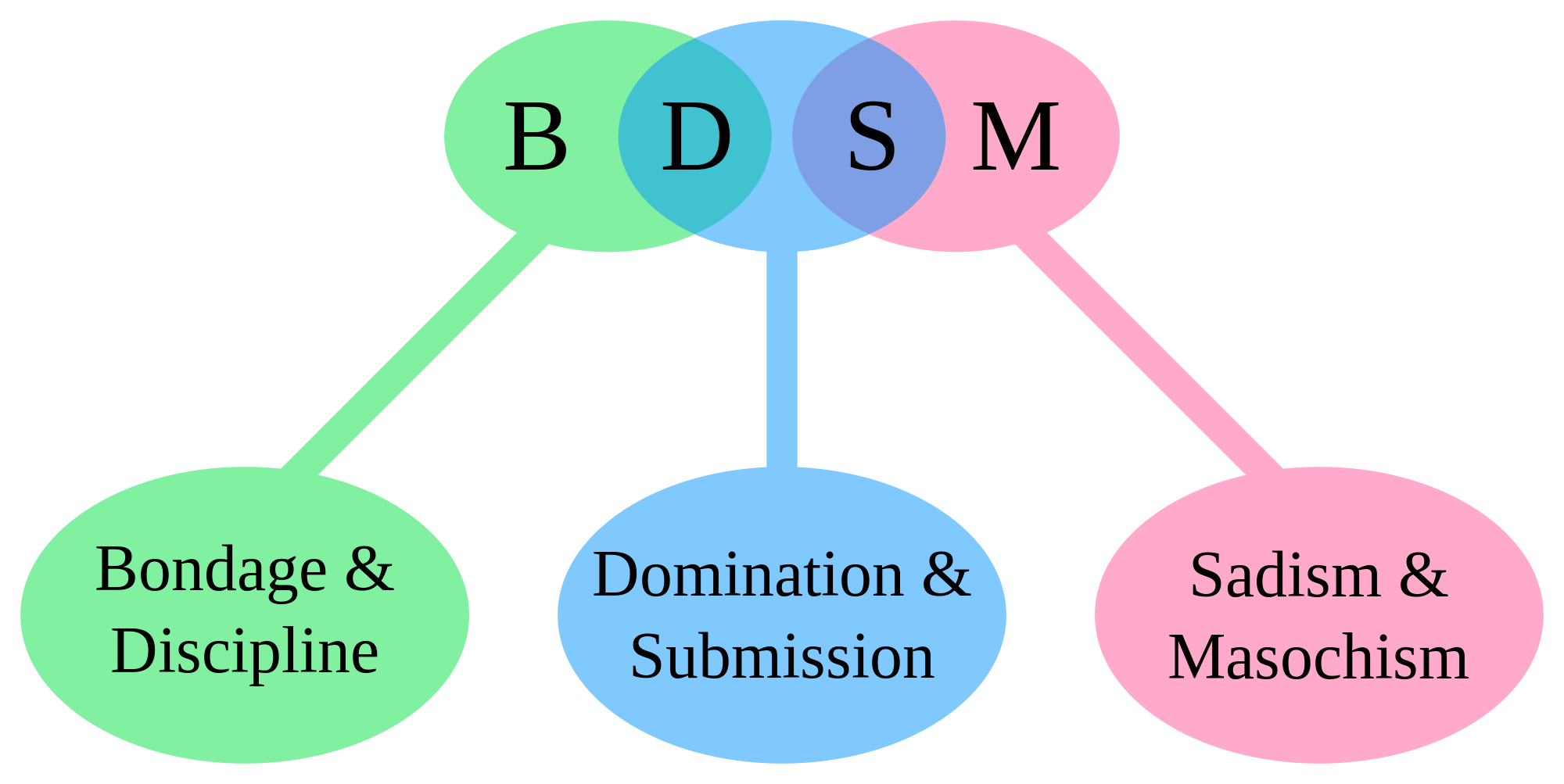
The initialism BDSM is first recorded in a Usenet post from 1991, and is interpreted as a combination of the abbreviations B/D (Bondage and Discipline), D/s (Dominance and submission), and S/M (Sadism and Masochism). BDSM is used as a catch-all phrase covering a wide range of activities, forms of interpersonal relationships, and distinct subcultures. BDSM communities generally welcome anyone with a non-normative streak who identifies with the community; this may include cross-dressers, body modification enthusiasts, animal roleplayers, rubber fetishists, and others.
Activities and relationships in BDSM are typically characterized by the participants' taking on roles that are complementary and involve inequality of power; thus, the idea of informed consent of both the partners is essential. The terms submissive and dominant are usually used to distinguish these roles: the dominant partner ("dom") takes psychological control over the submissive ("sub"). The terms top and bottom are also used; the top is the instigator of an action while the bottom is the receiver of the action. The two sets of terms are subtly different: for example, someone may choose to act as bottom to another person, for example, by being whipped, purely recreationally, without any implication of being psychologically dominated, and submissives may be ordered to massage their dominant partners. Although the bottom carries out the action and the top receives it, they have not necessarily switched roles.
The abbreviations sub and dom are frequently used instead of submissive and dominant. Sometimes the female-specific terms mistress, domme, and dominatrix are used to describe a dominant woman, instead of the sometimes gender-neutral term dom. Individuals who change between top/dominant and bottom/submissive roles—whether from relationship to relationship or within a given relationship—are called switches. The precise definition of roles and self-identification is a common subject of debate among BDSM participants.
BDSM is an umbrella term for certain kinds of erotic behaviour between consenting adults, encompassing various subcultures. Terms for roles vary widely among the subcultures. Top and dominant are widely used for those partner(s) in the relationship or activity who are, respectively, the physically active or controlling participants. Bottom and submissive are widely used for those partner(s) in the relationship or activity who are, respectively, the physically receptive or controlled participants. The interaction between tops and bottoms—where physical or mental control of the bottom is surrendered to the top—is sometimes known as "power exchange", whether in the context of an encounter or a relationship.
BDSM actions can often take place during a specific period of time agreed to by both parties, referred to as "play", a "scene", or a "session". Participants usually derive pleasure from this, even though many of the practices—such as inflicting pain or humiliation or being restrained—would be unpleasant under other circumstances. Explicit sexual activity, such as sexual penetration, may occur within a session, but is not essential. For legal reasons, such explicit sexual interaction is seen only rarely in public play spaces and is sometimes banned by the rules of a party or playspace. Whether it is a public "playspace"—ranging from a party at an established community dungeon to a hosted play "zone" at a nightclub or social event—the parameters of allowance can vary. Some have a policy of panties/nipple sticker for women (underwear for men) and some allow full nudity with explicit sexual acts.
The fundamental principles for the exercise of BDSM require that it be performed with the informed consent of all parties. Since the 1980s, many practitioners and organizations have adopted the motto (originally from the statement of purpose of GMSMA—a gay SM activist organization) safe, sane and consensual (SSC), which means that everything is based on safe activities, that all participants are of sufficiently sound mind to consent, and that all participants do consent. Mutual consent makes a clear legal and ethical distinction between BDSM and such crimes as sexual assault and domestic violence.
Some BDSM practitioners prefer a code of behaviour that differs from SSC. Described as "risk-aware consensual kink" (RACK), this code shows a preference for a style in which the individual responsibility of the involved parties is emphasized more strongly, with each participant being responsible for their own well-being. Advocates of RACK argue that SSC can hamper discussion of risk because no activity is truly "safe", and that discussion of even low-risk possibilities is necessary for truly informed consent. They further argue that setting a discrete line between "safe" and "not-safe" activities ideologically denies consenting adults the right to evaluate risks versus rewards for themselves; that some adults will be drawn to certain activities regardless of the risk; and that BDSM play—particularly higher-risk play or edgeplay—should be treated with the same regard as extreme sports, with both respect and the demand that practitioners educate themselves and practice the higher-risk activities to decrease risk. RACK may be seen as focusing primarily upon awareness and informed consent, rather than accepted safe practices.
Hub AI
BDSM AI simulator
(@BDSM_simulator)
BDSM
BDSM is a variety of often erotic practices or roleplaying involving bondage, discipline, dominance and submission, sadomasochism, and other related interpersonal dynamics. Given the wide range of practices, some of which may be engaged in by people who do not consider themselves to be practising BDSM, inclusion in the BDSM community or subculture often is said to depend on self-identification and shared experience.
The initialism BDSM is first recorded in a Usenet post from 1991, and is interpreted as a combination of the abbreviations B/D (Bondage and Discipline), D/s (Dominance and submission), and S/M (Sadism and Masochism). BDSM is used as a catch-all phrase covering a wide range of activities, forms of interpersonal relationships, and distinct subcultures. BDSM communities generally welcome anyone with a non-normative streak who identifies with the community; this may include cross-dressers, body modification enthusiasts, animal roleplayers, rubber fetishists, and others.
Activities and relationships in BDSM are typically characterized by the participants' taking on roles that are complementary and involve inequality of power; thus, the idea of informed consent of both the partners is essential. The terms submissive and dominant are usually used to distinguish these roles: the dominant partner ("dom") takes psychological control over the submissive ("sub"). The terms top and bottom are also used; the top is the instigator of an action while the bottom is the receiver of the action. The two sets of terms are subtly different: for example, someone may choose to act as bottom to another person, for example, by being whipped, purely recreationally, without any implication of being psychologically dominated, and submissives may be ordered to massage their dominant partners. Although the bottom carries out the action and the top receives it, they have not necessarily switched roles.
The abbreviations sub and dom are frequently used instead of submissive and dominant. Sometimes the female-specific terms mistress, domme, and dominatrix are used to describe a dominant woman, instead of the sometimes gender-neutral term dom. Individuals who change between top/dominant and bottom/submissive roles—whether from relationship to relationship or within a given relationship—are called switches. The precise definition of roles and self-identification is a common subject of debate among BDSM participants.
BDSM is an umbrella term for certain kinds of erotic behaviour between consenting adults, encompassing various subcultures. Terms for roles vary widely among the subcultures. Top and dominant are widely used for those partner(s) in the relationship or activity who are, respectively, the physically active or controlling participants. Bottom and submissive are widely used for those partner(s) in the relationship or activity who are, respectively, the physically receptive or controlled participants. The interaction between tops and bottoms—where physical or mental control of the bottom is surrendered to the top—is sometimes known as "power exchange", whether in the context of an encounter or a relationship.
BDSM actions can often take place during a specific period of time agreed to by both parties, referred to as "play", a "scene", or a "session". Participants usually derive pleasure from this, even though many of the practices—such as inflicting pain or humiliation or being restrained—would be unpleasant under other circumstances. Explicit sexual activity, such as sexual penetration, may occur within a session, but is not essential. For legal reasons, such explicit sexual interaction is seen only rarely in public play spaces and is sometimes banned by the rules of a party or playspace. Whether it is a public "playspace"—ranging from a party at an established community dungeon to a hosted play "zone" at a nightclub or social event—the parameters of allowance can vary. Some have a policy of panties/nipple sticker for women (underwear for men) and some allow full nudity with explicit sexual acts.
The fundamental principles for the exercise of BDSM require that it be performed with the informed consent of all parties. Since the 1980s, many practitioners and organizations have adopted the motto (originally from the statement of purpose of GMSMA—a gay SM activist organization) safe, sane and consensual (SSC), which means that everything is based on safe activities, that all participants are of sufficiently sound mind to consent, and that all participants do consent. Mutual consent makes a clear legal and ethical distinction between BDSM and such crimes as sexual assault and domestic violence.
Some BDSM practitioners prefer a code of behaviour that differs from SSC. Described as "risk-aware consensual kink" (RACK), this code shows a preference for a style in which the individual responsibility of the involved parties is emphasized more strongly, with each participant being responsible for their own well-being. Advocates of RACK argue that SSC can hamper discussion of risk because no activity is truly "safe", and that discussion of even low-risk possibilities is necessary for truly informed consent. They further argue that setting a discrete line between "safe" and "not-safe" activities ideologically denies consenting adults the right to evaluate risks versus rewards for themselves; that some adults will be drawn to certain activities regardless of the risk; and that BDSM play—particularly higher-risk play or edgeplay—should be treated with the same regard as extreme sports, with both respect and the demand that practitioners educate themselves and practice the higher-risk activities to decrease risk. RACK may be seen as focusing primarily upon awareness and informed consent, rather than accepted safe practices.
Recent media