Hubbry Logo
French Suites (Bach)French Suites (Bach)Main
Open search
French Suites (Bach)
Community hub
French Suites (Bach)
logo
8 pages, 0 posts
0 subscribers
Be the first to start a discussion here.
French Suites (Bach)
from Wikipedia

Gavotte from French Suite No. 5

The French Suites, BWV 812–817, are six suites which Johann Sebastian Bach wrote for the clavier (harpsichord or clavichord) between the years of 1722 and 1725.[1] Although Suites Nos. 1 to 4 are typically dated to 1722, it is possible that the first was written somewhat earlier.[1]

Style

[edit]

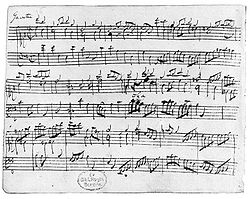
The suites were later given the name 'French' (first recorded usage by Friedrich Wilhelm Marpurg in 1762). Likewise, the English Suites received a later appellation. The name was popularised by Bach's biographer Johann Nikolaus Forkel, who wrote in his 1802 biography of Bach, "One usually calls them French Suites because they are written in the French manner."[1] This claim, however, is inaccurate: like Bach's other suites, they follow a largely Italian convention.[2] There is no surviving definitive manuscript of these suites, and ornamentation varies both in type and in degree across manuscripts.[1] The courantes of the first (in D minor) and third (in B minor) suites are in the French style; the courantes of the other four suites are all in the Italian style. In any case, Bach also employed dance movements (such as the polonaise of the sixth suite) that are foreign to the French manner. Usually, the swift second movement after the allemande is named either courante (French style) or corrente (Italian style), but in all these suites the second movements are named courante, according to the Bach catalog listing, which supports the suggestion that these suites are "French". Some of the manuscripts that have come down to us are titled "Suites Pour Le Clavecin", which is what probably led to the tradition of calling them "French" Suites.

Two additional suites, one in A minor (BWV 818), the other in E major (BWV 819), are linked to the familiar six in some manuscripts. The Overture in the French style, BWV 831, which Bach published as the second part of Clavier-Übung, is a suite in the French style but not connected to the French suites.[3] Some manuscripts have movements not found in other copies. These movements are probably spurious.[citation needed]

Movements

[edit]

Suite No. 1 in D minor, BWV 812

[edit]

Suite No. 2 in C minor, BWV 813

[edit]
  1. Allemande
  2. Courante
  3. Sarabande
  4. Air
  5. Menuet
  6. Menuet – Trio (in BWV 813a)
  7. Gigue

Suite No. 3 in B minor, BWV 814

[edit]
  1. Allemande
  2. Courante
  3. Sarabande
  4. Angloise
  5. Menuet – Trio
  6. Gigue

Suite No. 4 in E major, BWV 815

[edit]
  1. Allemande
  2. Courante
  3. Sarabande
  4. Gavotte
  5. Air
  6. Menuet
  7. Gigue

Suite No. 4 also exists in an alternative version, published as BWV 815a, which includes three additional movements: a Prelude, a second Gavotte and a Menuet.[4][5]

Suite No. 5 in G major, BWV 816

[edit]
  1. Allemande
  2. Courante
  3. Sarabande
  4. Gavotte
  5. Bourrée
  6. Loure
  7. Gigue

The first few bars of this suite were written in 1722 for Bach's second wife, but it was not completed until 1723. The Gigue, as often, is in fugal style, in binary form. The voices enter in descending order (Soprano-Alto-Bass), while in the second half of the piece the voices not only enter in opposite order but also an inversion of the 1st subject.[6]

Suite No. 6 in E major, BWV 817

[edit]
  1. Allemande
  2. Courante
  3. Sarabande
  4. Gavotte
  5. Polonaise
  6. Bourrée
  7. Menuet
  8. Gigue

Legacy

[edit]

The Menuet from Suite No. 3 in B-minor BWV 814 was provided as one of three soundtrack options in Nintendo's Game Boy version of Tetris.[7]

See also

[edit]

Notes and references

[edit]
[edit]
Revisions and contributorsEdit on WikipediaRead on Wikipedia
from Grokipedia
The French Suites, BWV 812–817, are a collection of six keyboard suites composed by Johann Sebastian Bach, originating during his tenure as in Cöthen around 1722 and largely completed by 1725. These works exemplify the suite form, each comprising a core sequence of stylized dances—, , , and —supplemented in several suites by optional galanterien such as minuets, gavottes, bourrées, or airs, all tailored for or performance. Distinguished by their elegant, melodies, reduced , and idiomatic keyboard textures, the suites reflect Bach's engagement with the French style galant, emphasizing charm and melodic flow over complexity. Bach likely compiled the French Suites as part of his educational efforts for pupils, alongside works like the Inventions and Sinfonias, while also presenting them as a wedding gift for his second wife, Anna Magdalena Wilcke, married in 1721; early versions appear in her personal Clavierbüchlein from 1722. The title "French Suites" was not Bach's own but was coined by the music theorist Friedrich Wilhelm Marpurg in his 1762 treatise Principes du clavecin, highlighting their adherence to French musical taste in dance rhythms and ornamentation, in contrast to the more Italianate English Suites (BWV 806–811), which include preludes and fuller textures. No autograph manuscript survives, with the primary sources being scribal copies by Bach's pupils, including Johann Schneider (for Suites Nos. 1–4 and 6) and Heinrich Nikolaus Gerber (for Suite No. 5), reflecting ongoing revisions up to around 1725. The suites progress from minor to major keys, beginning with three in minor (, , ) and concluding with three in major (, , ), a structure that underscores their pedagogical intent through graduated technical demands. Their movements vary slightly across the set:
  • Suite No. 1 in , BWV 812: Allemande; Courante; Sarabande; Menuet I & II; Gigue.
  • Suite No. 2 in , BWV 813: Allemande; Courante; Sarabande; Air; Menuet I & II; Gigue.
  • Suite No. 3 in , BWV 814: Allemande; Courante; Sarabande; Menuet I & II; Anglaise; Gigue.
  • Suite No. 4 in , BWV 815: Allemande; Courante; Sarabande; Gavotte; Menuet; Gigue.
  • Suite No. 5 in , BWV 816: Allemande; Courante; Sarabande; Gavotte; Bourrée; Loure; Gigue.
  • Suite No. 6 in , BWV 817: Allemande; Courante; Sarabande; Gavotte; Polonaise; Menuet; Bourrée; Gigue.
Notable for their brevity and accessibility compared to Bach's other suite cycles, the French Suites remain staples of the keyboard repertoire, valued for their blend of technical finesse and expressive poise.

Historical Background

Composition and Chronology

The French Suites, BWV 812–817, were primarily composed during Johann Sebastian Bach's tenure as Kapellmeister at the court of Prince Leopold of Anhalt-Köthen from 1717 to 1723, a period marked by his focus on secular instrumental music due to the prince's Calvinist leanings and lack of church duties. In this environment, Bach produced a wealth of keyboard and orchestral works, including the Brandenburg Concertos and the first book of The Well-Tempered Clavier, with the French Suites emerging as part of his exploration of the dance suite genre for clavier. The first four suites (BWV 812–815) are generally dated to 1722, during the height of Bach's Köthen productivity, while the remaining two (BWV 816–817) likely date to 1724–1725, after his move to Leipzig in 1723, reflecting ongoing revisions and compilation efforts. The first four suites, along with the opening movements of the fifth, appear in the Clavier-Büchlein für of 1722, which Bach began shortly after his marriage to his second wife in December 1721 and which provides the only autograph material for the French Suites. For Suite No. 5 in , BWV 816, watermark analysis of the paper in Anna Magdalena's 1722 Clavierbüchlein indicates it was begun in 1722, with completion around 1723, potentially as a dedicatory piece linked to the couple's early married life. Bach did not title these works "French Suites"; he referred to them simply as keyboard suites, as evidenced by contemporary copies such as Schneider's labeling them "Sex Sviten pur le Clavesin." The designation "French Suites" originated posthumously with music theorist Friedrich Wilhelm Marpurg, who first used it in 1762 to distinguish them stylistically from the English Suites, a later popularized by Bach's biographer Nikolaus Forkel in his 1802 publication.

Manuscripts and Transmission

No autograph manuscript of the French Suites in Johann Sebastian Bach's hand survives beyond the partial entries in the 1722 Clavier-Büchlein, with the earliest known sources being manuscript copies dating from 1722 to 1725. These copies provide the primary basis for understanding the work's early transmission, as Bach likely compiled the suites during his time in Köthen without producing a definitive fair copy. The most significant early copy is found in the Clavierbüchlein für of 1722, which contains the first four suites (BWV 812–815) and the opening of the fifth with minimal ornamentation in Bach's hand. Ornamented versions of movements from Suites 1 and 2 appear in Anna Magdalena's second Clavier-Büchlein of 1725, copied in her hand. Another key source is the copy by Bach's pupil and son-in-law Johann Christoph Altnikol, dating to after 1744, which transmits an earlier, less ornamented version of the complete set in the standard order. Additional copies, such as those by pupils Johann Schneider (1722) and Johann Caspar Vogler (c. 1725), further document the suites' dissemination among Bach's circle. Transmission of the French Suites reveals notable variations across sources, particularly in ornamentation levels and movement structures, reflecting Bach's ongoing revisions between 1722 and 1725. For instance, the 1722 Clavier-Büchlein presents unadorned versions suitable for instructional use, while later copies introduce more elaborate figurations and appoggiaturas; the Altnikol copy aligns more closely with the simpler early readings. Certain movements show potential revisions or additions, such as the prelude to Suite No. 4 (BWV 815), which appears in early sources like Vogler's copy but was likely omitted by Bach in the final compilation, raising questions about its authenticity in transmitted versions. The French Suites remained in manuscript form until the , when they were first printed in editions such as those by Breitkopf & Härtel. Modern critical editions standardize the text by collating these sources: the Bärenreiter Urtext edition (BA 5166, 1956; revised 1997) draws from the New Bach Edition (Serie V/1.1) and prioritizes the later ornamented readings, while the Henle Verlag edition (HN 594, 1965; revised 2017) offers both plain and embellished variants with updated fingerings. Recent advancements include digital facsimiles of Anna Magdalena's Clavierbüchlein manuscripts from the , made accessible via Bach Digital in the 2010s and enhanced in the 2020s for scholarly access.

Structure and Movements

Overall Organization

The French Suites, BWV 812–817, comprise six independent works for solo , composed in the early 1720s. Each suite adheres to the standard Baroque dance suite framework, featuring four obligatory movements—Allemande, , , and —all in , supplemented by one to four optional galanterie such as Menuets, Gavottes, Bourrées, or Airs inserted between the and . The keys progress from minor to major: (BWV 812), (BWV 813), (BWV 814), (BWV 815), (BWV 816), and (BWV 817). The obligatory dances follow established Baroque conventions in tempo, meter, and character, with each movement structured in binary form (||: A :||: B :||), where the A section typically modulates to the dominant and the B section returns to the tonic, and both halves are repeated. The Allemande is a moderate-tempo dance in flowing 4/4 meter, often featuring paired voices in a homophonic texture. The Courante exhibits rhythmic variety, with French variants in moderate 3/2 meter and Italian influences in lively 3/4, emphasizing flowing triple divisions. The Sarabande proceeds slowly in 3/4 meter, with an emphatic accent on the second beat creating a dignified, expressive profile. The Gigue concludes energetically in fast compound meter (6/8 or 12/8), frequently employing fugal or imitative counterpoint derived from English jig traditions. The galanterie provide lighter, characterful contrasts, often in binary form as well, and vary by suite without altering the core sequence. Collectively, the suites span a modest scope, with each averaging 15–20 minutes in performance duration, reflecting their intimate scale suitable for private keyboard study or play. In comparison to Bach's English Suites (BWV 806–811), the French Suites are simpler and more intimate, eschewing elaborate preludes and reducing contrapuntal complexity in favor of elegant, galant melodies. Unlike the Partitas (BWV 825–830), which exhibit greater structural freedom, virtuosity, and diversity of movements, the French Suites prioritize the purity and stylization of dance forms with less emphasis on technical display.

Suite No. 1 in D minor, BWV 812

The French Suite No. 1 in , BWV 812, is composed entirely in the key of , lending it a concise and introspective character that distinguishes it within the set. This suite follows the standard order of dances without a prelude, emphasizing a classical simplicity that reflects early 18th-century French stylistic influences adapted for keyboard. As the shortest of the French Suites, it lasts approximately 14 minutes in performance, making it an accessible entry point to Bach's suite idiom. The suite opens with an in flowing, lyrical style, characterized by steady 16th-note motion in 4/4 time and reduced that highlights a singing . The following adheres to the French manner in 3/2 meter, featuring a deliberate with hemiola effects and expressive harmonic progressions that add emotional depth. The then unfolds in a simple, affective manner, with homophonic texture in 3/4 time evoking a chorale-like through its straightforward over chordal accompaniment. Inserted as galanteries between the Sarabande and , the two Menuets provide rhythmic variety to the suite's structure. Menuet I presents an elegant, solemn character in 3/4 time, shifting briefly to the relative major for contrast while maintaining . Menuet II offers a lighter trio in contrast, with energetic ornaments and a homophonic texture that enhances dance-like clarity and hypermetric regularity every two bars. The suite concludes with a in energetic, imitative style, set in an unconventional simple 4/4 meter rather than compound time, featuring contrapuntal entries and ornate 32nd-note figuration across three voices. Unique to this suite is its early manuscript transmission: the earliest known copy appears in Anna Magdalena Bach's Clavierbüchlein of 1722, with minimal ornaments suggesting a straightforward possibly intended as a gift shortly after their 1721 marriage. This version indicates BWV 812 may be the earliest composition among the French Suites, dating to around 1722, and it employs strict binary forms throughout each movement for structural coherence. The Menuets, functioning as optional galanteries, introduce rhythmic diversity through their paired contrast, deviating slightly from the core dances while preserving the suite's intimate keyboard focus.

Suite No. 2 in C minor, BWV 813

The French Suite No. 2 in C , BWV 813, stands out for its darker and more dramatic tonality, which imbues the work with a profound emotional weight compared to the brighter keys of other suites in the set. Composed around 1722 during Bach's time in , this suite exemplifies his meticulous revision process, with multiple versions reflecting evolving refinements in structure and ornamentation. The 1722 copy in Anna Magdalena Bach's Clavier-Büchlein presents a simpler version (Version A), while later manuscripts, such as those copied by Christoph Altnickol, feature more elaborate ornaments in Version B, allowing performers flexibility in articulation and expression. The entire suite lasts approximately 15 minutes in performance. The suite comprises seven movements in , each drawing on stylized dances while showcasing Bach's contrapuntal ingenuity. It opens with a stately Allemande in moderate quadruple meter, featuring flowing and scalewise bass progressions that modulate from to in the first half and resolve back through . The following Courante, in 3/2 meter, unfolds with elegant, running sixteenth notes in two voices, progressing from to before cadencing in , evoking a sense of forward momentum. The Sarabande intensifies the drama through chromatic descending and ascending lines, creating an emotionally charged depth; its slow triple meter emphasizes dissonance and harmonic tension, modulating to in the first half and weaving through and in the second before returning to . Unique to this suite among the early ones is the insertion of an Air as a galanterie—a lyrical interlude in 3/4 meter that provides non-dance contrast after the Sarabande, its singing melody over a steady bass offering respite with modulations to G minor and back to C minor. This is followed by a robust Menuet I in triple meter, characterized by a vigorous C minor scale outline and descent to E-flat major, paired with a more delicate Menuet II variant that shifts to G major before resolving in C minor, allowing for ternary interplay. The suite concludes with a complex Gigue in compound duple meter, built on fugal counterpoint with chromatic elements in the subject, driving from C minor through E-flat major to a final cadence in the tonic after intricate developments.

Suite No. 3 in B minor, BWV 814

The Suite No. 3 in , BWV 814, stands out among Bach's French Suites for its graceful and varied , evoking a melancholic elegance that balances introspective depth with lively contrasts. Composed around 1722 in , it adheres to the core French suite while incorporating galanterie movements that enhance its balanced form. The work unfolds in six movements—, , , Menuet I, Menuet II (Trio), and —typically lasting about 16 minutes in performance. Unlike the preceding Suite No. 2, which features an Air and Italianate elements, this suite employs a French-style and a Trio for textural balance, maintaining a minor-key focus with Menuets in place of the major-key Gavottes found in Suite No. 4. The opening Allemande presents an intricate duet-like texture, with imitative motifs in inversion that create a delicate, almost conversational flow between the hands. This movement sets a graceful tone through its subtle and rhythmic subtlety, emphasizing B minor's varied expressive potential. The , in French style and notated in 6/4 time, drives forward with a lively bass motif from the opening bar that permeates the entire movement, infusing it with rhythmic vitality and forward momentum. Its elegant phrasing contrasts the Allemande's introspection, highlighting Bach's adaptation of the dance's characteristic patterns. Following is the Sarabande, an ornate and expressive movement that departs from stricter French models by adopting a more cantabile line, rich in melodic embellishment and emotional depth. The slow triple meter allows for profound expressivity, with harmonic tensions resolving in a way that underscores the suite's minor-key pathos. The Menuet I flows with rhythmic poise and courtly grace, serving as the first galanterie and providing a lighter interlude after the Sarabande. This movement gained modern popularity through its adaptation as the "Type C" theme in Nintendo's 1989 Game Boy version of Tetris, arranged by Hirokazu Tanaka. The subsequent Trio (Menuet II) introduces contrasting texture through its sparser accompaniment and melodic shifts, offering relief from the denser Menuet I before a da capo return to the latter. This pairing enhances the suite's balanced elegance, with the Trio's simplicity highlighting timbral variety on the keyboard. The suite concludes with a Gigue, a lively canonic movement at the octave where the voices pursue each other in imitation, culminating in brilliant virtuosity that resolves the work's tensions. Its energetic binary form provides a spirited close, true to the French gigue tradition yet enriched by Bach's contrapuntal ingenuity. In terms of transmission, the suite appears in multiple manuscripts, including a 1725 copy in the Notebook for , where variants feature added trills in several movements to heighten ornamental expressivity. These additions reflect ongoing revisions during Bach's teaching practice.

Suite No. 4 in E♭ major, BWV 815

The French Suite No. 4 in , BWV 815, stands out as the first in the collection to employ a major key, imparting a brighter and more character compared to the preceding minor-key suites. Composed around 1722–1725 during Bach's period, the work exemplifies his synthesis of French dance forms with idiomatic keyboard writing, emphasizing elegant melodies and refined textures suitable for or . The tonality of contributes to its warm, lyrical quality, evoking a sense of serenity through its rich harmonic palette and smooth progressions. The suite comprises six principal movements, each a stylized dance: an Allemande that opens gently with flowing arpeggios outlining shifting harmonies; a lively Courante in Italian style, characterized by 3/4 meter and groupings of three notes with occasional leaps for rhythmic vitality; a majestic Sarabande featuring more intricate motivic development beneath its stately triple rhythm; a dancelike Gavotte built on repeating pairs of notes in binary form; a lyrical Air serving as a contrasting, songlike interlude; and a bouncy Gigue concluding with imitative entries, simple leaps, and stepwise motions that drive its energetic close. Some manuscript sources, including Anna Magdalena Bach's Clavierbüchlein of 1725, include an additional Menuet inserted before the Gigue, suggesting a later revision to enhance the suite's variety. The overall duration is approximately 14 minutes in performance. An alternative version, catalogued as BWV 815a, incorporates a Prélude preceding the Allemande and features transposed movements along with variants such as a second Gavotte in place of the Air, preserved in fewer manuscripts and possibly representing an early or experimental form. Authenticity debates center on these variants, with scholars noting that while the core movements are firmly attributed to Bach via pupil copies like Johann Peter Kellner's (c. 1725), the Prélude and additional dances may stem from later adaptations or interpolations, as evidenced by inconsistencies across sources such as the Fair Copy (Autograph, c. 1725). Modern editions, such as Henle's, present the suite based on the New Bach Edition's "Version B," highlighting textual variants in footnotes for performers.

Suite No. 5 in G major, BWV 816

The Suite No. 5 in , BWV 816, exemplifies a joyful and expansive that renders it the sunniest and friendliest among the French Suites. Composed in the "French taste" with a focus on pleasing, predominant melodies, it follows the standard suite structure of , , , and , augmented by additional galanterie movements. This extended form contributes to its status as the longest suite in the set, typically lasting about 18 minutes in . The suite opens with an elegant in moderate tempo, featuring simple lines and string-like figurations that evoke a quality. The following adopts a spritely Italian corrente style in lively triple meter, diverging from the calmer French original with its flowing, two-part texture. The unfolds profoundly in slow triple time, presenting a smooth, arioso-style melody with French dotted rhythms and Italianate ornamentation variations. The light follows as an innocent French dance, leading into the energetic with its melodic right-hand line over a racing left-hand that imparts a rustic vigor. A rare Loure, resembling a slow or theatrical , inserts a lyrical interlude before the concluding , which unfolds as an extensive binary-form in 12/16 meter with imitative entries. Unique to this suite is the inclusion of the Loure as an additional dance, a form Bach employed only twice in his oeuvre, here blending French elegance with Italian lyricism in a cosmopolitan synthesis. Manuscript evidence from the 1722 Clavierbüchlein for indicates composition began around that year in , with revisions likely extending into 1723 during Bach's early period. The Bourrée's rustic flavor emerges through its simple rhythmic drive and active bass, evoking folk-like energy amid the suite's overall tuneful poise.

Suite No. 6 in E major, BWV 817

The Suite No. 6 in , BWV 817, stands as the final and most elaborate entry in Bach's set of French Suites, characterized by its brilliant and festive in , which lends a radiant, celebratory quality to the entire work. Composed around 1722–1725 during Bach's Cöthen period, it exemplifies the composer's mature synthesis of dance forms, serving both pedagogical and expressive purposes for performers like his wife, . The suite's structure follows the typical of the core dances while incorporating a wealth of galanterie, culminating in a sense of resolution and virtuosity that caps the collection. The suite comprises eight principal movements, each drawing on stylized dance rhythms adapted with Bach's contrapuntal ingenuity. It opens with a virtuosic Allemande in 3/4 time, featuring intricate ornamentation and flowing polyphony that demands technical precision. This is followed by a lively Courante in the Italian style (corrente), marked by rapid scalar passages and hemiola rhythms at a brisk tempo. The Sarabande presents an expressive, triple-meter melody with characteristic harmonic suspensions. The galanterie section includes a graceful Gavotte in duple meter, followed by a march-like Polonaise of Polish origin, featuring dotted rhythms and a stately processional character that diverges from strict French dance conventions. A Menuet provides courtly elegance, then a quick Bourrée in 2/4 time offers energetic contrast with its light, skipping motifs, leading to the concluding Gigue, a complex movement in fugal style and binary form, with the theme developed through imitative entries. Unique among the French Suites, BWV 817 boasts the richest array of galanterie movements—four in total: the , , Menuet, and —emphasizing its conclusive, ornate character as the latest-composed in the set. This version survives in an elaborate fair copy dated 1725, prepared by the scribe Johann Schneider (, Mus. ms. Bach P 418), which includes refined ornaments and revisions reflecting Bach's final thoughts. The work typically lasts about 17 minutes in performance, allowing space for its decorative flourishes without overwhelming the intimate keyboard medium.

Style and Characteristics

Influences from French Dance Music

The French Suites, composed by Johann Sebastian Bach around 1722–1725, draw significant inspiration from the French Baroque dance traditions established by composers such as and , reflecting the elegant and stylized conventions of the French court under . The designation "French Suites" stems from their adherence to the French taste in keyboard , characterized by graceful movements that evoke the refined rhythms and poise of 17th- and early 18th-century French orchestral and solo works. This influence is evident in the suites' core structure, which prioritizes forms over elaborate preludes, aligning with the simpler, more intimate style of French as opposed to the grander Italian or German models. Key dance movements exemplify these French roots. The , typically in 3/2 meter, incorporates the convention of , where equal-duration notes (such as eighth notes) are performed with subtle rhythmic inequality—long-short pairs—to mimic the lilting, flowing quality of French dance steps, a practice widespread in by Bach's time through exposure to French sources. Similarly, the adopts a slow, noble gait in triple meter, emphasizing expressive phrasing and a dignified that echoes the stately processional dance popularized in Lully's operas and Couperin's Pièces de clavecin. Galanterie movements, such as the menuet and , further capture courtly elegance through their moderate tempos, balanced phrases, and light, skipping rhythms that imitate the poised steps of aristocratic ballroom dancing. The suites' formal elements also borrow from French precedents. Most movements employ binary structure, with two contrasting sections (often repeated) that build tension toward a modulation in the dominant key before returning, a format derived from the tradition initiated by Lully and refined in keyboard suites by Couperin. Ornamentation follows French models, with Bach incorporating idiomatic signs for trills, mordents, and appoggiaturas akin to those in Jean-Henry d'Anglebert's 1689 table, which Bach personally copied as a young musician to master the agréments essential for expressive harpsichord playing. While predominantly French in style, the suites include non-French elements that add variety. The in Suite No. 6, BWV 817, introduces a Polish processional with its emphatic dotted rhythms and triple meter, diverging from strict French conventions to reflect broader European influences. The , though originating in French , features a lighter, more buoyant step in duple meter compared to the heavier or . Overall, Bach's suites are simpler than comprehensive French models like Couperin's, lacking introductory preludes or ouvertures and focusing instead on concise, -driven movements suitable for keyboard . Recent studies, including a 2025 quantitative analysis of 70 Baroque suites by various composers including Bach, highlight how these works preserve the core ordering—, , , —while adapting them for German audiences.

Bach's Stylistic Adaptations

Bach's French Suites demonstrate a distinctive synthesis of German and Italian musical traditions within the framework of French dance forms. The gigues in Suites Nos. 2, 5, and 6 adopt a fugal structure inspired by Italian models, featuring smooth-flowing imitative entries that contrast with the more homophonic French gigues, thereby infusing contrapuntal depth into the concluding movements. Similarly, the courantes in Suites Nos. 2, 4, and 6 reflect Italian influence through their meter and lively, running character, diverging from the slower, more polyphonic French-style courantes found in Suites Nos. 1 and 3. This fusion is evident in the sarabandes as well, particularly in Suite No. 5, where three-voice creates a rich, expressive texture that elevates the 's inherent gravity. Innovations in the French Suites include their intimate scale, tailored particularly for the rather than the more resonant , allowing for subtle dynamic nuances and personal expressivity suited to domestic performance. The minor-key suites (Nos. 1–3) exhibit particular affective depth, with melancholic inflections that convey emotional introspection, while rhythmic vitality is achieved through devices such as and , adding propulsion to movements like the allemandes and courantes. Compared to contemporary French suites, Bach's versions introduce greater , transforming the elegant simplicity of models like those by into more intricate contrapuntal dialogues, while remaining less ornate and structurally elaborate than his own English Suites. This balance reflects a pedagogical intent, as the suites promote finger independence through interwoven voices and varied articulations, making them ideal for teaching keyboard technique to students like . As musicologist Manfred Bukofzer observed, in these works "Italian, French, and German styles no longer stand side by side but wholly merge with Bach's personal style."

Performance and Reception

Instrumentation and Interpretation

The French Suites, BWV 812–817, were composed for the clavier, with partial evidence indicating the as the primary instrument, as reflected in the heading "Sex Sviten pur le Clavesin" from Bach's partial in ’s Clavier-Büchlein. The , favored for its intimate expressiveness and suitability for domestic practice, aligns with the suites' didactic purpose and four-octave range, making it an ideal choice for private settings like those in Bach's household. Since the , adaptations for the modern have become widespread, allowing performers to explore dynamic nuances unavailable on period keyboards, though scholars emphasize maintaining clarity to honor the original's contrapuntal texture. Ornamentation in the suites draws from Bach's revisions in copies by his wife , who added trills, mordents, and other embellishments to enhance the , as seen in her 1725 Clavier-Büchlein where suites Nos. 4 and 5 appear with such details. In the French-style Courantes, particularly those in 3/2 time (e.g., Suites Nos. 1 and 3), performers often apply , rendering equal written notes with a swung, unequal to evoke the graceful inequality typical of French Baroque dance practice. Performance tempos favor , with Allemandes typically at ♩=60–80 to support their flowing, serious character, while Sarabandes permit subtle rubato for expressive phrasing amid their ornamented melodies. fingering techniques, emphasizing thumb-under and finger-crossing for smooth , aid in voicing independent lines, as documented in 18th-century sources. On , interpreters avoid over-pedaling to preserve contrapuntal independence, opting for selective, shallow sustain to mimic the 's decay without blurring. Recent discussions, including 2025 analyses of overdotting and articulation, highlight ongoing debates on versus for their relative intimacy and projection, though the 's subtleties remain underexplored in larger venues.

Legacy and Cultural Impact

The French Suites circulated widely in manuscript copies during the , primarily among Bach's students and contemporary musicians, serving as an important resource for keyboard instruction and performance practice. Johann Nikolaus Forkel's 1802 biography of Bach highlighted the suites' less academic approach compared to larger suites, praising their pleasant and agreeable melodies as a model for elegant keyboard composition. These works were frequently used in contexts, with copies preserved in collections like those of Bach's pupil Johann Christoph Altnikol, underscoring their pedagogical value in the era. In the , the suites experienced a revival through the broader resurgence of Bach's music led by , who performed and promoted Bach's keyboard works in concerts and editions that introduced them to Romantic-era audiences. By the early , Landowska's pioneering recordings of the French Suites, completed between 1933 and 1939 on her custom Pleyel instrument, revitalized interest in authentic performance and influenced the revival movement. Concurrently, Carl Czerny's editions of the suites, published in the mid-19th century, established them as a staple in conservatory curricula, adapting the works for modern pedagogy while preserving their structures. The suites' modern cultural impact extends beyond classical music, notably through the Menuet from Suite No. 3 in B minor (BWV 814), which featured in the 1989 version of and gained widespread popularity in the 1990s via the game's global success, introducing Bach to video game audiences. Composers like drew stylistic inspiration from the French Suites, evident in his own keyboard variations that echo their contrapuntal clarity and rhythmic vitality. Iconic recordings include Glenn Gould's 1971 interpretations on , known for their idiosyncratic tempo and articulation, which brought the suites to mid-20th-century listeners. In the 2020s, historically informed performances like Mahan Esfahani's 2023 recording on Hyperion emphasize period instruments and ornamentation, reflecting ongoing scholarly refinements. In the , digital musicological analyses have illuminated aspects of Bach's keyboard works, including the suites' structural elements.

References

Add your contribution
Related Hubs
User Avatar
No comments yet.