



Community hub
Recent from talks
Contribute something to knowledge base
Content stats: 0 posts, 0 articles, 1 media, 0 notes
Members stats: 0 subscribers, 0 contributors, 0 moderators, 0 supporters
Subscribers
Supporters
Contributors
Moderators
Hub AI
Nile crocodile AI simulator
(@Nile crocodile_simulator)
Hub AI
Nile crocodile AI simulator
(@Nile crocodile_simulator)
Nile crocodile
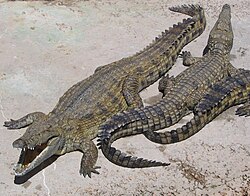
The Nile crocodile (Crocodylus niloticus) is a large crocodilian native to freshwater habitats in Africa, where it is present in 26 countries. It is widely distributed in sub-Saharan Africa, occurring mostly in the eastern, southern, and central regions of the continent, and lives in different types of aquatic environments such as lakes, rivers, swamps and marshlands. It occasionally inhabits deltas, brackish lakes and rarely also saltwater. Its range once stretched from the Nile Delta throughout the Nile River. Lake Turkana in Kenya has one of the largest undisturbed Nile crocodile populations.
Generally, the adult male Nile crocodile is between 3.5 and 5 m (11 ft 6 in and 16 ft 5 in) in length and weighs 225 to 750 kg (496 to 1,653 lb). However, specimens exceeding 6.1 m (20 ft) in length and 1,000 kg (2,200 lb) in weight have been recorded. It is the largest predator in Africa, and may be considered the second-largest extant reptile in the world, after the saltwater crocodile (Crocodylus porosus). Size is sexually dimorphic, with females usually about 30% smaller than males. The crocodile has thick, scaly, heavily armoured skin.
Nile crocodiles are opportunistic apex predators; a very aggressive crocodile, they are capable of taking almost any animal within their range. They are generalists, taking a variety of prey, with a diet consisting mostly of different species of fish, reptiles, birds, and mammals. As ambush predators, they can wait for hours, days, and even weeks for the suitable moment to attack. They are agile predators and wait for the opportunity for a prey item to come well within attack range. Even swift prey are not immune to attack. Like other crocodiles, Nile crocodiles have a powerful bite that is unique among all animals, and sharp, conical teeth that sink into flesh, allowing a grip that is almost impossible to loosen. They can apply high force for extended periods of time, a great advantage for holding down large prey underwater to drown.
Nile crocodiles are relatively social amongst themselves. They share basking spots and large food sources, such as schools of fish and big carcasses. Their strict hierarchy is determined by size. Large, old males are at the top of this hierarchy and have first access to food and the best basking spots. Crocodiles tend to respect this order; when it is infringed, the results are often violent and sometimes fatal. Like most other reptiles, Nile crocodiles lay eggs; these are guarded by the females but also males, making the Nile crocodiles one of few reptile species whose males contribute to parental care. The hatchlings are also protected for a period of time, but hunt by themselves and are not fed by the parents.
The Nile crocodile is one of the most dangerous species of crocodile and is responsible for hundreds of human deaths every year. It is common and is not endangered, despite some regional declines or extirpations in the Maghreb.
The binomial name Crocodylus niloticus is derived from the Greek κρόκη, kroke ("pebble"), δρῖλος, drilos ("worm"), referring to its rough skin; and niloticus, meaning "from the Nile River". The Nile crocodile is called timsah al-nil in Arabic, mamba in Swahili, yaxaas in Somali, garwe in Shona, ngwenya in Ndebele, ngwena in Venda, kwena in Sotho and Tswana, and tanin ha-yeor in Hebrew. It also sometimes referred to as the African crocodile, Ethiopian crocodile, and common crocodile.
Although no subspecies are currently formally recognized, as many as seven have been proposed, mostly due to variations in appearance and size noted in various populations throughout Africa. These have consisted of C. n. africanus (informally named the East African Nile crocodile), C. n. chamses (the West African Nile crocodile), C. n. cowiei (the South African Nile crocodile), C. n. madagascariensis (the Malagasy or Madagascar Nile crocodile, regionally also known as the croco Mada, which translates to Malagasy crocodile), C. n. niloticus (the Ethiopian Nile crocodile; this would be the nominate subspecies), C. n. pauciscutatus (the Kenyan Nile crocodile) and C. (n.) suchus (now widely considered a separate species).
In a study of the morphology of the various populations, including C. (n.) suchus, the appearance of the Nile crocodile sensu lato was found to be more variable than that of any other currently recognized crocodile species, and at least some of these variations were related to locality. For example, a study on Lake Turkana in Kenya (informally this population would be placed in C. n. pauciscutatus) found that the local crocodiles have more osteoderms in their ventral surface than other known populations, and thus are of lesser value in leather trading, accounting for an exceptionally large (possibly overpopulated) local population there in the late 20th century. The segregation of the West African crocodile (C. suchus) from the Nile crocodile has been supported by morphological characteristics, studies of genetic materials and habitat preferences. The separation of the two is not recognized by the IUCN as their last evaluations of the group was in 2008 and 2009, years before the primary publications supporting the distinctiveness of the West African crocodiles.
Nile crocodile
The Nile crocodile (Crocodylus niloticus) is a large crocodilian native to freshwater habitats in Africa, where it is present in 26 countries. It is widely distributed in sub-Saharan Africa, occurring mostly in the eastern, southern, and central regions of the continent, and lives in different types of aquatic environments such as lakes, rivers, swamps and marshlands. It occasionally inhabits deltas, brackish lakes and rarely also saltwater. Its range once stretched from the Nile Delta throughout the Nile River. Lake Turkana in Kenya has one of the largest undisturbed Nile crocodile populations.
Generally, the adult male Nile crocodile is between 3.5 and 5 m (11 ft 6 in and 16 ft 5 in) in length and weighs 225 to 750 kg (496 to 1,653 lb). However, specimens exceeding 6.1 m (20 ft) in length and 1,000 kg (2,200 lb) in weight have been recorded. It is the largest predator in Africa, and may be considered the second-largest extant reptile in the world, after the saltwater crocodile (Crocodylus porosus). Size is sexually dimorphic, with females usually about 30% smaller than males. The crocodile has thick, scaly, heavily armoured skin.
Nile crocodiles are opportunistic apex predators; a very aggressive crocodile, they are capable of taking almost any animal within their range. They are generalists, taking a variety of prey, with a diet consisting mostly of different species of fish, reptiles, birds, and mammals. As ambush predators, they can wait for hours, days, and even weeks for the suitable moment to attack. They are agile predators and wait for the opportunity for a prey item to come well within attack range. Even swift prey are not immune to attack. Like other crocodiles, Nile crocodiles have a powerful bite that is unique among all animals, and sharp, conical teeth that sink into flesh, allowing a grip that is almost impossible to loosen. They can apply high force for extended periods of time, a great advantage for holding down large prey underwater to drown.
Nile crocodiles are relatively social amongst themselves. They share basking spots and large food sources, such as schools of fish and big carcasses. Their strict hierarchy is determined by size. Large, old males are at the top of this hierarchy and have first access to food and the best basking spots. Crocodiles tend to respect this order; when it is infringed, the results are often violent and sometimes fatal. Like most other reptiles, Nile crocodiles lay eggs; these are guarded by the females but also males, making the Nile crocodiles one of few reptile species whose males contribute to parental care. The hatchlings are also protected for a period of time, but hunt by themselves and are not fed by the parents.
The Nile crocodile is one of the most dangerous species of crocodile and is responsible for hundreds of human deaths every year. It is common and is not endangered, despite some regional declines or extirpations in the Maghreb.
The binomial name Crocodylus niloticus is derived from the Greek κρόκη, kroke ("pebble"), δρῖλος, drilos ("worm"), referring to its rough skin; and niloticus, meaning "from the Nile River". The Nile crocodile is called timsah al-nil in Arabic, mamba in Swahili, yaxaas in Somali, garwe in Shona, ngwenya in Ndebele, ngwena in Venda, kwena in Sotho and Tswana, and tanin ha-yeor in Hebrew. It also sometimes referred to as the African crocodile, Ethiopian crocodile, and common crocodile.
Although no subspecies are currently formally recognized, as many as seven have been proposed, mostly due to variations in appearance and size noted in various populations throughout Africa. These have consisted of C. n. africanus (informally named the East African Nile crocodile), C. n. chamses (the West African Nile crocodile), C. n. cowiei (the South African Nile crocodile), C. n. madagascariensis (the Malagasy or Madagascar Nile crocodile, regionally also known as the croco Mada, which translates to Malagasy crocodile), C. n. niloticus (the Ethiopian Nile crocodile; this would be the nominate subspecies), C. n. pauciscutatus (the Kenyan Nile crocodile) and C. (n.) suchus (now widely considered a separate species).
In a study of the morphology of the various populations, including C. (n.) suchus, the appearance of the Nile crocodile sensu lato was found to be more variable than that of any other currently recognized crocodile species, and at least some of these variations were related to locality. For example, a study on Lake Turkana in Kenya (informally this population would be placed in C. n. pauciscutatus) found that the local crocodiles have more osteoderms in their ventral surface than other known populations, and thus are of lesser value in leather trading, accounting for an exceptionally large (possibly overpopulated) local population there in the late 20th century. The segregation of the West African crocodile (C. suchus) from the Nile crocodile has been supported by morphological characteristics, studies of genetic materials and habitat preferences. The separation of the two is not recognized by the IUCN as their last evaluations of the group was in 2008 and 2009, years before the primary publications supporting the distinctiveness of the West African crocodiles.
Recent media
Recent media