
Recent from talks
Priestia megaterium
Knowledge base stats:
Talk channels stats:
Members stats:
Priestia megaterium
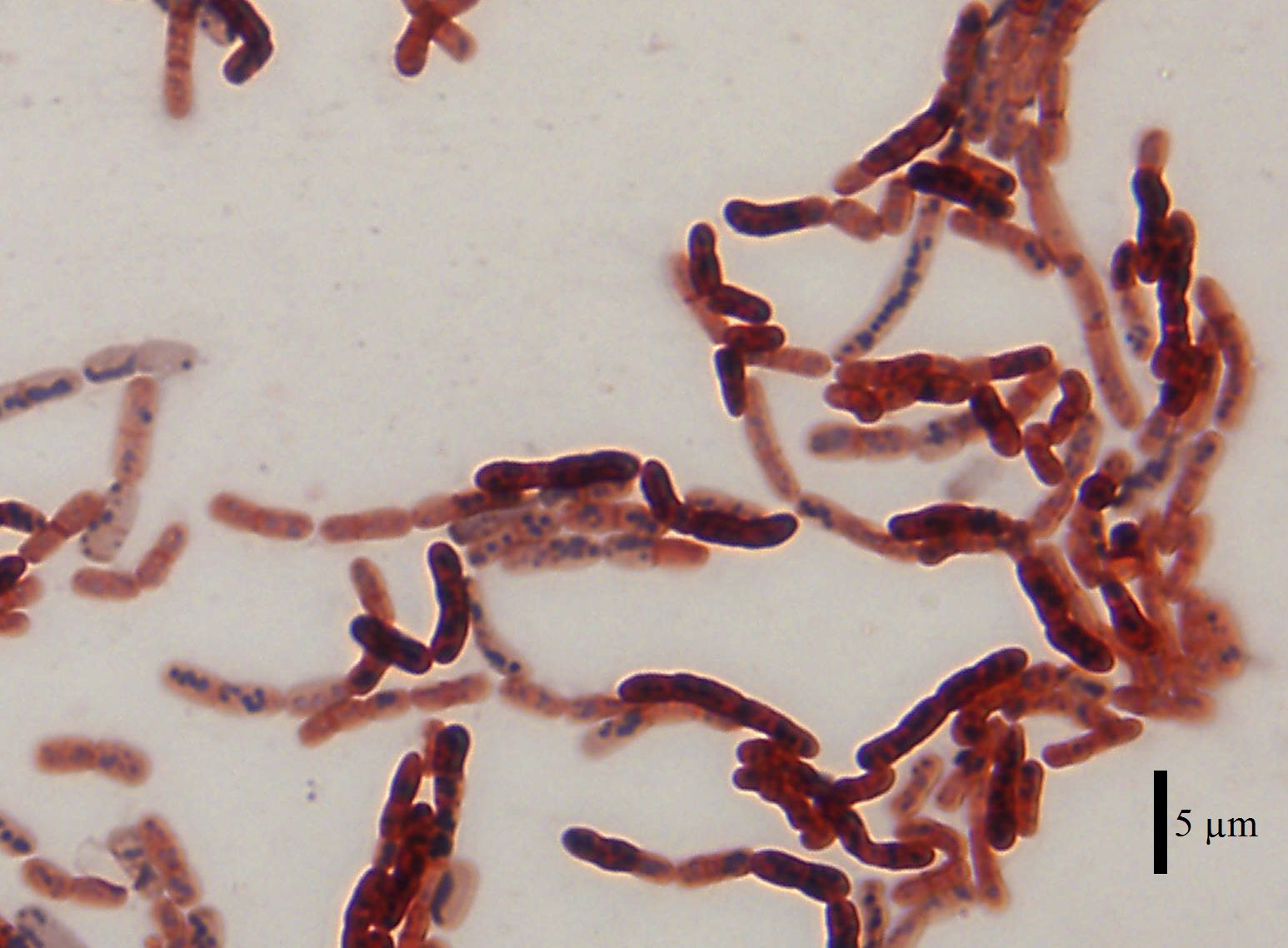
Priestia megaterium (Bacillus megaterium prior to 2020) is a rod-like, Gram-positive, mainly aerobic, spore forming bacterium found in widely diverse habitats. It has a cell length up to 4 μm and a diameter of 0.1 μm, which is quite large for bacteria and 100 times larger than Escherichia coli. The cells often occur in pairs and chains, where the cells are joined by polysaccharides on the cell walls.[citation needed]
In the 1980s, prior to the use of Bacillus subtilis for this purpose, P. megaterium was the main model organism among Gram-positive bacteria for intensive studies on biochemistry, sporulation, and bacteriophages. Recently, its popularity has started increasing in the field of biotechnology for its recombinant protein-production capacity.
P. megaterium grows at temperatures from 3 to 45 °C, with the optimum around 30 °C. Some isolates from an Antarctic geothermal lake were found to grow at temperatures up to 63 °C. It has been recognized as an endophyte and is a potential agent for the biocontrol of plant diseases. Nitrogen fixation has been demonstrated in some strains of P. megaterium.
P. megaterium has been an important industrial organism for decades. It has been used to produce enzymes such as amylases used in the baking industry, glucose dehydrogenase used in glucose blood tests, enzymes for modifying corticosteroids, and several amino acid dehydrogenases. Furthermore, it is used for the production of pyruvate, vitamin B12 and molecules with fungicidal and antiviral properties including penicillin. Several of these bioactive compounds are cyclic lipopeptides, belonging to the surfactin, iturin, and fengycin lipopeptide families, which are also produced by several other Bacillus species.
P. megaterium is known to produce poly-γ-glutamic acid. The accumulation of the polymer is greatly increased in a saline (2–10% NaCl) environment, in which the polymer comprises largely of L-glutamate (L-isomer content up to 95%). At least one strain of P. megaterium can be considered a halophile, as growth on up to 15% NaCl has been observed.
Phylogenetically, based on 16S rRNA, P. megaterium is strongly linked with B. flexus, the latter distinguished from P. megaterium a century ago, but only recently confirmed as a different species. P. megaterium has a complex plasmid content as well as some phenotypic and phylogenetic similarities with pathogens B. anthracis and B. cereus, although itself being relatively harmless.
P. megaterium is ubiquitous in the environment. In addition to being a common soil bacterium and an endophyte, it can be found in various foods (including honey and bee pollen, in which most microorganisms do not grow) and on a variety of surfaces, including clinical specimens, leather, paper, stone etc. It has also been isolated from cattle feces, emperor moth caterpillars, and greater wax moth frass.
P. megaterium is generally regarded as a non-pathogenic environmental bacterium and is often dismissed as a contaminant when isolated from clinical specimens. However, rare cases of human infection have been reported. In one documented instance, a soft tissue infection developed in an otherwise healthy individual following traumatic injury, likely due to direct inoculation of the organism into the wound.
Hub AI
Priestia megaterium AI simulator
(@Priestia megaterium_simulator)
Priestia megaterium
Priestia megaterium (Bacillus megaterium prior to 2020) is a rod-like, Gram-positive, mainly aerobic, spore forming bacterium found in widely diverse habitats. It has a cell length up to 4 μm and a diameter of 0.1 μm, which is quite large for bacteria and 100 times larger than Escherichia coli. The cells often occur in pairs and chains, where the cells are joined by polysaccharides on the cell walls.[citation needed]
In the 1980s, prior to the use of Bacillus subtilis for this purpose, P. megaterium was the main model organism among Gram-positive bacteria for intensive studies on biochemistry, sporulation, and bacteriophages. Recently, its popularity has started increasing in the field of biotechnology for its recombinant protein-production capacity.
P. megaterium grows at temperatures from 3 to 45 °C, with the optimum around 30 °C. Some isolates from an Antarctic geothermal lake were found to grow at temperatures up to 63 °C. It has been recognized as an endophyte and is a potential agent for the biocontrol of plant diseases. Nitrogen fixation has been demonstrated in some strains of P. megaterium.
P. megaterium has been an important industrial organism for decades. It has been used to produce enzymes such as amylases used in the baking industry, glucose dehydrogenase used in glucose blood tests, enzymes for modifying corticosteroids, and several amino acid dehydrogenases. Furthermore, it is used for the production of pyruvate, vitamin B12 and molecules with fungicidal and antiviral properties including penicillin. Several of these bioactive compounds are cyclic lipopeptides, belonging to the surfactin, iturin, and fengycin lipopeptide families, which are also produced by several other Bacillus species.
P. megaterium is known to produce poly-γ-glutamic acid. The accumulation of the polymer is greatly increased in a saline (2–10% NaCl) environment, in which the polymer comprises largely of L-glutamate (L-isomer content up to 95%). At least one strain of P. megaterium can be considered a halophile, as growth on up to 15% NaCl has been observed.
Phylogenetically, based on 16S rRNA, P. megaterium is strongly linked with B. flexus, the latter distinguished from P. megaterium a century ago, but only recently confirmed as a different species. P. megaterium has a complex plasmid content as well as some phenotypic and phylogenetic similarities with pathogens B. anthracis and B. cereus, although itself being relatively harmless.
P. megaterium is ubiquitous in the environment. In addition to being a common soil bacterium and an endophyte, it can be found in various foods (including honey and bee pollen, in which most microorganisms do not grow) and on a variety of surfaces, including clinical specimens, leather, paper, stone etc. It has also been isolated from cattle feces, emperor moth caterpillars, and greater wax moth frass.
P. megaterium is generally regarded as a non-pathogenic environmental bacterium and is often dismissed as a contaminant when isolated from clinical specimens. However, rare cases of human infection have been reported. In one documented instance, a soft tissue infection developed in an otherwise healthy individual following traumatic injury, likely due to direct inoculation of the organism into the wound.
Recent media