
Hubbry Logo
Pyruvic acidPyruvic acidMain
Open search
Pyruvic acid
Community hub
Pyruvic acid
logo
7 pages, 0 posts
0 subscribers
Be the first to start a discussion here.
Contribute something
Pyruvic acid
Pyruvic acid
from Wikipedia
Pyruvic acid
Names
Preferred IUPAC name
2-Oxopropanoic acid[1]
Systematic IUPAC name
2-Oxopropionic acid
Other names
Pyruvic acid[1]
α-Ketopropionic acid
Acetylformic acid
Pyroracemic acid
Acetylcarboxylic acid
Identifiers
3D model (JSmol)
Abbreviations Pyr
ChEBI
ChEMBL
ChemSpider
DrugBank
ECHA InfoCard 100.004.387 Edit this at Wikidata
KEGG
UNII
  • InChI=1S/C3H4O3/c1-2(4)3(5)6/h1H3,(H,5,6) checkY
    Key: LCTONWCANYUPML-UHFFFAOYSA-N checkY
  • O=C(C(=O)O)C
Properties
C3H4O3
Molar mass 88.06 g/mol
Density 1.250 g/cm3
Melting point 11.8 °C (53.2 °F; 284.9 K)
Boiling point 165 °C (329 °F; 438 K)
Acidity (pKa) 2.50[2]
Related compounds
Other anions
Pyruvate

Related compounds
Except where otherwise noted, data are given for materials in their standard state (at 25 °C [77 °F], 100 kPa).
☒N verify (what is checkY☒N ?)

Pyruvic acid (CH3COCOOH) is the simplest of the alpha-keto acids, with a carboxylic acid and a ketone functional group. Pyruvate, the conjugate base, CH3COCOO, is an intermediate in several metabolic pathways throughout the cell.

Pyruvic acid can be made from glucose through glycolysis, converted back to carbohydrates (such as glucose) via gluconeogenesis, or converted to fatty acids through a reaction with acetyl-CoA.[3] It can also be used to construct the amino acid alanine and can be converted into ethanol or lactic acid via fermentation.

Pyruvic acid supplies energy to cells through the citric acid cycle (also known as the Krebs cycle) when oxygen is present (aerobic respiration), and alternatively ferments to produce lactate when oxygen is lacking.[4]

Chemistry

[edit]

In 1834, Théophile-Jules Pelouze distilled tartaric acid and isolated glutaric acid and another unknown organic acid. Jöns Jacob Berzelius characterized this other acid the following year and named pyruvic acid because it was distilled using heat.[5][6] The correct molecular structure was deduced by the 1870s.[7]

Pyruvic acid is a colorless liquid with a smell similar to that of acetic acid and is miscible with water.[8] In the laboratory, pyruvic acid may be prepared by heating a mixture of tartaric acid and potassium hydrogen sulfate,[9] by the oxidation of propylene glycol by a strong oxidizer (e.g., potassium permanganate or bleach), or by the hydrolysis of acetyl cyanide, formed by reaction of acetyl chloride with potassium cyanide:[citation needed]

CH3COCl + KCN → CH3COCN + KCl
CH3COCN → CH3COCOOH

Biochemistry

[edit]

Pyruvate is an important chemical compound in biochemistry. It is the output of the metabolism of glucose known as glycolysis.[10] One molecule of glucose breaks down into two molecules of pyruvate,[10] which are then used to provide further energy, in one of two ways. Pyruvate is converted into acetyl-coenzyme A, which is the main input for a series of reactions known as the Krebs cycle (also known as the citric acid cycle or tricarboxylic acid cycle). Pyruvate is also converted to oxaloacetate by an anaplerotic reaction, which replenishes Krebs cycle intermediates; also, the oxaloacetate is used for gluconeogenesis.[citation needed]

These reactions are named after Hans Adolf Krebs, the biochemist awarded the 1953 Nobel Prize for physiology, jointly with Fritz Lipmann, for research into metabolic processes. The cycle is also known as the citric acid cycle or tricarboxylic acid cycle, because citric acid is one of the intermediate compounds formed during the reactions.[citation needed]

If insufficient oxygen is available, the acid is broken down anaerobically, creating lactate in animals and ethanol in plants and microorganisms (and in carp[11]). Pyruvate from glycolysis is converted by fermentation to lactate using the enzyme lactate dehydrogenase and the coenzyme NADH in lactate fermentation, or to acetaldehyde (with the enzyme pyruvate decarboxylase) and then to ethanol in alcoholic fermentation.[citation needed]

Pyruvate is a key intersection in the network of metabolic pathways. Pyruvate can be converted into carbohydrates via gluconeogenesis, to fatty acids or energy through acetyl-CoA, to the amino acid alanine, and to ethanol. Therefore, it unites several key metabolic processes.[citation needed]

Reference ranges for blood tests, comparing blood content of pyruvate (shown in violet near middle) with other constituents.

Pyruvic acid production by glycolysis

[edit]

In the last step of glycolysis, phosphoenolpyruvate (PEP) is converted to pyruvate by pyruvate kinase. This reaction is strongly exergonic and irreversible; in gluconeogenesis, it takes two enzymes, pyruvate carboxylase and PEP carboxykinase, to catalyze the reverse transformation of pyruvate to PEP.[citation needed]

phosphoenolpyruvate pyruvate kinase pyruvic acid
 
ADP ATP
ADP ATP
 
  pyruvate carboxylase and PEP carboxykinase

Compound C00074 at KEGG Pathway Database. Enzyme 2.7.1.40 at KEGG Pathway Database. Compound C00022 at KEGG Pathway Database.

Click on genes, proteins and metabolites below to link to respective articles.[§ 1]
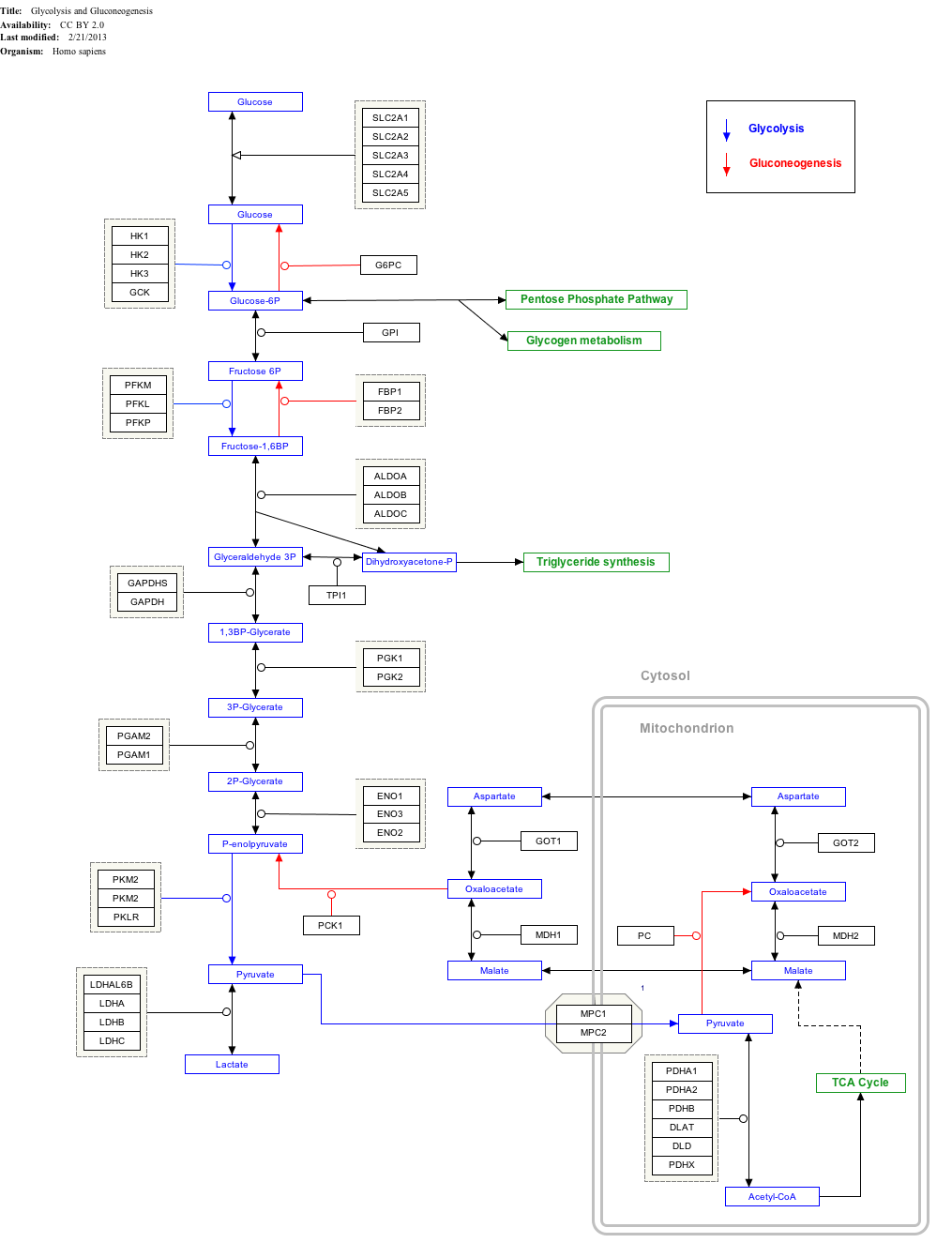
[[File:
GlycolysisGluconeogenesis_WP534go to articlego to articlego to articlego to articlego to articlego to articlego to articlego to articlego to articlego to articlego to articlego to articlego to articlego to articlego to articlego to articlego to articlego to articlego to articlego to articlego to articlego to articlego to articlego to articlego to articlego to articlego to articlego to articlego to articlego to articlego to articlego to articlego to articlego to articlego to articlego to articlego to articlego to articlego to articlego to articlego to articlego to articlego to articlego to articlego to articlego to articlego to articlego to articlego to articlego to articlego to articlego to articlego to articlego to articlego to articlego to articlego to articlego to articlego to articlego to articlego to articlego to articlego to articlego to articlego to articlego to articlego to articlego to articlego to articlego to articlego to WikiPathwaysgo to articlego to Entrezgo to article
[[
]]
[[
]]
[[
]]
[[
]]
[[
]]
[[
]]
[[
]]
[[
]]
[[
]]
[[
]]
[[
]]
[[
]]
[[
]]
[[
]]
[[
]]
[[
]]
[[
]]
[[
]]
[[
]]
[[
]]
[[
]]
[[
]]
[[
]]
[[
]]
[[
]]
[[
]]
[[
]]
[[
]]
[[
]]
[[
]]
[[
]]
[[
]]
[[
]]
[[
]]
[[
]]
[[
]]
[[
]]
[[
]]
[[
]]
[[
]]
[[
]]
[[
]]
[[
]]
[[
]]
[[
]]
[[
]]
[[
]]
[[
]]
[[
]]
[[
]]
[[
]]
[[
]]
[[
]]
[[
]]
[[
]]
[[
]]
[[
]]
[[
]]
[[
]]
[[
]]
[[
]]
[[
]]
[[
]]
[[
]]
[[
]]
[[
]]
[[
]]
[[
]]
[[
]]
[[
]]
[[
]]
[[
]]
[[
]]
[[
]]
[[
]]
GlycolysisGluconeogenesis_WP534go to articlego to articlego to articlego to articlego to articlego to articlego to articlego to articlego to articlego to articlego to articlego to articlego to articlego to articlego to articlego to articlego to articlego to articlego to articlego to articlego to articlego to articlego to articlego to articlego to articlego to articlego to articlego to articlego to articlego to articlego to articlego to articlego to articlego to articlego to articlego to articlego to articlego to articlego to articlego to articlego to articlego to articlego to articlego to articlego to articlego to articlego to articlego to articlego to articlego to articlego to articlego to articlego to articlego to articlego to articlego to articlego to articlego to articlego to articlego to articlego to articlego to articlego to articlego to articlego to articlego to articlego to articlego to articlego to articlego to articlego to WikiPathwaysgo to articlego to Entrezgo to article
|alt=Glycolysis and Gluconeogenesis edit]]
Glycolysis and Gluconeogenesis edit
  1. ^ The interactive pathway map can be edited at WikiPathways: "GlycolysisGluconeogenesis_WP534".

Decarboxylation to acetyl CoA

[edit]

Pyruvate decarboxylation by the pyruvate dehydrogenase complex produces acetyl-CoA.

pyruvate pyruvate dehydrogenase complex acetyl-CoA
 
CoA + NAD+ CO2 + NADH + H+


Carboxylation to oxaloacetate

[edit]

Carboxylation by pyruvate carboxylase produces oxaloacetate.

pyruvate pyruvate carboxylase oxaloacetate
 
ATP + CO2 ADP + Pi


Transamination to alanine

[edit]

Transamination by alanine transaminase produces alanine.

pyruvate alanine transaminase alanine
 
glutamate α-ketoglutarate


Reduction to lactate

[edit]

Reduction by lactate dehydrogenase produces lactate.

pyruvate lactate dehydrogenase lactate
 
NADH NAD+
NADH NAD+


Environmental chemistry

[edit]

Pyruvic acid is an abundant carboxylic acid in secondary organic aerosols.[12]

Uses

[edit]

Pyruvate is sold as a weight-loss supplement, though credible science has yet to back this claim. A systematic review of six trials found a statistically significant difference in body weight with pyruvate compared to placebo. However, all of the trials had methodological weaknesses and the magnitude of the effect was small. The review also identified adverse events associated with pyruvate such as diarrhea, bloating, gas, and increase in low-density lipoprotein (LDL) cholesterol. The authors concluded that there was insufficient evidence to support the use of pyruvate for weight loss.[13]

There is also in vitro as well as in vivo evidence in hearts that pyruvate improves metabolism by NADH production stimulation and increases cardiac function.[14][15]

See also

[edit]

Notes

[edit]

References

[edit]
[edit]
Revisions and contributorsEdit on WikipediaRead on Wikipedia
from Grokipedia
Pyruvic acid, systematically named 2-oxopropanoic acid, is a simple with the molecular formula C₃H₄O₃ that functions as a pivotal intermediate in cellular metabolism. As the end product of , it is generated from phosphoenolpyruvate by , providing a crucial link between breakdown and energy production via the or anaerobic to lactate. In aerobic conditions, pyruvic acid is transported into mitochondria and decarboxylated to by the , fueling ATP synthesis through and supporting biosynthetic processes such as and . This α-keto acid exhibits key physical properties including a density of 1.250 g/cm³ at 20 °C, a of 11.8 °C, and a of 165 °C, rendering it a colorless, with a vinegar-like that is fully miscible in , , and . Chemically, its structure features both a and a group, enabling reactivity in enolization, , and reactions, such as nonenzymatic interactions with due to its α-keto functionality. Beyond its biochemical roles, pyruvic acid finds applications as a for flavor enhancement, a supplement, and in for chemical peels at concentrations of 40–70% to treat , , photodamage, and superficial scars through keratolytic and effects. Its production via microbial is increasingly utilized industrially due to cost-effectiveness compared to .

Chemical Properties

Molecular Structure

Pyruvic acid, with the IUPAC name 2-oxopropanoic acid, is an characterized by the molecular formula C₃H₄O₃ and a molecular weight of 88.06 g/mol. Its structure consists of a linear three-carbon backbone, where the terminal carbon forms a (CH₃-), the central carbon bears a functional group (C=O), and the other terminal carbon comprises a group (-COOH). This arrangement positions the ketone carbonyl directly adjacent to the carboxylic acid, classifying pyruvic acid as the simplest α-keto acid. The dominant structural form of pyruvic acid is the keto tautomer, represented as CH₃C(O)COOH, where the oxygen is double-bonded to the central carbon atom. A minor enol tautomer, CH₂=C(OH)COOH, exists in equilibrium, resulting from keto-enol tautomerism, though it constitutes less than 0.1% of the population in aqueous solution at equilibrium. In the of the keto form, the methyl carbon is bonded to three hydrogens and the central carbonyl carbon, which exhibits sp² hybridization with a to oxygen (bond length approximately 1.21 ) and single bonds to the adjacent carbons. The carboxylic carbon is similarly sp² hybridized, featuring a to one oxygen (C=O) and a single bond to a hydroxyl group (C-OH), with the overall adopting a planar conformation around the functional groups due to conjugation effects. This α-keto acid classification arises from the proximity of the and moieties, which introduces unique electronic properties, such as enhanced electrophilicity at the carbonyl carbon, facilitating interactions in chemical and biological contexts. The structural simplicity and arrangement make pyruvic acid a foundational in , with its bonding pattern—primarily sigma bonds along the carbon chain and pi bonds in the carbonyls—dictating its stability and reactivity profile.

Physical Characteristics

Pyruvic acid is a colorless to pale yellow liquid at , exhibiting a pungent reminiscent of acetic acid. It has a of 11.8 °C and a of 165 °C at standard pressure. The density of pyruvic acid is 1.27 g/cm³ at 20 °C. In , pyruvic acid exists in equilibrium with a hydrated gem-diol form, with approximately 28% hydration at 25 °C (K_hyd = 0.39). Pyruvic acid is miscible with , , and , reflecting its moderate hydrophilicity as indicated by a log P value of approximately −0.05. It demonstrates instability under certain conditions, readily undergoing upon heating or during prolonged storage to form parapyruvic acid and higher-order oligomers. Spectroscopic characterization reveals key features attributable to its carbonyl and carboxyl functional groups. In the infrared (IR) spectrum, characteristic absorption bands appear near 1807 cm⁻¹ for the carboxylic C=O stretch and 1734 cm⁻¹ for the ketonic C=O stretch in the monomeric form. The ¹H NMR spectrum in D₂O shows a singlet for the methyl protons at approximately 2.38 ppm. Ultraviolet (UV) absorption in aqueous solution features a primary band around 320 nm, blue-shifted from the gas-phase maximum near 350–360 nm due to hydration effects.

Synthesis and Reactivity

Pyruvic acid can be synthesized in the through the oxidation of lactate salts, such as , using in , yielding the product after acidification and . Another established method involves the of acetyl , prepared from and , under acidic conditions to afford pyruvic acid in moderate yields. Historically, industrial production of pyruvic acid relied on the of in the presence of at approximately 220 °C, which promotes and to the target compound, though this process is now considered outdated due to inefficiencies and byproduct formation. Modern chemical routes favor the oxidative dehydrogenation of over catalysts like supported on titania, achieving selectivities up to 80% at 200 °C under oxygen flow. An alternative approach utilizes the of with , typically facilitated by enzymatic catalysis in aqueous media, to form pyruvic acid. As an α-keto acid, pyruvic acid exhibits reactivity dominated by the electrophilic , which readily undergoes reactions; for instance, it reacts with hydrazines to form stable hydrazones via initial attack at the ketone carbon followed by . Thermal occurs upon heating, decomposing the molecule to and through a concerted mechanism involving β-elimination of the carboxyl group: \ceCH3C(O)COOH>[Δ]CH3CHO+CO2\ce{CH3C(O)COOH ->[\Delta] CH3CHO + CO2} This reaction is endothermic and proceeds efficiently above 150 °C, with computational studies confirming acetaldehyde as the primary organic product. The carboxylic acid functionality imparts acidic properties, with a pKa of 2.50 for deprotonation to the pyruvate anion, reflecting the electron-withdrawing influence of the adjacent keto group that stabilizes the conjugate base. Pyruvic acid possesses no basic sites, as the structure lacks amine or other proton-accepting groups capable of significant protonation under physiological or standard conditions. Pyruvic acid displays keto-enol tautomerism, existing predominantly in the keto form in equilibrium with a minor tautomer: \ceCH3C(O)COOHCH2=C(OH)COOH\ce{CH3C(O)COOH ⇌ CH2=C(OH)COOH} In , the keto form constitutes more than 99.9% of the equilibrium mixture (K_enol = 7.8 × 10^{-5}), while the form accounts for less than 0.1%, driven by the greater stability of the conjugated keto structure; this ratio is influenced by solvent polarity and but remains heavily keto-favored.

Biological Role

Production in Glycolysis

represents the primary anaerobic catabolic pathway in cellular , converting one molecule of glucose into two molecules of pyruvic acid while generating a net yield of two molecules of ATP and two molecules of NADH. This process occurs without the need for oxygen and serves as a foundational energy-extraction mechanism across diverse organisms. The overall balanced equation for glycolysis is: C6H12O6+2NAD++2ADP+2Pi2CH3COCOOH+2NADH+2ATP+2H++2H2O\text{C}_6\text{H}_{12}\text{O}_6 + 2 \text{NAD}^+ + 2 \text{ADP} + 2 \text{P}_i \rightarrow 2 \text{CH}_3\text{COCOOH} + 2 \text{NADH} + 2 \text{ATP} + 2 \text{H}^+ + 2 \text{H}_2\text{O} The pathway unfolds in a series of ten enzymatic reactions divided into an energy-investment phase and an energy-payoff phase. In the initial phase, glucose undergoes phosphorylation by hexokinase to form glucose-6-phosphate, followed by isomerization to fructose-6-phosphate and a second phosphorylation by phosphofructokinase-1 to yield fructose-1,6-bisphosphate, consuming two ATP molecules. This is succeeded by cleavage via aldolase into dihydroxyacetone phosphate and glyceraldehyde-3-phosphate, with the former isomerized to the latter, resulting in two molecules of glyceraldehyde-3-phosphate. The payoff phase begins with oxidation of glyceraldehyde-3-phosphate by glyceraldehyde-3-phosphate dehydrogenase to 1,3-bisphosphoglycerate, reducing NAD⁺ to NADH. Subsequent substrate-level phosphorylations occur: 1,3-bisphosphoglycerate transfers a phosphate to ADP via phosphoglycerate kinase, forming 3-phosphoglycerate and ATP; this is followed by rearrangement to 2-phosphoglycerate, dehydration by enolase to phosphoenolpyruvate, and finally, the irreversible transfer of the phosphate from phosphoenolpyruvate to ADP by pyruvate kinase, producing pyruvic acid and ATP. Glycolysis takes place in the of both eukaryotic and prokaryotic cells, enabling rapid ATP production independent of mitochondrial involvement. The pathway's flux is tightly regulated to match cellular energy demands, primarily through allosteric modulation of key enzymes. Phosphofructokinase-1, which commits fructose-6-phosphate to the pathway, is inhibited by high levels of ATP and citrate while activated by AMP and fructose-2,6-bisphosphate, ensuring glycolysis accelerates under energy-deficient conditions. Similarly, is allosterically inhibited by ATP and , and activated by fructose-1,6-bisphosphate, preventing unnecessary pyruvate accumulation when energy is abundant. These regulatory mechanisms maintain metabolic and coordinate glycolysis with broader .

Oxidative Decarboxylation

Oxidative decarboxylation of pyruvate represents the committed step linking to the under aerobic conditions, ensuring efficient utilization of glucose-derived carbon for energy production. In eukaryotic cells, pyruvate, generated in the during , is actively transported into the , where it is irreversibly converted to . This transformation is exclusively catalyzed by the (PDC), a highly organized assembly of enzymes that coordinates the reaction with minimal diffusion of intermediates. The balanced for the process is: \ceCH3C(O)CO2+CoASH+NAD+>CH3C(O)SCoA+CO2+NADH+H+\ce{CH3C(O)CO2^- + CoA-SH + NAD^+ -> CH3C(O)-S-CoA + CO2 + NADH + H^+} This decarboxylation releases CO₂ and generates a high-energy thioester bond in acetyl-CoA, priming it for condensation with oxaloacetate in the citric acid cycle. The mechanism of PDC involves sequential actions by its three core enzyme subunits, each with specific cofactors, operating via a substrate-channelling 'swinging arm' model for efficiency. The E1 subunit (pyruvate dehydrogenase) uses thiamine pyrophosphate (TPP) to facilitate the initial decarboxylation: the carbanion of TPP attacks the carbonyl of pyruvate, releasing CO₂ and forming hydroxyethyl-TPP, which is oxidized to an acetyl group. This acetyl moiety is then transesterified to the lipoamide cofactor on E2 (dihydrolipoyl transacetylase), yielding acetyl-dihydrolipoamide-E2, which reacts with coenzyme A to produce acetyl-CoA and dihydrolipoamide-E2. Finally, E3 (dihydrolipoyl dehydrogenase), containing FAD, reoxidizes dihydrolipoamide-E2 back to its disulfide form, reducing NAD⁺ to NADH in the process. This multi-step orchestration prevents loss of reactive intermediates and integrates decarboxylation, oxidation, and transfer in a single complex. PDC activity is stringently regulated at both allosteric and covalent levels to align with metabolic needs, preventing futile cycling or overflow of reducing equivalents. Allosteric inhibition occurs via binding of NADH and to E2 and , which signal high energy status and reduce PDC flux; conversely, NAD⁺ and CoA promote activity. Covalent regulation involves phosphorylation of E1 by mitochondrial pyruvate dehydrogenase kinases (PDKs), which inactivate the complex under conditions like or exercise, while pyruvate dehydrogenase phosphatases (PDPs), activated by insulin and Ca²⁺, dephosphorylate and activate PDC during fed or active states. This dual control ensures pyruvate oxidation predominates in energy-demanding aerobic scenarios. The NADH generated feeds into the , where its oxidation drives proton pumping across complexes I, III, and IV, ultimately yielding approximately 2.5 ATP per NADH via . Clinically, congenital deficiencies in PDC components, particularly E1α mutations, cause primary deficiency, a mitochondrial disorder leading to chronic due to pyruvate accumulation and shunting to lactate. This results in elevated blood lactate (often >5 mmol/L) without a proportionally increased pyruvate, manifesting as severe , , seizures, and developmental delays, with poor prognosis if untreated.

Other Metabolic Pathways

Pyruvate serves as a central in several biosynthetic and replenishing pathways beyond its catabolic roles. One key conversion is the carboxylation of pyruvate to oxaloacetate, catalyzed by the biotin-dependent enzyme . This ATP-driven reaction, pyruvate + CO₂ + ATP → oxaloacetate + ADP + Pᵢ, plays a crucial anaplerotic function by replenishing intermediates in the tricarboxylic acid (TCA) cycle, which are often depleted for biosynthetic processes such as and synthesis. The enzyme is allosterically activated by , ensuring coordination with TCA cycle flux. Another important pathway involves the of pyruvate to , mediated by (ALT). The reversible reaction, pyruvate + glutamate → alanine + α-ketoglutarate, facilitates nitrogen shuttling between tissues, particularly in the glucose-alanine cycle. During fasting or exercise, muscle generates alanine, which is transported to the liver; there, ALT converts it back to pyruvate, providing substrate for while detoxifying . This cycle links amino acid catabolism to hepatic glucose production, maintaining blood glucose levels. In , pyruvate-derived oxaloacetate must be transported from the mitochondria to the , where it cannot cross the inner membrane directly. To achieve this, oxaloacetate is reduced to malate by mitochondrial , using NADH as a cofactor: oxaloacetate + NADH + H⁺ → malate + NAD⁺. Malate then exits via the malate-α-ketoglutarate and is reoxidized to oxaloacetate in the , regenerating NADH for the gluconeogenic pathway. This shuttle ensures efficient carbon flow from mitochondrial pyruvate to cytosolic phosphoenolpyruvate synthesis. Pyruvate also participates in fermentation pathways, such as in where it is decarboxylated to by pyruvate decarboxylase, releasing CO₂ and setting the stage for production under anaerobic conditions. Historically, isotope labeling experiments with ¹⁴C-pyruvate, beginning in the post-1940s era, have been pivotal in mapping carbon flow through these pathways, including and the TCA cycle, by tracking labeled carbons in downstream metabolites.

Role in Anaerobic Metabolism

In anaerobic conditions, pyruvic acid serves as a key intermediate for regenerating NAD⁺, which is essential for sustaining glycolysis when oxygen is limited. In animal cells, particularly skeletal muscle during intense exercise, pyruvate is reduced to lactate by the enzyme lactate dehydrogenase (LDH), catalyzing the reaction: \ceCH3COCOOH+NADH+H+>CH3CH(OH)COOH+NAD+\ce{CH3COCOOH + NADH + H+ -> CH3CH(OH)COOH + NAD+} This process oxidizes NADH back to NAD⁺, allowing glycolysis to continue and produce ATP without mitochondrial respiration. The lactate produced is then transported via the bloodstream to the liver, where it is converted back to pyruvate and ultimately glucose through gluconeogenesis, forming the Cori cycle that recycles lactate and prevents its accumulation in muscles. In microorganisms such as , pyruvate undergoes alcoholic to regenerate NAD⁺ under oxygen deprivation. First, pyruvate decarboxylase decarboxylates pyruvate to and : \ceCH3COCOOH>CH3CHO+CO2\ce{CH3COCOOH -> CH3CHO + CO2} Subsequently, reduces to using NADH: \ceCH3CHO+NADH+H+>CH3CH2OH+NAD+\ce{CH3CHO + NADH + H+ -> CH3CH2OH + NAD+} This pathway not only supports ATP production in anaerobic environments but also yields as a byproduct. Industrially, this process is harnessed for production, where converts glucose-derived pyruvate into on a large scale for biofuels and beverages. Physiologically, excessive lactate production from pyruvate under hypoxic conditions can lead to lactic acidosis, a state of metabolic acidosis characterized by elevated blood lactate levels (>5 mmol/L) and reduced pH, often seen in tissue hypoxia during shock or strenuous activity. Evolutionarily, anaerobic fermentation pathways involving pyruvate likely played a crucial role in early life forms, enabling energy extraction from glucose in oxygen-scarce primordial environments before the rise of aerobic respiration.

Applications and Occurrence

Industrial Production

The primary industrial production of pyruvic acid relies on the catalytic oxidative dehydrogenation of , typically conducted in the vapor phase at temperatures of 300–400 °C using metal catalysts such as copper-based systems or platinum-supported materials. This method converts to pyruvic acid with high selectivity, as demonstrated by CuO/SiO₂ catalysts achieving up to 70.8% conversion and 98.2% selectivity under optimized conditions. The process utilizes air or oxygen as an oxidant, enabling efficient scaling while leveraging the abundance and lower cost of bio-derived as feedstock. Alternative industrial routes include the vapor-phase oxidation of , which involves catalytic air oxidation to form pyruvic acid, though this method is less prevalent due to feedstock availability and byproduct formation challenges. Electrochemical oxidation of lactate represents an emerging alternative, where in aqueous or broth is oxidized under alkaline conditions at electrodes like or , yielding pyruvic acid with potential for integration into sustainable biorefineries. Yields in modern chemical processes often exceed 90%, with purification achieved through to minimize and achieve high purity levels above 99%. Historically, the and of served as the classical industrial method, involving heating with potassium pyrosulfate to produce crude pyruvic acid, but it has become obsolete due to the high cost of (approximately $3,000 per ton) and associated environmental pollution from waste generation. Global production is dominated by chemical synthesis, with major manufacturing hubs in and the ; the market was valued at approximately $45 million in 2020, reflecting an annual output on the order of thousands of tons to meet in pharmaceuticals and additives. efforts have driven a shift toward bio-based routes, utilizing fermented from renewable carbohydrates, which reduces and aligns with principles compared to traditional petrochemical-derived alternatives. Recent advancements as of 2025 include engineered microbial strains, such as achieving yields up to 110 g/L via , enhancing cost-effectiveness and scalability in biorefineries.

Medical and Industrial Uses

Pyruvic acid is employed in dermatological treatments as a chemical peeling agent, particularly in concentrations of 40–70% for addressing inflammatory , acne scars, oily , and . These peels promote epidermal exfoliation and dermal remodeling, leading to improved texture, reduced fine wrinkles, and lightened hyperpigmentations such as and lentigines, with minimal post-treatment discomfort when applied in sessions spaced 4 weeks apart. As a precursor to lactate, pyruvic acid is incorporated into intravenous resuscitation fluids to correct hypoxic in critically ill patients, enhancing acid-base balance through its conversion to lactate and subsequent metabolic effects. Emerging research post-2020 highlights its potential in via modulation of the (PDC); for instance, pharmacological activation of PDC flux alleviates lipid-induced in muscle, while inhibition of (PDK) reduces and renal dysfunction in diabetic models. Recent 2024–2025 studies further show pyruvate administration restores impaired and intraepidermal nerve fiber density in diabetic mice, and modulates glucose oxidation to mitigate cardiovascular risks in and . In the , pyruvic acid serves as an acidulant and in beverages and other products, leveraging its properties to extend and adjust , and it holds (GRAS) status from the FDA for use as a agent. As a key intermediate in , it is utilized in the production of pharmaceuticals, including such as through , and agrochemicals like pesticides. In cosmetics, pyruvic acid is featured in anti-aging formulations and peels at concentrations of 30–50%, where it facilitates exfoliation of the and stimulates activity to boost production, thereby reducing the appearance of fine lines, wrinkles, and uneven pigmentation. Its derivatives contribute to the synthesis of biodegradable polymers, such as via intermediates, offering eco-friendly alternatives for packaging and implants. Recent post-2020 explores pyruvic acid in thermo-electrochemical cells as part of biocompatible redox couples with , enabling efficient energy conversion in sustainable prototypes. Pyruvic acid exhibits low systemic , with an oral LD50 of 2.1 g/kg in rats, though it acts as a and eye irritant, causing severe burns and damage upon direct contact, necessitating protective handling in formulations.

Natural Occurrence and Environmental Aspects

Pyruvic acid occurs naturally in trace amounts in various plant-derived foods and products. It is present in fruits such as apples, where its concentration varies due to metabolic processes, typically at levels of several micromoles per gram of fresh weight. Similarly, pyruvic acid is found in and , resulting from microbial fermentation of sugars by and yeasts, with concentrations in fruit vinegars ranging from 0.1 to 1 mM depending on the substrate and conditions. In environments, pyruvic acid is produced by microorganisms, including streptomycetes and other , which excrete it as a metabolic byproduct during , contributing to cycling at concentrations up to several millimolar in microbial exudates. In the atmosphere, pyruvic acid serves as a photochemical oxidant, primarily formed through the oxidation of volatile organic compounds (VOCs) emitted from biogenic and anthropogenic sources. Its photolysis at air-water interfaces, such as those in atmospheric , generates reactive species that promote the formation of secondary organic aerosols (SOAs), which play a role in and . This process is particularly relevant in marine environments, where pyruvic acid is detected in ocean-derived aerosols over regions like the North Pacific, with gas-phase mixing ratios reaching up to 0.1 ppbv in boreal forests and contributing to aerosol burdens of 1-10 ng/m³. Pyruvic acid integrates into the biogeochemical via microbial degradation of dissolved , serving as an intermediate in the remineralization of organic carbon in aquatic systems. In , its concentrations typically range from 0.1 to 1 μM, influenced by photochemical production and bacterial uptake, linking surface to deeper carbon export. Regarding , pyruvic acid is highly biodegradable through microbial action, facilitating its natural attenuation in soils and waters; however, industrial effluents from processes can introduce elevated levels, potentially acidifying receiving waters with drops of 0.5-1 unit in high-concentration discharges. Additionally, in the atmosphere, it acts as a in sulfur trioxide (SO₃) , enhancing particle formation in polluted regions and indirectly contributing to precursors by promoting aerosol growth. Detection of pyruvic acid in environmental samples relies on sensitive analytical techniques, including (HPLC) with UV detection for quantification down to nanomolar levels in and aerosols, and enzymatic assays using for rapid, specific measurement in and extracts. From an evolutionary perspective, pyruvic acid's simple α-keto acid structure suggests its presence in prebiotic soups on , where it could form abiotically from and minerals under hydrothermal conditions, serving as a precursor to and essential metabolic pathways in the origin of life.

References

Add your contribution
Related Hubs
Contribute something
User Avatar
No comments yet.