Hubbry Logo
search
logo
1423936

Baconator

logo
Community Hub0 Subscribers
Read side by side
from Wikipedia
Baconator
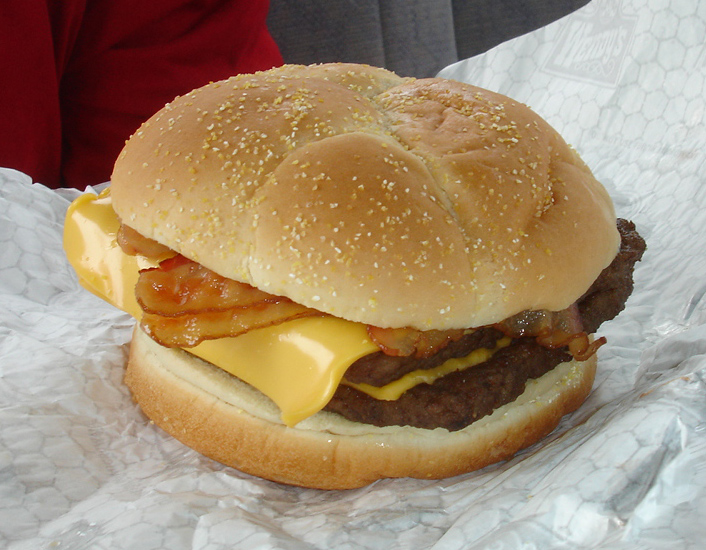
The Baconator
Nutritional value per 1 double sandwich (304 grams)
Energy930 kcal (3,900 kJ)
34 g
Sugars7 g
Dietary fiber1 g
63 g
Saturated26 g
Trans3 g
57 g
Vitamins and minerals
VitaminsQuantity
%DV
Vitamin A equiv.
9%
83 μg
Vitamin C
19%
17 mg
Vitamin E
307%
46 mg
MineralsQuantity
%DV
Calcium
15%
200 mg
Iron
29%
5.25 mg
Sodium
65%
1500 mg
Other constituentsQuantity
Cholesterol150 mg
Energy from sandwich930 kcal (3,900 kJ)

This information is effective as of March 2013.[needs update]
Percentages estimated using US recommendations for adults.[1]
Source: www.wendys.com

The Baconator is a brand of cheeseburger introduced by the international fast-food restaurant chain Wendy's in 2007. The primary product consists of two quarter-pound beef patties topped with mayonnaise, ketchup, two slices of cheese, and six strips of bacon. Single and triple patty versions were formerly offered, as well as limited-time seasonal variants.

The brand was later expanded with the Son of Baconator, which uses smaller patties, and the Breakfast Baconator, which replaces the hamburger patties with a sausage patty topped with an egg and a melted Swiss cheese sauce.

History

[edit]

The Baconator was introduced in April 2007 as part of a "back to basics" reorganization by Wendy's new CEO Kerrii Anderson.[2] The addition of the product was part of a push to add menu items intended to appeal to the 18- to 34-year-old demographic and expand late-night sales. This product and others, coupled with a new advertising program, contributed to an increase in store sales of approximately 11% during the period of five fiscal quarters ending in October 2007.[3]

Advertising

[edit]

As a cross promotion with the Canadian Football League, the Baconator has been named the official burger of the league.[4] They held a promotion running from April to May 2009 in which special scratch tickets shaped like bacon were given out with each purchase. In addition to being able to enter a draw to win an Xbox 360 by texting the number, the person could enter the numbers online to win a chance to compete in a halftime CFL contest to build a giant Baconator, with the winner getting $25,000. This was termed the 'Baconator Boot Camp'. During the promotion, the store workers wore T-shirts advertising the contest. On August 14, 2009, Pete Richardson from Halifax, Nova Scotia won the contest and the prize of $25,000, in front of a capacity crowd of 24,754 at the Rogers Centre.

Economic indicator

[edit]

The popularity of the Baconator has led to politicians and others using the burger as an example of the price of goods related to inflation and so-called "price gouging". US Senator Elizabeth Warren from Massachusetts has used the burger in examples of what she perceives to be price gouging and to lobby for more government control.[5]

Ingredients

[edit]

See also

[edit]

References

[edit]
Revisions and contributorsEdit on WikipediaRead on Wikipedia
from Grokipedia
The Baconator is a signature cheeseburger sold by the Wendy's fast-food restaurant chain, consisting of two quarter-pound patties of fresh, never frozen beef topped with American cheese, six strips of crispy Applewood-smoked bacon, ketchup, and mayonnaise on a premium bun.[1] Introduced in 2007 amid efforts to revitalize the brand following the death of founder Dave Thomas, the sandwich emphasizes hearty portions of beef and bacon to attract carnivorous customers.[2] With approximately 950 calories per serving, it exemplifies Wendy's focus on indulgent, high-protein fast food options and has sustained strong sales as a menu staple.[3][4]

History

Development and Introduction

The Baconator was developed by Wendy's in the mid-2000s as part of efforts to revitalize the brand following the 2002 death of founder Dave Thomas and amid declining sales.[2] The chain faced intensifying competition from established rivals like McDonald's Big Mac, introduced in 1967, and Burger King's Whopper, launched in 1957, which dominated the market for substantial fast-food burgers.[2] To differentiate, Wendy's emphasized premium ingredients, particularly bacon, positioning the Baconator as a hearty, value-driven option appealing to consumers seeking indulgent meals over lighter alternatives gaining traction in the industry.[2][5] Introduced in August 2007, the Baconator consists of two quarter-pound fresh beef patties, six strips of Applewood smoked bacon, American cheese, ketchup, and mayonnaise served on a toasted bun.[6][7] This configuration highlighted Wendy's commitment to fresh, never-frozen beef and abundant bacon to convey higher quality and satisfaction compared to competitors' offerings.[7] The burger achieved rapid popularity, with Wendy's selling 25 million units within the first two months after launch, signaling strong consumer demand for its bold flavor profile and substantial portions.[2] This initial surge helped bolster the chain's menu appeal during a period of strategic repositioning.[2]

Sales Milestones and Evolution

Upon its June 2007 launch, the Baconator quickly became a sales phenomenon, with Wendy's reporting nearly 25 million units sold across North America in the initial eight weeks of promotion.[8] This early performance drove a 0.2% uptick in quarterly same-store sales, though the overall impact on chain revenue remained modest amid competitive pressures.[9] By the close of its debut year, cumulative sales surpassed 68 million sandwiches, establishing the item as an enduring menu staple driven by consumer demand for its bacon-forward profile.[10] The product's pricing has evolved in tandem with fast-food sector inflation, reflecting rising costs for beef, bacon, and labor; by the early 2020s, a full Baconator meal averaged $13.09 in many markets, prompting public discourse on affordability amid post-pandemic economic shifts.[11] Core formulation tweaks have been minimal to preserve the original appeal—two quarter-pound fresh beef patties, six strips of bacon, American cheese, ketchup, and mayonnaise on a bun—though Wendy's has experimented with sourcing enhancements for bacon crispiness and occasional premium bun trials without fundamentally redesigning the stack.[12] Leveraging the Baconator's brand equity, Wendy's integrated it into its March 2, 2020, national breakfast rollout via the Breakfast Baconator, which substitutes eggs and sausage for the lunch version's patties while retaining the layered bacon and cheese elements to appeal to morning traffic.[13] This adaptation supported a multimillion-dollar push to expand daypart revenue, with the breakfast lineup—including the Baconator variant—aimed at capturing share in a market dominated by established competitors.[14] Sustained demand has cemented the Baconator family as a cornerstone of Wendy's value proposition, influencing strategic decisions like promotional pricing on variants to counter economic headwinds.[15]

Breakfast Variant

The Breakfast Baconator was introduced as part of Wendy's national breakfast rollout on March 2, 2020. It adapts the original Baconator's bacon-heavy design for morning consumption, featuring a fresh-cracked grade A egg, signature square breakfast sausage patty, six strips of Applewood smoked bacon, two slices of American cheese, and Swiss cheese sauce on a premium bun. Calorie counts range from approximately 680 calories standalone to 960 in combos with sides and drinks. The item has become a flagship breakfast product, often cited as a top seller for its indulgent, high-protein profile (around 37g protein), appealing to customers seeking hearty morning meals. As of 2026, it remains a core offering amid ongoing menu refinements and franchise hour adjustments.

Product Description

Core Ingredients and Preparation

The standard Baconator consists of two quarter-pound patties made from fresh, never-frozen beef, totaling a half-pound of beef per burger.[16][17] These patties are sourced daily to maintain freshness, distinguishing Wendy's from competitors that often use frozen beef patties.[16] Accompanying the beef are six strips of thick-cut Applewood smoked bacon, cooked to achieve crispiness, along with two slices of American cheese, ketchup, and mayonnaise, all assembled on a toasted premium bun.[17][18] Preparation begins with grilling the beef patties to order on a flat-top grill after seasoning with salt and pepper, ensuring a seared exterior while retaining juiciness from the fresh ground beef.[16] The bacon is separately cooked until crispy to provide textural contrast and enhanced flavor from the smoking process.[18] Assembly layers the components simply: the bottom bun receives mayonnaise and ketchup, followed by one beef patty topped with American cheese, three bacon strips, a second beef patty with another slice of cheese, the remaining bacon, additional condiments if desired, and the top bun, omitting vegetables or fillers to emphasize the core bacon-beef profile.[17] This straightforward stacking highlights the Baconator's design as an indulgent, meat-focused cheeseburger without extraneous elements.[18]

Nutritional Composition

The Baconator delivers 960 calories per serving, comprising 66 grams of total fat (including 27 grams of saturated fat and 3 grams of trans fat), 57 grams of protein, 36 grams of carbohydrates (with 2 grams of dietary fiber and 9 grams of sugars), 155 milligrams of cholesterol, and 1,540 milligrams of sodium.[19][17] These figures, reported consistently across nutrition aggregators drawing from Wendy's data, reflect the composition of two quarter-pound beef patties, six strips of Applewood smoked bacon, American cheese slices, ketchup, mayonnaise, and a premium bun.[20]
NutrientAmount per Serving% Daily Value*
Calories96048%
Total Fat66 g85%
Saturated Fat27 g135%
Trans Fat3 g-
Cholesterol155 mg52%
Sodium1,540 mg67%
Total Carbohydrates36 g13%
Dietary Fiber2 g7%
Sugars9 g-
Protein57 g114%
*Percent Daily Values are based on a 2,000-calorie diet as established by the U.S. Food and Drug Administration. Wendy's does not officially list nutrition facts for a "no bun" version of the Baconator as a separate item. However, an approximation can be made by subtracting the nutrition of the premium bun from the standard Baconator values, based on Wendy's February 2025 core menu nutrition PDF (likely unchanged as of 2026).[21] Approximate values are:
  • Calories: 818 kcal
  • Total Fat: 64 g (Saturated Fat: 26 g)
  • Total Carbohydrates: 5 g (Fiber: 0 g, Sugars: 3 g)
  • Protein: 56 g
This excludes the bun but includes the patties, bacon, cheese, ketchup, and mayonnaise. Third-party sites vary (e.g., some report ~690-780 calories), possibly due to differences in included condiments or other assumptions. This profile surpasses 50% of typical adult daily caloric requirements (1,600–3,000 calories, varying by age, sex, and activity level per USDA estimates) and exceeds two-thirds of the sodium upper limit (2,300 milligrams).[22][23] Actual values may vary slightly by preparation and regional sourcing.[3]

Variations and Adaptations

Standard Variations

The Son of Baconator, launched in 2011, consists of two junior-sized beef patties (each approximately 2.25 ounces), four strips of Applewood smoked bacon, two slices of American cheese, ketchup, and mayonnaise assembled on a toasted bun.[24] This configuration provides a scaled-down alternative to the original double-patty Baconator, targeting consumers seeking a less substantial yet flavor-similar option at a lower price point.[25] Wendy's menu also accommodates single-patty Baconator orders upon customer request, featuring one quarter-pound beef patty with the standard six strips of Applewood smoked bacon, American cheese, ketchup, and mayonnaise.[26] Beyond fixed variants, Wendy's enables build-your-own modifications to the Baconator through in-store requests or the mobile app, permitting additions like extra cheese slices, alternative condiments such as barbecue sauce, or ingredient swaps while preserving the foundational beef, bacon, and cheese elements.[27]

Limited-Time and Seasonal Offerings

The Breakfast Baconator, launched nationwide on March 2, 2020, alongside Wendy's expanded breakfast menu, incorporates two sausage patties, American cheese, a fried egg, and six strips of Applewood smoked bacon on a premium bun, repurposing the Baconator's bacon-centric profile to target morning demand.[28] [29] This adaptation has remained a staple breakfast item rather than a strictly temporary offering, reflecting Wendy's aim to leverage the Baconator's appeal across dayparts.[30] The Pretzel Baconator, introduced as a limited-time item in November 2023, features the standard two quarter-pound beef patties, American cheese, and six bacon strips but on a toasted pretzel bun with smoky honey mustard sauce, providing a seasonal twist on texture and flavor.[18] It remained available through early 2024 with app-based promotions offering discounts on orders over $15, but was discontinued by late 2024 in many locations, underscoring its promotional nature.[31] [32] [33] In June 2025, Wendy's extended the Baconator brand beyond restaurants via grocery retail, introducing its signature double-smoked bacon—used in the burger—at select Kroger and affiliated stores, enabling home replication of key components.[34] [35] This move coincided with a limited-edition collaboration: Cheez-It Baconator crackers, blending real cheese with Applewood smoked bacon essence, released for summer distribution to capitalize on snack trends.[36] [37]

Marketing and Cultural Role

Advertising Campaigns

The Baconator's initial advertising campaign launched in August 2007, featuring television commercials produced by Saatchi & Saatchi that targeted consumers aged 18 to 34 with high-energy spots emphasizing its half-pound of fresh beef and six strips of hickory-smoked bacon as an indulgent "bacon explosion" for meat lovers.[38][39] One notable ad depicted a man in a red wig aggressively kicking trees in a forest to convey raw excitement and appetite stimulation.[38] The campaign was complemented by in-store promotions and a national contest inviting participants to submit original "burger music" interpretations, with winning entries featured in subsequent advertising.[1] Subsequent television promotions maintained a direct, bold tone, highlighting the product's unique combination of ingredients to differentiate it from competitors. For instance, a 2019 spot titled "Only One" stressed the Baconator's exclusivity with the tagline underscoring its six bacon strips and fresh, never-frozen beef patty.[40] Later ads, such as the 2020 "Shakin' and Wakin'" commercial, integrated the Baconator into scenarios portraying it as a satisfying, no-compromise meal option for bold cravings.[41] These efforts focused on visceral appeal rather than subtlety, aligning with Wendy's strategy of unapologetic promotion of hearty fast food. Wendy's leveraged social media, particularly its Twitter presence, to amplify Baconator promotions through viral, sassy engagements that tied the product into memes, challenges, and interactive roasts. The brand's account, which originated from early Baconator-focused handles, frequently incorporated the burger into humorous, direct-response content to foster user-generated buzz and reinforce its indulgent image.[42] Strategic campaigns turned the Baconator into a social media staple by encouraging shares of extreme eating feats or tying it to cultural moments, prioritizing engagement over polished narratives.

Use as Economic Indicator

The Baconator's pricing has been invoked by U.S. Senator Elizabeth Warren and others as an illustration of perceived corporate price gouging amid post-2020 inflation, particularly in debates over dynamic pricing models tested by Wendy's in 2024, which could raise menu item costs during peak demand periods.[43][44] Launched in 2007 at a small combo price of $6.49, the item's standalone cost has risen to approximately $7.39 by 2024, with full combos exceeding $13 in some markets, reflecting cumulative pressures from elevated labor wages, pork supply constraints, and supply-chain disruptions exacerbated by the COVID-19 pandemic.[45][46][47] These price trajectories serve as a microcosm of fast-food sector economics, where Baconator demand correlates with discretionary spending patterns; sustained popularity during economic upswings, as evidenced by Wendy's reporting robust sales of premium burgers amid consumer recovery signals, underscores perceived value despite cost hikes, countering narratives of unbridled profiteering by highlighting competitive necessities to match rivals like McDonald's Quarter Pounder offerings.[48][49] Analysts note that such items gauge household confidence, with high-volume sales persisting even as input costs for bacon—subject to cyclical inflation from feed and disease outbreaks—rose sharply, driving operators to balance margins through portion adjustments and efficiency rather than unchecked markups.[50][51] Critics attributing rises solely to greed overlook verifiable causal factors, including a 35% chain-wide price escalation from 2021 to 2022 tied to wage mandates and commodity volatility, which empirical data from industry trackers link more directly to operational realities than monopolistic excess in a fragmented market.[50][43] Thus, the Baconator functions as a tangible barometer for everyday inflation metrics, revealing how consumer tolerance for premium fast-casual indulgences tests broader economic resilience without necessitating regulatory overrides on market-driven adjustments.[44]

Reception and Impact

Commercial Success and Sales Data

The Baconator achieved immediate commercial success upon its June 2007 launch, with Wendy's selling 25 million units within the first two months, fueled by aggressive advertising and its positioning as a premium, bacon-heavy cheeseburger.[52] This surge contributed to revitalizing Wendy's burger sales amid competition from larger chains, helping to elevate average unit volumes through higher-priced core menu items. By March 2008, cumulative sales surpassed 68 million, establishing it as an enduring bestseller that supported systemwide revenue growth during early expansion phases.[53] As of 2025, the Baconator remains one of Wendy's top-selling menu items, consistently ranking in popularity assessments alongside staples like the Dave's Single and Frosty, which bolsters franchise economics via premium pricing and margins relative to value offerings.[54] Its role in core menu performance has aided Wendy's competition against McDonald's and Burger King, despite the chain's approximately 6,000 U.S. locations compared to rivals' larger footprints, by driving traffic through bundled promotions and variations. However, in Q2 2025, a $3 Baconator value deal failed to deliver the anticipated incremental sales lift, contributing to a 2.9% U.S. same-restaurant sales decline amid promotional confusion and softened demand.[55] Overall systemwide sales for that quarter totaled $3.7 billion, down 1.8% year-over-year, highlighting reliance on flagship items like the Baconator for sustained profitability in a challenging consumer environment.[56]

Consumer Feedback and Criticisms

Consumers frequently praise the Baconator for its bold flavor profile, particularly the combination of crispy bacon and fresh, never-frozen beef patties, with many describing it as highly satisfying and superior to comparable fast-food options.[57][45] In aggregated reviews, it has earned an average rating of 8.1 out of 10, highlighting the savory taste and addictive appeal that draws repeat orders.[58] Food reviewers have noted its indulgent qualities, with one calling it the standout burger on Wendy's menu for balancing meaty richness without excess toppings.[57] Criticisms center on inconsistencies in preparation and quality control across locations. Reports of undercooked bacon strips or patties have surfaced in consumer complaints, such as instances where bacon appeared raw or insufficiently crisped, leading to dissatisfaction with texture and safety perceptions.[59][60] Some users have highlighted changes in bacon sourcing or preparation methods, describing recent versions as less flavorful or overly chewy compared to earlier iterations.[59] Value concerns have also emerged, with diners noting that portion discrepancies—like receiving only one patty instead of the standard two—exacerbate price sensitivity, especially as fast-food costs rise post-2022 inflation spikes.[61] While not universal, these issues contribute to variability in location-specific feedback on platforms like Yelp, where Wendy's outlets average around 2-3 stars amid broader service gripes.[62]

Health Debates and Empirical Perspectives

Frequent consumption of fast foods high in saturated fats and sodium, such as the Baconator, correlates with elevated cardiovascular disease (CVD) risk factors including hypertension, dyslipidemia, and cardiometabolic syndrome, primarily through contributions to excess caloric intake, endothelial dysfunction, and inflammation.[63][64] Meta-analyses of randomized trials indicate that diets exceeding recommended saturated fat levels (e.g., over 10% of daily calories) are associated with modest increases in low-density lipoprotein cholesterol, a CVD precursor, though effect sizes diminish when replaced with unsaturated fats rather than refined carbohydrates.[65][66] Similarly, sodium intakes above 2,300 mg daily, common in single servings of such items, heighten blood pressure in salt-sensitive individuals and overweight populations, amplifying stroke and heart disease incidence by 20-30% in prospective cohorts.[67][68] These associations stem from observational data on ultra-processed food patterns, where fast food comprises 11-53% of calories in U.S. adults, linking to higher all-cause mortality and CVD events, but causation remains indirect without isolating the Baconator or equivalent items.[69][70] However, empirical evidence does not support unique causation from occasional Baconator consumption, as meta-analyses of unprocessed red meat (a key component) show neutral effects on CVD biomarkers like lipids and blood pressure when intake is moderate (e.g., 3-4 servings weekly) within calorie-controlled diets.[71][72] Broader reviews emphasize that total dietary context—fiber, exercise, and micronutrient balance—mediates risks more than isolated meals, with no randomized trials demonstrating harm from infrequent burger intake amid varied patterns.[73] High-protein content (typically 40-60g per serving in similar burgers) promotes satiety via thermogenic effects and hormone modulation (e.g., increased peptide YY, reduced ghrelin), aiding adherence to weight management and preserving lean mass during energy deficits, countering narratives of inherent detriment.[74][75] Critiques of absolutist anti-fast-food positions highlight their oversight of hedonic value in sustaining long-term behavioral change, as pleasure-driven moderation outperforms restrictive regimes in observational adherence data.[76] Supply chain vulnerabilities underscore non-nutritional health considerations, as evidenced by the 2022 E. coli O157:H7 outbreak tied to Wendy's romaine lettuce in salads, burgers, and sandwiches, affecting 109 individuals across seven states with 52 hospitalizations and 13 acute kidney failures, though not Baconator-specific.[77][78] Wendy's preemptively removed implicated produce, resolving the cluster without deaths, illustrating pathogen risks from fresh toppings rather than cooked meats or inherent product flaws.[79] Such incidents, resolved via traceability, affirm individual agency in hygiene practices and portion control over systemic demonization, with no recurrent Baconator-linked outbreaks post-2022.[80]

References

User Avatar
No comments yet.