


Community hub
Recent from talks
Contribute something
Nothing was collected or created yet.
Rinderroulade
View on Wikipedia | This article needs additional citations for verification. (October 2016) |


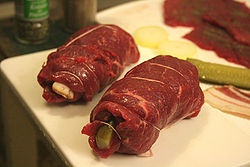
Rinderrouladen (German: [ˈʁɪndɐʁuˌlaːdn̩] ⓘ; plural, singular Rinderroulade (German: [ˈʁɪndɐʁuˌlaːdə] ⓘ)) are a German meat dish, usually consisting of bacon, onions, mustard and pickles wrapped in thinly sliced beef which is then cooked.[1] The dish is also considered traditional in the Upper Silesia region of Poland, where it is known as rolada śląska (Silesian roulade; Silesian: Sylezyjsko ruleta) and in the Czech Republic, where it is known as španělský ptáček (Spanish bird). In Britain, the equivalent dish is widely referred to as beef olives.[2]
Beef or veal is typically used, though some food scholars tend to believe that the original version was probably venison or pork, and pork is still popular in some areas. Beef rouladen, as we know them today, have gained popularity over the past century. The cut is usually topside beef or silverside since this is the cheaper cut. The meat is cut into large, thin slices.
The filling is a mixture of smoked fatback, chopped onions and chopped pickles (gherkins), which is at times varied by adding minced meat or sausage meat. The mixture varies from region to region. Rouladen are traditionally served for dinner. Red wine is often used for the gravy.
Serving
[edit]Rinderrouladen are usually served with either Kartoffelklösse or mashed potatoes and braised red cabbage. Roasted winter vegetables are another common side dish. The gravy is an absolute necessity and is made with a combination of the drippings, a packet of natural gravy mix and red wine. Spätzle are a good complement to the dish since they soak up the gravy well.
Originally considered a dish for common people, it is today enjoyed by many as a festive dish, especially during the Christmas season.
See also
[edit]- Roulade – filled rolled meat or pastry in general
- Braciole
- Zrazy
- List of beef dishes
- List of stuffed dishes
References
[edit]- ^ "Rinderroulade". TheFreeDictionary.com. 2014. Farlex, Inc. 31 Dec. 2014
- ^ "Simple Beef Olives recipe". Scottish Scran. 11 May 2022. Retrieved 2023-01-18.
3. Leckeres Gericht Zarte Rinderrouladen im Backofen Dec. 2023
 | This German cuisine-related article is a stub. You can help Wikipedia by expanding it. |
 | This Austrian cuisine-related article is a stub. You can help Wikipedia by expanding it. |
.jpg) | This Polish cuisine-related article is a stub. You can help Wikipedia by expanding it. |
Rinderroulade
View on GrokipediaDescription
Definition and Characteristics
Rinderroulade, also known as Rinderrouladen, is a traditional German meat dish consisting of thin slices of beef—typically cut from the topside or silverside—rolled around a savory filling of bacon, onions, mustard, and pickles, then slowly braised in a flavorful gravy.[1] This preparation creates a compact roll that captures the essence of German home cooking, emphasizing hearty, comforting flavors derived from simple, accessible ingredients.[3] The key characteristics of Rinderroulade lie in its textural and flavor contrasts: the exterior beef becomes exceptionally tender through prolonged cooking, while the interior filling provides a tangy, salty, and slightly crunchy counterpoint from the mustard, pickles, and bacon.[4] The slow braising process not only infuses the meat with aromatic depth from the gravy but also results in a melt-in-the-mouth quality that defines the dish's appeal as a rich, warming entrée.[5] In this regard, Rinderroulade shares conceptual similarities with equivalents like beef olives in Britain or rolada śląska in Poland, where rolled meats with comparable fillings are prepared.[6][7]Regional Names and Equivalents
Rinderroulade, the standard German term for this dish, literally translates to "beef roulade," where "Rind" denotes beef and "Roulade" refers to something rolled.[8] The word "Roulade" originates from the French verb "rouler," meaning "to roll," reflecting the preparation method of encasing fillings within thin slices of beef.[9] In neighboring regions, the dish bears distinct local names that evoke its rolled structure. In Upper Silesia, Poland, it is known as rolada śląska, or Silesian roulade, a traditional preparation featuring beef rolled around bacon, onions, and pickles.[10] In the Czech Republic, the equivalent is called španělský ptáček, translating to "Spanish bird," a whimsical designation for the beef roll that has no connection to Spain or avian ingredients but highlights the fanciful imagery of its bundled form; this name emerged in the 19th century for various meat roulade recipes.[11] Across the English Channel, similar beef rolls are termed beef olives in Britain and Scotland, a name derived from the compact, oval shape of the tied parcels, which resemble olives despite containing no such ingredient.[12][13] These linguistic variations underscore the dish's widespread appeal while adapting to cultural contexts through evocative terminology.History
Origins
Rinderroulade originated in 18th-century Germany, where written recipes from the 1700s indicate it was initially a delicacy for nobility and royalty, as beef was an expensive ingredient at the time.[2] This preparation method drew from broader European traditions of braising to enhance tougher cuts, reflecting French culinary influences where "roulade" referred to a slice of meat spread with stuffing and rolled for cooking.[14] In Germany, this evolved into Rinderroulade, adapting the roulade method to local ingredients like mustard and pickles, with early descriptions appearing in 18th-century records.[2] These highlight its roots in affluent cooking practices, often incorporating preserved elements like pickled vegetables for flavor.[15] Possible ties to earlier European rolled meat preparations exist, as recipes from the medieval period and Renaissance across the continent featured stuffed and rolled meats, though the specific form of Rinderroulade developed in the German context during the 18th century.[14] This evolution underscores its emergence from resourceful cooking adapted to local preferences.Development and Popularity
By the 19th and 20th centuries, Rinderroulade evolved into a beloved household favorite, transitioning from a delicacy to an affordable dish for broader households due to improvements in meat production and accessibility.[2] It emerged as a prominent feature in German home cooking and restaurant fare during the early 20th century, becoming a national dish due to its hearty appeal using more accessible beef cuts.[16] This rise was facilitated by advancements in meat processing, particularly the widespread adoption of industrial slicing machines that made thin beef sheets more accessible for household preparation.[17] By the mid-century, it had become a fixture in cookbooks and everyday meals, symbolizing comforting, traditional flavors amid post-war recovery.[18] Following World War II, Rinderroulade solidified its status as comfort food in both West and East Germany, often prepared for Sunday family gatherings to evoke stability and warmth during times of hardship.[15] In the German Democratic Republic (GDR) era from 1949 to 1990, it was a common dish in state-endorsed recipes and home kitchens, reflecting the era's emphasis on simple, filling meals with available ingredients like mustard, onions, and pickles.[19] Its inclusion in GDR culinary guides highlighted its role as an accessible staple, adaptable to rationed resources while maintaining cultural continuity.[20] The dish's popularity extended beyond Germany through mid-20th-century immigration waves, as German families brought recipes to countries like the United States and Australia, where it integrated into diaspora communities' festive traditions.[9] In these settings, Rinderroulade often appeared at holiday meals, particularly Christmas, enhancing its festive allure with its rich gravy and savory filling that paired well with seasonal sides.[1] This association with celebrations like Christmas further boosted its enduring appeal, cementing it as a symbol of German heritage worldwide.[8]Preparation
Ingredients
The traditional Rinderroulade, a staple of German cuisine, requires thinly sliced beef as its primary component, typically sourced from cuts like topside or silverside for optimal tenderness when braised. For a standard recipe serving four, four to six slices of beef, each weighing approximately 150 grams and pounded to about 1/4-inch thickness, form the foundation of the dish.[1][4] These slices should be sourced from a reputable butcher to ensure even thinness for uniform cooking and tenderness.[5] The filling balances savory, tangy, and umami elements, starting with German or Dijon mustard spread generously—about 1 to 2 teaspoons per slice—to provide acidity and bind the ingredients. Smoked bacon or fatback, cut into 1 to 2 strips per roll (totaling 4 to 8 slices for the recipe), adds richness and moisture. One medium onion, finely diced (around 150 grams), contributes sweetness and texture, while 4 to 6 gherkins or dill pickles, sliced lengthwise, offer a sharp, briny contrast that enhances the overall flavor profile.[1][3][21] For the braising liquid, which develops the dish's signature gravy, 500 milliliters of beef stock forms the base, augmented by 200 to 250 milliliters of dry red wine for depth and acidity. One tablespoon of tomato paste intensifies the color and umami, while a roux made from 2 tablespoons of flour and butter, or alternatively a slurry, thickens the sauce post-cooking. Standard vegetables for the gravy include one additional medium onion (chopped), one large carrot (chopped), and one celery stalk (chopped), with one small leek (chopped) optional for added aroma; also include 1 to 2 tablespoons of butter or oil for searing. Opt for unsalted stock to control seasoning, and select a robust red wine like Burgundy to complement the beef without overpowering it.[5][22][1][3] Optional additions may include a small amount of minced sausage or fresh herbs like parsley in the filling for varied texture, particularly in regional adaptations, though these are not essential to the classic version. For tenderness, veal can substitute for beef in some preparations, reducing cooking time slightly while maintaining authenticity.[4][3]| Core Ingredient | Quantity (for 4 servings) | Notes |
|---|---|---|
| Beef slices (topside/silverside) | 4-6 pieces, ~150g each | Thinly sliced and pounded flat; source from butcher for quality. |
| German/Dijon mustard | 1-2 tsp per slice | Provides tangy base for filling. |
| Smoked bacon or fatback | 4-8 strips | Adds savory fat; thick-cut preferred. |
| Onion (diced, for filling) | 1 medium (~150g) | Finely chopped for even distribution. |
| Gherkins/pickles | 4-6, sliced | Dill variety for authentic brine. |
| Onion (chopped, for gravy) | 1 medium | For sautéing in braising liquid. |
| Carrot (chopped) | 1 large | For flavor base in gravy. |
| Celery (chopped) | 1 stalk | For flavor base in gravy. |
| Leek (chopped, optional) | 1 small | Adds aroma to braising liquid. |
| Beef stock | 500ml | Unsalted, homemade or low-sodium. |
| Red wine (dry) | 200-250ml | Burgundy or similar for balance. |
| Tomato paste | 1 tbsp | Concentrated for umami depth. |
| Flour (for roux) | 2 tbsp | With equal butter; for gravy thickening. |
| Butter or oil | 1-2 tbsp | For searing rouladen. |