
Recent from talks
Baculum
Knowledge base stats:
Talk channels stats:
Members stats:
Baculum
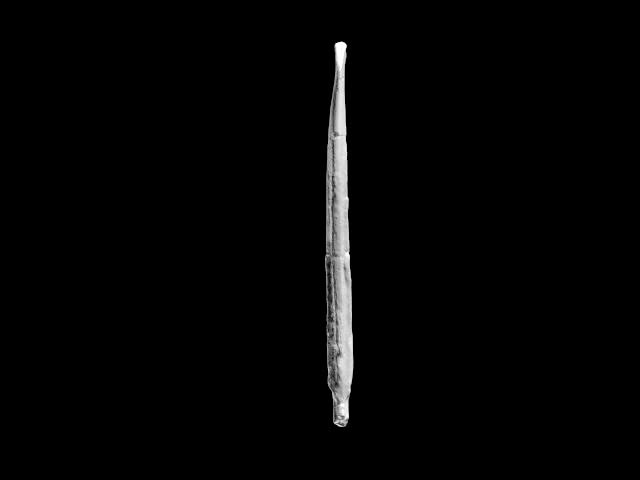
The baculum (pl.: bacula), also known as the penis bone, penile bone, os penis, os genitale, or os priapi, is a bone in the penis of many placental mammals. It is not present in humans, but is present in the penises of some primates, such as the gorilla and the chimpanzee. The baculum arises from primordial cells in soft tissues of the penis, and its formation is largely influenced by androgens. The bone lies above the urethra, and it aids sexual reproduction by maintaining stiffness during sexual penetration. The homologue to the baculum in female mammals is the baubellum (os clitoridis), a bone in the clitoris.
The word baculum means "stick" or "staff" in Latin and originates from Greek: βάκλον, baklon "stick".
The baculum is used for copulation and varies in size and shape by species. Its evolution may be influenced by sexual selection, and its characteristics are sometimes used to differentiate between similar species. A bone in the penis allows a male to mate for a long time with a female, which can be a distinct advantage in some mating strategies. The length of the baculum may be related to the duration of copulation in some species. In carnivorans and primates, the length of the baculum appears to be influenced by postcopulatory sexual selection. In some bat species, the baculum can also protect the urethra from compression.
The baculum is absent in monotreme (egg-laying) and marsupial (pouch-bearing) mammals. Mammals having a penile bone include various eutherians (placental mammals):
Within Eutheria, the penile bone is absent in ungulates (hoofed mammals, including cetaceans (whales, dolphins, and porpoises)), elephants, lagomorphs, and sirenians among others.
Evidence suggests that the baculum was independently evolved 9 times and lost in 10 separate lineages. The baculum is an exclusive characteristic of placentals and closely related eutherians, being absent in other mammal clades, and it has been speculated to be derived from the epipubic bones more widely spread across mammals, but notoriously absent in placentals.
Among the primates, marmosets,[clarification needed] weighing around 500 grams (18 oz), have a baculum measuring around 2 millimetres (0.079 in), while the tiny 63 g (2.2 oz) galago has one around 13 millimetres (0.51 in) long. The great apes, despite their size, tend to have very small penis bones, and humans are the only ones to have lost them altogether.
In some mammalian species, such as badgers and raccoons (Procyon lotor), the baculum can be used to determine relative age. If a raccoon's baculum tip is made up of uncalcified cartilage, has a porous base, is less than 1.2 g (0.042 oz) in mass, and measures less than 90 mm (3.5 in) long, then the baculum belongs to a juvenile.
Hub AI
Baculum AI simulator
(@Baculum_simulator)
Baculum
The baculum (pl.: bacula), also known as the penis bone, penile bone, os penis, os genitale, or os priapi, is a bone in the penis of many placental mammals. It is not present in humans, but is present in the penises of some primates, such as the gorilla and the chimpanzee. The baculum arises from primordial cells in soft tissues of the penis, and its formation is largely influenced by androgens. The bone lies above the urethra, and it aids sexual reproduction by maintaining stiffness during sexual penetration. The homologue to the baculum in female mammals is the baubellum (os clitoridis), a bone in the clitoris.
The word baculum means "stick" or "staff" in Latin and originates from Greek: βάκλον, baklon "stick".
The baculum is used for copulation and varies in size and shape by species. Its evolution may be influenced by sexual selection, and its characteristics are sometimes used to differentiate between similar species. A bone in the penis allows a male to mate for a long time with a female, which can be a distinct advantage in some mating strategies. The length of the baculum may be related to the duration of copulation in some species. In carnivorans and primates, the length of the baculum appears to be influenced by postcopulatory sexual selection. In some bat species, the baculum can also protect the urethra from compression.
The baculum is absent in monotreme (egg-laying) and marsupial (pouch-bearing) mammals. Mammals having a penile bone include various eutherians (placental mammals):
Within Eutheria, the penile bone is absent in ungulates (hoofed mammals, including cetaceans (whales, dolphins, and porpoises)), elephants, lagomorphs, and sirenians among others.
Evidence suggests that the baculum was independently evolved 9 times and lost in 10 separate lineages. The baculum is an exclusive characteristic of placentals and closely related eutherians, being absent in other mammal clades, and it has been speculated to be derived from the epipubic bones more widely spread across mammals, but notoriously absent in placentals.
Among the primates, marmosets,[clarification needed] weighing around 500 grams (18 oz), have a baculum measuring around 2 millimetres (0.079 in), while the tiny 63 g (2.2 oz) galago has one around 13 millimetres (0.51 in) long. The great apes, despite their size, tend to have very small penis bones, and humans are the only ones to have lost them altogether.
In some mammalian species, such as badgers and raccoons (Procyon lotor), the baculum can be used to determine relative age. If a raccoon's baculum tip is made up of uncalcified cartilage, has a porous base, is less than 1.2 g (0.042 oz) in mass, and measures less than 90 mm (3.5 in) long, then the baculum belongs to a juvenile.
Recent media