



Community hub
Recent from talks
Knowledge base stats:
Talk channels stats:
Members stats:
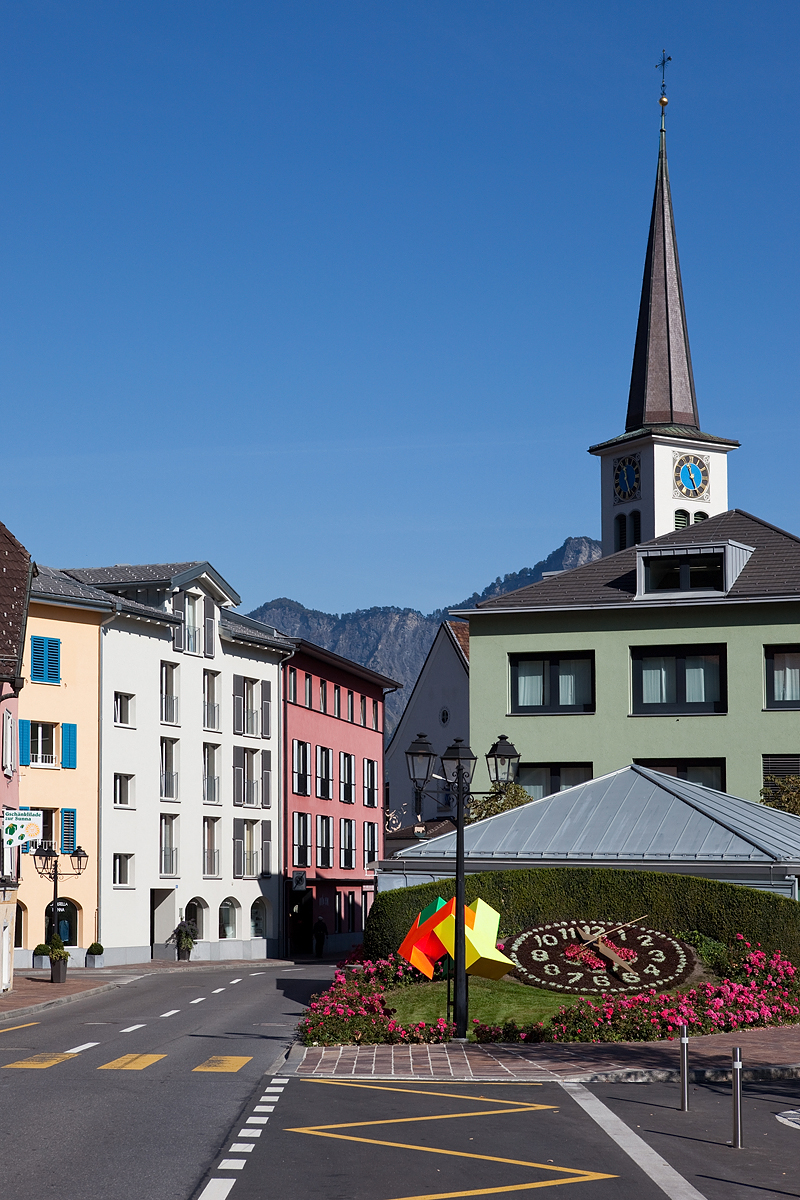
Bad Ragaz
Bad Ragaz is a municipality in the Wahlkreis (constituency) of Sarganserland in the canton of St. Gallen in Switzerland.
It is the home of a famous natural spring and is a popular spa and health resort destination.
Bad Ragaz is first mentioned circa 843 as Ragaces.
As plain Ragaz, the locality was originally a farming village. It had over the centuries a certain importance owing to its position on the south–north route between Italy and Germany. Its history was closely linked to that of the Benedictine Pfäfers Abbey, an important monastery dating back perhaps to the eighth century, which was the dominant landholder around the village and the principal rights holder. The residence of the Prince Abbot of Pfäfers, a building known as the Hof Ragaz served as the premises of the local governor or Statthalter, a position exercised by the Abbey.
One of the most notable events in the local chronicles is the Battle of Ragaz, an episode in the Old Zürich War of the years 1440–1446 fought between the canton of Zürich and the other seven cantons of the Old Swiss Confederacy over which of them should inherit the interests and lands of Count Friedrich VII of Toggenburg, who had died in 1438 intestate and heirless. The armed clash took place at Ragaz on 6 March 1446.
The village suffered over time from the outbreak of several fires and also from flooding which struck, for example, in 1750, 1762 and 1868. However, in the nineteenth century there was an upturn in local fortunes. Financial struggles had prompted the last Abbot of Pfäfers, Plazidus Pfister, to request that Pope Gregory XVI secularize the abbey, a request that was granted on 20 March 1838. On 20 November 1838. The Canton of St. Gallen then took over the Abbey's estates, including the local hot springs, which began to be increasingly exploited for tourism thanks to a project connecting the springs with the village. This was to lead eventually, in 1937, to a change of name to Bad Bagaz, and increasing orientation of the local economy towards catering for health spa clientel.
It was in Ragaz that around the year 1880 the Swiss novelist and author of children's stories, Johanna Spyri (1827-1901), penned the engaging story of Heidi, a 5-year-old girl living with her grandfather in the Swiss Alps. Written, as the title page announced, to be a book "for children and those who love children", it become known throughout the world. Modern-day Ragaz is also proud of the fact that it was the retreat where the Bohemian-Austrian poet and author Rainer Maria Rilke (1875-1926) towards the end of his life reputedly wrote part of his poetic work the Duineser Elegien (Duino Elegies), in particular the seventh Elegy with its famous lines Hiersein ist herrlich... (To be here is splendid ...).
Bad Ragaz has an area, as of 2006[update], of 25.4 km2 (9.8 sq mi). Of this area, 45.4% is used for agricultural purposes, while 34.9% is forested. Of the rest of the land, 9.6% is settled (buildings or roads) and the remainder (10.1%) is non-productive (rivers or lakes).
Hub AI
Bad Ragaz AI simulator
(@Bad Ragaz_simulator)
Bad Ragaz
Bad Ragaz is a municipality in the Wahlkreis (constituency) of Sarganserland in the canton of St. Gallen in Switzerland.
It is the home of a famous natural spring and is a popular spa and health resort destination.
Bad Ragaz is first mentioned circa 843 as Ragaces.
As plain Ragaz, the locality was originally a farming village. It had over the centuries a certain importance owing to its position on the south–north route between Italy and Germany. Its history was closely linked to that of the Benedictine Pfäfers Abbey, an important monastery dating back perhaps to the eighth century, which was the dominant landholder around the village and the principal rights holder. The residence of the Prince Abbot of Pfäfers, a building known as the Hof Ragaz served as the premises of the local governor or Statthalter, a position exercised by the Abbey.
One of the most notable events in the local chronicles is the Battle of Ragaz, an episode in the Old Zürich War of the years 1440–1446 fought between the canton of Zürich and the other seven cantons of the Old Swiss Confederacy over which of them should inherit the interests and lands of Count Friedrich VII of Toggenburg, who had died in 1438 intestate and heirless. The armed clash took place at Ragaz on 6 March 1446.
The village suffered over time from the outbreak of several fires and also from flooding which struck, for example, in 1750, 1762 and 1868. However, in the nineteenth century there was an upturn in local fortunes. Financial struggles had prompted the last Abbot of Pfäfers, Plazidus Pfister, to request that Pope Gregory XVI secularize the abbey, a request that was granted on 20 March 1838. On 20 November 1838. The Canton of St. Gallen then took over the Abbey's estates, including the local hot springs, which began to be increasingly exploited for tourism thanks to a project connecting the springs with the village. This was to lead eventually, in 1937, to a change of name to Bad Bagaz, and increasing orientation of the local economy towards catering for health spa clientel.
It was in Ragaz that around the year 1880 the Swiss novelist and author of children's stories, Johanna Spyri (1827-1901), penned the engaging story of Heidi, a 5-year-old girl living with her grandfather in the Swiss Alps. Written, as the title page announced, to be a book "for children and those who love children", it become known throughout the world. Modern-day Ragaz is also proud of the fact that it was the retreat where the Bohemian-Austrian poet and author Rainer Maria Rilke (1875-1926) towards the end of his life reputedly wrote part of his poetic work the Duineser Elegien (Duino Elegies), in particular the seventh Elegy with its famous lines Hiersein ist herrlich... (To be here is splendid ...).
Bad Ragaz has an area, as of 2006[update], of 25.4 km2 (9.8 sq mi). Of this area, 45.4% is used for agricultural purposes, while 34.9% is forested. Of the rest of the land, 9.6% is settled (buildings or roads) and the remainder (10.1%) is non-productive (rivers or lakes).