Hubbry Logo
HeidiHeidiMain
Open search
Heidi
Community hub
Heidi
logo
8 pages, 0 posts
0 subscribers
Be the first to start a discussion here.
Heidi
Heidi
from Wikipedia

Heidi (/ˈhdi/; German: [ˈhaɪdi]) is a work of children's fiction published between 1880 and 1881 by Swiss author Johanna Spyri, originally published in two parts as Heidi: Her Years of Wandering and Learning[1] (German: Heidis Lehr- und Wanderjahre) and Heidi: How She Used What She Learned[2] (German: Heidi kann brauchen, was es gelernt hat)[3] by Friedrich Andreas Perthes of Gotha.[4] It is a novel about the events in the life of a 5-year-old girl in her paternal grandfather's care in the Swiss Alps. It was written as a book "for children and those who love children" (as quoted from its subtitle).

Key Information

Heidi is one of the best-selling books ever written and is among the best-known works of Swiss literature.[5][6]

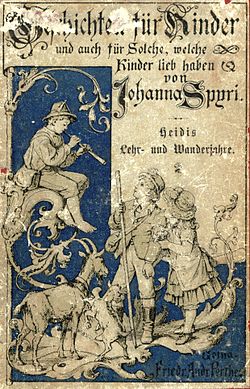
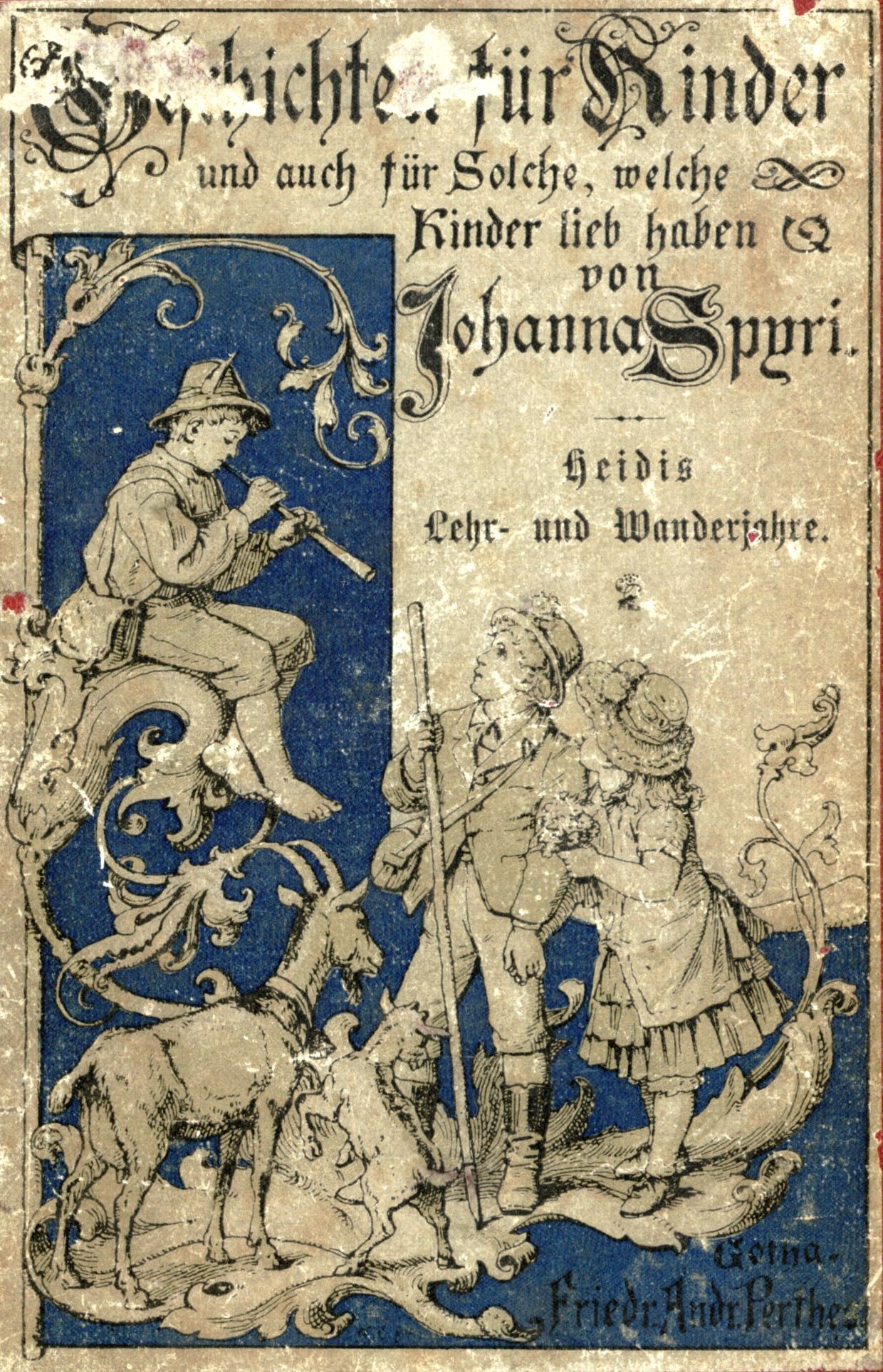
1880 first edition title page

Plot

[edit]
Aunt Dete hurrying away after leaving Heidi with her grandfather

Following his service in the army of the Kingdom of the Two Sicilies in Naples, the younger of two Swiss brothers moves to Dörfli ('small village' in Swiss German) in the municipality of Maienfeld with his son Tobias. The villagers are distrustful of newcomers, spreading rumors about the father's life in Naples, and the man becomes known as the Alm-Uncle, as he lives in seclusion on the mountain alm. Tobias marries a village girl called Adelheid and have a daughter, also named Adelheid but affectionately nicknamed Heidi, but tragically both parents are killed soon after. The Alm-Uncle holds this against God and becomes bitter, rarely coming down the mountain from then on.

Heidi[7] is raised by her maternal grandmother and aunt Dete in Maienfeld following the deaths of her parents. Shortly after her grandmother passes, Dete takes 5-year-old Heidi to live with the Alm-Uncle so she can take advantage of a job offer. Though he is at first resentful of Dete leaving the child with him out of nowhere, Heidi's intelligence and cheerful yet unaffected demeanour soon win her grandfather over. Heidi goes on to befriend her new neighbours: young Peter the goatherd, his mother Brigitte, and his blind maternal grandmother called Granny. Time passes and the mountaintop inhabitants, especially Peter and Granny, grow more attached to Heidi, and she to them. However, due to his past treatment from the townsfolk, the Alm-Uncle refuses to allow Heidi to attend school.

Three years later, Dete returns to forcefully take Heidi to Frankfurt to be a hired lady's companion to the wealthy invalid girl Klara Sesemann, who is unable to walk. The friendly Klara is charmed by Heidi and her descriptions of life on the Alm, and delights in all the funny mishaps brought about by Heidi's naïvety with city life, but the Sesemanns' strict housekeeper, Fräulein Rottenmeier, places the free-spirited Heidi under more and more restraint, adding to Heidi's homesickness for the Alm. Her one diversion is learning to read and write using a collection of Biblical stories, guided by Klara's kindly grandmother Frau Sesemann.

Heidi's homesickness leads to episodes of sleepwalking, which the household initially takes as the work of ghosts. The family doctor recommends she be sent home before she becomes seriously ill and Heidi is jubilant to learn she is being sent home to her beloved Alm.

Heidi returns to the Alm the next day bringing presents for her friends and the book from Frau Sesemann. Everyone is overjoyed to have her back, most of all her grandfather and Peter's Granny, and she puts her new ability to read to work in reading hymns to Peter's blind grandmother, who can no longer do so for herself. Her faith in God speaks to something in the Alm-Uncle. One day Heidi reads to him "The Prodigal Son" from a book Frau Sesemann gave her. That night Alm-Uncle prays for the first time in years. He accompanies Heidi to church, and that winter takes accommodation in the village so that she can attend school.

Heidi and Klara continue to keep in touch and exchange letters. A visit by the doctor to Heidi leads him to recommend that Klara visit Heidi, believing that the mountain environment and the wholesome companionship will do her good. Klara makes the journey the next season and spends a wonderful summer with Heidi, becoming stronger on goat's milk and fresh mountain air. Peter, jealous of Heidi's and Klara's friendship, pushes her empty wheelchair down the mountain. He is soon wracked with guilt about what he did and ultimately confesses to it. Without her wheelchair, Klara has no choice but to learn to walk; she attempts to do so and is gradually successful. Her grandmother and father are overcome with joy to see Klara walking again. The Sesemann family promises to provide permanent care for Heidi, if there ever comes a time when her grandfather is no longer able to do so.

Characters

[edit]
  • Heidi: A joyful and free-spirited young girl who is orphaned as a toddler. At the beginning of the story, she is five years old. Heidi loves her grandfather (uncle Alm) and the beauty and fresh air of the mountains. Only Fräulein Rottenmeier calls her by her given name "Adelheid", in some translations "Adelaide".
  • Grandfather: Heidi's paternal grandfather, a cantankerous loner who lives in a hut high in the mountains. By people other than Heidi, he is called "Uncle Alm" and, in some translations, "Uncle Alp".
  • Adelheid: Heidi's mother, she died from fever soon after her husband Tobias died. It is spelled "Adelaide" in some translations.
  • Tobias: Heidi's father who was killed by a beam falling on his head when Heidi was a baby.
  • Dete: Heidi's selfish and insensitive aunt, the sister of Adelheid. Heidi lived with her after her parents died. Dete is related to Grandfather (her and her sister Adelheid's great grandmother and Grandfather's grandmother were sisters). It is spelled "Deta" or "Detie" in some translations.
  • Peter: A goat herder who lives with his mother and grandmother in a hut up the mountain located between the village of Dörfli and the hut where Heidi's grandfather lives. He is eleven years old at the beginning of the story. He is sullen, pessimistic, and fond of Heidi to the point of being insanely jealous of anyone around her more than him.
  • Brigitte: Peter's mother and spelled "Brigitta" or "Bridget" in some translations.
  • Grannie: Peter's blind grandmother, Heidi gets attached to her.
  • Klara Sesemann: A frail girl who cannot walk. Her mother died when she was young. Her father is often away on business trips. She lives in a big household with servants in Frankfurt and is twelve years old when the 8-year-old Heidi comes to live with her. It is spelled "Clara" in some translations.
  • Herr Sesemann: Klara's father, a successful businessman who travels often. In some translations he is called "Mr Sesemann".
  • Frau Sesemann: By Klara and Heidi called "Grandmamma", she is Herr Sesemann's mother and Klara's grandmother. She is a kind woman and successfully encourages Heidi to learn reading. In some translations she is called "Mrs Sesemann".
  • Doctor Classen: Friend of Herr Sesemann.
  • Fräulein Rottenmeier: The strict and arrogant housekeeper at Herr Sesemann's home who antagonizes Heidi. In some translations she is called "Miss Rottenmeier".
  • Sebastian: A manservant in the Sesemann household who is kind if dandified.
  • Tinette: A maidservant in the Sesemann household who is scornful and contemptuous.

Translations

[edit]

Thirteen English translations were done between 1882 and 1959, by British and American translators: Louise Brooks, Helen B. Dole, H.A. Melcon, Helene S. White, Marian Edwardes, Elisabeth P. Stork, Mabel Abbott, Philip Schuyler Allen, Shirley Watkins, M. Rosenbaum, Eileen Hall, and Joy Law.[8] As of 2010, only the Brooks, Edwardes and Hall translations are still in print.[9] The preface of the 1924 English translation was written by Adeline Zachert.[10]

Basis for Heidi

[edit]

In April 2010, a Swiss scholar named Peter Otto Büttner, uncovered a book written in 1830 by German author Hermann Adam von Kamp entitled Adelaide: The Girl from the Alps (German: Adelaide, das Mädchen vom Alpengebirge).[11] The two stories share many similarities in plotline and imagery.[12] Spyri's biographer Regine Schindler said it was entirely possible that Spyri may have been familiar with the story, as she grew up in a literate household with many books.[citation needed]

Adaptations

[edit]

Film and television

[edit]

About 25 film or television productions of the original story have been made. The Heidi films were popular far and wide, becoming a huge hit, and the Japanese animated series became iconic in several countries around the world. The only incarnation of the Japanese-produced animated TV series to reach the English language was a dubbed feature-length compilation film using the most pivotal episodes of the television series, released on video in the United States in 1985.

Versions of the story include:

  • Heidi, a 1937 motion picture by 20th Century Fox (now 20th Century Studios) which starred Shirley Temple in the title role.
  • Heidi, a 1952 film in Swiss German and German, directed by Luigi Comencini, starring Elsbeth Sigmund (filmed on location in Switzerland), and followed by a sequel, Heidi and Peter, in 1955, directed by Franz Schnyder, also starring Ms. Sigmund.
  • Heidemarie S'Waisechind vo Engelberg, a 1956 Austrian film, directed by Hermann Kugelstadt.[citation needed]
  • A Gift for Heidi (1958), by George Templeton.[13]
  • Do Phool, a 1958 Indian Hindi-language family drama film adaptation by A. R. Kardar, starring Baby Naaz in the role of Poornima (Heidi).
  • Heidi (1959), music by Clay Warnick, adapted by William Friedberg with Neil Simon.[citation needed]
  • Heidi, a six-part 1959 BBC TV series starring Sara O'Connor in the title role, with Mark Dignam as her grandfather and Lesley Judd as Klara.[14]
  • Heidi, a 1965 Austrian film, directed by Werner Jacobs.[15]
  • Heidi, a 1968 television film which starred Jennifer Edwards with Maximilian Schell and Michael Redgrave. This was the version that became notorious for interrupting an American football game that was broadcast the same day (November 17) on NBC. The game between the Oakland Raiders and the New York Jets was cut off a few minutes before the end of the game when it looked as if the Jets were going to win, but after the cutoff, the Raiders made a comeback and beat the Jets with TV viewers on the east coast missing the conclusion. TV channels displayed the final score (Oakland winning 43–32) during the film, further enraging football fans. This incident led to a policy of not ending coverage of any sports games until after their conclusion. The game has gone down in professional football lore as "The Heidi Game" or "Heidi Bowl".[16]
  • Heidi (Disneyland Storyteller Record), a 1968 old time radio–style adaptation of the story by Disneyland Records, with music by Camarata, recorded in London and starring Brenda Dunnich, John Witty and introducing (to American audiences) Ysanne Churchman as Heidi.[citation needed]
  • Heidi, Girl of the Alps, a 1974 Japanese anime series directed by Isao Takahata for Zuiyo Eizo (later, Nippon Animation), dubbed into various languages. It was compiled into an English-dubbed film entitled The Story of Heidi.
  • Heidi, a 1974 BBC adaptation starring Emma Blake.[17]
  • Heidi, a 1978 26-episode Swiss/German television series, starring Katia Polletin as the protagonist, which was dubbed into various languages, including English.[18]
  • The New Adventures of Heidi (1978), directed by Ralph Senensky.
  • Heidi: La marveilleuse histoire d'une fille de la montagne (2 record set). Story read by actress Irène Vidy, Heidi theme song sung by Tony Schmitt. Milan Entertainment, a product of Activ-Records, Altendorf, Schwyz Switzerland, 1980 (SLP 77).[citation needed]
  • Heidi's Song, a 1982 American animated film produced by Hanna-Barbera.
  • Climb a Tall Mountain, a Christian film from 1987 that uses the story's characters to illustrate a message about the importance of love and forgiveness.[citation needed]
  • Courage Mountain, a 1990 American adventure drama film and serves as a sequel to Johanna Spyri's novel Heidi, directed by Christopher Leitch.
  • Heidi, a 1992 video-art project directed by Paul McCarthy and Mike Kelley as a collaboration project.[19][20]
  • Heidi, a two-part American television miniseries from 1993, starring Noley Thornton as Heidi. Co-stars included Jane Seymour as Miss Rottenmeier, Jason Robards as Grandfather and Lexi Randall as Klara.
  • Heidi, a 1995 animated film.
  • Heidi, a 2005 animated film.
  • Heidi, a 2005 British live-action film directed by Paul Marcus, starring Irish child actress Emma Bolger in the title role, alongside Max Von Sydow and Diana Rigg.
  • Heidi, a 2007 Swiss-French-Spanish-Czech television series set in modern times, starring Élodie Bollée as a teenage Heidi.
  • Heidi 4 Paws, a comedic 2008 adaptation featuring talking dogs with the voice of Angela Lansbury.
  • Heidi, a CGI remake of the 1974 anime series developed in 2015, made by Studio 100 Animation, the makers of Maya the Bee.[21]
  • Heidi, a 2015 Swiss live-action film directed by Alain Gsponer.
  • Heidi, bienvenida a casa, a 2017 telenovela from Argentina
  • Heidi (2024), a 2024 US American Christian film, directed by Lynn Moody[22][23][24]

Two new separate upcoming German-language television productions were announced in 2025 in the context of the upcoming 200th birthday of Johanna Spyri in 2027.[25][26][27][28]

Theatre

A stage musical adaptation of Heidi with book and lyrics by Francois Toerien, music by Mynie Grové and additional lyrics by Esther von Waltsleben, premiered in South Africa at the Klein Karoo National Arts Festival in 2016. Directed by Toerien with musical direction by Dawid Boverhoff, the production starred Tobie Cronjé (Rottenmeier), Dawid Minnaar (Sesemann), Albert Maritz (Grandfather), Ilse Klink (Aunt Dete), Karli Heine (Heidi), Lynelle Kenned (Klara), Dean Balie (Peter), Jill Middlekop and Marlo Minnaar. Puppets for the production were created by Hansie Visagie.[29]

A stage musical adaptation of Heidi of the Mountain (music and lyrics by Claude Watt, book by Claude and Margaret Watt) was performed in Sidney, BC, Canada by Mountain Dream Productions, premiering in 2007 at the Charlie White Theatre, and has been performed again several times since then.[30] The 2007 production starred Claude Watt (Grandfather), Margaret Watt (Rottenmeier), Rianne Craig (Heidi) and Katrina Brindle (Klara).

Computer games

[edit]

There have been two Heidi computer games released for mobile devices, with the most recent being Heidi: Mountain Adventures. Both games are based on the Studio 100 TV series of 2015 and are aimed at young children, with educational elements and a series of mini-games.[31][32]

Heidiland

[edit]
Maienfeld, the main town in Heidiland

Heidiland, named after the Heidi books, is an important tourist area in Switzerland, popular especially with Japanese and Korean tourists.[33] Maienfeld is the center of what is called Heidiland; one of the villages, formerly called Oberrofels,[34] is actually renamed "Heididorf".[35] Heidiland is located in an area called Bündner Herrschaft; it is criticized as being a "laughable, infantile cliché"[33] and "a more vivid example of hyperreality".[36]

Sequels

[edit]

Literary

[edit]

Between 1933 and 1955, French publishing company Flammarion published a new edition of Heidi along with a series of new original sequels. Despite being all published under Johanna Spyri's name, this books were neither written nor endorsed by Spyri, but were adapted from her other works by her French translator, Charles Tritten in the 1930s and 1940s, many years after she died, while the last one was written by Nathalie Gala.[37][38][39][40] The series is composed of a total of 7 books, 2 translated from Spyri's works and 5 original. Only two of them were published in English.

  1. Heidi. La merveilleuse histoire d'une fille de la montagne (1933), translation of the first Heidi volume (Heidis Lehr- und Wanderjahre).
  2. Heidi grandit (1934), translation of the second Heidi volume (Heidi kann brauchen, was es gelernt hat) with the addition of an original ending by Charles Tritten, which announces Heidi's further adventures.
  3. Heidi Grows Up (Heidi jeune fille, 1936) by Charles Tritten, it follows Heidi's teenage years.
  4. Au pays de Heidi (1938) by Charles Tritten, the story is told from the perspective of Heidi's village seen by some of its inhabitants.[41]
  5. Heidi's Children (Heidi et ses enfants, 1939) by Charles Tritten, about Heidi's adulthood with Peter and their children.
  6. Heidi grand'mère (1941) by Charles Tritten, about Heidi's later years with her grandchildren.[42]
  7. Le sourire de Heidi (1955) by Nathalie Gala,[43] a new story set once again during Heidi's younger years.[44]

There are some major differences between the original Heidi and the Tritten sequels. These include:

  • Heidi, the original story by Spyri, shows the simple life of Heidi imbued with a deep love of children and childhood. Spyri mentioned that the work was "for children and those who love children". The sequels portray Heidi in a different manner, as she grows up and gets married.
  • Heidi in the first book, Heidi, is described as having "short, black curly hair", when she is around five to eight years of age. In Heidi Grows Up, when she is fourteen, her hair is long, straight and fair.
  • In some English editions of Heidi the names of the goats are translated into English (Little Swan and Little Bear), while other editions use their original Swiss-German names, Schwanli and Baerli. In Heidi Grows Up only the names Schwanli and Baerli are used.

Film

[edit]

In 1990, screenwriters Weaver Webb and Fred & Mark Brogger, and director Christopher Leitch, produced Courage Mountain, starring Charlie Sheen and Juliette Caton as Heidi. Billed as a sequel to Spyri's story, the film is anachronistic in that it depicts Heidi as a teenager during World War I, despite the fact that the original novel (where Heidi is only five years old) was published in 1881.

Reception

[edit]
Heidi on a CHF 50 Swiss commemorative coin, 2001

The book has been criticised for black-and-white character portrayals and an idealization of pastoral life.[45][page needed]

In Japan, since its first Japanese translation in 1906, the book has been influential upon the general, stereotypical image of Switzerland for the Japanese, especially its tourists, many visiting the Heidi's Village park.

See also

[edit]

References

[edit]
[edit]
Revisions and contributorsEdit on WikipediaRead on Wikipedia
from Grokipedia
Heidi is a classic children's by Swiss author , originally published in two volumes in German as Heidis Lehr- und Wanderjahre (1880) and Heidi kann brauchen, was sie gelernt hat (1881), chronicling the life of a young girl named Heidi who is sent to live with her reclusive grandfather in the , where she finds joy in nature and before facing challenges in the urban world of . Johanna Spyri, born Johanna Heusser in 1827 in Hirzel, , and who died in 1901, drew from her own experiences in the Swiss countryside for the story; she began her writing career at age 44, producing around 50 works, including 32 children's books, often donating proceeds to charitable causes like aiding refugees. The novel's plot centers on five-year-old Heidi, whose aunt Dete leaves her with the grumpy grandfather known as Alm-Uncle in the mountainous Dörfli region; Heidi quickly befriends local children like Peter the goatherd and transforms her grandfather's isolated life with her cheerful spirit, emphasizing themes of nature's healing power, family bonds, and the contrast between rural simplicity and city constraints. When taken to to serve as a companion to the invalid Clara Sesemann, Heidi suffers from and illness, ultimately returning to the , where her presence brings reconciliation and recovery to those around her. Since its publication, Heidi has become one of the most enduring works of , translated into over 70 languages and selling more than 50 million copies worldwide, with significant popularity in the United States (over 20 million by 1936) and (spurred by a 1974 ). The story has inspired over 15 film and television adaptations, starting with a 1920 , and was recognized by as part of the "Memory of the World" register in 2023 for its cultural significance in portraying Swiss identity and universal childhood experiences. Although sequels like (1938) by Charles Tritten were unauthorized continuations, the original novel remains Spyri's masterpiece, celebrated for its vivid Alpine settings and moral depth.

Background

Author

Johanna Louise Heusser Spyri was born on June 12, 1827, in the rural village of Hirzel in the , , as the fourth of six children to Johann Jakob Heusser-Schweizer, a local physician, and Meta Heusser-Schweizer, a . Growing up in this pastoral setting at the foot of the , she developed a deep affinity for nature, which later shaped her literary themes; she attended a higher girls' school in , studied foreign languages and music, and tutored her younger sisters while becoming self-taught in literature. In 1852, she married Johann Bernhard Spyri, a and childhood acquaintance whom she had known since youth, and the couple relocated to , where they resided overlooking and welcomed their only child, a son named Bernhard Diethelm, in 1855. Spyri's literary career began in her mid-forties, prompted by her excursions to the Swiss Alps in the canton of Grisons, where she found inspiration in the landscapes and local customs. At age 44, she published her debut short story, Ein Blatt auf Vronys Grab (A Leaf on Vrony's Grave), anonymously in the Swiss journal Deutsche Schweizerblätter in 1871, addressing themes of domestic hardship in a rural context. This was followed by additional short stories and tales for adults and children in Swiss periodicals throughout the 1870s, marking her entry into professional writing without consistent use of pseudonyms beyond initial anonymity. Personal tragedies profoundly impacted Spyri's life and output in the ; her son Bernhard succumbed to at age 29 in 1884, and her husband Johann Bernhard died later that same year at age 63. Left widowed and childless, she channeled her grief into charitable work and an intensified focus on , producing over 50 stories that emphasized healing through nature and simplicity as a form of emotional solace. Spyri passed away on July 7, 1901, in at age 74, leaving a legacy rooted in her Swiss heritage.

Inspiration and Publication

Johanna Spyri drew inspiration for Heidi from her deep familiarity with the , shaped by her childhood in the rural and subsequent visits to alpine regions near and . Her observations of local children and the natural landscape informed the novel's portrayal of mountain life and youthful resilience. Spyri composed the story rapidly between late 1879 and early , completing the first volume in approximately four weeks amid her growing focus on . Originally envisioned as a tale for young readers, it expanded from her earlier works rooted in Swiss rural themes. The novel appeared in two volumes: Heidis Lehr- und Wanderjahre in and Heidi kann brauchen, was sie gelernt hat in 1881, published anonymously by Friedrich Andreas Perthes in , . It quickly gained traction in , establishing itself as a children's classic by the mid-1880s due to its evocative depiction of alpine simplicity and moral uplift. The first English translation emerged in 1882, issued in two volumes—Heidi's Early Experiences and Heidi's Further Experiences—by W. Swan Sonnenschein in , though the translator remains unidentified. Subsequent German editions retained Spyri's original structure, with the work's enduring appeal stemming from its authentic alpine voice rather than later authorial alterations.

Narrative Elements

Plot Summary

The Heidi by follows the story of a five-year-old girl named Heidi, who is brought by her aunt Dete from the village of to live with her reclusive grandfather, known as Alm-Uncle, in a remote hut high in the near Dörfli. Initially gruff and isolated from the villagers due to past hardships, the grandfather reluctantly accepts Heidi, who quickly adapts to the rugged mountain life, discarding her city clothes for simple garments and exploring the alpine meadows with joy. She forms a close friendship with Peter, the eleven-year-old goatherd, and accompanies him daily to tend the goats, including the lively Little Swan and Little Bear, learning their names and delighting in the freedom of the pastures. Heidi also visits Peter's grandmother in the village below, reading to the blind woman from hymns and bringing her soft white rolls to alleviate her , fostering a tender bond that brings light to the old woman's days. Over the next three years, from ages five to eight, Heidi grows robust and happy in this environment, helping her grandfather with chores like making hay and watching the sunsets from the hut, though harsh winters confine her indoors until spring returns. At age eight, Heidi's idyllic life is upended when Dete reappears and takes her to to serve as a companion to her wealthy acquaintance's daughter, Clara Sesemann, insisting it is for Heidi's benefit despite the child's tearful protests. In the grand Sesemann household in , Heidi, now far from the , bonds with the wheelchair-bound Clara, who is twelve and kind-hearted, sharing stories of the mountains that captivate her new friend. However, the stifling urban atmosphere and separation from nature cause Heidi intense , manifesting in sleepless nights, , and a refusal to eat, which alarms the household. With encouragement from Clara's grandmother, Heidi learns to read using a , but her condition worsens until the family physician intervenes, recognizing the ' restorative influence from Heidi's vivid descriptions and arranging her return to the mountains at around age nine. Back in the , Heidi reunites joyfully with her grandfather and Peter, resuming her days of goat-herding and visits to Peter's grandmother, whom she aids with reading and provisions brought from . The doctor follows soon after, visiting the Alm-Uncle's hut and praising the pure mountain air for its healing properties, while encouraging the grandfather to reconnect with the below. Several years pass, with Heidi now thirteen, thriving in her home until Clara, still frail, arrives for an extended summer stay in the accompanied by her grandmother. Under Heidi's guidance and her grandfather's patient instruction, Clara practices walking in the meadows, gradually gaining strength from the , sunshine, and nutritious , ultimately standing and walking unaided in a triumphant moment. Peter's initial leads him to sabotage Clara's , but he repents and is forgiven, solidifying the friendships as the Sesemann family decides to build a home nearby, ensuring ongoing connections and the grandfather's reconciliation with Dörfli's villagers.

Characters

Heidi, the novel's , is an orphaned Swiss girl who spans ages five to thirteen across the story. She embodies innocence, a profound love for , and remarkable resilience, thriving in the simplicity of alpine life while struggling with urban constraints. Orphaned at one year old after her parents' deaths, Heidi is initially raised by her in the village of Dorfli before being sent to live with her grandfather on , where she forms deep bonds with the natural world and its inhabitants. Her arc involves a transformation marked by and emotional distress during her time in , ultimately leading to a restoration of harmony upon her return to the , where she extends her to help others, such as teaching Peter to read and aiding Clara's recovery. As Spyri portrays her, Heidi's cheerful and empathetic influences those around her, refusing to yield to cynicism and elevating their spirits through her unbound joy. Alm-Uncle, Heidi's grandfather, is a reclusive and initially antisocial living in isolation on the Alm . Portrayed as gruff and solitary on the surface, he possesses a kind-hearted core, marked by strength, wisdom, and resourcefulness honed from years of self-sufficiency herding goats. His reveals a man once prosperous in Dorfli who suffered devastating losses—his wife and son (Heidi's father) died young, compounded by his own past mistakes like away wealth—leading to his withdrawal from and a life of bitterness. Motivated by a desire for redemption and protection of Heidi, he gradually softens under her influence, evolving from a resistant guardian who avoids village norms to a nurturing figure who attends church, reconciles with the community, and even supports excursions to aid Clara. This arc culminates in his renewed engagement with the world, as he reflects on his isolation and embraces familial bonds. Peter, the young goatherd, serves as Heidi's loyal friend and occasional rival in the alpine setting. An eleven-year-old boy from Dorfli, he is illiterate yet kind-hearted, characterized by , playfulness, and a stubborn impulsiveness, often prioritizing ease and his over formal learning. Living with his blind grandmother and mother in modest circumstances, Peter's motivations center on daily routines of and enjoying Heidi's companionship, though he exhibits when her attention shifts to Clara. His development arc shows growth from laziness and selfishness—exemplified by his destructive act out of envy—to maturity, as Heidi's persistence inspires him to learn reading, fostering responsibility and deeper loyalty. Clara Sesemann, a wealthy girl from confined to a , contrasts sharply with Heidi's vitality, representing urban fragility and dependency. Over twelve years old, she is gentle, kind, and appreciative, driven by a longing for health and genuine amid her state, which stems from an unspecified childhood illness. Her motivations include retaining Heidi as a companion to alleviate her isolation, and through their bond, she experiences hope and curiosity about world. Clara's arc is one of physical and emotional restoration; influenced by Heidi's energy and the alpine environment, she gains strength, learns , and ultimately achieves the ability to walk, symbolizing a shift from frailty to joyful . Among the secondary figures, Aunt Dete is Heidi's pragmatic and self-interested aunt who raised her after her parents' deaths but abandons her at the Alm for personal advancement, securing a job in that requires unencumbered mobility. Motivated by ambition and a sense of duty fulfilled, she later insists on taking Heidi to the city despite resistance, viewing it as an opportunity for the child. Fräulein Rottenmeier, the strict housekeeper and in the Sesemann household, enforces rigid order with an anxious and authoritative demeanor, fearing disruption from Heidi's free-spirited ways; her antagonism arises from an inability to comprehend the girl's indifference to urban conventions, creating ongoing tension. The Sesemann family doctor, a caring and observant professional, advocates for holistic well-being, diagnosing Heidi's as beyond medical remedies and recognizing the ' restorative power for both her and Clara; melancholic from personal losses like his daughter's death, he finds solace in the mountains and commits to supporting Heidi's future.

Literary Analysis

Themes

One of the central themes in Johanna Spyri's Heidi is the restorative power of nature, particularly the , which serve as a force for both physical and emotional ailments. The depicts the mountains as a divine environment that rejuvenates characters, as seen in Heidi's recovery from severe after her return from , where the fresh air and familiar sounds like cowbells alleviate her psychological distress. Similarly, Clara's is cured through exposure to the Alpine sunshine, wind, and open spaces, symbolizing nature's therapeutic role in 19th-century literature. This motif underscores the Alps as a space where God's presence is manifest, enhancing spiritual and bodily well-being. Spyri contrasts social classes through the simplicity of rural mountain life against the of urban existence, critiquing the latter's stifling effects. In , the opulent Sesemann household represents bourgeois excess and emotional isolation, exacerbating Heidi's trauma and contrasting sharply with the grandfather's self-sufficient, nature-bound existence on the Alm. The grandfather's rejection of city life, evident in his initial bitterness toward society, highlights a preference for rural and over urban constraints, reflecting 19th-century Swiss attitudes toward industrialization. This rural-urban dichotomy emphasizes mutual coexistence in nature, where social harmony arises from symbiotic relationships rather than hierarchical wealth. The explores childhood innocence and , portraying intuitive learning from as superior to formal urban schooling. Heidi's growth occurs through interactions with the , animals, and elders like the grandmother, who teaches her stories and hymns, fostering moral and emotional development without rigid classrooms. This anti-urban sentiment critiques Frankfurt's structured lessons, which overwhelm Heidi and fail to nurture her innate curiosity, instead advocating for rooted in the natural world. Themes of and belonging address hood, redemption, and chosen bonds, central to the protagonists' arcs. As an , Heidi embodies displacement until her reunion with grandfather Alm-Öhi transforms their isolated lives into a familial unit, redeeming his reclusive bitterness through her influence and leading to his reconciliation with the village. This chosen family extends to Clara and Peter, illustrating belonging as a product of emotional ties forged in rather than blood alone. Subtle Christian undertones permeate the narrative, reflecting 19th-century Swiss Protestant values through elements like , , and moral growth. Heidi's spiritual maturation involves learning parables such as the Prodigal Son, which inspires Alm-Öhi's redemption and return to faith, while characters like Mrs. Sesemann emphasize as a source of comfort. These motifs promote a Pietist-influenced focused on and communal harmony, without overt proselytizing.

Style and Structure

The novel Heidi employs a third-person omniscient perspective, allowing access to the thoughts and feelings of multiple characters while centering on the young protagonist's experiences, which fosters reader and immersion in her world. This approach, combined with an episodic structure reminiscent of children's fairy tales, presents the story through a series of self-contained vignettes—such as Heidi's daily alpine routines or her urban challenges—that build gradually toward emotional climaxes, making the accessible and engaging for young readers. Spyri's prose is simple and direct, prioritizing clarity and emotional resonance over complexity to suit its intended child audience. The book is divided into two distinct parts, originally published separately in and : the first, idyllic and , focuses on Heidi's joyful life in the with her grandfather, emphasizing ; the second introduces conflict through her relocation to the urban environment of , heightening tensions between rural simplicity and city constraints before culminating in a restorative, harmonious resolution upon her return to the mountains. This binary structure underscores the novel's exploration of environmental contrasts while maintaining a forward momentum through Heidi's personal growth. The work features short chapters, typically spanning just a few pages, which enhance and allow young readers to digest the story in digestible segments without overwhelming detail. Spyri incorporates elements of Swiss German dialect, particularly in the speech of alpine characters like the grandfather, to lend authenticity to the rural setting, while the overall language remains in standard German for broader accessibility. The tone is sentimental, blending realistic depictions of hardship with idealized portrayals of emotional bonds and moral uplift, evoking warmth and optimism. In terms of symbolism, the function almost as a character in their own right, with vivid sensory descriptions of winds, wildflowers, and goats that immerse readers in the landscape's vitality and portray it as a nurturing, almost spiritual force central to the characters' well-being. These stylistic choices reflect influences from , drawing on earlier works like Albrecht von Haller's Die Alpen (1732) that celebrated the sublime beauty of mountains and nature's restorative power. Additionally, Spyri echoes Jean-Jacques Rousseau's ideas in Émile (1762), particularly the emphasis on natural education through immersion in the environment rather than formal schooling, positioning Heidi as a "sentimental sister" to Rousseau's idealized child raised in .

Global Dissemination

Translations

The first translations of Johanna Spyri's Heidi emerged rapidly following its original publication in German as two volumes in 1880 and 1881. A Dutch version appeared in 1882, followed by French in 1883 and English in 1884, rendered by Louise Winsor Brooks under the title Heidi: Her Years of Wandering and Learning. Translators encountered difficulties in capturing the novel's inflections, often opting for or equivalent vernaculars to maintain flow and accessibility, which occasionally softened the regional authenticity. In the , key English editions gained prominence, including Helen B. Dole's 1899 translation for Ginn & , whose copyright expired in 1927, allowing widespread reprints and revisions that popularized the work in Anglo-American markets. The Japanese translation, first completed in 1920 by Yaeko Nogami, introduced Heidi to and fueled its enduring appeal there, influencing perceptions of Swiss . By 2025, Heidi had been translated into over 70 languages worldwide, including early 20th-century versions in Chinese and Spanish, contributing to global sales surpassing 50 million copies. These translations often featured simplifications to suit child readers, such as streamlined prose and abridged chapters, alongside cultural localizations like renaming Alpine locales to resonate with non-European audiences. Some editions controversially attenuated the story's Protestant religious motifs—such as biblical references and themes of —to align with secular or diverse readerships, prompting debates over fidelity to Spyri's original intent. The original work entered the in the United States long ago, as pre-1929 publications are public domain as of 2024, supporting numerous free digital versions in multiple languages, accessible through platforms like , further broadening its reach in the digital era.

Adaptations

The adaptation of Johanna Spyri's Heidi into non-literary formats began shortly after its initial publication in 1880–1881. A surge in adaptations followed in the early , driven by the novel's growing international popularity and its translation into over 70 languages, which facilitated global interest. By 2025, Heidi had inspired numerous major adaptations across media, including over 15 film and television versions, emphasizing its family-friendly themes of resilience, nature, and friendship. Recent developments include a new Swiss-German television series in production by SRF and RTL, focusing on the story's spiritual elements. Common modifications in these adaptations include plot compression to suit runtime limitations, a heightened focus on the Alpine scenery to evoke the story's idyllic setting, and occasional updates to Clara's portrayal for modern audiences, such as shifting from historical descriptions to more empathetic representations. adaptations have been particularly enduring, with key theatrical versions including the musical by Ann Pugh and Betty Utter, which transforms the into an enchanting production. Other notable examples encompass European pantomimes that incorporate interactive, festive elements for holiday seasons. Animated and illustrated versions further expand Heidi's reach, beginning with early comic strips in the 1930s that captured the story's charm in serialized form. Modern iterations include graphic novels like Mariah Marsden and Maarta Laiho's 2019 adaptation, which uses folk art-inspired visuals to reimagine Heidi's adventures for contemporary young readers. Cross-media trends reveal a consistent prioritization of Heidi's wholesome, inspirational core, with adaptations often amplifying visual and emotional elements over the original's subtler psychological depths, ensuring broad accessibility while preserving the narrative's timeless allure.

Adaptations

Film and Television

The earliest known of Johanna Spyri's Heidi was a 1920 American silent short film directed by William D. Taylor, featuring child actress as the titular character in a story emphasizing the orphan girl's separation from her grandfather and his efforts to reunite with her. This loose interpretation marked the story's initial transition to the screen, capturing the emotional core of family bonds amid alpine settings. Among classic cinematic versions, the 1937 Hollywood production directed by stands out as a musical drama produced by 20th Century Fox, with portraying Heidi alongside as her grandfather and as the tyrannical housekeeper Frau Rottenmeier. The film, which grossed over $3 million at the and received two Academy Award nominations for cinematography and sound, deviated from the novel by incorporating songs and a happier urban resolution but highlighted themes of resilience and nature's power. Another notable early international take is the 1952 Swiss-German family drama directed by Luigi Comencini, starring young Elsbeth Sigmund as Heidi, which faithfully recreated the alpine landscapes on location and emphasized the child's integration into mountain life before her city ordeal. Critically praised for its authentic portrayal and natural performances, it ran 97 minutes and became a benchmark for European adaptations. A prominent television adaptation is the 1968 American made-for-TV film directed by , starring as Heidi and as her grandfather, which aired on and emphasized the novel's emotional contrasts between rural and urban life. The 1974 Japanese series (premiered January 7, 1974), produced by Zuiyo Eizo under director with character designs by Yoichi Kotabe and layouts by , spanned 52 episodes and achieved massive global export, airing in over 30 countries. In , it became a cultural phenomenon, boosting tourism to the by an estimated 20% annually in the late 1970s and influencing the "" format for literary adaptations, though it received no major international awards beyond its enduring popularity. Television adaptations proliferated in the late , including the 1978 Swiss-German (26 episodes) starring Katia Polletin as Heidi, which aired on the and was lauded for its faithful scripting and location filming in the and , capturing the novel's emotional depth without musical elements. The 1993 Anglo-American (two parts, 193 minutes total) directed by Michael Ray Rhodes and produced by Harmony Gold, featured as Heidi and as the grandfather, filmed in Austria's Tyrol region; it earned praise for its scenic visuals and family-friendly pacing but drew criticism for simplifying character motivations. More recent productions include the 2015 Swiss-German live-action directed by Alain Gsponer, starring Anuk Steffen as Heidi and as her grandfather, which blended realistic alpine cinematography with subtle environmental undertones and won the for Best along with the Bavarian in the same category. Noted for its visual poetry evoking Studio Ghibli's nature-focused style, it grossed approximately $35 million (€32 million) worldwide and received seven Swiss nominations. The 2017 Netflix release of the Heidi (Season 1 from a 2015 European co-production by and , 39 episodes), targeted young audiences with vibrant CGI depictions of Swiss locales. As of 2025, international co-productions continue, such as the animated feature Heidi: Rescue of the Lynx by Studio 100 Media, emphasizing eco-themes through Heidi's efforts to save a lynx family from development threats, set for theatrical release with a focus on environmental stewardship and alpine conservation.

Other Media

The story of Heidi has inspired various video games, often designed as educational tools for children to explore themes of nature and friendship in the Swiss Alps. The 2004 PC adventure game Heidi: Deine Welt sind die Berge, developed for ages 5-11, allows players to navigate Heidi's world through interactive quests based on the 1974 Japanese anime series Heidi, Girl of the Alps. In 2005, Heidi: The Game was released for the Game Boy Advance, featuring side-scrolling platforming where players control Heidi to complete levels inspired by the contemporary film adaptation, emphasizing exploration and simple puzzles. The 2015 mobile application Heidi: Alpine Adventure, developed by Studio 100 Media, includes 19 mini-games focused on puzzle-solving and Alpine activities like music-making and wildlife interaction, available in English, German, French, Spanish, and Flemish. These games typically simplify the narrative for educational play, prioritizing nature exploration over complex storytelling, with greater output in Europe and Asia—owing to the anime's Japanese origins—compared to limited Western releases. Audio adaptations of Heidi encompass radio dramas and audiobooks that bring to life through and . A notable example is the 1995 BBC Radio 4 full-cast dramatization, starring as Heidi and Richard Johnson as her grandfather, which captures the emotional journey from the to in a 90-minute production. Audiobooks from the and later include recordings such as the 1997 version narrated by Frances Cassidy, offering a straightforward reading of Johanna Spyri's text for young listeners. In the , retellings have emerged, such as the audio series on Spreaker that narrates Heidi's adventures in an episodic format, making the story accessible for modern digital audiences. Merchandise tied to Heidi has proliferated since the late , shortly after the book's publication, including dolls, board games, and apparel evoking the character's rustic Alpine lifestyle. Early items featured dolls dressed in traditional Swiss attire, while board games like memory and puzzle sets based on the story appeared in the to engage children interactively. Contemporary offerings extend to apparel such as embroidered clothing and accessories inspired by Heidi's world, alongside educational toys. Post-2020, virtual reality experiences simulating the have gained traction, providing immersive tours of mountainous landscapes reminiscent of Heidiland, though directly branded Heidi VR content remains niche.

Legacy

Cultural Impact

Heidi by has profoundly influenced , particularly in the genre of nature-centric stories that emphasize healing and personal growth through environmental immersion. The novel's portrayal of the restorative power of the inspired subsequent works, such as Frances Hodgson Burnett's The Secret Garden (1911), where both narratives depict frail urban children regaining health and vitality amid natural surroundings, highlighting themes of transformation via outdoor life. Spyri's depiction of alpine serenity also advanced the "Alpine idyll" tradition in , romanticizing rural mountain existence as a moral and spiritual antidote to industrialization, a motif rooted in earlier Romantic works but popularized through Heidi's accessible . In education, Heidi has served as a staple in curricula across and , fostering discussions on , , and . During the , European schools, especially in German-speaking regions, integrated simplified versions of the novel into language classes to explore family dynamics, , and values, making it a tool for cultural and ethical instruction. In , the book's themes of , , and appreciation were emphasized in moral education programs following the 1974 anime adaptation, which amplified its role in teaching resilience and with the environment to generations of students. The character of Heidi embodies Swiss national identity, symbolizing innocence, simplicity, and alpine purity in global . Since its publication, the novel has shaped perceptions of , with campaigns leveraging its imagery to promote the as an idyllic escape; for instance, advertisements in the late featured Heidi to evoke the charm of Swiss landscapes and hospitality. This enduring has influenced , drawing visitors to alpine regions for restorative experiences long before formalized sites emerged, contributing to 's image as a haven for health and rejuvenation. In 2023, the and Heidi archives in Zurich were inscribed on 's Memory of the World International Register, recognizing their cultural significance in portraying Swiss identity and universal childhood experiences. Socially, Heidi has prompted diverse interpretations reflecting evolving cultural concerns. Early 20th-century readings highlighted the protagonist's as a model of female agency for girls, portraying her in the mountains as a form of amid adversity. In the , eco-critical analyses have reexamined the narrative through lenses of and , interpreting Heidi's bond with nature as a call for sustainable coexistence, especially relevant amid global climate discourses. These layers underscore the novel's versatility, with over 50 million copies sold worldwide since 1880, ensuring its continued resonance across demographics.

Heidiland

Heidiland refers to a in , primarily in the canton of Graubünden, centered around the village of and extending to areas like the Bündner Herrschaft and the Five Villages near Lake Walen. This area draws its name from Johanna Spyri's novel Heidi, with Maienfeld serving as the real-life inspiration for the fictional Dörfli, a quaint alpine settlement depicted in the story. The Alm-Uncle's hut, a key setting in the book, is recreated at the Heidi House within Heididorf, a site that immerses visitors in 19th-century rural life. Tourism in Heidiland gained momentum in the late , with the "Heidiland" brand emerging as a word mark for a motorway service station near in 1989 and expanding to designate the broader holiday region shortly thereafter. Initially developed by the tourism board in the late to boost summer visits—drawing from a 1979 Swiss TV adaptation filmed there—the branding faced local pushback from residents, who felt overshadowed by the distant, upscale association. By the early , management shifted to the Heidiland Tourism office in , fostering collaborative promotion across 32 villages and attracting around 60,000 visitors annually to core sites like Heididorf as of the early (recent figures unavailable). The region now features hiking trails such as the Heidi Path, goat farms offering animal interactions, and seasonal festivals celebrating alpine traditions, all tied to the novel's themes of and simplicity. Key attractions include Heididorf, the open-air Heidi Village in , where the 300-year-old Heidi House—opened to the public in 1998—serves as the centerpiece, alongside a , , and farmyard exhibits. Visitors can access alpine meadows via the Heidi Trail or a from nearby Flumserberg, providing panoramic views that echo the book's pastoral landscapes. These developments have economically supported local industries, particularly dairy production through farms and traditional handicrafts like woodcarving, which see increased sales from tourist traffic. Since the , Heidiland has faced critiques of over-commercialization, with traditionalists arguing that exploiting Heidi's image of purity undermines the story's essence, as highlighted in regional debates over themed merchandise and competing town promotions. Environmental concerns have also arisen from in the fragile Alpine , including trail erosion and strain on local resources amid rising visitor numbers. Post-2020, Heidiland has introduced sustainable initiatives to address these issues, such as eco-tours emphasizing low-impact activities like e-bike excursions around Lake Walen and guided nature walks in the Weisstannen Valley that highlight the novel's environmental themes. These efforts include CO2-neutral transport options and partnerships promoting regenerative practices in , aligning with broader Swiss goals for eco-friendly alpine preservation.

Sequels

Although Johanna Spyri did not write any direct sequels to her 1880 novel Heidi, several authorized and unofficial literary continuations emerged in the 20th century, primarily expanding Heidi's life into adolescence and adulthood. The most prominent are two English-language novels by Charles Tritten, the French translator of Spyri's original work, who received permission from Spyri's heirs to continue the story. Heidi Grows Up (originally published in French as Heidi, jeune fille in 1936 and in English in 1938) follows the teenage Heidi as she attends boarding school in Frankfurt, navigates friendships, and returns to the Swiss Alps, where she marries Peter and begins teaching in the village. This was followed by Heidi's Children (1939), which depicts Heidi as a mother raising twins alongside an adopted girl from the city, emphasizing themes of family and rural life while introducing new challenges like illness and community integration. Tritten wrote additional sequels in French, including Heidi grand'mère (1941), but only the first two were widely translated into English. These books achieved commercial success, with multiple editions published by and sales reflecting sustained interest in the Heidi character, though critical reception was mixed. Reviewers praised their gentle, moral tone echoing Spyri's style but often criticized them for diluting the original's simplicity and poetic descriptions of , resulting in a more formulaic narrative focused on domesticity. For instance, received a 3.89 out of 5 rating on from over 3,397 users (as of 2025), with comments highlighting its enjoyable bridge to further stories but noting a loss of the first book's charm. An additional unofficial sequel, Heidi's Friends (1965), ghostwritten by Margaret Sutton under Charles Tritten's name and published by , extends Heidi's childhood adventures with new friends in the , though it diverged further from Spyri's vision by emphasizing episodic tales over character depth. In film and television, sequels to major adaptations have been sparse but notable for updating or extending the story. A 1958 short film, A Gift for Heidi, directed by George Templeton and starring as a teenage Heidi, serves as a loose to earlier cinematic versions, portraying her return to the during a summer where she receives carved wooden figures symbolizing , charity, and while aiding a friend in need; it was produced by RKO and billed as a continuation despite anachronistic elements like modern toys. The 1978 made-for-TV movie The New Adventures of Heidi (also known as Heidi's Christmas), starring as a modernized Heidi and as her grandfather, functions as a by relocating the story to with urban-rural contrasts, focusing on Heidi's adjustment after city life and a reunion. These visual sequels were generally seen as formulaic, prioritizing heartwarming resolutions over innovation, with The New Adventures of Heidi earning modest praise for its musical elements but criticism for straying from the source material's Alpine authenticity. Modern derivatives include retellings that reimagine Heidi as an adult, such as fan-inspired works, though official remain limited. For example, 21st-century graphic novels like the adaptation by Mariah Marsden and artist Togashi have inspired extensions, but no major 2020s literary directly continuing the storyline has emerged, leaving Tritten's works as the primary extensions. Overall, these have preserved Heidi's enduring appeal by tying back to themes of and personal growth, albeit with varying fidelity to Spyri's original.

References

Add your contribution
Related Hubs
User Avatar
No comments yet.